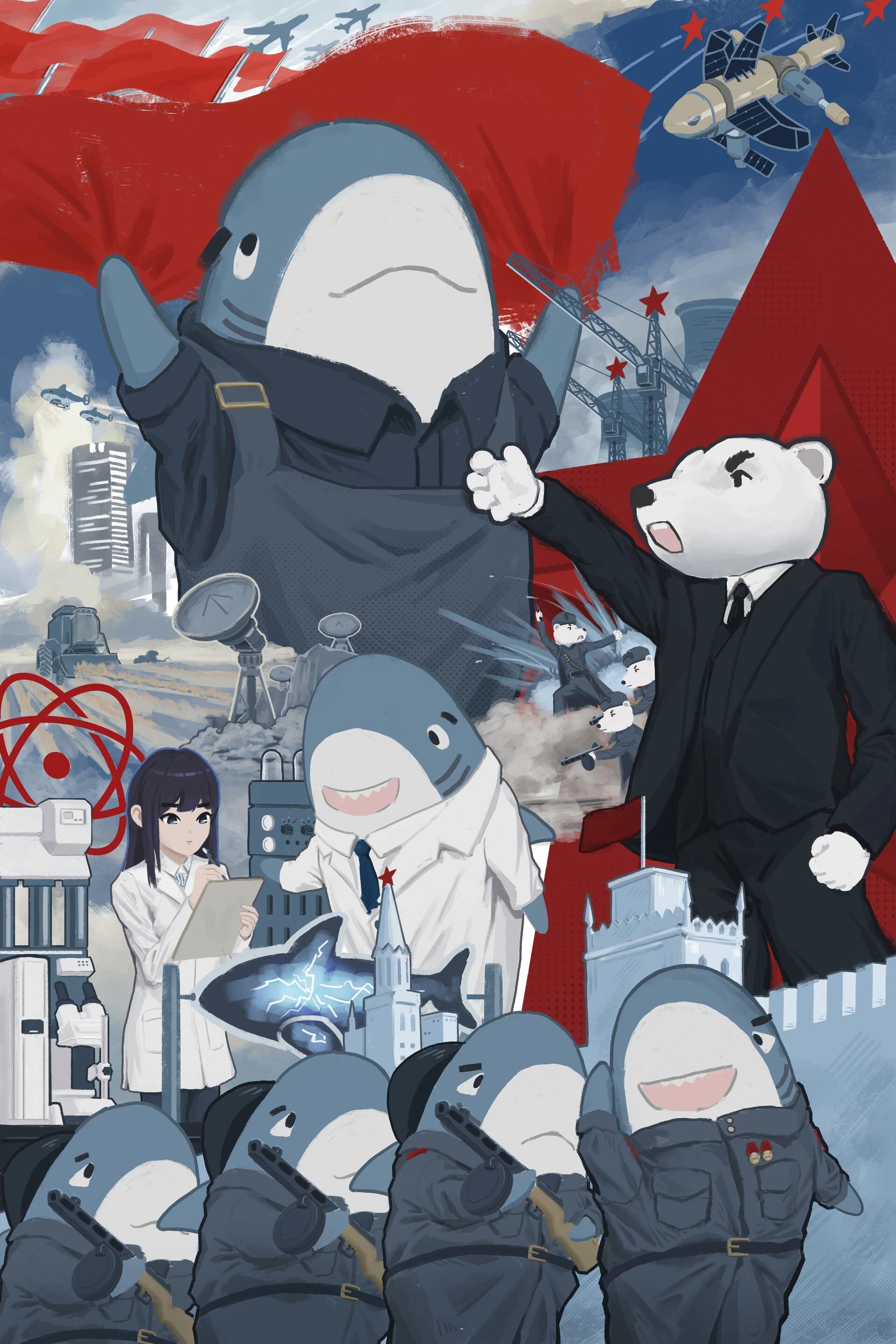
Photo by Andreas Filla, taken at the Berlin Pride Parade 1994. CC-BY-SA
Hi my trans siblings!
I'm late writing this mega this week, I had hoped to do more research but maybe I can add stuff and re-write this as the week goes on.
This time I'd like to share some information I stumbled across about 20th century trans icon Charlotte von Mahlsdorf. She was born in the Weimar Republic in 1928 and survived Nazi Germany to make it as the most prominent trans woman that I'm aware of in the DDR (GDR or East Germany). There she ran the Gründerzeit museum, dedicated to the founding period of the German Empire and the period of its industrialization. The museum ended up becoming a popular hotspot for the gay and I presume trans and queer scene in the DDR.
She was politically active, having been an unofficial informant of the Stasi which ideally I'd love more information on. Was she helping them identify Nazis? Surely being a trans woman would've lured a lot of reactionaries out from behind their masks in her presence. In fact, after the DDR was taken over by the BRD (West Germany) in 1990, it only took about one year before one of the parties she threw at the museum was the target of a neo-Nazi attack, at which point she announced she was considering leaving Germany. She eventually moved to Sweden in 1997, where I believe she lived the rest of her life.
She died of natural causes at the age of 74 during a visit to Berlin in 2002.
This has been more or less a summary of the Wikipedia article on her where I did check some sources, but I really want to learn more about her. I only learned of her in the past couple days, and there is a film about her from 1992 called I Am My Own Woman, by Rosa von Praunheim.
Join our public Matrix server!
https://rentry.co/tracha#tracha-rooms
As a reminder, please do not discuss current struggle sessions in the mega. We want this to be a little oasis for all of us and the best way to do that is not to feed into existing conflict on the site.
Also, be sure to properly give content warnings and put sensitive subjects behind proper spoiler tags. It's for the mental health of not just your comrades, but yourself as well.
Here is a screenshot of where to find the spoiler button.
spoiler


Hey peeps,
Considering how  -ish the chuds have been lately, we're a couple steps removed from them claiming we're all witches that hexed the economy or something. I thought it might be a good time to get an updated thread going on anything to do with sourcing your HRT.
Be it through conventional means and if you've been having trouble with certain pharmacy companies, states (assuming you live in Burgereich), or insurance. Or grey market successes or failures, shipping times, reliability, etc. Or adventures in DIY!
Please share any news of what you're seeing and hearing on restrictions, blocks, or protections. Any new online stores or ones that are changing or closing?
Please include details and links, but do not share specifics that could doxx you. For instance, insurance may have a state name in it or a pharmacy may be a small regional chain.
Edit: please add any news to do with potential supply chain problems due to the war. Also, this is not a replacement for the help thread, this is for us to keep apprised of any current shifts.
Respond to this post if interested, generally we prefer to add fairly active accounts but its a wide open door
We will also probably be removing some inactive accounts on our mod roster so don't be alarmed 
Hey folks, hoping to have a semi-permanent thread for compiling resources to make finding really cool posts easier. Please suggest links and info in the comments below. I consider this necessary because there's a lot of things we would like pinned but obviously things get very crowded quickly. This thread will start sparse and I will edit new things in as people suggest them.
Transgender Mutual Aid
These posts are done by a transgender mutual aid group looking to help people in unusual circumstances. Please contact me if you need help with HRT info, their posts here are for donors only.
Trans Chemist Series
These posts are done by a Hexbear user that I have verified as legit, offering unique information about trans DIY hrt, including quality sources, sanitation, storage recommendations. Verified by very expensive industrial chemistry equipment.
DIY Electrolysis Series
There posts are also done by a Hexbear user that is making an open source DIY electrolysis setup.
Elara's Transonomicon
-
https://trans.queer.my.id/ id change stuff
PSAs
Site Surveys
Guides
Links
-
https://genderdysphoria.fyi/ (this link has allegedly been problematic deep into the past, but seems to have cleaned up a lot)
-
/r/transdiy wiki archive : https://archive.md/gDgj1
-
/r/transwiki wiki archive : https://archive.md/OzyAk
-
trans australia : https://trans.au/
-
haircuts for trans people : https://strandsfortrans.org/
-
.Do It Yourself - Hormone Replacement Therapy - Very Basic Information Thread on DIY HRT. https://hexbear.net/post/8763710, guide to using Monero, a private cryptocurrency
-
https://hrtcafe.net/ - DIY sources
-
how do I determine my dosage / how do I take estrogen safely? http://transfemscience.org/
-
https://transfemme.style/ clothing for trans fems
-
https://estrannai.se/ - estradiol simulator with a wide range of features
-
https://diyhrt.info/ - informational wiki on DIY HRT with transmasc and transfem guides; a successor to diyhrt.wiki
-
https://diyhrt.market/ a compendium of HRT vendors, similar to hrtcafe
Webrings and Friends
Public Chats
-
https://matrix.to/#/#tracha:chapo.chat - Our public group chat, text only. Has fun emojis

-
https://www.transacademy.org/ - Trans Academy is a VRChat group that provides help/community for trans people. Among other things, they do free bi-weekly voice training seminars (in VRChat but also streamed on Discord and Twitch) and make-up tutorials (on Discord), and the classes include content for transmasc, enby, transfem peeps. VRChat is free and doesn't require VR (using the desktop or android app), but you can also participate in most of the class stuff through the Discord.
cross-posted from: https://news.abolish.capital/post/44357
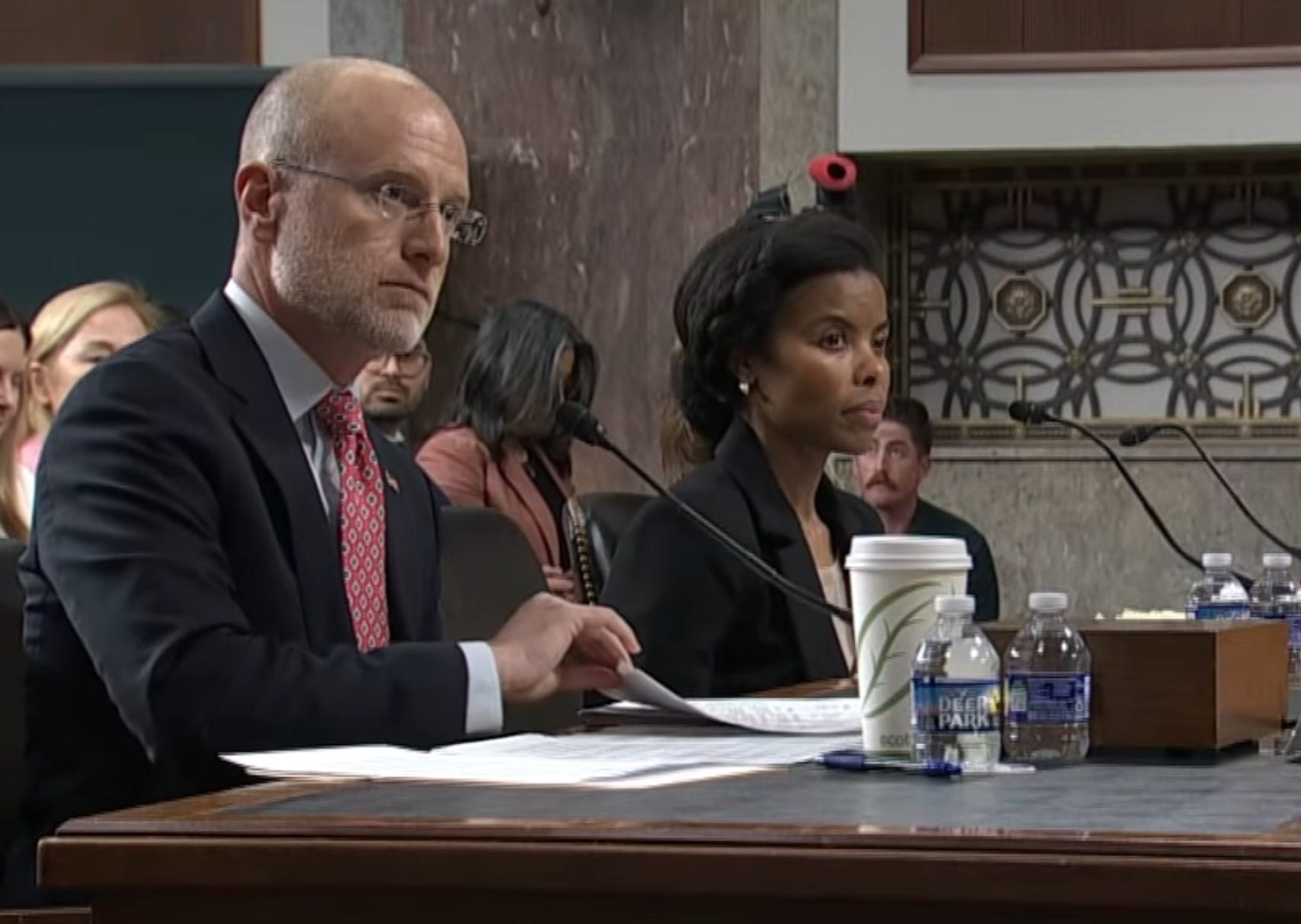
Brendan Carr // CSPAN
Erin In The Morning is a reader-supported publication. To receive new posts and support my work, consider becoming a subscriber.
Today, FCC Chairman Brendan Carr announced that the FCC would be seeking comment on whether the TV Parental Guidelines rating system needs to be changed to address shows with transgender or nonbinary characters. The public notice, which Carr posted on twitter this morning, seeks to weaponize the TV ratings system to restrict shows that include such characters—asking whether programs that contain "the discussion or promotion of gender identity themes" should "be rated differently or contain relevant descriptions." Though the FCC's direct authority over the TV ratings system is limited—the system is voluntary and industry-run, and streaming platforms like Netflix and Disney+ can maintain their own standards—the FCC retains enormous coercive power over broadcast networks and their parent companies, many of which also operate streaming platforms. The move comes after a series of attacks on network television weaponizing the FCC for political purposes, including Carr's threats to revoke broadcast licenses over news coverage of the Iran war and his targeting of ABC over late-night host Jimmy Kimmel. It appears to be an attempt to extend "Don't Say Gay"-style policies—which have restricted discussion of LGBTQ+ people in classrooms across red states—to national television ratings.
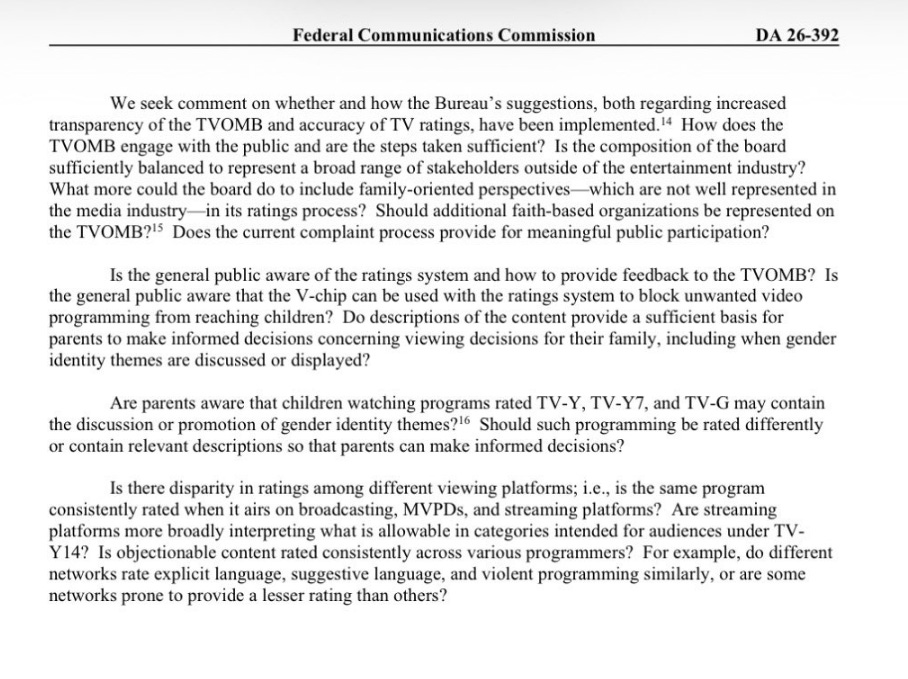
“Years ago, Congress passed a law that empowers parents to decide the types of TV programs that are appropriate for their kids by standing up a TV show ratings system. But recently, parents have raised concerns with the industry’s approach—including with ratings creep. Specifically, they argue that New York & Hollywood programmers are promoting controversial issues in kids programming without providing any transparency or disclosures to parents. This undermines the whole point of the law and the ratings system parents rely on. The FCC is now seeking comment on whether the industry’s approach provides parents with the types of information and disclosures relevant to them today,” Carr wrote on twitter. However, the actual document posted alongside his statement tells a more specific story—it primarily centers on gender identity.
The document states, “Recently, parents have raised concerns that controversial gender identity issues are being included or promoted in children’s programs without providing any disclosure or transparency to parents. Specifically, the industry guidelines that parents rely on are rating shows with transgender and gender non-binary programming as appropriate for children and young children, and doing so without providing this information to parents, thereby undermining the ability of parents to make informed choices for their families.” It then poses a series of loaded questions: “Are parents aware that children watching programs rated TV-Y, TV-Y7 and TV-G may contain the discussion or promotion of gender identity themes? Should such programming be rated differently or contain relevant descriptions so that parents can make informed decisions?” The document also asks whether “additional faith-based organizations” should be given seats on the TV Parental Guidelines Monitoring Board—the industry body that oversees the ratings system.
The TV Parental Guidelines rating system was established in 1997, after Congress passed the Telecommunications Act of 1996. The TV Parental Guidelines Monitoring Board has overseen the system since, applying familiar ratings like TV-G and TV-PG to programming across broadcast television. Cable television and streaming platforms like Netflix, Disney+, and Hulu are not subject to the FCC's regulatory authority and are not required to use the system, but have voluntarily adopted the same rating categories for consistency—meaning that any changes to how the system treats transgender content could ripple across the entire television landscape even without a legal mandate. While the FCC cannot directly change how the industry rates its programming, under Carr it hasn't needed to—the agency has repeatedly used legally dubious threats to pressure networks into self-censorship, and this public notice sends the same kind of signal to an already skittish industry.
If networks bow to this pressure, the impact on LGBTQ+ programming could be enormous. Transgender and nonbinary characters in children's television are already vanishingly rare—GLAAD's most recent report found just one transgender character on all of broadcast television. Youth shows could see what little representation remains stripped out entirely, as networks preemptively remove trans and nonbinary characters rather than risk a ratings penalty or government scrutiny.
The pressure extends well beyond broadcast: Disney owns both ABC, which requires an FCC broadcast license, and Disney+, which does not. NBCUniversal owns NBC and Peacock. Paramount owns CBS and Paramount+. When Carr threatened ABC's station licenses over Jimmy Kimmel, it was Disney that pulled Kimmel off the air—and Disney also owns the streaming platform that produced The Owl House, one of the most beloved queer animated shows in recent memory, which Disney canceled after its creator said it didn't fit the company's "brand." The parent company dynamic means that FCC pressure on a broadcast license can cascade into content decisions on streaming platforms the FCC has no jurisdiction over. And the FCC appears to know this—the document explicitly targets streaming platforms despite having no regulatory authority over them, asking, "Is there disparity in ratings among different viewing platforms; i.e., is the same program consistently rated when it airs on broadcasting, MVPDs, and streaming platforms? Are streaming platforms more broadly interpreting what is allowable in categories intended for audiences under TV-Y14?"
The targeting comes at an already devastating time for queer animation. Beloved shows with LGBTQ+ characters have been systematically canceled or ended, and the shows that remain are under increasing pressure to strip queer content. Disney removed a transgender storyline from the Pixar series Win or Lose before it aired, with the company stating that parents should discuss such topics with children "in their own time"—the exact framing the FCC's public notice now uses. Disney+'s "Junior Mode" parental controls were found to filter out LGBTQ+ content entirely from kids' profiles. Anonymous Pixar employees have alleged that executives demanded they cut queer content, writing in a letter that "nearly every moment of overtly gay affection is cut at Disney's behest."
“It is hard to imagine just a few years ago when Pixar’s own Luca (2021) was celebrated within the community for its queer themes. Now, the queerness of Pixar’s Luca no longer seems like the result of a studio being held back by higher powers from telling an openly queer story but rather the result of Pixar leadership’s own mandate to relegate any queer characters to the background. I am no longer certain that the studio would have even released the same cut of Luca in 2025 as it did in 2021, such is the frighteningly fast normalisation of queer erasure in mainstream media, including animation, that has occurred in the last couple years,” writes Oliver Vigni, a fantasy/animation writer.
The public comment period is open now through May 22, 2026. Anyone can submit comments opposing this effort through the FCC's Comment Filing System under MB Docket No. 19-41. LGBTQ+ organizations, parents, animators, and allies are encouraged to make their voices heard—the FCC is required to consider all comments submitted during the period.
Erin In The Morning is a reader-supported publication. To receive new posts and support my work, consider becoming a subscriber.
From Erin In The Morning via This RSS Feed.
Happy 4/20 everyone! I recently started drinking coffee in the last year after never really liking it. Growing up I would try my mom's coffee every once in a while but it always tasted burnt and bitter. Looking back I realize that I didn't like that coffee due to my mom usually steeping it in a French press for 15-20 minutes.
I got into coffee in the last year due to my roommate who worked as a barista making me some and it being actually flavorful. But we were using a drip coffee machine and it wasn't strong enough for my liking. Before I actually started drinking coffee I liked to watch coffee gadget reviews cause I thought they were interesting? Which is how I found out about the aeropress which is my way I make my coffee in the morning.
The aeropress is kind of a three one thing cause it's a pour over, French press and manual espresso machine all in one, in addition I use a hand crank burr grinder to grind my beans and typically only add a bit of creamer as I want to taste the coffee as much as possible I also usually use medium roast beans.
How do you take your coffee/tea?
Join our public Matrix server!
https://rentry.co/tracha#tracha-rooms
As a reminder, please do not discuss current struggle sessions in the mega. We want this to be a little oasis for all of us and the best way to do that is not to feed into existing conflict on the site.
Also, be sure to properly give content warnings and put sensitive subjects behind proper spoiler tags. It's for the mental health of not just your comrades, but yourself as well.
Here is a screenshot of where to find the spoiler button.
spoiler


Dia daoibh a chairde!
Some of you may remember the previous Transfeminism Reading List I compiled: https://hexbear.net/post/4435465
Unfortunately, not long after that I lost access to that account, and was unable to update the post. So here I am, remaking it, in a way that allows me to keep it updated into the future.
Have you ever found yourself wanting to read a good book about queer feminism but you weren't sure where to look?
I have spent more hours than I would care to admit studying, writing about, and educating on the topic of gender and sexuality, and I've realized that I could lend a bit of my educational development work to you kind folks by prepping this here reading list.
I hope you can find something to interest you--and I would love to talk about any of the works listed. The categories are not hard and fast, with many books belonging in several of them, but I figured there had to be some way to organize this, so bear with me. I also tried to narrow inclusion to books relating to queer/feminist studies.
1. Introduction to Feminism
The Second Sex - Simone De Beauvior
This Sex Which Is Not One - Luce Irigaray
In the Beginning, She Was - Luce Irigaray
An Ethics of Sexual Difference - Luce Irigaray
Speculum of Other Women - Luce Irigaray
The Political Economy of Women's Liberation - Margaret Benston
Women and Economics - Charlotte Perkins Gilman
The Power of Women and the Subversion of the Community - Mariarosa Dalla Costa and Selma James
The Dialectic of Sex: The Case for Feminist Revolution - Shulamith Firestone
I am Woman: Native Perspective of Sociology and Feminism - Lee Maracle
I Myself am a Woman: Selected Writings of Ding Ling - Ding Ling
Living a Feminist Life - Sara Ahmed
Philosophical Trends in the Feminist Movement - Anuradha Ghandy
Witches, Witch-Hunting, and Women - Silvia Federici
Compañeras: Zapatista Women's Stories - Hilary Klein
Chinese Femininities/Chinese Masculinities: A Reader - Susan Brownell and Jeffrey N. Wasserstrom
Women in the Sky: Gender and Labor in the Making of Modern Korea - Hwasook Nam
Outsiders Inside: Whiteness, Place, and Irish Women - Bronwen Walter
2. Intersectionality and Black Feminism
Sister Outsider: Essays and Speeches - Geraldine Audre Lorde
This Bridge Called My Back: Writings by Radical Women of Color - Cherríe Moraga and Gloria E. Anzaldúa
How We Get Free: Black Feminism and the Combahee River Collective - Keeanga-Yahmatta Taylor
Women, Race, and Class - Angela Y. Davis
Women, Culture, and Politics - Angela Y. Davis
Race, Class, and Gender: An Anthology - Margaret L. Anderson and Patricia Hill Collins
Intersectionality - Patricia Hill Collins and Sirma Bilge
Emerging Intersections: Race, Class, and Gender in Theory, Policy, and Practice - Bonnie Thornton Dill, Ruth Enid Zambrana and Patricia Hill Collins
Black Feminist Thought: Knowledge, Consciousness, and the Politics of Empowerment - Patricia Hill Collins
Liner Notes for the Revolution: The Intellectual Life of Black Feminist Sound - Daphne A. Brooks
3. Trans* and Gender Diversity
The Transfeminist Manifesto - Emi Koyama
Transfeminism: A Collection - Emi Koyama
Gender Outlaw: On Men, Women, and the Rest of Us - Kate Bornstein
Gender Outlaws: the Next Generation - Kate Bornstein and S. Bear Bergman
Read My Lips: Sexual Subversion and the End of Gender - Riki Wilchins
Trans Liberation: Beyond Pink or Blue - Leslie Feinberg
Transgender Warriors: Making History from Joan of Arc to Dennis Rodman - Leslie Feinberg
Beyond Gender Binaries: The History of Trans, Intersex, and Third-Gender Individuals - Rita Santos
Whipping Girl: A Transsexual Woman on Sexism and the Scapegoating of Femininity - Julia Serano
Excluded: Making Feminist and Queer Movements More Inclusive - Julia Serano
Sexed Up: How Society Sexualizes Us, and How We Can Fight Back - Julia Serano
Outspoken: A Decade of Transgender Activism and Trans Feminism - Julia Serano
Invisible Lives: The Erasure of Transsexual and Transgendered People - Viviane K. Namaste
Sex Change, Social Change: Reflections on Identity, Institutions, and Imperialism - Viviane K. Namaste
My Words to Victor Frankenstein Above the Village of Chamounix: Performing Transgender Rage - Susan Stryker
The Transgender Studies Reader - Susan Stryker and Stephen Whittle
The Transgender Studies Reader 2 - Susan Stryker and Aren Aizura
Transgender History: The Roots of Today’s Revolution - Susan Stryker
We Want It All: An Anthology of Radical Trans Poetics - Andrea Abi-Karam and Kay Gabriel
Imagining Transgender: An Ethnography of a Category - David Valentine
Second Skins: The Body Narratives of Transsexuality - Jay Prosser
You've Changed: Sex Reassignment and Personal Identity - Laurie J. Shrage
In a Queer Time and Place: Transgender Bodies, Subcultural Lives - Judith Halberstam
How Sex Changed: A History of Transsexuality in the United States - Joanne Meyerowitz
Assuming a Body: Transgender and Rhetorics of Materiality - Gayle Salamon
The Lives of Transgender People - Genny Beemyn and Susan Rankin
Side Affects: On Being Trans and Feeling Bad - Hil Malatino
Trans/Love: Radical Sex, Love & Relationships Beyond the Gender Binary - Morty Diamond
Queer and Trans Madness: Struggles for Social Justice - Merrick Daniel Pilling
Please Select Your Gender: From the Invention of Hysteria to the Democratizing of Transgenderism - Patricia Gherovici
Gender: An Ethnomethodological Approach - Suzanne J. Kessler and Wendy McKenna
Travesti: Sex, Gender, and Culture Among Brazilian Transgendered Prostitutes - Don Kulick
Beyond Emasculation: Pleasure and Power in the Making of hijra in Bangladesh - Adnan Hossain
Badhai: Hijra-Khwaja Sira-Trans Performance Across Borders in South Asia - Adnan Hossain, Claire Pamment and Jeff Roy
Beauty and Power: Transgendering and Cultural Transformation in the Southern Philippines - Mark Johnson
Changing Ones: Third and Fourth Genders in Native North America - Will Roscoe
A Short History of Transmisogyny – Jules Gill-Peterson
4. Understanding Intersex
Myths of Gender: Biological Theories About Women and Men - Anne Fausto-Sterling
Sex/Gender/Biology in a Social World - Anne Fausto-Sterling
Sexing the Body: Gender Politics and the Construction of Sexuality - Anne Fausto-Sterling
Hermaphrodites and the Medical Invention of Sex - Alice Dromurat Dreger
Intersex - Catherine Harper
Bodies in Doubt: An American History of Intersex - Elizabeth Reis
Making Sex: Body and Gender from the Greeks to Freud - Thomas Walter Laqueur
Contesting Intersex: The Dubious Diagnosis - Georgiann Davis
The Spectrum of Sex: The Science of Male, Female, and Intersex - Hida Vilori and Maria Nieto
Body Guards: The Cultural Politics of Gender Ambiguity - Julia Epstein and Kristina Straub
Queer Embodiment: Monstrosity, Medical Violence, and Intersex Experience - Hil Malatino
Critical Intersex - Morgan Holmes
Fixing Sex: Intersex, Medical Authority, and Lived Experience - Katrina Karkazis
Intersex Matters: Biomedical Embodiment, Gender Regulation, and Transnational Activism - David A. Rubin
Intersex Rights: Living Between Sexes - Nikoletta Pikramenou
Transgender and Intersex: Theoretical, Practical, and Artistic Perspectives - Stefan Horlacher
Expanding the Rainbow: Exploring the Relationships of Bi+, Polyamorous, Kinky, Ace, Intersex, and Trans People - Brandy L. Simula, J. E. Sumerau and Andrea Miller
Challenging Lesbian Norms: Intersex, Transgender, Intersectional, and Queer Perspectives - Angela Pattatuchi Aragón
5. Queer Theory and Philosophy
Gender Trouble: Feminism and the Subversion of Identity - Judith Butler
Bodies That Matter: On the Discursive Limits of Sex - Judith Butler
Undoing Gender - Judith Butler
Performativity and Performance - Andrew Parker and Eve Kosofsky Sedgwick
Queer Phenomenology: Orientations, Objects, Others - Sara Ahmed
Deleuze and Queer Theory - Chrysanthi Nigianni and Merl Storr
Epistemology of the Closet - Eve Kosofsky Sedgwick
Tendencies - Eve Kosofsky Sedgwick
Touching Feeling: Affect, Pedagogy, and Performativity - Eve Kosofsky Sedgwick
Queer Performance and Contemporary Ireland: Dissent and Disorientation - Fintan Walsh
New Feminist Perspectives on Embodiment - Clara Fischer and Luna Dolezal
Volatile Bodies: Toward a Corporeal Feminism - Elizabeth Grosz
Sexual Subversions - Elizabeth Grosz
Time Travels: Feminism, Nature, Power - Elizabeth Grosz
Sexy Bodies: The Strange Carnalities of Feminism - Elizabeth Grosz and Elspeth Probyn
Beyond the Periphery of the Skin: Rethinking, Remaking, and Reclaiming the Body in Contemporary Capitalism - Silvia Federici
Thinking Through the Skin - Sara Ahmed and Jackie Stacey
Differences that Matter: Feminist Theory and Postmodernism - Sara Ahmed
Strange Encounters: Embodied Others in Post-coloniality - Sara Ahmed
Jacques Lacan: A Feminist Introduction - Elizabeth Grosz
A Rave at the End of the World: The Politics of Queer Hauntology and Psychedelic Chronomancy - Sean Michael Feiner
Queer/Early/Modern - Carla Freccero
6. Exploring Sexuality
The Straight Mind and Other Essays - Monique Wittig
Cherry Grove, Fire Island: Sixty Years in America's First Gay and Lesbian Town - Esther Newton
Margaret Mead Made Me Gay: Personal Essays, Public Ideas - Esther Newton
Mother Camp: Female Impersonators in America - Esther Newton
Sapphists and Sexologists: Histories of Sexualities - Mary McAuliffe
Witchcraft and Gay Counterculture - Arthur Evans
Deviations: A Gayle Rubin Reader - Gayle S. Rubin
Conditional Spaces: Hong Kong Lesbian Desires and Everyday Life - Denise Tse-Shang Tang
Queer Comrades: Gay Identity and Tongzhi Activism in Postsocialist China - Hongwei Bao
Maid to Queer: Asian Labor Migration and Female Same-Sex Desires - Francisca Yuenki Lai
Oral Histories of Older Gay Men in Hong Kong: Unspoken but Unforgotten - Travis S. K. Kong
Tongzhi: Politics of Same-Sex Eroticism in Chinese Societies - Chou Wah-Shan
The Emerging Lesbian: Female Same-Sex Desire in Modern China - Tze-Lan D. Sang
Tongzhi Living: Men Attracted to Men in Postsocialist China - Tiantian Zheng
Queer Women in Urban China: An Ethnography - Elisabeth L. Engebretsen
Backward Glances: Contemporary Chinese Cultures and the Female Homoerotic Imaginary - Fran Martin
Queer Politics and Sexual Modernity in Taiwan - Xianyong Bai and Hans Tao-Ming Huang
Queer Sinophone Cultures - Howard Chiang and Ari Larissa Heinrich
Boy-wives and Female Husbands: Studies in African Homosexualities - Stephen O. Murray and Will Roscoe
Islamic Homosexualities: Culture, History, and Literature - Stephen O. Murray and Will Roscoe
Gender and Sexuality in Muslim Cultures - Gul Ozyegin
Gender and Sexuality in Modern Ireland - Anthony Bradley and Maryann Gialanella Valiulis
Neuroqueer Heresies: Notes on the Neurodiversity Paradigm, Autistic Empowerment, and Postnormal Possibilities – Nick Walker
7. Cultural Critique
Cultural Sites of Critical Insight: Philosophy, Aesthetics, and African American and Native American Women's Writings - Angela L. Cotten and Christa Davis Acampora
The Dress of Women: A Critical Introduction to the Symbolism and Sociology of Clothing - Charlotte Perkins Gilman
Vested Interests: Cross-dressing and Cultural Anxiety - Marjorie Garber
Leatherfolk: Radical Sex, People, Politics, and Practice - Mark Thompson
Queer Pulp: Perverted Passions from the Golden Age of the Paperback - Susan Stryker
Women in the Chinese Enlightenment: Oral and Textual Histories - Zheng Wang
Desiring China: Experiments in Neoliberalism, Sexuality, and Public Culture - Lisa Rofel
Transgender China - Howard Chiang
A Society Without Fathers or Husbands: the Na of China - Cai Hua
Queer/Tongzhi China: New Perspectives on Research, Activism, and Media Cultures - Elisabeth L. Engebretsen, William F. Schroeder and Hongwei Bao
Queer TV China: Televisual and Fannish Imaginaries of Gender, Sexuality and Chineseness - Jamie J. Zhao
Queer China: Lesbian and Gay Literature and Visual Culture Under Postsocialism - Hongwei Bao
Queer Media in China - Hongwei Bao
Boys' Love, Cosplay, and Androgynous Idols: Queer Fan Culture in Mainland China, Hong Kong, and Taiwan - Maud Lavin, Ling Yang and Jing Jamie Zhao
Trad Nation: Gender, Sexuality, and Race in Irish Traditional Music - Tes Slominski
Celtic Women: Women in Celtic Society and Literature - Peter Berresford Ellis
The Irish Novel at the End of the Twentieth Century: Gender, Bodies, and Power - Jennifer M. Jeffers
Contemporary Irish and Welsh Women's Fiction: Gender, Desire and Power - Linden Peach
LGBTQ Visibility, Media and Sexuality in Ireland - Páraic Kerrigan
The Poor Bugger's Tool: Irish Modernism, Queer Labor, and Postcolonial History - Patrick R. Mullen
Women and the Irish Nation: Gender, Culture, and Irish Identity, 1890-1914 - D. A. J. MacPherson
Between Men: English Literature and Male Homosocial Desire - Eve Kosofsky Sedgwick
Smut: Erotic Reality/Obscene Ideology - Murray S. Davis
Veiled Sentiments: Honor and Poetry in a Bedouin Society - Lila Abu-Lughod
Writing Women's Worlds: Bedouin Stories - Lila Abu-Lughod
Gramsci, Migration, and the Representation of Women's Work in Italy and the U.S. - Laura E. Ruberto
Queer Bangkok: 21st Century Markets, Media, and Rights - Peter Jackson
Re-reading the Monstrous-Feminine: Art, Film, Feminism and Psychoanalysis – Nicholas Chare, Jeanette Hoorn, and Audrey Yue
8. Queer Marxism
Transgender Marxism - Jules Joanne Gleeson and Elle O'Rourke
Transition and Abolition: Notes on Marxism and Trans Politics - Jules Joanne Gleeson
Lavender and Red - Leslie Feinberg
Caliban and the Witch: Women, The Body, and Primitive Accumulation - Silvia Federici
Re-enchanting the World: Feminism and the Politics of the Commons - Silvia Federici
Revolution at Point Zero: Housework, Reproduction, and Feminist Struggle - Silvia Federici
The Problematics of Heterosexuality: Marxism, Psychoanalysis, and Mother Nature - Hilary Manette Klein
The Politics of Everybody: Feminism, Queer Theory, and Marxism at the Intersection - Holly Lewis
Raya Dunayevskaya's Intersectional Marxism: Race, Class, Gender, and the Dialectics of Liberation - Kevin B. Anderson, Kieran Durkin and Heather A. Brown
Queer Marxism in Two Chinas - Petrus Liu
Finding Women in the State: A Socialist Feminist Revolution in the People’s Republic of China, 1949-1964 - Zheng Wang
Some of Us: Chinese Women Growing Up in the Mao Era - Xueping Zhong, Wang Zheng and Bai Di
The Women's Revolution: Russia 1905 - 1917 - Judy Cox
Social-Democracy and Woman Suffrage - Clara Zetkin
Lenin on the Woman Question - Clara Zetkin
The New Soviet Man and Woman: Sex-Role Socialization in the USSR - Lynne Attwood
Revolution, She Wrote - Clara Fraser
The Specter of Materialism: Queer Theory and Marxism in the Age of the Beijing Consensus – Petrus Liu
Marxism and Education Beyond Identity: Sexuality and Schooling – Faith Agostinone-Wilson
Revolutionary Learning: Marxism, Feminism and Knowledge – Sara Carpenter and Sharzad Mojab
9. Abolition
Abolition. Feminism. Now. - Angela Y. Davis, Gina Dent, Erica Meiners and Beth Richie
Invisible No More: Police Violence Against Black Women and Women of Color - Andrea J. Ritchie
Arrested Justice: Black Women, Violence, and America’s Prison Nation - Beth E. Richie
We Do This 'Til We Free Us - Mariame Kaba
Abolitionist Intimacies - El Jones
Queer (In)Justice: The Criminalization of LGBT People in the United States - Joey L. Mogul, Andrea J. Ritchie and Kay Whitlock
Captive Genders: Trans Embodiment and the Prison Industrial Complex - Eric A. Stanley
Normal Life: Administrative Violence, Critical Trans Politics, and the Limits of Law - Dean Spade
Transgender Sex Work and Society - Larry Nutbrock
Revolting Prostitutes - Molly Smith and Juno Mac
Prostitution and Victorian Society: Women, Class, and the State - Judith R. Walkowitz
The Social Construction of AIDS Issues - Suiming Pan
Thinking Differently About HIV/AIDS: Contributions from Critical Social Science - Eric Mykhalovskiy and Viviane K. Namaste
Insurgent Love: Abolition and Domestic Homicide - Ardath Whynacht
Written on the Body: Letters from Trans and Non-Binary Survivors of Sexual Assault and Domestic Violence - Lexie Bean
Curative Violence: Rehabilitating Disability, Gender, and Sexuality in Modern Korea - Eunjung Kim
Sex Workers in the Maritimes Talk Back – Leslie Ann Jeffrey and Gayle MacDonald
On the Decriminalization of Sex Work in China: HIV and Patients’ Rights – Jinmei Meng
Markets and Bodies: Women, Service Work, and the Making of Inequality in China – Eileen Otis
Manufacturing Freedom: Sex Work, Anti-Trafficking Rehab, and the Racial Wages of Rescue – Elena Shih
Violent Intimacy: Family Harmony, State Stability, and Intimate Partner Violence in Post-Socialist China – Tiantian Zheng
Sex Trafficking, Human Rights and Social Justice – Tiantian Zheng
Ethnographies of Prostitution in Contemporary China: Gender Relations, HIV/AIDS, and Nationalism – Tiantian Zheng
China’s Commercial Sexscapes: Rethinking Intimacy, Masculinity, and Criminal Justice – Eileen Yuk-Ha Tsang
Sex Workers and Criminalization in North America and China: Ethical and Legal Issues in Exclusionary Regimes – Susan Dewey, Tiantian Zheng, and Treena Orchard
Enemy Feminisms: Terfs, Policewomen, and Girlbosses Against Liberation – Sophie Lewis
10. Anti-Imperialism and Internationalism
Terrorist Assemblages: Homonationalism in Queer Times - Jasbir Puar
Class, Gender, and Neoliberalism - Nancy Lindisfarne and Jonathan Neale
Gender and Colonialism: A Psychological Analysis of Oppression and Liberation - Geraldine Moane
Gender and Imperialism - Clare Midgley
The Beginning and End of R-pe: Confronting Sexual Violence in Native America - Sarah Deer
Conquest: Sexual Violence and American Indian Genocide - Andrea Smith
Western Women and Imperialism: Complicity and Resistance - Nupur Chaudhuri and Margaret Strobel
Do Muslim Women Need Saving? - Lila Abu-Lughod
Anti-Veiling Campaigns in the Muslim World: Gender, Modernism and the Politics of Dress - Stephanie Cronin
Embodying Geopolitics: Generations of Women's Activism in Egypt, Jordan, and Lebanon - Nicola Pratt
Greater Than the Sum of Our Parts: Feminism, Inter/Nationalism, and Palestine - Nada Elia
Palestinian Women's Activism: Nationalism, Secularism, Islamism - Islah Jad
Israel/Palestine and the Queer International - Sarah Schulman
Queer Palestine and the Empire of Critique - Saed Atshan
Even a Freak Like You Would Be Safe in Tel Aviv: Transgender Subjects, Wounded Attachments, and the Zionist Economy of Gratitude - Saffo Papantonopoulou
Militarization and Violence Against Women in Conflict Zones in the Middle East: A Palestinian Case-Study - Nadera Shalhoub-Kevorkian
Decolonial Feminism in Abya Yala: Caribbean, Meso, and South American Contributions and Challenges - María Lugones, Yuderkys Espinosa-Miñoso and Nelson Maldonado-Torres
Positioning Gender and Race in (Post)colonial Plantation Space: Connecting Ireland and the Caribbean - Eve Walsh Stoddard
Ireland and the Magdalene Laundries: A Campaign for Justice - Claire McGettrick, Katherine O’Donnell, Maeve O'Rourke, James M. Smith and Mari Steed
Family and Gender in the Pacific: Domestic Contradictions and the Colonial Impact - Margaret Jolly and Martha Macintyre
Oceanic Encounters: Exchange, Desire, Violence - Margaret Jolly, Serge Tcherkézoff and Darrell Tryon
Maternities and Modernities: Colonial and Postcolonial Experiences in Asia and the Pacific - Kalpana Ram and Margaret Jolly
Paradoxes of Hawaiian Sovereignty: Land, Sex, and the Colonial Politics of State Nationalism - J. Kēhaulani Kauanui

Self Portrait with Skeleton Arm, 1896
Edvard Munch is a Norwegian born expressionist painter. His best-known work, The Scream, has become one of the most iconic images of world art. In the late 20th century, he played a great role in German expressionism and the art form that later followed; namely because of the strong mental anguish that was displayed in many of the pieces that he created.
Edvard Munch was born in Norway in 1863, and was raised in Christiania (known as Oslo today). He was related to famous painters and artists in their own right, Jacob Munch (painter), and Peter Munch (historian). Only a few years after he was born, Edvard Munch's mother died of tuberculosis in 1868, and he was raised by his father. Edvard's father suffered from mental illness, and this played a role in the way he and his siblings were raised. Their father raised them with the fears of deep-seated issues, which is part of the reason why the work of Edvard Munch took a deeper tone, and why the artist was known to have so many repressed emotions as he grew up.
In 1885, Edvard Munch traveled to Paris, and was extremely influenced by Impressionist such as Claude Monet, Neo-Impressionist Georges Seurat, and followed by the Post-Impressionists Vincent van Gogh, Paul Cezanne, and Paul Gauguin. In fact, the main style of Munch's work is post-impressionism, and focused on this style.
From about 1892, to 1908, Munch split most of his time between Paris and Berlin; it was in 1909 that he decided to return to his hometown, and go back to Norway. During this period, much of the work that was created by Edvard Munch depicted his interest in nature, and it was also noted that the tones and colors that he used in these pieces, did add more color, and seemed a bit more cheerful, than most of the previous works he had created in years past. The pessimistic toning which was quite prominent in much of his earlier works, had faded quite a bit, and it seems he took more of a colorful, playful, and fun tone with the pieces that he was creating, as opposed to the dark and somber style which he tended to work with earlier on during the course of his career. From this period, up to his death, Edvard Munch remained in Norway, and much of his work that was created from this period on, seemed to take on the similar, colorful approach which he had adopted, since returning home in 1909.
A majority of the works which Edvard Munch created, were referred to as the style known as symbolism. This is mainly because of the fact that the paintings he made focused on the internal view of the objects, as opposed to the exterior, and what the eye could see. Symbolist painters believed that art should reflect an emotion or idea rather than represent the natural world in the objective, quasi-scientific manner embodied by Realism and Impressionism. In painting, Symbolism represents a synthesis of form and feeling, of reality and the artist's inner subjectivity. Along with Austrian artist Gustav Klimt, Edvard Munch is considered as the most prominent Symbolist painters of 20th century.
Many of Munch's works depict life and death scenes, love and terror, and the feeling of loneliness was often a feeling which viewers would note that his work patterns focused on. These emotions were depicted by the contrasting lines, the darker colors, blocks of color, somber tones, and a concise and exaggerated form, which depicted the darker side of the art which he was designing. Munch is often and rightly compared with Van Gogh, who was one of the first artists to paint what the French artist called "the mysterious centers of the mind." But perhaps a more overreaching influence was Sigmund Freud, a very close contemporary. Freud explained much human behavior by relating it to childhood experiences. Munch saw his mother die of tuberculosis when he was 5, and his sister Sophie died of the same disease when he was 14. Munch gives the By the Death Bed and Death in the Sickroom a universal cast by not specifically depicting what he had witnessed. Several versions of The Sick Child are surely his sister.
Edvard Munch passed away in 1944, in a small town which was just outside of his home town in Oslo. Upon his death, the works which he had created, were not given to family, but they were instead donated to the Norwegian government, and were placed in museums, in shows, and in various local public buildings in Norway. In fact, after his death, more than 1000 paintings that Edvard Munch had created were donated to the government. In addition to the paintings that he had created during the course of his career, all other art forms he created were also donated to the government. A total of 15,400 prints were donated, 4500 drawings and water-color art was donated, and six sculptures which Edvard Munch had created, were all turned over to the Oslo government, and were used as display pieces in many locations.
Join our public Matrix server!
https://rentry.co/tracha#tracha-rooms
As a reminder, please do not discuss current struggle sessions in the mega. We want this to be a little oasis for all of us and the best way to do that is not to feed into existing conflict on the site.
Also, be sure to properly give content warnings and put sensitive subjects behind proper spoiler tags. It's for the mental health of not just your comrades, but yourself as well.
Here is a screenshot of where to find the spoiler button.
spoiler


cross-posted from: https://news.abolish.capital/post/40807
Childen’s Minnesota
Erin In The Morning is a reader-supported publication. To receive new posts and support my work, consider becoming a subscriber.
Some Minnesota families caught in the crosshairs of Trump’s war on trans kids can once again breathe a little easier, at least for now. Children’s Minnesota, a major regional hospital system, is reinstating the care it had paused on February 27 for transgender youth.
“The decision follows a federal court ruling that vacated a federal declaration attempting to restrict gender-affirming care,” a statement from the hospital, shared with Erin in the Morning, said.
“We are contacting patient families that were affected by the temporary pause in certain services. Offering science- and research-based health care to transgender and gender diverse youth is part of Children’s Minnesota’s vision of being every family’s essential partner in raising healthier children.”
Of the Gender Health program’s 700 active patients, less than 5% were directly and immediately impacted, the hospital said. In other words, the federal government’s crackdown targeted a program that was serving only a few dozen minors with these specific treatments.
The care pause only ever impacted puberty blockers and hormone replacement therapy. Children’s Minnesota never performed gender-affirming surgeries specific to trans patients under 18 and psychotherapeutic interventions were relatively unaffected.
“This pause was difficult and hard news for all of our patients,” the statement continued. “The temporary pause was a decision we did not want to make. It was a decision we had to make due to conditions at the time.”
On Dec. 18, Robert F. Kennedy Jr., Secretary of the Department of Health and Human Services issued a declaration that dubbed gender-affirming care for trans minors as medically unsound, and could therefore be restricted. However, the March ruling from Judge Mustafa T. Kasubhai found that Kennedy does not possess the legal or scientific authority to render an entire field of health care “not medicine.” Therefore, the Dec. 18 HHS declaration, which excluded providers of such care from participating in federal healthcare programs, was deemed unlawful.
Over 20 states filed a federal lawsuit in December, including Minnesota, against the Trump regime in response to the attacks on trans people’s health care.
Then, in April, the BMJ reported:
The coalition argued that the HHS declaration unlawfully sought to pressure providers by threatening their participation in federal health programmes including Medicare and Medicaid. Accepting this argument, Kasubhai said, “There’s a theme of break it and see what others will do” in the way that the HHS attempted to change national health policy on gender affirming care, using a public statement without allowing the necessary public consultation.
“That’s not a system or method committed to the rule of law,” Kasubhai added.
Now, Judge Kasubhai must decide “whether the federal government should be barred from using the declaration’s reasoning in any future action against hospitals, according to legal analysts,” Becker’s Hospital Review, an industry publication, reported on April 1. In other words, it’s weighing whether the declaration can be cited or used as evidence in a court of law in the future.
“That question, which could determine how much leverage the administration retains over healthcare organizations going forward, remains unresolved.”
Recently, the Department of Justice also sued the state of Minnesota over its trans-inclusive bathroom and sports policies in schools.
“We have been living in a world in Minnesota that is inclusive of LGBTQ people for a long time, and these issues have never been prevalent—it’s not been a problem until we had a federal government that decided that we had to eradicate these people,” said Rep. Leigh Finke, the first openly transgender member of the Minnesota Legislature and a founding member of its Queer Caucus, in an interview with Erin in the Morning earlier this month.
Pam Bondi, who had been leading the charge at the DOJ since Trump’s return to office, was fired from her position as the Attorney General on April 2. It’s not immediately clear who will take her place—or how they will maneuver the upcoming legal battles over trans rights coming down the pike.
Erin In The Morning is a reader-supported publication. To receive new posts and support my work, consider becoming a subscriber.

From Erin In The Morning via This RSS Feed.
cross-posted from: https://news.abolish.capital/post/40807
Childen’s Minnesota
Erin In The Morning is a reader-supported publication. To receive new posts and support my work, consider becoming a subscriber.
Some Minnesota families caught in the crosshairs of Trump’s war on trans kids can once again breathe a little easier, at least for now. Children’s Minnesota, a major regional hospital system, is reinstating the care it had paused on February 27 for transgender youth.
“The decision follows a federal court ruling that vacated a federal declaration attempting to restrict gender-affirming care,” a statement from the hospital, shared with Erin in the Morning, said.
“We are contacting patient families that were affected by the temporary pause in certain services. Offering science- and research-based health care to transgender and gender diverse youth is part of Children’s Minnesota’s vision of being every family’s essential partner in raising healthier children.”
Of the Gender Health program’s 700 active patients, less than 5% were directly and immediately impacted, the hospital said. In other words, the federal government’s crackdown targeted a program that was serving only a few dozen minors with these specific treatments.
The care pause only ever impacted puberty blockers and hormone replacement therapy. Children’s Minnesota never performed gender-affirming surgeries specific to trans patients under 18 and psychotherapeutic interventions were relatively unaffected.
“This pause was difficult and hard news for all of our patients,” the statement continued. “The temporary pause was a decision we did not want to make. It was a decision we had to make due to conditions at the time.”
On Dec. 18, Robert F. Kennedy Jr., Secretary of the Department of Health and Human Services issued a declaration that dubbed gender-affirming care for trans minors as medically unsound, and could therefore be restricted. However, the March ruling from Judge Mustafa T. Kasubhai found that Kennedy does not possess the legal or scientific authority to render an entire field of health care “not medicine.” Therefore, the Dec. 18 HHS declaration, which excluded providers of such care from participating in federal healthcare programs, was deemed unlawful.
Over 20 states filed a federal lawsuit in December, including Minnesota, against the Trump regime in response to the attacks on trans people’s health care.
Then, in April, the BMJ reported:
The coalition argued that the HHS declaration unlawfully sought to pressure providers by threatening their participation in federal health programmes including Medicare and Medicaid. Accepting this argument, Kasubhai said, “There’s a theme of break it and see what others will do” in the way that the HHS attempted to change national health policy on gender affirming care, using a public statement without allowing the necessary public consultation.
“That’s not a system or method committed to the rule of law,” Kasubhai added.
Now, Judge Kasubhai must decide “whether the federal government should be barred from using the declaration’s reasoning in any future action against hospitals, according to legal analysts,” Becker’s Hospital Review, an industry publication, reported on April 1. In other words, it’s weighing whether the declaration can be cited or used as evidence in a court of law in the future.
“That question, which could determine how much leverage the administration retains over healthcare organizations going forward, remains unresolved.”
Recently, the Department of Justice also sued the state of Minnesota over its trans-inclusive bathroom and sports policies in schools.
“We have been living in a world in Minnesota that is inclusive of LGBTQ people for a long time, and these issues have never been prevalent—it’s not been a problem until we had a federal government that decided that we had to eradicate these people,” said Rep. Leigh Finke, the first openly transgender member of the Minnesota Legislature and a founding member of its Queer Caucus, in an interview with Erin in the Morning earlier this month.
Pam Bondi, who had been leading the charge at the DOJ since Trump’s return to office, was fired from her position as the Attorney General on April 2. It’s not immediately clear who will take her place—or how they will maneuver the upcoming legal battles over trans rights coming down the pike.
Erin In The Morning is a reader-supported publication. To receive new posts and support my work, consider becoming a subscriber.
From Erin In The Morning via This RSS Feed.

Multi-User Dungeons, also called MUDs, are a form of online text-based roleplaying game. MUDs were typically played over telnet protocol and steadily grew in popularity until graphical MMORPGs began to take their place. Initially inspired by text based adventure games such as Colossal Cave Adventure and Zork, as well as early computer RPGs, MUDs most often follow a classic fantasy setting, though you can also find a pretty diverse range of world settings, systems, and playstyles with MUDs and various other related MU* virtual worlds. Some other types of MU* games under the MUD umbrella include:
-
MUSH (Multi-User Shared Hallucination) which emphasized social interaction in a virtual world over actual gameplay (fun fact: The phrase "chatroom" supposedly comes from these types of games).
-
MUCK (Multi-User... Chat Kingdom? Creation Kit? The origin isn't entirely clear) also emphasizes social interaction, but with the addition of in-game tools that allow the players themselves to help with world building.
-
MOO (MUD, Object Oriented) allows users to do programming directly within the game/world server.
The first official MUD was started by two students (first Roy Trubshaw, then Richard Bartle later took over) in 1978 at the University of Essex and was simply called "MUD". This MUD was only accessible on the university network until 1980 when the university network was connected to ARPANET, introducing it to the wider world. During the 1980's and early 1990's, MUDs grew in popularity, and over time a diverse range of worlds had been created primarily from a few widely replicated MUD codebases like TinyMUD, LPMUD, and DikuMUD. MUDs eventually reached the peak of their popularity in the mid-to-late 1990s just before the introduction of early MMORPGs like Everquest (created by a DikuMUD player and largely based on it). Since then, they've become a bit more obscure, but never faded away completely and there are still a large number of active MUDs in use today.
As to how to actually play MUDs, you can access them from anything with a telnet client. This means you can log in directly from a terminal window if you want, or you can use MUD clients that offer useful features such as custom add-on packs, scripting/aliasing, audio (including music), auto-mapping, and much more. Two of the more popular clients I'm familiar with are Mudlet and MUSHClient. One I saw recently that looks promising is QMud which is a full cross-platform Qt6 port of MUSHclient. It's supposed to be compatible with existing MUSHClient add-ons, but I haven't tried it yet myself.
If you're new to MUDs and looking for a place to get started, here are three I've played at least somewhat recently and would recommend:
-
AwakeMUD CE (telnet: play.awakemud.com port 4000): This is a cyberpunk MUD based on Shadowrun 3E that was started in 1994 and has seemingly been running continuously (for the most part) since 2000. This is one I've been playing daily lately and love it so far. The community seems good (and very queer-friendly as far as I can tell) and I'm really liking the Shadowrun 3E world/system. Right now I'm an Adept and have obtained some cool powers and bioware. Currently working on getting cyberfins and retractable shark teeth for new cyberware. AwakeMUD also has a decent UI add-on pack for Mudlet that I'd recommend (available here). If you join this one, let me know and we can join up and do some runs or just go exploring. I usually idle on there so if you're online you can just do a "tell carcharodonna" or send me a message with the pocket secretary.
-
Unofficial Squaresoft MUD (telnet: uossmud.sandwich.net port 9000): Running since 1997, this MUD is a combination of various worlds and systems taken from popular Squaresoft JRPGs of the 1990s. If you like NES/SNES JRPGs as much as I do, you'll probably like this one. The devs for this MUD seem VERY active and are constantly updating and introducing new features. There's also a very cool MUSHClient soundpack for this (available here) that adds all the wonderful SNES era Squaresoft sound effects and music.
-
Aardwolf (telnet: aardwolf.org port 4000): Running since 1996, this is a full-featured fantasy MUD which (as far as I know) is currently the most popular traditional MUD going right now. The world of Aardwolf is massive and there's an absurd amount of content to be found here. Aardwolf also has a VERY good MUSHclient package (available here) that includes UI, maps, audio, and lots of other stuff.
Having explained MUD basics above, I wanted to finish this post outlining why MUDs are (still) awesome and why more people should play them:
-
Ease of access: Vast majority of MUDs are run by volunteers and 100% free (not just "free-to-play"), and can be run on anything with a telnet-enabled terminal. Also, since it's text based, you could play MUDs on the shittiest of internet connections. If you wanted to, you could probably play MUDs on a smart toaster while sitting in a McDonalds bathroom and leaching off their wifi. If nuclear war happens and communication infrastructure gets wiped out, you could probably still play MUDs with something like ham radio packet switching or Meshtastic. Oh, many MUDs also offer screen reader compatibility for people who are vision impaired, which is extremely cool.
-
Ease of development: Again, since it's text-based, there's much less of a learning curve (in some ways at least) and less of a need for certain skillsets or dev tools. There still is at least some learning curve, however, and the easiest way to get started making your own MUD would be to either use and modify an existing MUD codebase, or... you could use a tool like Evennia. Evennia is a pretty awesome MUD creation FOSS project that's python based and relatively easy to learn. I haven't made anything substantial with it myself, though I did once set up the example world and played around with the world building tools. The basics at least didn't seem all that difficult, though I'm sure there's a lot more you can do with it that requires much more time and skill. Like interesting game mechanics.
-
Focus on quality of writing and worldbuilding: Without graphics, you're more dependent on the quality of the writing and your own imagination, which in my view can often be a better experience. There's also more freedom in making a MUD than you otherwise might have in making a graphical game, due to the lower barriers and relative obscurity of MUDs. You're really only limited by knowing how to use the tools to make what you want. For example.. If you wanted to make a virtual world where being cis is illegal and cis men are sent to forcefem gulags and used in "unethical" mpreg medical experiments, you could totally do that. No one is stopping you. The sky's the limit, really.
-
Better online communities: MUDs have historically been a refuge for queer folks, neurodiverse people, or just generally anyone who doesn't feel like they fit well in mainstream society or is looking for a safe space to explore who they are. Maybe as an example, here's a cool zine from 1993 about the zine author's experience with a furry community known as FurryMuck. I can't speak for every MUD out there, but in my experience MUDs generally tend to be more comfortable spaces for queer people than a lot of normal gaming communities typically are.
So that's it. That's the post. Thank you for letting me info dump on this topic and I hope it was at least somewhat informative.
Join our public Matrix server!
https://rentry.co/tracha#tracha-rooms
As a reminder, please do not discuss current struggle sessions in the mega. We want this to be a little oasis for all of us and the best way to do that is not to feed into existing conflict on the site.
Also, be sure to properly give content warnings and put sensitive subjects behind proper spoiler tags. It's for the mental health of not just your comrades, but yourself as well.
Here is a screenshot of where to find the spoiler button.
spoiler


cross-posted from: https://news.abolish.capital/post/39721
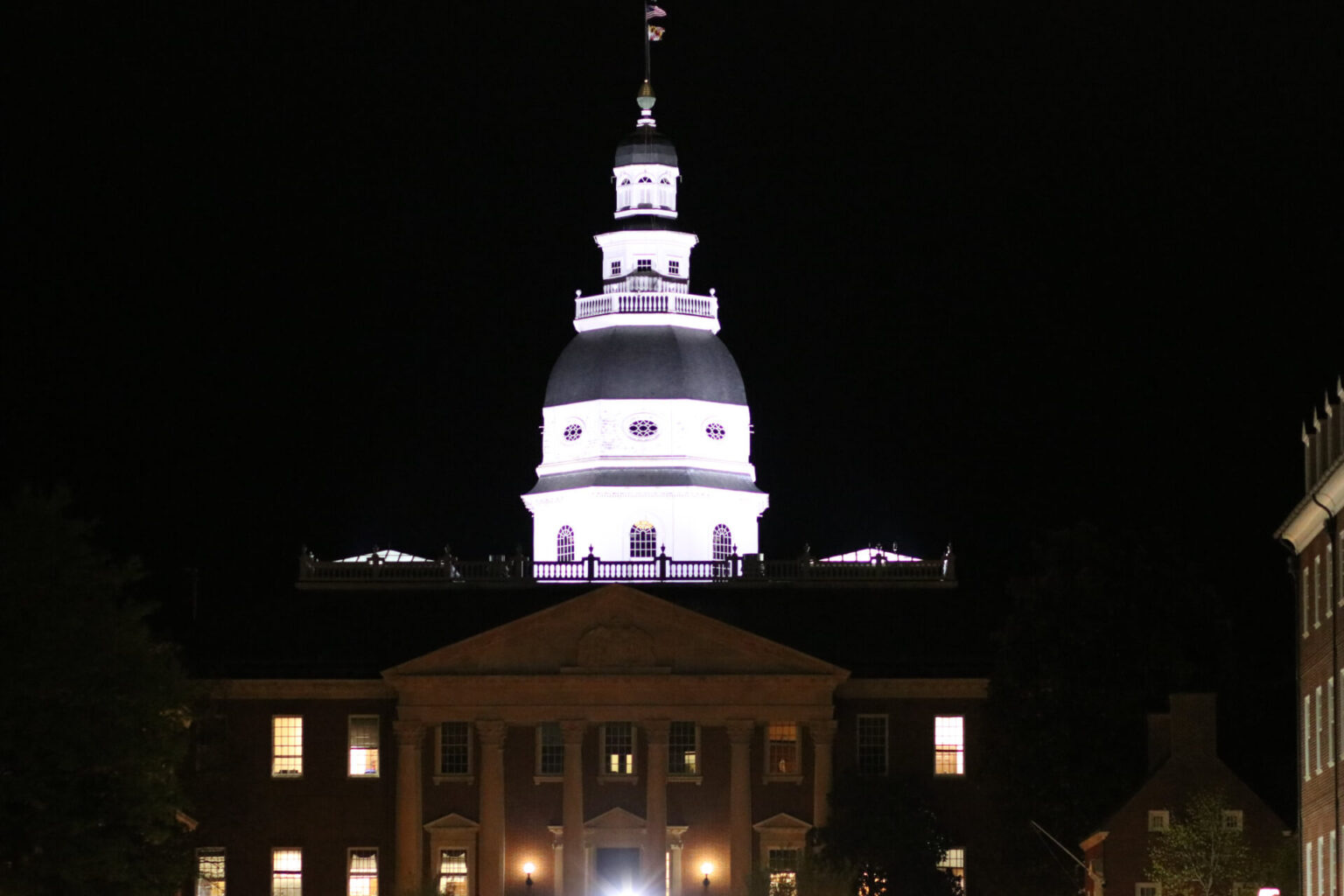
Photo by Danielle E. Gaines.
Erin In The Morning is a reader-supported publication. To receive new posts and support my work, consider becoming a subscriber.
During the Trump administration’s time in power, transgender students have lost the ability to fight for their Title IX protections against schools that discriminate against them. Meanwhile, the Supreme Court has greenlit the targeting of LGBTQ+ students repeatedly this term. Maryland, though, appears poised to push back with a new bill that is rapidly advancing through the state legislature. HB 649, which has already passed the House of Delegates 100-35, would significantly expand protections for transgender students across the state, giving them a private right of action to sue schools that discriminate against them in "any program or activity"—a phrase borrowed directly from Title IX that would explicitly protect participation in sports, admissions, and access to school facilities and programs statewide. The bill was heard in a Senate committee yesterday.
The bill states that "an educational institution may not exclude an individual from participation in, deny a person the benefits of, or subject an individual to discrimination within, any program or activity of the educational institution on the basis of race, color, national origin, ethnicity, ancestry, religion, sex, pregnancy, sexual orientation, gender identity, disability, age, or marital status" (emphasis added). The language is significant and expansive: the bill defines "educational institution" to include both public and nonpublic prekindergarten programs, elementary schools, secondary schools, institutions of postsecondary education, institutions of higher education, and any other educational program leading to a certificate, diploma, or degree—covering virtually every school in the state from pre-K through college.
The bill was brought at the request of Maryland's own Commission on Civil Rights. In its testimony, the Commission laid out the urgency in stark terms: the federal Office for Civil Rights, which has historically been the primary enforcement mechanism for students facing discrimination, has been gutted under the Trump administration. OCR complaints from Maryland residents surged to 130 in 2024—but after January 2025, the office effectively stopped processing them. Furthermore, when the administration does take action, it is against transgender students, not in favor of their rights. The ACLU of Maryland, which also testified in favor of the bill, noted that when the current president took office, many OCR complaints were dismissed without investigation. "With the dismantling of USDE and OCR, Maryland must fill the gap to ensure that the civil rights of all Maryland students are protected and upheld," the ACLU wrote.
The bill is notable for two reasons. The first is its use of the phrase "any program or activity" in its protection of transgender students. Maryland's existing nondiscrimination law, the 2022 Inclusive Schools Act, prohibits schools from "discriminating against” students based on gender identity—but does not explicitly guarantee the right to participate in all school programs and activities. The current vague language can leave room for schools to argue that barring a trans student from a sports team or denying access to facilities does not constitute discrimination. Only a handful of states have closed this gap. California's landmark 2013 School Success and Opportunity Act explicitly guarantees transgender students the right to "participate in sex-segregated school programs and activities, including athletic teams and competitions, and use facilities consistent with his or her gender identity." Connecticut similarly requires "equal opportunity to participate in school activities, programs, and courses of study" regardless of gender identity. Maryland's HB 649, by adopting the Title IX formula—"exclude from participation in, deny the benefits of, or subject to discrimination within any program or activity"—would place the state among this small group.
Secondarily, the bill creates a private right of action. Under Maryland's current framework, a student alleging discrimination must depend on government agencies acting in their favor. HB 649 changes that. A transgender student experiencing discrimination in bathrooms, sports, dormitories, or any other school program would be able to sue the school directly in state court, without waiting for the state superintendent or the attorney general to act on their behalf. The National Women's Law Center Action Fund, which testified in support of the bill, called this pathway "critical for student survivors of sexual assault and LGBTQI+ students who may face greater hurdles in obtaining justice on federal civil rights claims." Any school that capitulates to Trump administration demands to roll back transgender protections may now face lawsuits directly from the students it harms, should this bill pass.
The bill has the support of Maryland's LGBTQ+ Caucus, which submitted a letter of support calling it a necessary step to close enforcement gaps in civil rights law. "For LGBTQ+ students, actionable nondiscrimination enforcement supports a safer school climate, better academic outcomes, and recognition and respect for gender diversity and sexual orientation as integral parts of students' identities," the caucus wrote. "Ensuring that LGBTQ+ students and educators are protected under state civil rights law helps educational environments become more inclusive, safe, and equitable for all."
The bill passed the House 100-35 on March 23 and has been referred to the Senate Education, Energy, and the Environment Committee, where it was heard yesterday. The Senate must act before the legislative session ends on April 13. If passed, the bill is likely to be signed by Gov. Wes Moore, who has signed the Trans Shield Act, the Trans Health Equity Act expanding Medicaid coverage for gender-affirming care, and declared Maryland a sanctuary state for transgender people.
Erin In The Morning is a reader-supported publication. To receive new posts and support my work, consider becoming a subscriber.
From Erin In The Morning via This RSS Feed.
cross-posted from: https://news.abolish.capital/post/39745
Topeka Capital Journal
Erin In The Morning is a reader-supported publication. To receive new posts and support my work, consider becoming a subscriber.
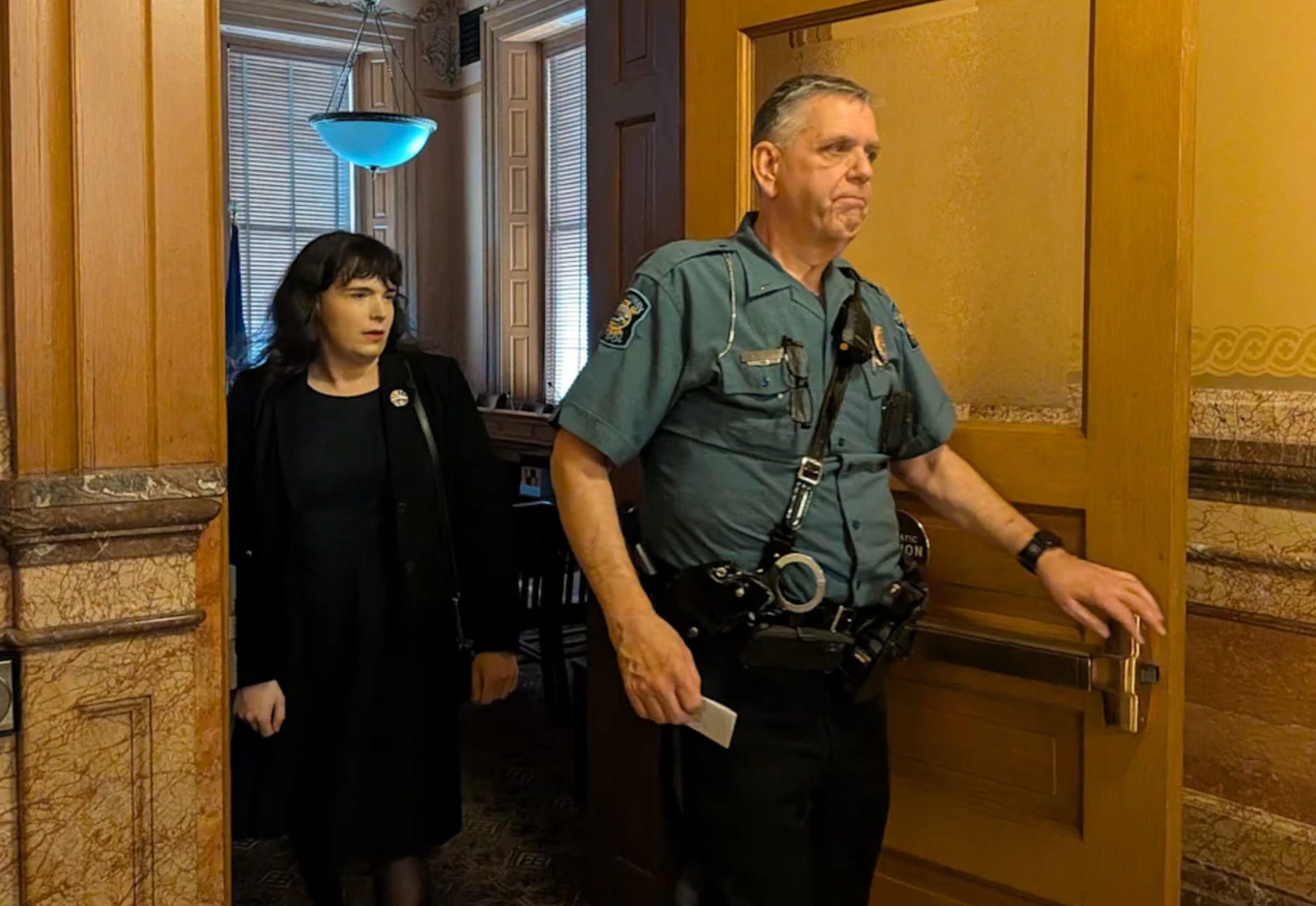
Samantha Boucher openly defied the state laws of Kansas when, in the presence of the Governor and the police, she walked into the bathroom in an act of civil disobedience.
Boucher is the founder and executive director of Trans Liberty and a transgender woman. The bathroom was in the Kansas statehouse. The morning was March 31st: the Transgender Day of Visibility.
The police showed her the way. Governor Laura Kelly, who Boucher encountered along the way, accepted a gracious thanks from Boucher. Kelly had tried to veto the bathroom ban bill that Boucher was now defying, but she was overridden by a heavily conservative state legislature.
“I think this would be extremely dangerous for a Kansan to do, but ... I’m more than happy to put myself at that risk if it means that somebody else doesn’t have to, because eventually someone would try this,” Boucher told the Topeka Capital-Journal. “I’m really interested to see what the attorney general chooses to do here.”
The Topeka Capital-Journal on Instagram: "A transgender activis…
Boucher’s modest protest transpired as the state crackdowns on trans people escalated: banning them from using bathrooms in public buildings that don’t match their sex assigned at birth, instituting a “bounty” to incentivize snitching on trans people who use the “wrong” restroom and institutions that don’t sufficiently sex-check people at the bathroom door, and most notably, revoking transgender people’s driver’s licenses if they don’t match their sex assigned at birth. Those caught with the “wrong” gender on their driver’s license could face criminal charges, making it the most extreme anti-trans ID law in the country.
None of this deterred Boucher. “I commend her for calling attention to state-sanctioned discrimination and for her bravery in challenging those who support such discrimination to put their votes into action,” Rep. Abi Boatman of Kansas’ 86th district in Wichita, told Erin in the Morning.
Boatman is one of a handful of transgender state lawmakers in the country; she is not legally allowed to use the women’s restroom in her own place of work at the Capitol, and she cannot drive to work with an ID that accurately depicts her gender.
Boucher left yesterday a free woman, but Kansas authorities are investigating the matter.
Others are not so lucky. Transgender and cisgender people alike have been caught up in the anti-trans panic—people have been harassed and filmed in the bathroom, accosted by police or security guards, physically assaulted, and arrested after using the restroom, even in states with no such “bathroom ban” on the books.
Some of these instances have been planned protests; others were unsuspecting patrons and private citizens simply using the restroom. That’s because these laws rely on piecemeal enforcement, vigilante bathroom police, self-censorship, and above all, fear.
The political landscape is especially dangerous for Black and brown trans people, who face disproportionate levels of violence and police brutality.
As Boucher approached the restrooms on the second floor, she encountered Governor Laura Kelly, who was attending an unrelated event. Boucher told the Governor what she was about to do.
“In regard to SB 244, I will use the restroom 3 times, triggering a misdemeanor,” Boucher said. “I appreciate your veto.”
Kelly commended her—and apologized. “I am very sorry that you and others have been put in this situation,” Kelly said.
According to the law, Boucher could face criminal charges as well as a $1,000 civil penalty.
Boucher was the first openly trans federal campaign manager, as per her social media. In 2019, she oversaw Democratic candidate Kimberly Graham’s Senate campaign in Iowa ahead of the June primaries. She is the founder and executive director of Trans Liberty, a trans equality PAC.
“What I hope to have accomplished here, and in whatever I become embroiled in as a result, is making sure that the nation doesn’t forget that this is happening here,” Boucher said as per local press reports. “This is unprecedented, and it cannot be allowed to stand.”
Erin In The Morning is a reader-supported publication. To receive new posts and support my work, consider becoming a subscriber.

From Erin In The Morning via This RSS Feed.


cross-posted from: https://news.abolish.capital/post/39411
ACCEPT Romania
Erin In The Morning is a reader-supported publication. To receive new posts and support my work, consider becoming a subscriber.
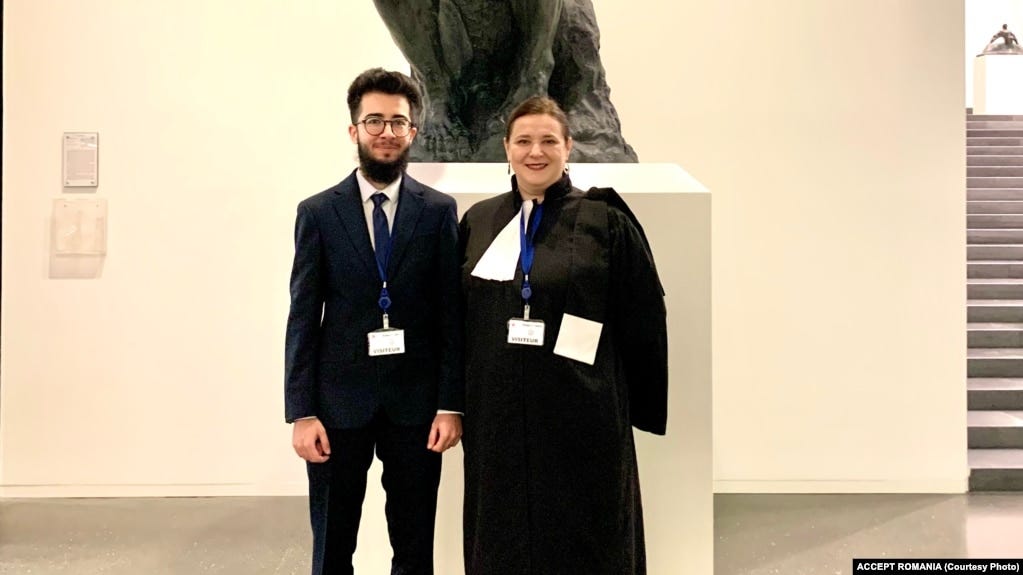
On Transgender Day of Visibility, a Romanian appellate court ordered the government to recognize a transgender man's gender identity on state documents—the first known court enforcement of a landmark 2024 ruling by the Court of Justice of the European Union. That ruling requires all member states to recognize legal gender changes obtained elsewhere in the bloc. The Bucharest Tribunal's decision is final and cannot be appealed. While the ruling directly applies only to transgender people who obtained gender recognition documents in another EU country, it sets a significant precedent in a nation that ranks dead last among all 27 EU member states on LGBTQ+ rights, according to ILGA-Europe's 2025 Rainbow Map.
The case centers on Arian Mirzarafie-Ahi, a transgender man with dual British and Romanian citizenship who was born in Romania and moved to the United Kingdom in 2008. Arian began his transition in the UK in 2016 and obtained a gender recognition certificate in 2020, while the UK was still treated as an EU member state during the Brexit transition period. Romania's own gender recognition procedure was not a viable option—the European Court of Human Rights found in 2021 that the country had no "clear and foreseeable" framework for gender recognition and had forced transgender people into an "impossible dilemma" by requiring surgery that was either unwanted or unavailable domestically. ACCEPT Romania estimates fewer than 50 people have successfully changed their civil status documents in the country in the last 20 years.
When Arian attempted to register his UK gender change with Romanian authorities in 2021, they refused. He sued. The Romanian court sent the legal question to the Court of Justice of the European Union (CJEU) for a binding interpretation, and in October 2024, the CJEU ruled that Romania’s refusal violated EU law—holding that “gender, like a first name, is a fundamental element of personal identity” and that forcing a citizen to carry conflicting identities across member states was an illegal barrier to free movement.
Even after the CJEU's ruling, Romania resisted. When the case returned to domestic courts, three government agencies—the Cluj Personal Records Directorate, the Civil Status Service, and the General Directorate for Personal Records—appealed a lower court's order to comply. The Bucharest Tribunal rejected all three appeals on March 31, making the order final: Romania must recognize gender changes from other EU member nations.
"The legal process we accompanied Arian through over the past several years has, at last, reached a conclusion that does him justice. More than a personal victory, the ruling confirmed by the Bucharest Tribunal is a major step toward respecting the rights of all transgender people in Romania," said lawyer Iustina Ionescu in a press release by ACCEPT Romania. "Romanians who have obtained a final gender recognition decision in another member state will no longer need to go through Romania's arduous procedure. We call on the Ministry of Internal Affairs and the Ministry of Justice to adopt a clear, fast, and accessible procedure for changing documents for all Romanian transgender citizens—regardless of whether they have lived in other EU member states—as the European Court of Human Rights has required since 2021 in X and Y v. Romania." (Translated from Romanian.)
The ruling has significance well beyond Romania. Because the underlying CJEU decision is binding on all 27 EU member states, the Romanian court's enforcement serves as a practical test case for how the principle will be applied across the bloc. ILGA-Europe's Senior Strategic Litigation Advisor Marie-Hélène Ludwig called the decision "a victory for the many trans people in the EU who are still refused identity documents matching their gender identity and are forced to live with different identities when crossing borders," adding that since "Romania has resisted implementing the CJEU ruling in the Coman case for eight years, it is particularly important to see a Romanian court giving practical effects to a CJEU ruling." The organization said it is now monitoring implementation in other EU countries. Three member states—Hungary, Bulgaria, and Slovakia—have effectively banned legal gender recognition entirely through laws, court decisions, or constitutional amendments, all of which now run contrary to the CJEU's evolving jurisprudence.
The ruling does have significant limitations. It applies only to transgender people who obtained legal gender recognition in another EU member state—it does not help trans Romanians who have never left the country and remain trapped in Romania's domestic procedure, which the European Court of Human Rights condemned in 2021 but which remains unchanged. As the Reuters noted in its analysis of the underlying CJEU decision, "as the litigation in this case was focused on freedom of movement rights, it means the process for Romanian citizens seeking to change legal gender remains unchanged." Ionescu's statement directly addressed this gap, calling on the Romanian government to create a procedure for all transgender citizens "regardless of whether they have lived in other EU member states." ACCEPT has already begun distributing template legal forms for other trans people with cross-border documents to file their own requests.
Erin In The Morning is a reader-supported publication. To receive new posts and support my work, consider becoming a subscriber.
From Erin In The Morning via This RSS Feed.


traaaaaaannnnnnnnnns
Welcome to /c/traaaaaaannnnnnnnnns, an anti-capitalist meme community for transgender and gender diverse people.
-
Please follow the Hexbear Code of Conduct
-
Selfies are not permitted for the personal safety of users.
-
No personal identifying information may be posted or commented.
-
Stay on topic (trans/gender stuff).
-
Bring a trans friend!
-
Any image post that gets 200 upvotes with "banner" or "rule 6" in the title becomes the new banner.
-
Posts about dysphoria/trauma/transphobia should be NSFW tagged for community health purposes.
-
When made outside of NSFW tagged posts, comments about dysphoria/traumatic/transphobic material should be spoiler tagged.
-
Arguing in favor of transmedicalism is unacceptable. This is an inclusive and intersectional community.
-
While this is mostly a meme community, we allow most trans related posts as we grow the trans community on the fediverse.
If you need your neopronouns added to the list, please contact the site admins.
Remember to report rulebreaking posts, don't assume someone else has already done it!
Matrix Group Chat:
Suggested Matrix Client: Cinny
https://rentry.co/tracha (Includes rules and invite link)
WEBRINGS:
🏳️⚧️ Transmasculine Pride Ring 🏳️⚧️