top 50 comments

sorted by: hot top controversial new old
[–] 235 points 2 years ago (32 children)

From a grid stability point, you can't produce more than is used, else you get higher frequencies and/or voltages until the automatics shut down. It's already a somewhat frequent occurence in germany for the grid operator to shut down big solar plants during peak hours because they produce way more power than they can dump (because of low demand or the infrastructure limiting transfer to somewhere else)

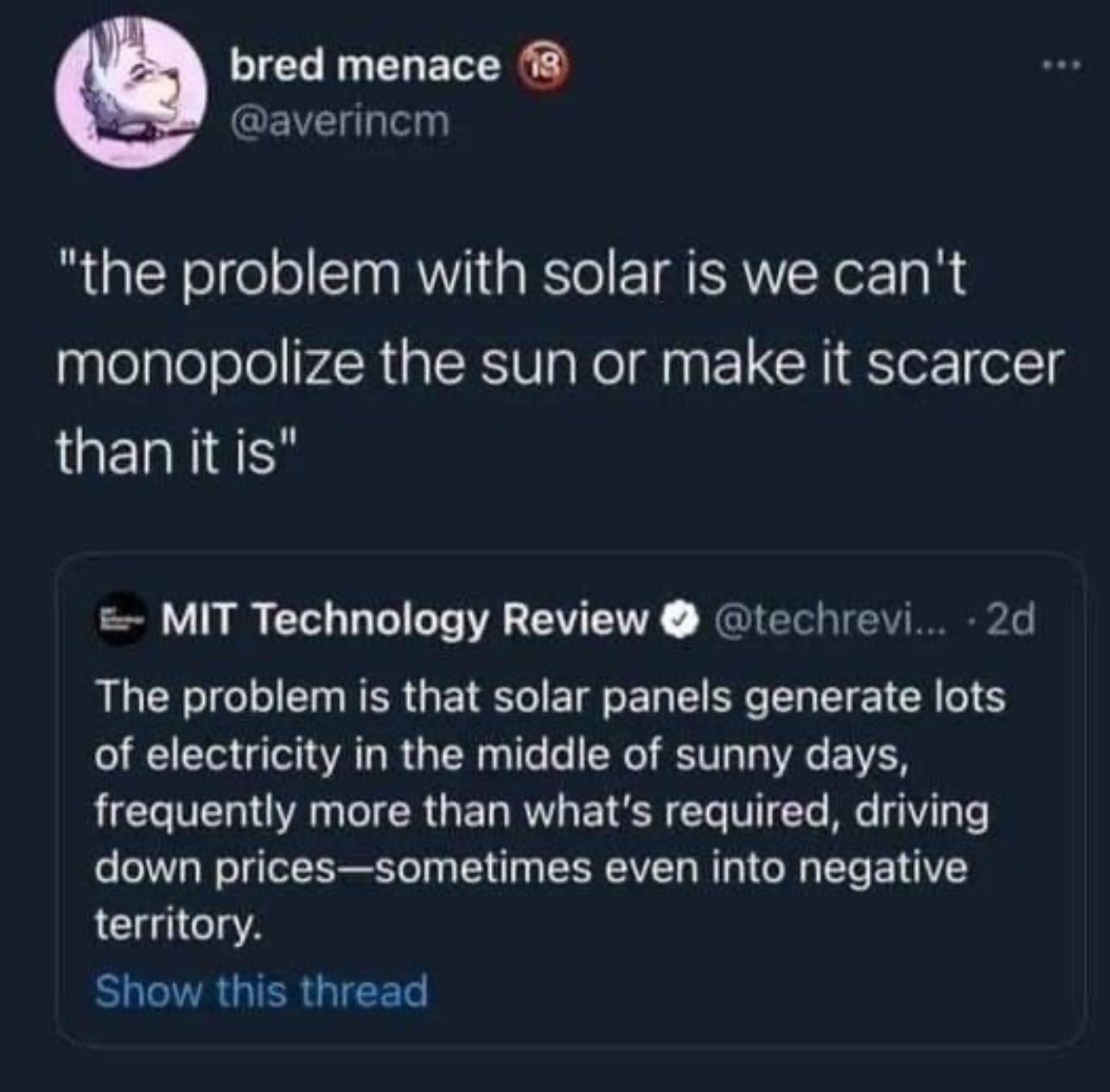
Negative prices are the grid operator encouraging more demand so it can balance out the increased production.

  • source
  • hideshow 32 child comments
  • [–] 10 points 2 years ago (5 children)

    Piggybacking on your grid stability point, another issue I don’t see getting addressed here is ramp rate.

    If we install enough solar where 100% of our daytime load is served by solar, that’s great. But what about when the solar starts to drop off later in the day?

    A/Cs are still running while the sun is setting, the outside air is still hot. People are also getting home from work, and turning on their A/Cs to cool off the house, flipping on their lights, turning on the oven, etc.

    Most grids have their peak power usage after solar has completely dropped off.

    The issue then becomes: how can we serve that load? And you could say “just turn on some gas-fired units, at least most of the day was 100% renewable.”

    But some gas units take literal hours to turn on. And if you’re 100% renewable during the day, you can’t have those gas units already online.

    Grid operators have to leave their gas units online, running as low as they can, while the sun is out. So that when the peak hits, they can ramp up their grid to peak output, without any help from solar.

    There are definitely some interesting solutions to this problem, energy storage, load shifting, and energy efficiency, but these are still in development.

    People expect the lights to turn on when they flip the switch, and wouldn’t be very happy if that wasn’t the case. Grid operators are unable to provide that currently without dispatchable units.

  • source
  • parent
  • hideshow 5 child comments
  • load more comments (5 replies)
  • load more comments (18 replies)
    [–] 91 points 2 years ago (35 children)

    If only there were some way to take energy made from sunshine and store it in some form for later. Like in a battery. Or as heat. Or in a flywheel. Or just use the energy for something we'd really like to do as cheaply as possible. Like sequester CO2. Or desalinate water. Or run industries that would otherwise use natural gas.

  • source
  • hideshow 35 child comments
  • load more comments (25 replies)
    [–] 74 points 2 years ago (36 children)

    Literal free goddamn energy from the sky and these greedy fucks are going to burn the world down because they can't flip it for a buck

  • source
  • hideshow 36 child comments
  • [–] 25 points 2 years ago (34 children)

    It sounds dumb, but because you can't turn off solar power, if it produces more then you need, you have to use it somehow or it can damage equipment. Hence the driving prices into negative territory. It's a technical problem more than it is a financial one.

  • source
  • parent
  • hideshow 34 child comments
  • [–] 29 points 2 years ago (11 children)

    It is a financial problem. Technically you can just cover the solar panels. But that's not good financially.

  • source
  • parent
  • hideshow 11 child comments
  • load more comments (1 reply)
  • [–] 11 points 2 years ago* (4 children)

    "Damaging equipment" is just nonsense. I've got an off-grid solar system. When the battery is fully charged the solar panels simply stops producing. It has potential (voltage) but no current until you draw power. Just like a battery is full of energy but it just sits there until you draw power from it.

    All solar systems could have smart switches to intelligently disconnect from the grid as needed, some inverter already do this automatically. So it's not a technical problem. It's a political problem.

  • source
  • parent
  • hideshow 4 child comments
  • load more comments (1 reply)
  • load more comments (17 replies)
  • load more comments (1 reply)
    [–] 73 points 2 years ago (16 children)

    In this thread: a bunch of armchair energy scientists who think they've solved the energy storage problem all on their own.

  • source
  • hideshow 16 child comments
  • [–] 38 points 2 years ago (7 children)

    Theres tons of ways that people with even a little brains could figure out, the problem is often cost or feasability.

    A big burried water tank in my yard could be heated during the day and used to warm the house via underfloor heating at night, could do the reverse with chilled water in the middle of summer plumbed to an air recirculator with a heat exchanger. Its really simple engineering but expensive to implement.

    I think an awful lot of people just dont understand the sheer scale of a lot of these problems, not the fundamentals.

  • source
  • parent
  • hideshow 7 child comments
  • [–] 17 points 2 years ago*

    an awful lot of people just dont understand the sheer scale of a lot of these problems

    Sheer scale is why we're in this mess to begin with. Coal power for a population of 50M people living on either side of the Atlantic isn't what caused climate change. It's the scale up to provide power for 8B people that's broiling the planet.

    "Ah, but you don't understand! There will be engineering obstacles to upgrading the grid!" is shit you can say when you aren't spending billions to maintain the existing fossil fuel infrastructure that's currently in place.

    We have the capacity to reorient our economy around a predictable daily regionally glut of solar electricity. We already exploit time variable ecological events to optimize consumption. And we built out a global grid 40 years ago to handle logistics at this scale. You can move electricity from coast to coast and we routinely do. This isn't an impossible problem, it's just one that Western financial centers in particular don't want to invest in solving.

  • source
  • parent
  • load more comments (6 replies)
  • load more comments (8 replies)
    [–] 60 points 2 years ago* (last edited 2 years ago) (53 children)

    This is idiotic. The fact is your electricity transmission system operator has to pay a lot of money to keep the grid stable at 50 or 60Hz or your electronics would fry. With wind and especially with solar power, the variable output is always pushing the frequency one way or the other, and that creates a great need for costly balancing services. Negative pricing is an example of such a balancing service. Sounds good, but for how long do you think your electricity company can keep on paying you to consume power?

  • source
  • hideshow 53 child comments
  • load more comments (31 replies)
    [–] 53 points 2 years ago

    This reminds me of a quote (that probably isn't real) from Westinghouse to Tesla in regard to wireless energy transmission he was trying to create.

    "This is wonderful, but where would we put the meter!?"

  • source
  • [–] 47 points 2 years ago (34 children)

    This is a real problem for renewables.

    You don't get paid when the sun shines, and you don't get paid for when it does not.

    You had to pay for building the solar panels and maintaining them. Corporate greed aside none sane would like their tax money either to be spent on producing electricity when it's not needed.

    Next step for renewables must be storage that is cheap enough for it to beat having fossil fuel on standby.

  • source
  • hideshow 34 child comments
  • load more comments (27 replies)
    [–] 42 points 2 years ago* (last edited 2 years ago) (3 children)

    Didn't China have a community use lots of solar and they ended up with such a glut of excess power that they didn't know what to do with it?

    All communities should have that. Electricity should be free and it would be plausible to make it free. Except for maintenance costs, but that would be peanuts compared to what we pay now.

  • source
  • hideshow 3 child comments
  • load more comments (3 replies)
    [–] 42 points 2 years ago (10 children)

    The "problem" of negative energy costs is easy to solve, but quite costly.

    Build water desalination/carbon capture and storage/hydrogen generation plants that only run when the price goes below 0; even though these are very energy intensive, they would help stabilize the grid.

    Then build more solar; you want to try to have the daytime price stay in the negative as often as possible.

  • source
  • hideshow 10 child comments
  • [–] 24 points 2 years ago (5 children)

    The solution we're using instead of course, instead of all that environment crap you suggested, is running huge crypto farms only during the hours when the energy is in surplus.

  • source
  • parent
  • hideshow 5 child comments
  • [–] 19 points 2 years ago (3 children)

    To be fair; this is a valid use case.

    If you are a solar power producer; rather than offering your energy at -ve rates; run a crypto farm when the output is too high. This is far better than running the same farm on coal.

    But it would be better going into something useful.

  • source
  • parent
  • hideshow 3 child comments
  • [–] 12 points 2 years ago (2 children)

    I want to pre-empt the argument from the Bitcoin people that while this is a logically sound argument for how Bitcoin mining could potentially help the environment by making renewables more economically feasible, using this argument to describe Bitcoin mining electricity usage is completely invalid—Bitcoin mining as it exists today does not merely use excess renewable energy; it consumes energy even in times of demand when it could be given to residential, commercial, or industrial customers. Without the excess demand from today's Bitcoin mines, the capacity that is freed up can be used to close fossil fuel power plants.

  • source
  • parent
  • hideshow 2 child comments
  • load more comments (2 replies)
  • load more comments (1 reply)
  • load more comments (4 replies)
    [–] 38 points 2 years ago (19 children)

    So what they are saying is that our current financial system is too focused on short term gains to cope with short term losses?

    Sigh, when I grew up, I was allways taught to save money so that I have a buffer to fall back on. This concept seems to have completely gone out the window for busniesses lately.

    I dislike the talk about how capitalism is bad as a general concept, but when seeing stuff like this I do agree with it in parts.

    Ok, so let's solve the issue.

    There is too much electricity, so generating power to transmit to the network will cost us money.

    This has an easy solution, just don't transmit it to the network.

    Build a battery facility where you store the power instead, infact if the price of electricity is negative, use the power on the grid and charge your batteries as well, I mean, when the electricity cost is negative, you are being paid to consume power.

    Then when the sun goes down, and the electricity price goes up, you sell the charge you have in the batteries.

    Depending on your location you could even set up a pumped storage system, where instead of batteries getting charged, you use the cheap excess energy to pump a resarvoir full of water, and release it when you need the power.

  • source
  • hideshow 19 child comments
  • [–] 18 points 2 years ago (6 children)

    This is exactly what we're gonna see on a large scale in a few years.

  • source
  • parent
  • hideshow 6 child comments
  • load more comments (1 reply)
  • [–] 17 points 2 years ago (6 children)

    This is generally the right idea of a solution, but it’s a difficult engineering problem.

    It’s not “just an economics problem” despite the headline.

    The “cost of power becoming negative” is phrased in an economic way but what it really means is the grid has too much power and that power needs to go somewhere or it will damage infrastructure.

  • source
  • parent
  • hideshow 6 child comments
  • load more comments (6 replies)
  • load more comments (4 replies)
    [–] 32 points 2 years ago (13 children)

    it's long past time we took businessman out of control and replaced them with scientists.

  • source
  • hideshow 13 child comments
  • load more comments (13 replies)
    [+] 31 points 2 years ago* (last edited 2 years ago) (8 children)
  • load more comments (4 replies)
    [–] 23 points 2 years ago (2 children)

    The real issue isn't the overproduction per se, but that we (globally speaking) don't have enough cheap scalable responsive distributed storage. I'm writing this from a privileged position since Switzerland has loads of dams and can pump water during such peaks. But it's clear that's not the solution everywhere. I hope a good cheap mass producible battery tech with less rare earth metal requirements comes along soon.

  • source
  • hideshow 2 child comments
  • load more comments (2 replies)
    [–] 17 points 2 years ago (17 children)

    That's not what they were saying, they were saying that it's not economical to have an abundance of electricity when people need it the least, and little or no electricity when people need it the most. It would be one thing if utilities could sell solar electricity at peak demand hours for a higher price, to make up the difference, but that's just when solar generation is slowly down significantly or stopped entirely.

    And, yes, I know that battery storage could theoretically solve this, but battery technology is not currently capable of providing electricity for the entirety of the time we need it. New technologies are being developed right now with the goal of achieving long term grid storage, but they are still in the R&D phase. I'm confident a suitable storage technology, or multiple technologies, will eventually come to market, but it's going to take a while.

    Regardless, it is likely we will always need some kind of on-demand power generation to supplement renewables and maintain grid stability, and I think nuclear is the best option.

    But we shouldn't act like the problem is that utilities are just greedy. Many utilities aren't even for-profit companies, as many are either not-for-profit cooperatives or public entities. Sure, there are also many for-profit power utilities as well, maybe even some with connections to the fossil fuel industry, but generally power utilities are not some great villain.

  • source
  • hideshow 17 child comments
  • load more comments (17 replies)
    [–] 17 points 2 years ago (5 children)

    The real special bit is that this crap isn't coming from, say Harvard, who one expects is all about business, but MIT which is supposed to be about Science and Engineering.

  • source
  • hideshow 5 child comments
  • [–] 17 points 2 years ago

    The media arm of MIT has been steaming garbage for years and constantly misrepresents the studies from their own researchers for clickbait.

    But that aside, even though the engineering work out of MIT is solid, their economic opinions heavily reflect the fact that it’s an institution full of trust fund nepotism.

  • source
  • parent
  • load more comments (4 replies)
    [–] 16 points 2 years ago

    "For years, mankind has yearned to destroy the Sun." - CM Burns.

  • source
  • [–] 15 points 2 years ago (1 child)

    Ya know what, I'm gonna solar even harder

  • source
  • hideshow 1 child comment
  • load more comments (1 reply)
    [–] 14 points 2 years ago (2 children)

    Before commenting, you should know there are 2 types of solar panels:

    • the ones owned by people (which may or may not feed into the grid)
    • the ones owned by corporations

    The article is probably about the 2nd kind (if you can only sell energy when there is a surplus, your company will fail), while the twitter user makes it seem like the 1st kind was meant. We probably need to built more of both types. Identify what type the other commenters are talking about before getting in any arguments here.

  • source
  • hideshow 2 child comments
  • load more comments (2 replies)
    [–] 12 points 2 years ago

    Negative prices are an opportunity and people will take advantage. This would be the perfect time to change batteries, make hydrogen, send compressed air into an old mine or refill a dam

  • source
  • load more comments
    view more: next ›