you are viewing a single comment's thread
view the rest of the comments
[–] 60 points 2 years ago* (last edited 2 years ago) (53 children)

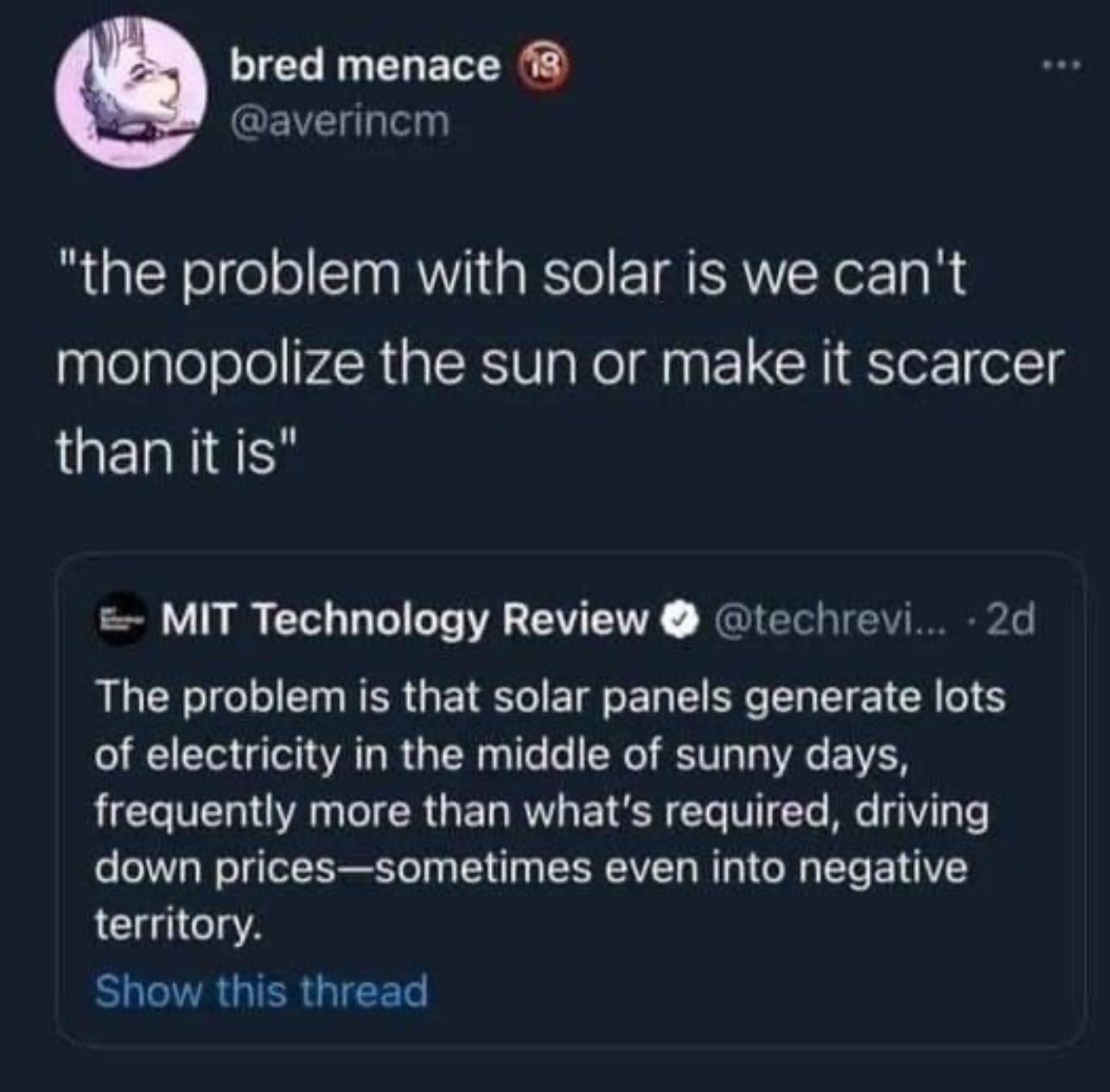
This is idiotic. The fact is your electricity transmission system operator has to pay a lot of money to keep the grid stable at 50 or 60Hz or your electronics would fry. With wind and especially with solar power, the variable output is always pushing the frequency one way or the other, and that creates a great need for costly balancing services. Negative pricing is an example of such a balancing service. Sounds good, but for how long do you think your electricity company can keep on paying you to consume power?

  • source
  • hideshow 53 child comments
  • [–] 18 points 2 years ago (21 children)

    People also don't realize that too much power is just as bad as too little, worse in fact. There's always useful power sinks: pumped hydro, batteries, thermal storage, but these are not infinite.

  • source
  • parent
  • hideshow 21 child comments
  • [–] 3 points 2 years ago

    Just have few percent of spare capacity. If suddenly it will become too sunny, you can just disconnect solar cells. If not sunny enough, then connect them back.

    Obviously I'm talking only about day - the only time when solar panel output can fluctuate.

  • source
  • parent
  • [–] 3 points 2 years ago (3 children)

    Why isn't this as easy as storing some of that excess energy in a home battery and letting the rest down in a wire into the ground? Then if it's smart enough it could only give back energy when needed.

  • source
  • parent
  • hideshow 3 child comments
  • [–] 10 points 2 years ago

    The easiest solution is to send the power somewhere else where it can offset the use of fossil fuels. This solution is fraught with political hurdles, subject to market forces (due to privatization) and often grid compatability issues(looking at you Texas). It is, however, a time tested and common method for mitigating excess production.

  • source
  • parent
  • [–] 7 points 2 years ago

    While water in pipes is often a metaphor for electricity, it's not particularly useful here. You can't ground out part of a charge. Energy storage is the solution though. Batteries are good, pumping water up back up into dams to be regained from a hydro plant when needed is ideal, as I understand it.

  • source
  • parent
  • [–] 6 points 2 years ago*

    Well, that's what they're doing some places. The batteries assets are not in private homes usually though, they're by themself or run by power-consuming industries. Batteries are expensive though, and they degrade quickly if you use them wrong. In the EU, ENTSO-E defines the market rules, trade systems and messaging systems that energy companies and asset owners play by. Sometimes the revenue-generating asset is a battery, sometimes it's a hot water boiler, wind park, factory, hydro plant etc.

  • source
  • parent
  • [–] 2 points 2 years ago

    This whole thread has way too many people who see the price as some kind of made up number that dictates how people behave, rather than recognizing that the price is a signal about the availability of useful real-world resources.

    Even if the prices were strictly mandated by a centrally planned tariff that kept the same price throughout the day, every day, we'd still have the engineering challenge of how to match the energy fed into the grid versus taken out of the grid.

    The prices are just a reflection of that technical issue, so solving it still needs to be done.

  • source
  • parent
  • [–] 2 points 2 years ago

    You're answering the wrong questions. I don't think people are assuming that it's simple to manage the power grid (if so, they shouldn't be...) but rather why are we locked into a system that lets business profit motive be responsible for the continued existence of the ecosystem.

  • source
  • parent
  • [+] 0 points 2 years ago* (last edited 2 years ago) (1 child)
  • [–] 8 points 2 years ago

    Having knowledge in power electronics i can confidently say the DC output of solar is easily and regularly inverted in phase with grid. In fact, DC is often used for undersea cables switching AC to dc then back to AC, All at extremely high voltage and varying demand(up yo 600kV/600MW but varying by installation).

    Wind turbines go online after the blades start spinning and connect to the grid in the same way as any other generator, controlled by internal electronics. Power is regulated through blade feathering and can be turned off as supply exceeds demand. This, other than for maintenance reasons, is why you might see one turbine spinning while the next is standing still. This capability actually means the grid is MORE stable with wind power.

    Any further fluctuation is managed in the same way as conventional power generation.

  • source
  • parent
  • load more comments (20 replies)