you are viewing a single comment's thread
view the rest of the comments
[–] 25 points 2 years ago (34 children)

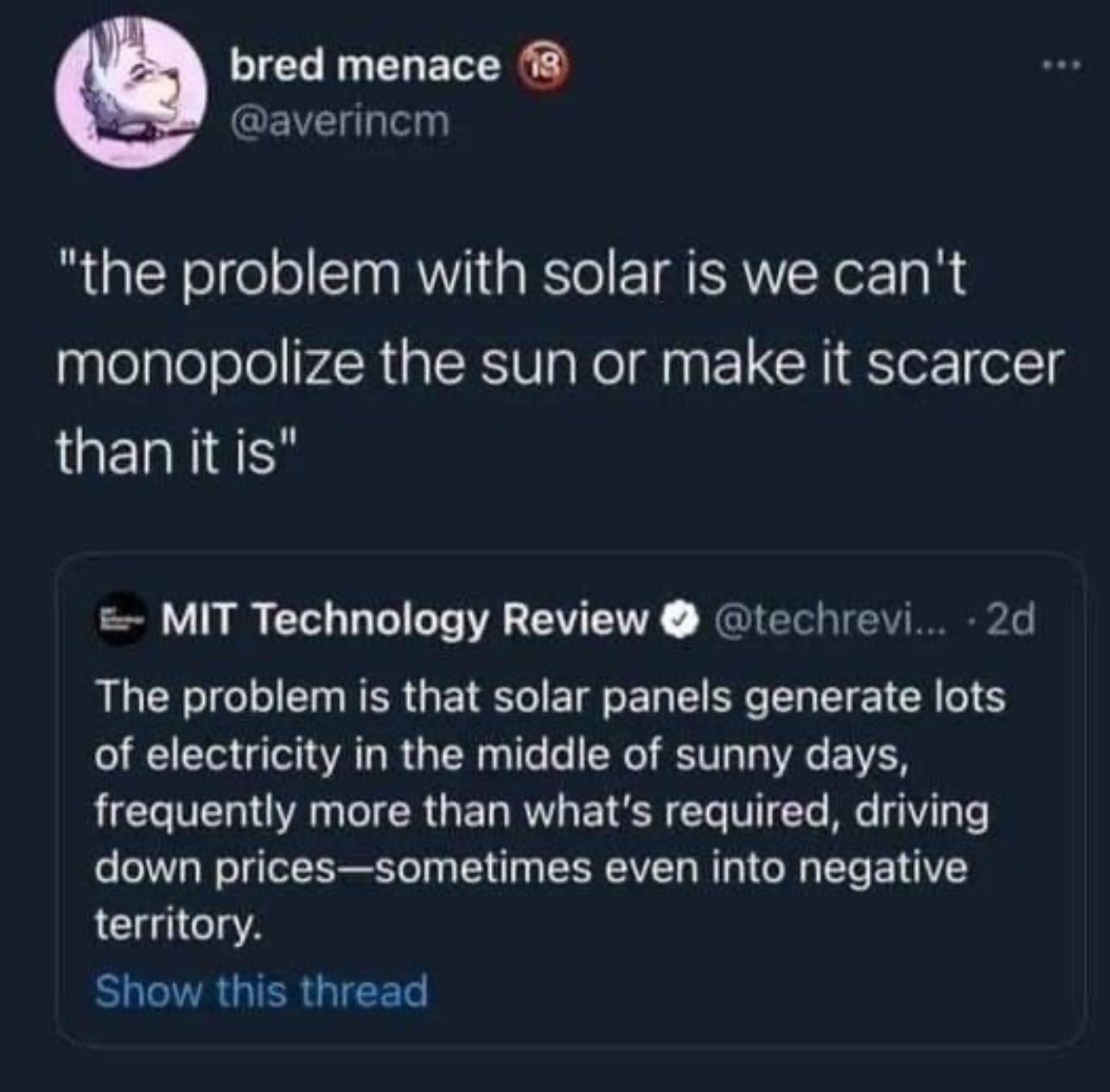
It sounds dumb, but because you can't turn off solar power, if it produces more then you need, you have to use it somehow or it can damage equipment. Hence the driving prices into negative territory. It's a technical problem more than it is a financial one.

  • source
  • parent
  • hideshow 34 child comments
  • [–] 29 points 2 years ago (11 children)

    It is a financial problem. Technically you can just cover the solar panels. But that's not good financially.

  • source
  • parent
  • hideshow 11 child comments
  • [–] 19 points 2 years ago* (9 children)

    Your "technically you can" is actually a huge logistical nightmare to implement.

    Having electricity rates go really low is intended to incentivize people or companies to sink the excess energy to wherever they can. And also to discourage producers to produce more at that hour, if they are able to.

  • source
  • parent
  • hideshow 9 child comments
  • [–] 9 points 2 years ago* (1 child)

    Logistical problems are still financial problems though. That's my point. Hire enough people/develop the appropriate automation and the issue is no more.

    We have the technology to solve this, the problem is the money.

    In fact, you could just buy enough batteries and the problem will also go away. Still a financial problem, not a technology one.

    EDIT: just to clarify, if at some point energy prices go negative, it means that it is cheaper to buy energy usage than a solution. Unless the energy company is dumb enough to just lose money for the lazyness of considering other options.

  • source
  • parent
  • hideshow 1 child comment
  • [–] 6 points 2 years ago

    You could spend the money, but you also need to consider whether that money is well spent. Batteries do not last forever. Maybe that money is better spent on R&D to develop better batteries first. Also natural resources and environmental impact needs to be considered. Batteries take natural resources to build and also occupies a lot of space.

    20 years ago, we also have the technology to run AI workloads. Except we probably had to deploy billions of CPUs to match the capability of today's GPUs. We have the technology then, but it is not practical. And that money was much better spent in the R&D that lead to today's GPUs. So similarly our batteries probably needs to be a few magnitude better than what we have today before it is practical to use.

  • source
  • parent
  • [–] 5 points 2 years ago (6 children)

    Really? I'm seriously asking, because I thought solar farms already had automated ways of cleaning off the panels, surely an automated way to cover the panels wouldn't be any more complex than that. It would add maintenance costs for sure, but calling it a logistical nightmare seems like an exaggeration.

  • source
  • parent
  • hideshow 6 child comments
  • [–] 6 points 2 years ago* (last edited 2 years ago) (3 children)

    Most use a horizontal single axis configuration and could just tilt the panels away from the sun.

    The real question that we should be asking, is why nobody can think of what to do with free energy?

    Desalination? Mine Bitcoin? Giant space laser?

  • source
  • parent
  • hideshow 3 child comments
  • [–] 2 points 2 years ago (1 child)

    It's not a question of ideas, it's a question of money. Building things to use excess power costs a lot of money.

  • source
  • parent
  • hideshow 1 child comment
  • [–] 0 points 2 years ago*

    Or in a pinch: just run big-ass space heaters. Seriously. It's a stupid way to burn off excess power, but it's dirt simple and cheap. Just have a big array of resistive heaters out in an empty field somewhere with a high fence around it. Need to burn off an extra GW? Run it through massive heating elements and burn burn it off. It's a stupid waste of good energy, but as an emergency backup, it's not a bad option. It's trivially easy to dispose of huge amounts of excess electricity if you just run the mother-of-all space heaters. Run your stupid giant resistive heater at the bottom of a lake for even better effect.

  • source
  • parent
  • [–] 4 points 2 years ago (1 child)

    You need to consider more than just solar farms. There are many roof top solar systems on people's houses. That's what I'm referring to regarding logistical nightmare.

    Second, if we are just going to cover up solar panels, then it really defeats the purpose of having it. A better way is to come up with ways to store this excess energy to use when there is low production and not have to depend on fossil fuels at night.

  • source
  • parent
  • hideshow 1 child comment
  • [–] 2 points 2 years ago* (last edited 2 years ago)

    Yeah I understand storing and using the energy is obviously a better solution than to stop producing the energy. But in the short term, in the context of large solar arrays, until we have storage solutions or ways to use* the excess, covering the panels up or turning them to face the ground for a bit doesn't seem like a very big logisticical hurdle.

    There are many roof top solar systems on people's houses. That's what I'm referring to regarding logistical nightmare.

    Are there really enough residential rooftop panels for this to even be a problem? And couldn't it be solved just by installing a battery for your home to store the excess? Again, if you could explain how this would be a logistical nightmare for my ignorant self, I'd appreciate it.

  • source
  • parent
  • [–] 11 points 2 years ago* (4 children)

    "Damaging equipment" is just nonsense. I've got an off-grid solar system. When the battery is fully charged the solar panels simply stops producing. It has potential (voltage) but no current until you draw power. Just like a battery is full of energy but it just sits there until you draw power from it.

    All solar systems could have smart switches to intelligently disconnect from the grid as needed, some inverter already do this automatically. So it's not a technical problem. It's a political problem.

  • source
  • parent
  • hideshow 4 child comments
  • [–] 13 points 2 years ago (2 children)

    This can cause degradation of the PN junction on the panel shortening life. The plans I've seen all have a resistive heater some place to dump the excess when full. Smart equipment does help mitigate most issues like moving the resistance point on the panel for lower efficiency when signaled to do so but less is not the same as none.

  • source
  • parent
  • hideshow 2 child comments
  • [–] 2 points 2 years ago (1 child)

    How does it damage the PN junction of the panel is open circuit or barely loaded? It doesn't seem logical that this would damage the panel, but I'm open to being proven wrong.

    There are all kinds of follow up questions to ask as well, but I think the main one is how big an effect are we talking?

  • source
  • parent
  • hideshow 1 child comment
  • [–] 4 points 2 years ago

    Not a huge effect now with smart systems but if you leave solar panel disconnected from everything and out in the sun for weeks at a time you will damage the panel. Open circuit voltage is higher than operating voltage and higher voltage will break down insulation. PN depends on the insulating properties of a doped layer. If I remember correctly electron tunneling causes damage by making the band gap smaller

  • source
  • parent
  • [–] 7 points 2 years ago (6 children)

    It is a technical problem of how can you convince electrical companies to overcome a problem they have no financial incentive to solve.

  • source
  • parent
  • hideshow 6 child comments
  • [–] -2 points 2 years ago (5 children)

    that's not a technical problem. that's a weakness of the people's resolve problem. we can, at any time, force them to do the right thing.

  • source
  • parent
  • hideshow 5 child comments
  • [–] 3 points 2 years ago (4 children)

    I'm aware its not a technical problem, I was using the word ironically to point out the person I was responding to was wrong to say it...

    Also saying we can at any time fix a problem is just being ignorant of the many near impossible steps needed to fix the problem. In this case the problem is capitalism. We could come up with ways to end capitalism or make capitalism work in the interest of humanity, but will it realistically ever happen? No it wont, private money won, look at the topics discussed for presidential debate, never a mention of doing something about private capital owning Washington. Just super effective wedge issues.

  • source
  • parent
  • hideshow 4 child comments
  • [–] 1 point 2 years ago (3 children)

    You're being too broad. We don't need to undo all of capitalism here. Nationalising the electric grid is a reasonable solution to this particular problem.

  • source
  • parent
  • hideshow 3 child comments
  • [–] 1 point 2 years ago (2 children)

    What incentive does a politician have to support nationalizing the power grid? It wont be a super splashy issue to tackle so it isnt worth doing it for the credit, and the different power companies of the world will just put their money into buying opposition to your effort anyways.

    That's the problem with capitalism is that any single thing you would want to do that would impact some cocksuckers capital, and the threat alone makes it a necessity to pay to win in congress. Usually the only way stuff like this happens is because there is new capital entering the market that can afford to donate against the old capital to overtake them. Its just rich assholes all the way down.

  • source
  • parent
  • hideshow 2 child comments
  • [–] 1 point 2 years ago (1 child)

    If the government seizes control of a major industry, that's a lot of power and opportunity for politicians. It's already been done in some local areas, and it had the broad support of the people because "the electric company is gouging us, the gov should take it over" is an easy sell.

  • source
  • parent
  • hideshow 1 child comment
  • [–] 1 point 2 years ago

    I just don't think it's feasible at a federal level. Or even for some states (Newsom refusing to do anything about SDGE comes to mind) It's so easy to cry socialism about this topic too.

    I also think there might be a disconnect between government power and politician power.

  • source
  • parent
  • [–] 4 points 2 years ago (2 children)

    Sounds like energy companies or independent entities should invest in energy storage so they can get paid to draw from the grid.

  • source
  • parent
  • hideshow 2 child comments
  • [–] 4 points 2 years ago* (last edited 2 years ago) (1 child)

    But then you've got cities like Morro Bay, CA that are trying to stop a plan to replace a coal plant with a battery storage facility because batteries are supposedly dangerous.

  • source
  • parent
  • hideshow 1 child comment
  • [–] 1 point 2 years ago (3 children)

    Can they not route excess electricity into the ground?

  • source
  • parent
  • hideshow 3 child comments
  • [–] 5 points 2 years ago (2 children)

    No, unfortunately, you can't.

    Ground doesn't typically dissipate power, rather, power is dissipated in the circuit/load


    so if you just hook a wire to ground, you're dumping gobs of power into the wire. If you do this in your home (DON'T), best case it will trip the breaker, worst case it will melt and catch something on fire.

    It's easy enough to burn a kilowatt


    just boil some water. But it's entirely something else to burn megawatt, or yikes, gigawatt scale power.

  • source
  • parent
  • hideshow 2 child comments
  • [–] 5 points 2 years ago (1 child)

    It seems braindead simple to me to work some controls into an industrial scale solar array to manage its output by regulating its input. Like, rotating the panels to put them out of their optimal alignment with the sun or mechanically partially covering them with shutters.

  • source
  • parent
  • hideshow 1 child comment