477

cross-posted from: https://feddit.uk/post/44126927

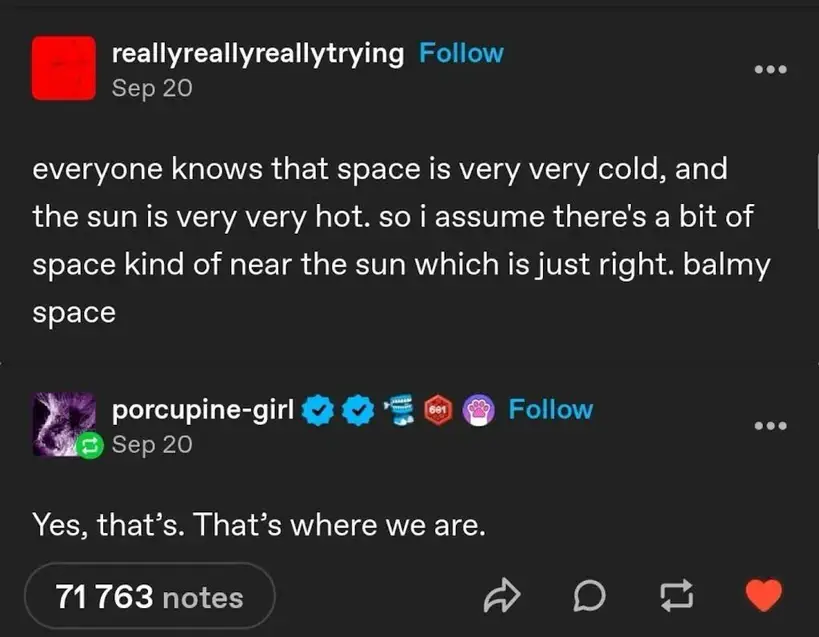
Goldilocks
top 50 comments
sorted by: hot top new old
[-] Tollana1234567@lemmy.today 1 points 49 minutes ago

a massive plasma cannon.

[-] genuineparts@infosec.pub 1 points 1 hour ago

The Sun is a mass of incandescent gas, A giant nuclear furnace.

[-] Fedizen@lemmy.world 37 points 14 hours ago* (last edited 14 hours ago)

Goldilocks space is like "my breath immediately turns solid in the shade and my body is turning to charcoal in the direct sunlight"

You need a giant buffer of atmosphere to help average the temperature a bit. Maybe some kind of large rock with a dense atmosphere?

[-] MeatPilot@sh.itjust.works 13 points 13 hours ago

That or a giant space turtle with elephants holding a flatten rock on it's back.

[-] SkaveRat@discuss.tchncs.de 1 points 1 hour ago

But what's holding up the elephants?

[-] HeyThisIsntTheYMCA@lemmy.world 2 points 2 hours ago* (last edited 2 hours ago)

that's not quite right. see that turtle has its own sun and moon chasing it around. and they did the math the sun and moon are superluminal bodies

[-] Fedizen@lemmy.world 2 points 3 hours ago

If you go that way you gotta have at least 8 colors.

[-] dwemthy@lemmy.world 7 points 13 hours ago

A strong thaumic field slows down the sunlight too. Doesn't change the heat but it's nice to see sunrise pour across the landscape like honey

[-] tensorpudding@lemmy.world 22 points 14 hours ago

This is not completely correct though. It is our atmosphere/albedo/geological and natural processes that help maintain consistently livable temperatures, not just living in the habitable zone. No atmosphere? We'd be like the Moon, where it is too hot in sunlight and too cold in shade despite being similarly far from the sun as Earth.

[-] sun_is_ra@sh.itjust.works 5 points 7 hours ago

Also its not true that space is "very very cold".

If you are in space wearing space suite that doesn't radiate heat properly, you could die from the excessive heat. Once dead your body stops producing heat and the existing heat eventually radiate away and your body freeze.

Space is neither hot or cold because these are property of matter. Since space has very little atoms, it technically has no temperature.

[-] Rooskie91@discuss.online 57 points 17 hours ago

If that blows your mind then think about this: As the universe expanded after the Big Bang, it cooled from unimaginably high temperatures. In principle, this suggest that there could have been a very short window much later, tens of millions of years after the Big Bang, when the background temperature of the entire universe was capable of sustaining life everywhere. Some physicists have suggested this might have created a brief, universe-wide “habitable epoch,” though this remains theoretical.

I'm not an expert, so this is probably not a muture understanding, but it's cool to imagine a universe where life was incredibly abundant.

[-] marcos@lemmy.world 41 points 16 hours ago* (last edited 16 hours ago)

but it’s cool to imagine a universe where life was incredibly abundant

There was probably nothing but helium, hydrogen and a tiny bit of lithium at that period.

[-] panda_abyss@lemmy.ca 29 points 16 hours ago

Those are some of the best elements though. 

[-] kozy138@slrpnk.net 6 points 12 hours ago

Top 3 probably

[-] marcos@lemmy.world 17 points 16 hours ago

They surely are popular...

[-] Dicska@lemmy.world 3 points 13 hours ago

Yeah, season 8 of helium is just chef's kiss.

[-] wolframhydroxide@sh.itjust.works 4 points 11 hours ago

More weird to me is that, at some point before the first stars, the entire universe glowed through the entire rainbow, so there is a moment when, were you to travel back in time, the entire universe would glow blindingly green.

[-] SkyeStarfall@lemmy.blahaj.zone 5 points 9 hours ago

It probably would never appear green, due to the black-body radiation distribution. When the peak is at green, it just looks like white to us. Our sun is kinda a "green" star due to this

But it would go from blue to white to red. Similar colour progression that we can find in the distribution of stars

[-] wolframhydroxide@sh.itjust.works 2 points 7 hours ago* (last edited 7 hours ago)

Indeed! Good point! For some reason, I was under the impression that the CMB was monochromatic (corresponding to a red shifted equivalent of the precise energy of W and Z boson annihilation to produce photons). Thanks!!

[-] engywook@programming.dev 13 points 16 hours ago* (last edited 16 hours ago)

Interesting theory, I'd never heard of it before. All of the sudden, "a long time ago, in a galaxy far, far away", actually seems plausible (although this theory looks like it came well after SW in 2014).

The actual paper about it: https://lweb.cfa.harvard.edu/~loeb/habitable.pdf

[-] DylanMc6@lemmy.dbzer0.com 6 points 12 hours ago

Not anymore, there's a blanket

[-] Zwiebel@feddit.org 31 points 17 hours ago

Vacuum doesn't have a temperature~

[-] starik@lemmy.zip 32 points 17 hours ago

But you will if you sit in a vacuum for a while without a radiation source nearby, and it will be quite low.

[-] Mesophar@pawb.social 13 points 17 hours ago

Are you dissipating heat in a vacuum, though? Pressure shenanigans aside, would someone's body heat slowly, continually build up, or would they freeze?

[-] Tar_alcaran@sh.itjust.works 17 points 16 hours ago* (last edited 16 hours ago)

If you could somehow prevent yourself from dying due to lack of pressure, without blocking heat, you would radiate about 650W more than you generate.

That's using the Stefan Boltzmann law, at normal body temp, perfect blackbody and 1.5m2 of skin. (~ 750 Watt) And then assuming 2000kcal a day (~100W)

You'd cool down pretty quickly.

[-] Mesophar@pawb.social 1 points 9 hours ago

Good to know! I didn't realize humans would radiate heat so much, I wrongly assumed it was more convective and relied on atmosphere

[-] ivanafterall@lemmy.world 8 points 15 hours ago

So how long do I have? Also, if you guys could hurry with the answer...?

[-] Fedizen@lemmy.world 1 points 3 hours ago
[-] Tar_alcaran@sh.itjust.works 9 points 14 hours ago* (last edited 14 hours ago)

I can't really find a good number for how cold you can get and not die, so let's say 20 degrees. That gives 16 degrees to lose.

Meat has a specific heat of about 3.5kJ per kilo per degree, so say you weigh 70kg, that's about 4 million joules to lose before you die.

At 650 joules per second, you've got slightly over 10 minutes. Of course, shivering will burn more calories and stuff, and the panic of impending death will likely stretch it a few more.

I didn't include clothes, because then the maths would make me cry.

[-] bobo@lemmy.ml 2 points 10 hours ago* (last edited 9 hours ago)

Meat has a specific heat of about 3.5kJ per kilo per degree, so say you weigh 70kg, that's about 4 million joules to lose before you die.

At 650 joules per second, you've got slightly over 10 minutes.

4,000,000/650/60=102.57 minutes

But that's for a resting body, a shivering one would lose only like 200j/s

Also, you forgot one important aspect, if you're getting bathed by the sun and spinning, you're constantly getting heated up.

[-] Zwiebel@feddit.org 4 points 13 hours ago

Your skin isn't at core temp tho, so the loss rate should be lower I think

[-] Tar_alcaran@sh.itjust.works 5 points 11 hours ago

At that point, you'll have to calculate the heat transport of the human body, and answer questions like "how long can a person live with frozen skin" and other fun questions I'm not equipped to answer.

[-] DaddleDew@lemmy.world 9 points 17 hours ago* (last edited 17 hours ago)

You constantly radiate heat. The warmer you are, the faster you radiate it away. In space this is the primary way you lose heat.

In your living room you are constantly bombarded by radiated heat from all the objects that surround you, even if they're just at room temperature, which lessens the effect. In space, not so much.

Someone who knows better might chime in, but as far as I know the trope of rapidly freezing out in space is exaggerated. You would definitely freeze eventually, but perhaps not as dramatically fast as portrayed in The Guardians of The Galaxy for example.

[-] craftrabbit@lemmy.zip 3 points 16 hours ago

Have you ever looked up at a clear summer night sky? Your face will feel cold. Colder than when looking at the ground. That's because there's not as much stuff radiating heat at you up there.

load more comments (10 replies)
[-] hemko@lemmy.dbzer0.com 2 points 16 hours ago

It would be pretty warm at earth if the planet didn't radiate some of the heat away

[-] Snowclone@lemmy.world 2 points 17 hours ago* (last edited 17 hours ago)

Yes. Like all multipliers the heat of the sun requires not only itself the thing that which is acting but also that which is to be acted upon. If you are a handsome wet rock, the distance you are to the sun effects how your heat is multiplied.

load more comments (2 replies)
[-] nexguy@lemmy.world 14 points 16 hours ago

The dark side of your body in space is freezing cold while the light side gets hot. You really need to rotate to get that even crispy layer.

[-] pr06lefs@lemmy.ml 2 points 17 hours ago

balmy is an understatement

load more comments
view more: next ›
this post was submitted on 12 Feb 2026
477 points (97.8% liked)

Science Memes

19038 readers
701 users here now

Welcome to c/science_memes @ Mander.xyz!

A place for majestic STEMLORD peacocking, as well as memes about the realities of working in a lab.


Rules

  1. Don't throw mud. Behave like an intellectual and remember the human.
  2. Keep it rooted (on topic).
  3. No spam.
  4. Infographics welcome, get schooled.

This is a science community. We use the Dawkins definition of meme.


Research Committee

Other Mander Communities

Science and Research

Biology and Life Sciences

Physical Sciences

Humanities and Social Sciences

Practical and Applied Sciences

Memes

Miscellaneous

founded 3 years ago
MODERATORS