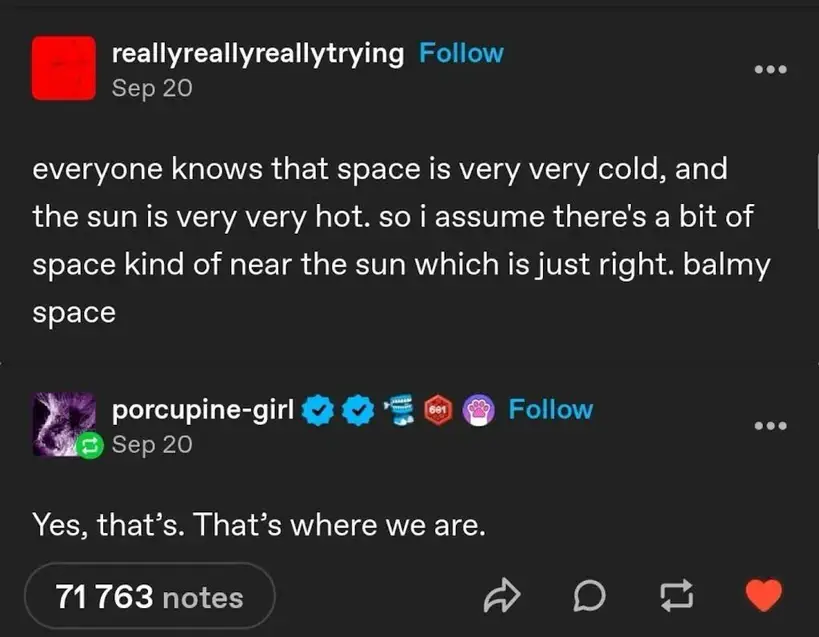
▲ 685 ▼ The sun is a deadly laser... (files.catbox.moe) submitted 7 months ago by Zuriz@sh.itjust.works to c/science_memes@mander.xyz 82 comments fedilink hide all child comments cross-posted from: https://feddit.uk/post/44126927 Goldilocks
[–] Zwiebel@feddit.org 36 points 7 months ago (27 children) Vacuum doesn't have a temperature~ permalink fedilink source hideshow 27 child comments replies: [–] starik@lemmy.zip 36 points 7 months ago (23 children) But you will if you sit in a vacuum for a while without a radiation source nearby, and it will be quite low. permalink fedilink source parent hideshow 23 child comments replies: [–] Mesophar@pawb.social 15 points 7 months ago (22 children) Are you dissipating heat in a vacuum, though? Pressure shenanigans aside, would someone's body heat slowly, continually build up, or would they freeze? permalink fedilink source parent hideshow 22 child comments replies: [–] ExperiencedWinter@lemmy.world 24 points 7 months ago https://en.wikipedia.org/wiki/Black-body_radiation permalink fedilink source parent [–] Tar_alcaran@sh.itjust.works 24 points 7 months ago* (7 children) If you could somehow prevent yourself from dying due to lack of pressure, without blocking heat, you would radiate about 650W more than you generate. That's using the Stefan Boltzmann law, at normal body temp, perfect blackbody and 1.5m2 of skin. (~ 750 Watt) And then assuming 2000kcal a day (~100W) You'd cool down pretty quickly. permalink fedilink source parent hideshow 7 child comments replies: [–] ivanafterall@lemmy.world 11 points 7 months ago (5 children) So how long do I have? Also, if you guys could hurry with the answer...? permalink fedilink source parent hideshow 5 child comments replies: [–] Tar_alcaran@sh.itjust.works 12 points 7 months ago* (last edited 7 months ago) (3 children) I can't really find a good number for how cold you can get and not die, so let's say 20 degrees. That gives 16 degrees to lose. Meat has a specific heat of about 3.5kJ per kilo per degree, so say you weigh 70kg, that's about 4 million joules to lose before you die. At 650 joules per second, you've got slightly over 10 minutes. Of course, shivering will burn more calories and stuff, and the panic of impending death will likely stretch it a few more. I didn't include clothes, because then the maths would make me cry. permalink fedilink source parent hideshow 3 child comments replies: [–] Zwiebel@feddit.org 5 points 7 months ago (1 child) Your skin isn't at core temp tho, so the loss rate should be lower I think permalink fedilink source parent hideshow 1 child comment replies: [–] Tar_alcaran@sh.itjust.works 9 points 7 months ago At that point, you'll have to calculate the heat transport of the human body, and answer questions like "how long can a person live with frozen skin" and other fun questions I'm not equipped to answer. permalink fedilink source parent [–] bobo@lemmy.ml 2 points 7 months ago* (last edited 7 months ago) Meat has a specific heat of about 3.5kJ per kilo per degree, so say you weigh 70kg, that's about 4 million joules to lose before you die. At 650 joules per second, you've got slightly over 10 minutes. 4,000,000/650/60=102.57 minutes But that's for a resting body, a shivering one would lose only like 200j/s Also, you forgot one important aspect, if you're getting bathed by the sun and spinning, you're constantly getting heated up. permalink fedilink source parent [–] Fedizen@lemmy.world 4 points 7 months ago RIP permalink fedilink source parent [–] Mesophar@pawb.social 1 point 7 months ago Good to know! I didn't realize humans would radiate heat so much, I wrongly assumed it was more convective and relied on atmosphere permalink fedilink source parent [–] DaddleDew@lemmy.world 11 points 7 months ago* (last edited 7 months ago) (11 children) You constantly radiate heat. The warmer you are, the faster you radiate it away. In space this is the primary way you lose heat. In your living room you are constantly bombarded by radiated heat from all the objects that surround you, even if they're just at room temperature, which lessens the effect. In space, not so much. Someone who knows better might chime in, but as far as I know the trope of rapidly freezing out in space is exaggerated. You would definitely freeze eventually, but perhaps not as dramatically fast as portrayed in The Guardians of The Galaxy for example. permalink fedilink source parent hideshow 11 child comments replies: [–] craftrabbit@lemmy.zip 4 points 7 months ago Have you ever looked up at a clear summer night sky? Your face will feel cold. Colder than when looking at the ground. That's because there's not as much stuff radiating heat at you up there. permalink fedilink source parent [+] Triumph@fedia.io -7 points 7 months ago (9 children) Heat doesn't work quite like that. In order for heat to transfer efficiently, there has to be "stuff" for it to transfer to. Vacuums are famous for lacking "stuff". permalink fedilink source parent hideshow 9 child comments replies: [–] DaddleDew@lemmy.world 13 points 7 months ago (7 children) You're talking about conduction. I'm talking about radiation. permalink fedilink source parent hideshow 7 child comments replies: [–] Triumph@fedia.io 4 points 7 months ago (6 children) Sure, but radiation acts extremely slowly in the scenario of a person in the vacuum of space. permalink fedilink source parent hideshow 6 child comments replies: [–] DaddleDew@lemmy.world 8 points 7 months ago* (5 children) Yes it is. But it is the main way by which things cool down in space. That's how satellite electronics are cooled down. They have large heat sinks that slowly radiate heat away. permalink fedilink source parent hideshow 5 child comments replies: [–] Triumph@fedia.io 1 point 7 months ago (4 children) And those heat sinks are large because at the low temperatures involved, radiation is not an efficient way to shed heat. I thought we were talking about a person in the vacuum of space. permalink fedilink source parent hideshow 4 child comments replies: [–] DaddleDew@lemmy.world 3 points 7 months ago* (3 children) A human body will also eventually freeze in space. The same physics apply. It's just not going to happen fast. permalink fedilink source parent hideshow 3 child comments replies: [–] Tar_alcaran@sh.itjust.works 1 point 7 months ago (2 children) I just did the maths in another post. It's surprisingly fast! 10 minutes till you die, under 20 till you freeze. Assuming perfect heat conduction and no increased energy generation from shivering or panicking, which probably won't make much of a difference. permalink fedilink source parent hideshow 2 child comments replies: [–] DaddleDew@lemmy.world 1 point 7 months ago* (last edited 7 months ago) (1 child) I presume a person would curl up into a ball to preserve heat which would reduce the effective skin surface area. But that is still quite fast permalink fedilink source parent hideshow 1 child comment replies: [–] Tar_alcaran@sh.itjust.works 1 point 7 months ago I did the maths three times, because I was sure I got it wrong, but on Earth you get a LOT of energy from the radiation of stuff around you. I never really thought about that. permalink fedilink source parent [–] gens@programming.dev 3 points 7 months ago* (last edited 7 months ago) Infrared Bonus: Making Infrared Cooling Paint From Grocery Store Items permalink fedilink source parent [–] hemko@lemmy.dbzer0.com 2 points 7 months ago It would be pretty warm at earth if the planet didn't radiate some of the heat away permalink fedilink source parent [–] Snowclone@lemmy.world 2 points 7 months ago* Yes. Like all multipliers the heat of the sun requires not only itself the thing that which is acting but also that which is to be acted upon. If you are a handsome wet rock, the distance you are to the sun effects how your heat is multiplied. permalink fedilink source parent [–] pipe01@programming.dev 1 point 7 months ago (1 child) Is water wet? permalink fedilink source parent hideshow 1 child comment replies: [–] Lemmyoutofhere@lemmy.ca 4 points 7 months ago No, water makes other things wet. permalink fedilink source parent
[–] starik@lemmy.zip 36 points 7 months ago (23 children) But you will if you sit in a vacuum for a while without a radiation source nearby, and it will be quite low. permalink fedilink source parent hideshow 23 child comments replies: [–] Mesophar@pawb.social 15 points 7 months ago (22 children) Are you dissipating heat in a vacuum, though? Pressure shenanigans aside, would someone's body heat slowly, continually build up, or would they freeze? permalink fedilink source parent hideshow 22 child comments replies: [–] ExperiencedWinter@lemmy.world 24 points 7 months ago https://en.wikipedia.org/wiki/Black-body_radiation permalink fedilink source parent [–] Tar_alcaran@sh.itjust.works 24 points 7 months ago* (7 children) If you could somehow prevent yourself from dying due to lack of pressure, without blocking heat, you would radiate about 650W more than you generate. That's using the Stefan Boltzmann law, at normal body temp, perfect blackbody and 1.5m2 of skin. (~ 750 Watt) And then assuming 2000kcal a day (~100W) You'd cool down pretty quickly. permalink fedilink source parent hideshow 7 child comments replies: [–] ivanafterall@lemmy.world 11 points 7 months ago (5 children) So how long do I have? Also, if you guys could hurry with the answer...? permalink fedilink source parent hideshow 5 child comments replies: [–] Tar_alcaran@sh.itjust.works 12 points 7 months ago* (last edited 7 months ago) (3 children) I can't really find a good number for how cold you can get and not die, so let's say 20 degrees. That gives 16 degrees to lose. Meat has a specific heat of about 3.5kJ per kilo per degree, so say you weigh 70kg, that's about 4 million joules to lose before you die. At 650 joules per second, you've got slightly over 10 minutes. Of course, shivering will burn more calories and stuff, and the panic of impending death will likely stretch it a few more. I didn't include clothes, because then the maths would make me cry. permalink fedilink source parent hideshow 3 child comments replies: [–] Zwiebel@feddit.org 5 points 7 months ago (1 child) Your skin isn't at core temp tho, so the loss rate should be lower I think permalink fedilink source parent hideshow 1 child comment replies: [–] Tar_alcaran@sh.itjust.works 9 points 7 months ago At that point, you'll have to calculate the heat transport of the human body, and answer questions like "how long can a person live with frozen skin" and other fun questions I'm not equipped to answer. permalink fedilink source parent [–] bobo@lemmy.ml 2 points 7 months ago* (last edited 7 months ago) Meat has a specific heat of about 3.5kJ per kilo per degree, so say you weigh 70kg, that's about 4 million joules to lose before you die. At 650 joules per second, you've got slightly over 10 minutes. 4,000,000/650/60=102.57 minutes But that's for a resting body, a shivering one would lose only like 200j/s Also, you forgot one important aspect, if you're getting bathed by the sun and spinning, you're constantly getting heated up. permalink fedilink source parent [–] Fedizen@lemmy.world 4 points 7 months ago RIP permalink fedilink source parent [–] Mesophar@pawb.social 1 point 7 months ago Good to know! I didn't realize humans would radiate heat so much, I wrongly assumed it was more convective and relied on atmosphere permalink fedilink source parent [–] DaddleDew@lemmy.world 11 points 7 months ago* (last edited 7 months ago) (11 children) You constantly radiate heat. The warmer you are, the faster you radiate it away. In space this is the primary way you lose heat. In your living room you are constantly bombarded by radiated heat from all the objects that surround you, even if they're just at room temperature, which lessens the effect. In space, not so much. Someone who knows better might chime in, but as far as I know the trope of rapidly freezing out in space is exaggerated. You would definitely freeze eventually, but perhaps not as dramatically fast as portrayed in The Guardians of The Galaxy for example. permalink fedilink source parent hideshow 11 child comments replies: [–] craftrabbit@lemmy.zip 4 points 7 months ago Have you ever looked up at a clear summer night sky? Your face will feel cold. Colder than when looking at the ground. That's because there's not as much stuff radiating heat at you up there. permalink fedilink source parent [+] Triumph@fedia.io -7 points 7 months ago (9 children) Heat doesn't work quite like that. In order for heat to transfer efficiently, there has to be "stuff" for it to transfer to. Vacuums are famous for lacking "stuff". permalink fedilink source parent hideshow 9 child comments replies: [–] DaddleDew@lemmy.world 13 points 7 months ago (7 children) You're talking about conduction. I'm talking about radiation. permalink fedilink source parent hideshow 7 child comments replies: [–] Triumph@fedia.io 4 points 7 months ago (6 children) Sure, but radiation acts extremely slowly in the scenario of a person in the vacuum of space. permalink fedilink source parent hideshow 6 child comments replies: [–] DaddleDew@lemmy.world 8 points 7 months ago* (5 children) Yes it is. But it is the main way by which things cool down in space. That's how satellite electronics are cooled down. They have large heat sinks that slowly radiate heat away. permalink fedilink source parent hideshow 5 child comments replies: [–] Triumph@fedia.io 1 point 7 months ago (4 children) And those heat sinks are large because at the low temperatures involved, radiation is not an efficient way to shed heat. I thought we were talking about a person in the vacuum of space. permalink fedilink source parent hideshow 4 child comments replies: [–] DaddleDew@lemmy.world 3 points 7 months ago* (3 children) A human body will also eventually freeze in space. The same physics apply. It's just not going to happen fast. permalink fedilink source parent hideshow 3 child comments replies: [–] Tar_alcaran@sh.itjust.works 1 point 7 months ago (2 children) I just did the maths in another post. It's surprisingly fast! 10 minutes till you die, under 20 till you freeze. Assuming perfect heat conduction and no increased energy generation from shivering or panicking, which probably won't make much of a difference. permalink fedilink source parent hideshow 2 child comments replies: [–] DaddleDew@lemmy.world 1 point 7 months ago* (last edited 7 months ago) (1 child) I presume a person would curl up into a ball to preserve heat which would reduce the effective skin surface area. But that is still quite fast permalink fedilink source parent hideshow 1 child comment replies: [–] Tar_alcaran@sh.itjust.works 1 point 7 months ago I did the maths three times, because I was sure I got it wrong, but on Earth you get a LOT of energy from the radiation of stuff around you. I never really thought about that. permalink fedilink source parent [–] gens@programming.dev 3 points 7 months ago* (last edited 7 months ago) Infrared Bonus: Making Infrared Cooling Paint From Grocery Store Items permalink fedilink source parent [–] hemko@lemmy.dbzer0.com 2 points 7 months ago It would be pretty warm at earth if the planet didn't radiate some of the heat away permalink fedilink source parent
[–] Mesophar@pawb.social 15 points 7 months ago (22 children) Are you dissipating heat in a vacuum, though? Pressure shenanigans aside, would someone's body heat slowly, continually build up, or would they freeze? permalink fedilink source parent hideshow 22 child comments replies: [–] ExperiencedWinter@lemmy.world 24 points 7 months ago https://en.wikipedia.org/wiki/Black-body_radiation permalink fedilink source parent [–] Tar_alcaran@sh.itjust.works 24 points 7 months ago* (7 children) If you could somehow prevent yourself from dying due to lack of pressure, without blocking heat, you would radiate about 650W more than you generate. That's using the Stefan Boltzmann law, at normal body temp, perfect blackbody and 1.5m2 of skin. (~ 750 Watt) And then assuming 2000kcal a day (~100W) You'd cool down pretty quickly. permalink fedilink source parent hideshow 7 child comments replies: [–] ivanafterall@lemmy.world 11 points 7 months ago (5 children) So how long do I have? Also, if you guys could hurry with the answer...? permalink fedilink source parent hideshow 5 child comments replies: [–] Tar_alcaran@sh.itjust.works 12 points 7 months ago* (last edited 7 months ago) (3 children) I can't really find a good number for how cold you can get and not die, so let's say 20 degrees. That gives 16 degrees to lose. Meat has a specific heat of about 3.5kJ per kilo per degree, so say you weigh 70kg, that's about 4 million joules to lose before you die. At 650 joules per second, you've got slightly over 10 minutes. Of course, shivering will burn more calories and stuff, and the panic of impending death will likely stretch it a few more. I didn't include clothes, because then the maths would make me cry. permalink fedilink source parent hideshow 3 child comments replies: [–] Zwiebel@feddit.org 5 points 7 months ago (1 child) Your skin isn't at core temp tho, so the loss rate should be lower I think permalink fedilink source parent hideshow 1 child comment replies: [–] Tar_alcaran@sh.itjust.works 9 points 7 months ago At that point, you'll have to calculate the heat transport of the human body, and answer questions like "how long can a person live with frozen skin" and other fun questions I'm not equipped to answer. permalink fedilink source parent [–] bobo@lemmy.ml 2 points 7 months ago* (last edited 7 months ago) Meat has a specific heat of about 3.5kJ per kilo per degree, so say you weigh 70kg, that's about 4 million joules to lose before you die. At 650 joules per second, you've got slightly over 10 minutes. 4,000,000/650/60=102.57 minutes But that's for a resting body, a shivering one would lose only like 200j/s Also, you forgot one important aspect, if you're getting bathed by the sun and spinning, you're constantly getting heated up. permalink fedilink source parent [–] Fedizen@lemmy.world 4 points 7 months ago RIP permalink fedilink source parent [–] Mesophar@pawb.social 1 point 7 months ago Good to know! I didn't realize humans would radiate heat so much, I wrongly assumed it was more convective and relied on atmosphere permalink fedilink source parent [–] DaddleDew@lemmy.world 11 points 7 months ago* (last edited 7 months ago) (11 children) You constantly radiate heat. The warmer you are, the faster you radiate it away. In space this is the primary way you lose heat. In your living room you are constantly bombarded by radiated heat from all the objects that surround you, even if they're just at room temperature, which lessens the effect. In space, not so much. Someone who knows better might chime in, but as far as I know the trope of rapidly freezing out in space is exaggerated. You would definitely freeze eventually, but perhaps not as dramatically fast as portrayed in The Guardians of The Galaxy for example. permalink fedilink source parent hideshow 11 child comments replies: [–] craftrabbit@lemmy.zip 4 points 7 months ago Have you ever looked up at a clear summer night sky? Your face will feel cold. Colder than when looking at the ground. That's because there's not as much stuff radiating heat at you up there. permalink fedilink source parent [+] Triumph@fedia.io -7 points 7 months ago (9 children) Heat doesn't work quite like that. In order for heat to transfer efficiently, there has to be "stuff" for it to transfer to. Vacuums are famous for lacking "stuff". permalink fedilink source parent hideshow 9 child comments replies: [–] DaddleDew@lemmy.world 13 points 7 months ago (7 children) You're talking about conduction. I'm talking about radiation. permalink fedilink source parent hideshow 7 child comments replies: [–] Triumph@fedia.io 4 points 7 months ago (6 children) Sure, but radiation acts extremely slowly in the scenario of a person in the vacuum of space. permalink fedilink source parent hideshow 6 child comments replies: [–] DaddleDew@lemmy.world 8 points 7 months ago* (5 children) Yes it is. But it is the main way by which things cool down in space. That's how satellite electronics are cooled down. They have large heat sinks that slowly radiate heat away. permalink fedilink source parent hideshow 5 child comments replies: [–] Triumph@fedia.io 1 point 7 months ago (4 children) And those heat sinks are large because at the low temperatures involved, radiation is not an efficient way to shed heat. I thought we were talking about a person in the vacuum of space. permalink fedilink source parent hideshow 4 child comments replies: [–] DaddleDew@lemmy.world 3 points 7 months ago* (3 children) A human body will also eventually freeze in space. The same physics apply. It's just not going to happen fast. permalink fedilink source parent hideshow 3 child comments replies: [–] Tar_alcaran@sh.itjust.works 1 point 7 months ago (2 children) I just did the maths in another post. It's surprisingly fast! 10 minutes till you die, under 20 till you freeze. Assuming perfect heat conduction and no increased energy generation from shivering or panicking, which probably won't make much of a difference. permalink fedilink source parent hideshow 2 child comments replies: [–] DaddleDew@lemmy.world 1 point 7 months ago* (last edited 7 months ago) (1 child) I presume a person would curl up into a ball to preserve heat which would reduce the effective skin surface area. But that is still quite fast permalink fedilink source parent hideshow 1 child comment replies: [–] Tar_alcaran@sh.itjust.works 1 point 7 months ago I did the maths three times, because I was sure I got it wrong, but on Earth you get a LOT of energy from the radiation of stuff around you. I never really thought about that. permalink fedilink source parent [–] gens@programming.dev 3 points 7 months ago* (last edited 7 months ago) Infrared Bonus: Making Infrared Cooling Paint From Grocery Store Items permalink fedilink source parent [–] hemko@lemmy.dbzer0.com 2 points 7 months ago It would be pretty warm at earth if the planet didn't radiate some of the heat away permalink fedilink source parent
[–] ExperiencedWinter@lemmy.world 24 points 7 months ago https://en.wikipedia.org/wiki/Black-body_radiation permalink fedilink source parent
[–] Tar_alcaran@sh.itjust.works 24 points 7 months ago* (7 children) If you could somehow prevent yourself from dying due to lack of pressure, without blocking heat, you would radiate about 650W more than you generate. That's using the Stefan Boltzmann law, at normal body temp, perfect blackbody and 1.5m2 of skin. (~ 750 Watt) And then assuming 2000kcal a day (~100W) You'd cool down pretty quickly. permalink fedilink source parent hideshow 7 child comments replies: [–] ivanafterall@lemmy.world 11 points 7 months ago (5 children) So how long do I have? Also, if you guys could hurry with the answer...? permalink fedilink source parent hideshow 5 child comments replies: [–] Tar_alcaran@sh.itjust.works 12 points 7 months ago* (last edited 7 months ago) (3 children) I can't really find a good number for how cold you can get and not die, so let's say 20 degrees. That gives 16 degrees to lose. Meat has a specific heat of about 3.5kJ per kilo per degree, so say you weigh 70kg, that's about 4 million joules to lose before you die. At 650 joules per second, you've got slightly over 10 minutes. Of course, shivering will burn more calories and stuff, and the panic of impending death will likely stretch it a few more. I didn't include clothes, because then the maths would make me cry. permalink fedilink source parent hideshow 3 child comments replies: [–] Zwiebel@feddit.org 5 points 7 months ago (1 child) Your skin isn't at core temp tho, so the loss rate should be lower I think permalink fedilink source parent hideshow 1 child comment replies: [–] Tar_alcaran@sh.itjust.works 9 points 7 months ago At that point, you'll have to calculate the heat transport of the human body, and answer questions like "how long can a person live with frozen skin" and other fun questions I'm not equipped to answer. permalink fedilink source parent [–] bobo@lemmy.ml 2 points 7 months ago* (last edited 7 months ago) Meat has a specific heat of about 3.5kJ per kilo per degree, so say you weigh 70kg, that's about 4 million joules to lose before you die. At 650 joules per second, you've got slightly over 10 minutes. 4,000,000/650/60=102.57 minutes But that's for a resting body, a shivering one would lose only like 200j/s Also, you forgot one important aspect, if you're getting bathed by the sun and spinning, you're constantly getting heated up. permalink fedilink source parent [–] Fedizen@lemmy.world 4 points 7 months ago RIP permalink fedilink source parent [–] Mesophar@pawb.social 1 point 7 months ago Good to know! I didn't realize humans would radiate heat so much, I wrongly assumed it was more convective and relied on atmosphere permalink fedilink source parent
[–] ivanafterall@lemmy.world 11 points 7 months ago (5 children) So how long do I have? Also, if you guys could hurry with the answer...? permalink fedilink source parent hideshow 5 child comments replies: [–] Tar_alcaran@sh.itjust.works 12 points 7 months ago* (last edited 7 months ago) (3 children) I can't really find a good number for how cold you can get and not die, so let's say 20 degrees. That gives 16 degrees to lose. Meat has a specific heat of about 3.5kJ per kilo per degree, so say you weigh 70kg, that's about 4 million joules to lose before you die. At 650 joules per second, you've got slightly over 10 minutes. Of course, shivering will burn more calories and stuff, and the panic of impending death will likely stretch it a few more. I didn't include clothes, because then the maths would make me cry. permalink fedilink source parent hideshow 3 child comments replies: [–] Zwiebel@feddit.org 5 points 7 months ago (1 child) Your skin isn't at core temp tho, so the loss rate should be lower I think permalink fedilink source parent hideshow 1 child comment replies: [–] Tar_alcaran@sh.itjust.works 9 points 7 months ago At that point, you'll have to calculate the heat transport of the human body, and answer questions like "how long can a person live with frozen skin" and other fun questions I'm not equipped to answer. permalink fedilink source parent [–] bobo@lemmy.ml 2 points 7 months ago* (last edited 7 months ago) Meat has a specific heat of about 3.5kJ per kilo per degree, so say you weigh 70kg, that's about 4 million joules to lose before you die. At 650 joules per second, you've got slightly over 10 minutes. 4,000,000/650/60=102.57 minutes But that's for a resting body, a shivering one would lose only like 200j/s Also, you forgot one important aspect, if you're getting bathed by the sun and spinning, you're constantly getting heated up. permalink fedilink source parent [–] Fedizen@lemmy.world 4 points 7 months ago RIP permalink fedilink source parent
[–] Tar_alcaran@sh.itjust.works 12 points 7 months ago* (last edited 7 months ago) (3 children) I can't really find a good number for how cold you can get and not die, so let's say 20 degrees. That gives 16 degrees to lose. Meat has a specific heat of about 3.5kJ per kilo per degree, so say you weigh 70kg, that's about 4 million joules to lose before you die. At 650 joules per second, you've got slightly over 10 minutes. Of course, shivering will burn more calories and stuff, and the panic of impending death will likely stretch it a few more. I didn't include clothes, because then the maths would make me cry. permalink fedilink source parent hideshow 3 child comments replies: [–] Zwiebel@feddit.org 5 points 7 months ago (1 child) Your skin isn't at core temp tho, so the loss rate should be lower I think permalink fedilink source parent hideshow 1 child comment replies: [–] Tar_alcaran@sh.itjust.works 9 points 7 months ago At that point, you'll have to calculate the heat transport of the human body, and answer questions like "how long can a person live with frozen skin" and other fun questions I'm not equipped to answer. permalink fedilink source parent [–] bobo@lemmy.ml 2 points 7 months ago* (last edited 7 months ago) Meat has a specific heat of about 3.5kJ per kilo per degree, so say you weigh 70kg, that's about 4 million joules to lose before you die. At 650 joules per second, you've got slightly over 10 minutes. 4,000,000/650/60=102.57 minutes But that's for a resting body, a shivering one would lose only like 200j/s Also, you forgot one important aspect, if you're getting bathed by the sun and spinning, you're constantly getting heated up. permalink fedilink source parent
[–] Zwiebel@feddit.org 5 points 7 months ago (1 child) Your skin isn't at core temp tho, so the loss rate should be lower I think permalink fedilink source parent hideshow 1 child comment replies: [–] Tar_alcaran@sh.itjust.works 9 points 7 months ago At that point, you'll have to calculate the heat transport of the human body, and answer questions like "how long can a person live with frozen skin" and other fun questions I'm not equipped to answer. permalink fedilink source parent
[–] Tar_alcaran@sh.itjust.works 9 points 7 months ago At that point, you'll have to calculate the heat transport of the human body, and answer questions like "how long can a person live with frozen skin" and other fun questions I'm not equipped to answer. permalink fedilink source parent
[–] bobo@lemmy.ml 2 points 7 months ago* (last edited 7 months ago) Meat has a specific heat of about 3.5kJ per kilo per degree, so say you weigh 70kg, that's about 4 million joules to lose before you die. At 650 joules per second, you've got slightly over 10 minutes. 4,000,000/650/60=102.57 minutes But that's for a resting body, a shivering one would lose only like 200j/s Also, you forgot one important aspect, if you're getting bathed by the sun and spinning, you're constantly getting heated up. permalink fedilink source parent
[–] Mesophar@pawb.social 1 point 7 months ago Good to know! I didn't realize humans would radiate heat so much, I wrongly assumed it was more convective and relied on atmosphere permalink fedilink source parent
[–] DaddleDew@lemmy.world 11 points 7 months ago* (last edited 7 months ago) (11 children) You constantly radiate heat. The warmer you are, the faster you radiate it away. In space this is the primary way you lose heat. In your living room you are constantly bombarded by radiated heat from all the objects that surround you, even if they're just at room temperature, which lessens the effect. In space, not so much. Someone who knows better might chime in, but as far as I know the trope of rapidly freezing out in space is exaggerated. You would definitely freeze eventually, but perhaps not as dramatically fast as portrayed in The Guardians of The Galaxy for example. permalink fedilink source parent hideshow 11 child comments replies: [–] craftrabbit@lemmy.zip 4 points 7 months ago Have you ever looked up at a clear summer night sky? Your face will feel cold. Colder than when looking at the ground. That's because there's not as much stuff radiating heat at you up there. permalink fedilink source parent [+] Triumph@fedia.io -7 points 7 months ago (9 children) Heat doesn't work quite like that. In order for heat to transfer efficiently, there has to be "stuff" for it to transfer to. Vacuums are famous for lacking "stuff". permalink fedilink source parent hideshow 9 child comments replies: [–] DaddleDew@lemmy.world 13 points 7 months ago (7 children) You're talking about conduction. I'm talking about radiation. permalink fedilink source parent hideshow 7 child comments replies: [–] Triumph@fedia.io 4 points 7 months ago (6 children) Sure, but radiation acts extremely slowly in the scenario of a person in the vacuum of space. permalink fedilink source parent hideshow 6 child comments replies: [–] DaddleDew@lemmy.world 8 points 7 months ago* (5 children) Yes it is. But it is the main way by which things cool down in space. That's how satellite electronics are cooled down. They have large heat sinks that slowly radiate heat away. permalink fedilink source parent hideshow 5 child comments replies: [–] Triumph@fedia.io 1 point 7 months ago (4 children) And those heat sinks are large because at the low temperatures involved, radiation is not an efficient way to shed heat. I thought we were talking about a person in the vacuum of space. permalink fedilink source parent hideshow 4 child comments replies: [–] DaddleDew@lemmy.world 3 points 7 months ago* (3 children) A human body will also eventually freeze in space. The same physics apply. It's just not going to happen fast. permalink fedilink source parent hideshow 3 child comments replies: [–] Tar_alcaran@sh.itjust.works 1 point 7 months ago (2 children) I just did the maths in another post. It's surprisingly fast! 10 minutes till you die, under 20 till you freeze. Assuming perfect heat conduction and no increased energy generation from shivering or panicking, which probably won't make much of a difference. permalink fedilink source parent hideshow 2 child comments replies: [–] DaddleDew@lemmy.world 1 point 7 months ago* (last edited 7 months ago) (1 child) I presume a person would curl up into a ball to preserve heat which would reduce the effective skin surface area. But that is still quite fast permalink fedilink source parent hideshow 1 child comment replies: [–] Tar_alcaran@sh.itjust.works 1 point 7 months ago I did the maths three times, because I was sure I got it wrong, but on Earth you get a LOT of energy from the radiation of stuff around you. I never really thought about that. permalink fedilink source parent [–] gens@programming.dev 3 points 7 months ago* (last edited 7 months ago) Infrared Bonus: Making Infrared Cooling Paint From Grocery Store Items permalink fedilink source parent
[–] craftrabbit@lemmy.zip 4 points 7 months ago Have you ever looked up at a clear summer night sky? Your face will feel cold. Colder than when looking at the ground. That's because there's not as much stuff radiating heat at you up there. permalink fedilink source parent
[+] Triumph@fedia.io -7 points 7 months ago (9 children) Heat doesn't work quite like that. In order for heat to transfer efficiently, there has to be "stuff" for it to transfer to. Vacuums are famous for lacking "stuff". permalink fedilink source parent hideshow 9 child comments replies: [–] DaddleDew@lemmy.world 13 points 7 months ago (7 children) You're talking about conduction. I'm talking about radiation. permalink fedilink source parent hideshow 7 child comments replies: [–] Triumph@fedia.io 4 points 7 months ago (6 children) Sure, but radiation acts extremely slowly in the scenario of a person in the vacuum of space. permalink fedilink source parent hideshow 6 child comments replies: [–] DaddleDew@lemmy.world 8 points 7 months ago* (5 children) Yes it is. But it is the main way by which things cool down in space. That's how satellite electronics are cooled down. They have large heat sinks that slowly radiate heat away. permalink fedilink source parent hideshow 5 child comments replies: [–] Triumph@fedia.io 1 point 7 months ago (4 children) And those heat sinks are large because at the low temperatures involved, radiation is not an efficient way to shed heat. I thought we were talking about a person in the vacuum of space. permalink fedilink source parent hideshow 4 child comments replies: [–] DaddleDew@lemmy.world 3 points 7 months ago* (3 children) A human body will also eventually freeze in space. The same physics apply. It's just not going to happen fast. permalink fedilink source parent hideshow 3 child comments replies: [–] Tar_alcaran@sh.itjust.works 1 point 7 months ago (2 children) I just did the maths in another post. It's surprisingly fast! 10 minutes till you die, under 20 till you freeze. Assuming perfect heat conduction and no increased energy generation from shivering or panicking, which probably won't make much of a difference. permalink fedilink source parent hideshow 2 child comments replies: [–] DaddleDew@lemmy.world 1 point 7 months ago* (last edited 7 months ago) (1 child) I presume a person would curl up into a ball to preserve heat which would reduce the effective skin surface area. But that is still quite fast permalink fedilink source parent hideshow 1 child comment replies: [–] Tar_alcaran@sh.itjust.works 1 point 7 months ago I did the maths three times, because I was sure I got it wrong, but on Earth you get a LOT of energy from the radiation of stuff around you. I never really thought about that. permalink fedilink source parent [–] gens@programming.dev 3 points 7 months ago* (last edited 7 months ago) Infrared Bonus: Making Infrared Cooling Paint From Grocery Store Items permalink fedilink source parent
[–] DaddleDew@lemmy.world 13 points 7 months ago (7 children) You're talking about conduction. I'm talking about radiation. permalink fedilink source parent hideshow 7 child comments replies: [–] Triumph@fedia.io 4 points 7 months ago (6 children) Sure, but radiation acts extremely slowly in the scenario of a person in the vacuum of space. permalink fedilink source parent hideshow 6 child comments replies: [–] DaddleDew@lemmy.world 8 points 7 months ago* (5 children) Yes it is. But it is the main way by which things cool down in space. That's how satellite electronics are cooled down. They have large heat sinks that slowly radiate heat away. permalink fedilink source parent hideshow 5 child comments replies: [–] Triumph@fedia.io 1 point 7 months ago (4 children) And those heat sinks are large because at the low temperatures involved, radiation is not an efficient way to shed heat. I thought we were talking about a person in the vacuum of space. permalink fedilink source parent hideshow 4 child comments replies: [–] DaddleDew@lemmy.world 3 points 7 months ago* (3 children) A human body will also eventually freeze in space. The same physics apply. It's just not going to happen fast. permalink fedilink source parent hideshow 3 child comments replies: [–] Tar_alcaran@sh.itjust.works 1 point 7 months ago (2 children) I just did the maths in another post. It's surprisingly fast! 10 minutes till you die, under 20 till you freeze. Assuming perfect heat conduction and no increased energy generation from shivering or panicking, which probably won't make much of a difference. permalink fedilink source parent hideshow 2 child comments replies: [–] DaddleDew@lemmy.world 1 point 7 months ago* (last edited 7 months ago) (1 child) I presume a person would curl up into a ball to preserve heat which would reduce the effective skin surface area. But that is still quite fast permalink fedilink source parent hideshow 1 child comment replies: [–] Tar_alcaran@sh.itjust.works 1 point 7 months ago I did the maths three times, because I was sure I got it wrong, but on Earth you get a LOT of energy from the radiation of stuff around you. I never really thought about that. permalink fedilink source parent
[–] Triumph@fedia.io 4 points 7 months ago (6 children) Sure, but radiation acts extremely slowly in the scenario of a person in the vacuum of space. permalink fedilink source parent hideshow 6 child comments replies: [–] DaddleDew@lemmy.world 8 points 7 months ago* (5 children) Yes it is. But it is the main way by which things cool down in space. That's how satellite electronics are cooled down. They have large heat sinks that slowly radiate heat away. permalink fedilink source parent hideshow 5 child comments replies: [–] Triumph@fedia.io 1 point 7 months ago (4 children) And those heat sinks are large because at the low temperatures involved, radiation is not an efficient way to shed heat. I thought we were talking about a person in the vacuum of space. permalink fedilink source parent hideshow 4 child comments replies: [–] DaddleDew@lemmy.world 3 points 7 months ago* (3 children) A human body will also eventually freeze in space. The same physics apply. It's just not going to happen fast. permalink fedilink source parent hideshow 3 child comments replies: [–] Tar_alcaran@sh.itjust.works 1 point 7 months ago (2 children) I just did the maths in another post. It's surprisingly fast! 10 minutes till you die, under 20 till you freeze. Assuming perfect heat conduction and no increased energy generation from shivering or panicking, which probably won't make much of a difference. permalink fedilink source parent hideshow 2 child comments replies: [–] DaddleDew@lemmy.world 1 point 7 months ago* (last edited 7 months ago) (1 child) I presume a person would curl up into a ball to preserve heat which would reduce the effective skin surface area. But that is still quite fast permalink fedilink source parent hideshow 1 child comment replies: [–] Tar_alcaran@sh.itjust.works 1 point 7 months ago I did the maths three times, because I was sure I got it wrong, but on Earth you get a LOT of energy from the radiation of stuff around you. I never really thought about that. permalink fedilink source parent
[–] DaddleDew@lemmy.world 8 points 7 months ago* (5 children) Yes it is. But it is the main way by which things cool down in space. That's how satellite electronics are cooled down. They have large heat sinks that slowly radiate heat away. permalink fedilink source parent hideshow 5 child comments replies: [–] Triumph@fedia.io 1 point 7 months ago (4 children) And those heat sinks are large because at the low temperatures involved, radiation is not an efficient way to shed heat. I thought we were talking about a person in the vacuum of space. permalink fedilink source parent hideshow 4 child comments replies: [–] DaddleDew@lemmy.world 3 points 7 months ago* (3 children) A human body will also eventually freeze in space. The same physics apply. It's just not going to happen fast. permalink fedilink source parent hideshow 3 child comments replies: [–] Tar_alcaran@sh.itjust.works 1 point 7 months ago (2 children) I just did the maths in another post. It's surprisingly fast! 10 minutes till you die, under 20 till you freeze. Assuming perfect heat conduction and no increased energy generation from shivering or panicking, which probably won't make much of a difference. permalink fedilink source parent hideshow 2 child comments replies: [–] DaddleDew@lemmy.world 1 point 7 months ago* (last edited 7 months ago) (1 child) I presume a person would curl up into a ball to preserve heat which would reduce the effective skin surface area. But that is still quite fast permalink fedilink source parent hideshow 1 child comment replies: [–] Tar_alcaran@sh.itjust.works 1 point 7 months ago I did the maths three times, because I was sure I got it wrong, but on Earth you get a LOT of energy from the radiation of stuff around you. I never really thought about that. permalink fedilink source parent
[–] Triumph@fedia.io 1 point 7 months ago (4 children) And those heat sinks are large because at the low temperatures involved, radiation is not an efficient way to shed heat. I thought we were talking about a person in the vacuum of space. permalink fedilink source parent hideshow 4 child comments replies: [–] DaddleDew@lemmy.world 3 points 7 months ago* (3 children) A human body will also eventually freeze in space. The same physics apply. It's just not going to happen fast. permalink fedilink source parent hideshow 3 child comments replies: [–] Tar_alcaran@sh.itjust.works 1 point 7 months ago (2 children) I just did the maths in another post. It's surprisingly fast! 10 minutes till you die, under 20 till you freeze. Assuming perfect heat conduction and no increased energy generation from shivering or panicking, which probably won't make much of a difference. permalink fedilink source parent hideshow 2 child comments replies: [–] DaddleDew@lemmy.world 1 point 7 months ago* (last edited 7 months ago) (1 child) I presume a person would curl up into a ball to preserve heat which would reduce the effective skin surface area. But that is still quite fast permalink fedilink source parent hideshow 1 child comment replies: [–] Tar_alcaran@sh.itjust.works 1 point 7 months ago I did the maths three times, because I was sure I got it wrong, but on Earth you get a LOT of energy from the radiation of stuff around you. I never really thought about that. permalink fedilink source parent
[–] DaddleDew@lemmy.world 3 points 7 months ago* (3 children) A human body will also eventually freeze in space. The same physics apply. It's just not going to happen fast. permalink fedilink source parent hideshow 3 child comments replies: [–] Tar_alcaran@sh.itjust.works 1 point 7 months ago (2 children) I just did the maths in another post. It's surprisingly fast! 10 minutes till you die, under 20 till you freeze. Assuming perfect heat conduction and no increased energy generation from shivering or panicking, which probably won't make much of a difference. permalink fedilink source parent hideshow 2 child comments replies: [–] DaddleDew@lemmy.world 1 point 7 months ago* (last edited 7 months ago) (1 child) I presume a person would curl up into a ball to preserve heat which would reduce the effective skin surface area. But that is still quite fast permalink fedilink source parent hideshow 1 child comment replies: [–] Tar_alcaran@sh.itjust.works 1 point 7 months ago I did the maths three times, because I was sure I got it wrong, but on Earth you get a LOT of energy from the radiation of stuff around you. I never really thought about that. permalink fedilink source parent
[–] Tar_alcaran@sh.itjust.works 1 point 7 months ago (2 children) I just did the maths in another post. It's surprisingly fast! 10 minutes till you die, under 20 till you freeze. Assuming perfect heat conduction and no increased energy generation from shivering or panicking, which probably won't make much of a difference. permalink fedilink source parent hideshow 2 child comments replies: [–] DaddleDew@lemmy.world 1 point 7 months ago* (last edited 7 months ago) (1 child) I presume a person would curl up into a ball to preserve heat which would reduce the effective skin surface area. But that is still quite fast permalink fedilink source parent hideshow 1 child comment replies: [–] Tar_alcaran@sh.itjust.works 1 point 7 months ago I did the maths three times, because I was sure I got it wrong, but on Earth you get a LOT of energy from the radiation of stuff around you. I never really thought about that. permalink fedilink source parent
[–] DaddleDew@lemmy.world 1 point 7 months ago* (last edited 7 months ago) (1 child) I presume a person would curl up into a ball to preserve heat which would reduce the effective skin surface area. But that is still quite fast permalink fedilink source parent hideshow 1 child comment replies: [–] Tar_alcaran@sh.itjust.works 1 point 7 months ago I did the maths three times, because I was sure I got it wrong, but on Earth you get a LOT of energy from the radiation of stuff around you. I never really thought about that. permalink fedilink source parent
[–] Tar_alcaran@sh.itjust.works 1 point 7 months ago I did the maths three times, because I was sure I got it wrong, but on Earth you get a LOT of energy from the radiation of stuff around you. I never really thought about that. permalink fedilink source parent
[–] gens@programming.dev 3 points 7 months ago* (last edited 7 months ago) Infrared Bonus: Making Infrared Cooling Paint From Grocery Store Items permalink fedilink source parent
[–] hemko@lemmy.dbzer0.com 2 points 7 months ago It would be pretty warm at earth if the planet didn't radiate some of the heat away permalink fedilink source parent
[–] Snowclone@lemmy.world 2 points 7 months ago* Yes. Like all multipliers the heat of the sun requires not only itself the thing that which is acting but also that which is to be acted upon. If you are a handsome wet rock, the distance you are to the sun effects how your heat is multiplied. permalink fedilink source parent
[–] pipe01@programming.dev 1 point 7 months ago (1 child) Is water wet? permalink fedilink source parent hideshow 1 child comment replies: [–] Lemmyoutofhere@lemmy.ca 4 points 7 months ago No, water makes other things wet. permalink fedilink source parent
[–] Lemmyoutofhere@lemmy.ca 4 points 7 months ago No, water makes other things wet. permalink fedilink source parent