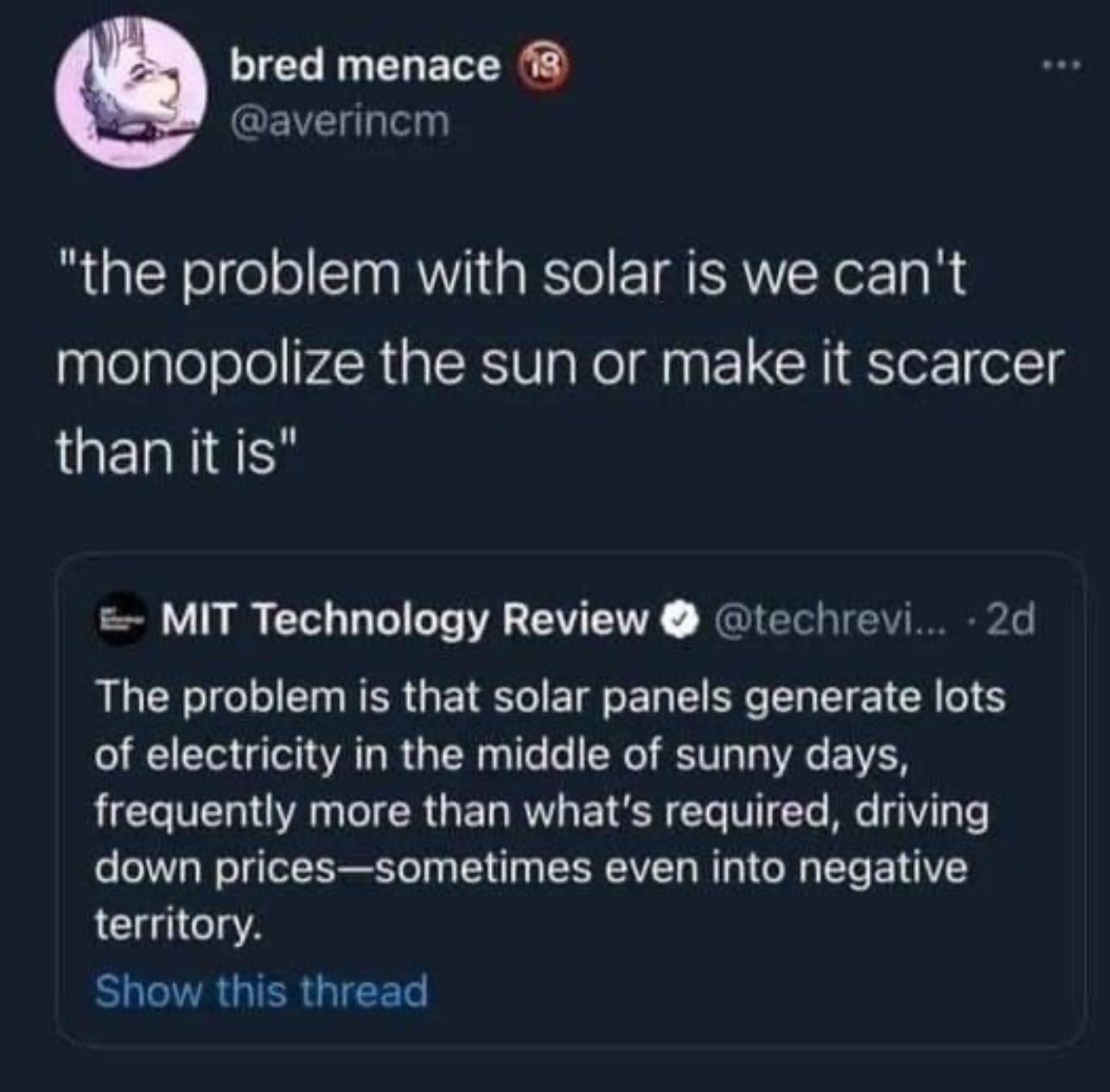
This is what gets me. Relative efficiency of stuff is pretty much nullified when the energy used is free. Total power use still matters because it will determine the total size of the array of solar panels to generate the power needed.
But this is near and dear to my heart. I like hydrogen as energy storage. If you burn it, you get water. Natural gas is just CH4, so the output of burning it is 1CO2 + 2H2O. But a lot of natural gas stuff can also use hydrogen with little modification, so we don't have to upend entire industries to adapt. Machines can be updated to use the new fuel type with little expense and we're not throwing out entire production lines to replace them with ones based on electricity.
Why hydrogen? Simple, hydrolysis. Using power generated for free from the sun, you can split water into its base components. Hydrogen and oxygen. With some fancy knowledge, you can capture pretty much all of the hydrogen and none of the oxygen, and store it for use.
It's inefficient compared to some other technologies, in that it takes a lot of power compared to how much hydrogen/oxygen you get, but bluntly, if it's coming from solar, who cares? Not like we're paying for the power anyways.
I keep thinking about this in the form of industry. Say a factory uses natural gas in boilers to make something hot. Whatever the material, whatever the reason, that's what they're doing. With little modification, the system can be adapted to hydrogen, and the company can build a hydrogen hydrolysis reactor on site using either city water, rain water, lake or river water.... Even an underground well. The reactor runs all day and generates hydrogen, stored in a large, high pressure tank, also on site, then pipelines run it to the machines, boilers, whatever, to run the production lines. It's free to run, and only requires a single capital investment.
Hydrogen, also, can be stored indefinitely and not "lose charge" unlike other, battery-based storage systems (or heat, or flywheels). So hydrogen is ideal for long term energy storage. Fuel cells are still the most efficient way to convert hydrogen to electricity, and yeah, you lose a lot of potential energy in the electrolysis/fuel cell conversions, but the energy input is free in the first place, so who cares?
I'm not saying we should go all in on hydrogen. I'm just saying that it's worth continuing to develop the technology for it. Batteries, capacitors, storage via heat or flywheels, they all have their place in the energy future. At least until fusion makes them all obsolete (once we find a way to make that self fueling or use materials that are not extremely limited. IMO, we're making good progress but we're decades, if not centuries away from something practical, given our currently known planetary resources).
And yes, battery EVs are a good thing. Hydrogen electric vehicles... Let's just say "too soon", and leave it at that. Batteries for daily charge/discharge for home use, absolutely. Larger scale heat/flywheel storage, absolutely. But longer term than days to months, hydrogen may be the better option. It's certainly a good option for industry that currently relies almost exclusively on natural gas.