Why YSK: These email tips are helpful for people who struggle with boundaries and want to communicate more assertively.
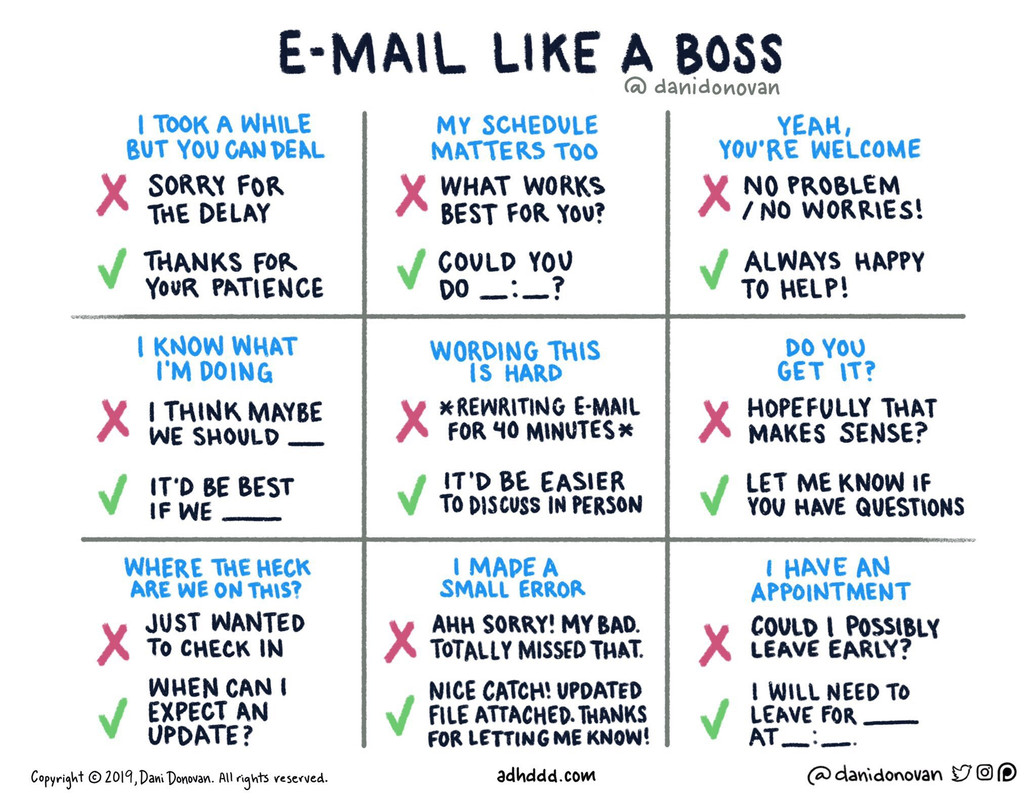
Why YSK: These email tips are helpful for people who struggle with boundaries and want to communicate more assertively.
Some of these are good, some are just needlessly assertive nonsense. Especially the two where it's actively refusing to acknowledge fault or apologize for it, which is standard PR crap. Refusing to apologize and instead saying "thanks for your patience" is what I expect to hear from my ISP when they miss their scheduled install, not from a coworker.
There's nothing wrong with being a normal human being that is capable of admitting their own shortcomings. If never saying sorry means "being a boss" then that explains why there's so many sociopaths as CEOs.
"Hope that make sense?" Vs "Let me know if you have any questions."
The latter is saying "here's the explanation, figure it out, bother me again if you can't". The fromer, while poorly worded, is being helpful, actively attempting to make sure the person understands before leaving them to it. It's both a kindness and doing your due diligence.
My personal ones for corporate use:
Never use I when you can use we.
Even if you're the only one working on a project, never refer to it as yours. Always refer to it as ours.
Don't apologize, present solutions.
Don't say "read my fucking email again you goddamn illiterate moron", say "As previously noted in our communications...."
To be honest, I find most of these passive aggressive and patronizing.
Half of it is fragile CEO ego reply
"When can I expect an update" makes you sound like a micro managing POS
God I hate forced formality like this. This is the kind of shit Gen Z and millennials are rebelling against and I'm all for it. It is stupid for us to encourage people to be themselves and then to expect them to act like a completely different person at work, including the way they talk.
"It'd be easier to discuss in person" means "I don't want a record of this because it's either illegal or shows my incompetence".
Any meeting that they want to talk about in writing should ALWAYS be recorded.
YSK, the person that embraces all of these, as written, is RIGHTFULLY perceived as an assholes by their peers.
I greatly prefer some of the "wrong" ones. Not everyone needs to talk like a corporate robot.
I think it definitely depends on your relationship with the recipient. While I do think most of those are better options, I wouldn’t say they’re necessarily what you should write.
All of these are really good examples of writing a good email, except the bottom left one.
The "wrong" example is perfectly fine, and the "correct" example is pretty rude unless you're a project manager addressing your team. Even if you were a project manager, it's still pretty rude.
In a good workplace, none of these fucking matter...
Take those tips with a grain of salt, as this sort of conventional politeness strategy is heavily dependent on culture, situation, and sometimes even individual*.
I predict that those tips would work poorly with people from cultures where negative politeness ("don't burden the others") is valued over positive politeness ("show appreciation towards the others"). This is fairly common in East Asia for example, but even here in Latin America I got a few people rolling their eyes at "biztalk" like "obrigado pela paciência" (thank you for the patience) over a simple apology.
In special, I can picture the centre advice rubbing a lot of people the wrong way, as it's basically the writer lifting a burden from one's own shoulders (struggling to word something) by creating a burden to the reader ("I expect you to be available offline for a meeting").
*if anyone wants to dig deeper into this subject, check Penelope Brown and Stephen Levinson's Politeness: Some Universals in Language Usage. It's a bit of a technical read for Linguistics (more specifically Pragmatics), but I got plenty laymen who love the book.
For me personally, receiving a ‘just wanted to check in’ feels less aggressive than ‘when can I expect an update’
Otherwise I agree with the rest
Some of those "wrong" ones would be fine for instant messages like Slack or Teams.
Its not that simple. Its ok to apologize sometimes. But not so apologize every fucking time like I do for every minor slide. Also I can see the usefulness to just make the shot call instead of staying 1h writing that message/email. Others are ok too.
I'd never say 'always happy to help' because sometimes I'm actually not, particularly if a client is a pain and badgers me constantly. I don't want to invite more interruption
It’d be easier to discuss in person
Hold on, hold on, they must have put something crazy in the coffee this morning
Some of these are great. “Could you do” takes the burden off the other person to propose something initially, and suggests respect for their time. “I will need to leave for” begs forgiveness rather than asks permissions, and since you are communicating it, it gives others the opportunity to correct your decision. These are examples of saving everyone time while still communicating them. Being too nice can be a time waste, like saying hello and then waiting for a response before asking your question.
Some of these take away the autonomy of the other person though, and that’s shitty. “When can I expect an update?” is one of those. It would be better to express this in terms of what you need and why, like “I am reporting to X person at noon tomorrow on this, could you give me an update before then?”
Of course, whether you say “just checking in” or “when can I expect…”, if you have no good reason (micromanaging is not a good reason) for checking in then you’re just being an asshole.
The thank you for your patience one has always rubbed me wrong. There's honor in apologizing in my opinion. I do like the making a mistake one though and I've tried to adopt that mentality when I'm working with QA on something I've merged. I want them to feel good about finding the mistakes and I want to avoid an adversarial relationship. I've learned that I get way better tickets from QA if they like how I treat them. Treat them like valuable experts and they'll act like valuable experts.
Non-native speaker here. What are the disadvantages of being straightforward? In my native language, it is considered more efficient and polite to be to the point. I have worked with Americans in the past, and I have noticed that they are not straightforward.
Improving my work emails is 99% of what I use ChatGPT for.
Nobody really wants to spend time reading long emails at work. Make it short, direct, and polite works best.
I have very mixed feelings about this. I feel personally attacked, but also might reference this moving forward
I never open email. Work is so much easier.
Yeah, I can tell why this is from adhddd.com, it's all about assertiveness. People with ADHD in general (including myself, to an extent) have trouble with being assertive, so most of the phrases in this chart try to change a meek or mild-mannered response to a more assertive one. I think part of the struggle of life is finding balance because while some of these are generally improvements, others are generally worse, and the difference will depend on the tone you're going for and the person that you're sending the email.
While most of these are a good rule of thumb, I disagree with 'Always Happy to Help.' > 'No Problem.'
'I'm Always Happy to Help' is a fine response, if you're actually willing to make your time available for the recipient at the drop of a hat. Sometimes that's called for, but I would only reserve it for a few very specific circumstances. I also don't see an issue with saying 'no problem' most of the time. There are situations where something a little more formal is called for, but 90% of the time 'no problem' should work imho.
Some of these come across dickish
top 50 comments