top 50 comments

sorted by: hot top controversial new old
[–] 107 points 2 years ago (18 children)

Yeah only 2 generations ago, LGBT people were considered mentally ill. 4 generations ago women were considered unfit to vote. 8 generations ago about half the US though it was OK to own slaves. It takes a while for ideas to die out. That's why US elections turn out the way they do.

  • source
  • hideshow 18 child comments
  • [–] 38 points 2 years ago (1 child)

    Humanity isn't progressing uniformly forward like this. Lgbtqia+ people were considered normal part of society by various cultures. Also Magnus Hirschfeld was an advocate for lgbtqia+ people a hundred years ago. Slavery has been transformed into modern slavery because the western world has found other, more concealed ways to force people into labor. Ideas may die out, but they will pop into people's head again and again.

  • source
  • parent
  • hideshow 1 child comment
  • [–] 14 points 2 years ago*

    And yet discussing progress in this manner can be a confort. All that you said was true... But what the person you replied said was also true. Two generations since fertilizer or two generations since we locked in Malthusian anarchy[please note I do not espouse Malthusianism]. Three generations since the worst war known to man and three generations that did not experience that kind of war. Glass half full, glass half empty. It's correct to question the myth of unstoppable progress thru which you can just kick your feet up and relax. But equally is it important to keep perspective remember that, yeah, eight generations ago chattel slavery was a bonafide institution and four generations women were unfranchised. Things get better and they get worse. We make progress and it is wiped away. We still keep trying.

  • source
  • parent
  • [–] 24 points 2 years ago (14 children)

    Two steps forward. One step back

  • source
  • parent
  • hideshow 14 child comments
  • [–] 22 points 2 years ago* (12 children)

    Wonder how long it'll take before we get to step forward again. As far as I'm seeing, we're in for a long ride back. Not just for 4 years.

  • source
  • parent
  • hideshow 12 child comments
  • [–] 13 points 2 years ago* (6 children)

    The American people are pretty fickle. It won't take long for them to become unhappy with the Republican party. Of course once that happens and you and I are celebrating "Yay! We got rid of the fascists!" they'll be going "Hmm... These other guys are pretty uninspiring. Maybe we should try fascism again."

    * There's a big asterisk here that this is all predicted on elections continuing unabated. Which is not a given.

  • source
  • parent
  • hideshow 6 child comments
  • load more comments (6 replies)
  • load more comments (3 replies)
  • load more comments (1 reply)
    [–] 87 points 2 years ago (15 children)

    The lengths Americans will go to in order not to use the metric system is insane.

  • source
  • hideshow 15 child comments
  • [–] 24 points 2 years ago (12 children)

    I am interested in learning about this metric time.

  • source
  • parent
  • hideshow 12 child comments
  • [–] 8 points 2 years ago

    The French tried to impose "metric" time way back in the day. Even they learned that was a bad idea and quietly dropped it. The solar system seems to prefer it's base12 time.

    I think it maybe helped give rise the the saying: "The French follow no one. And no one follows the French."

  • source
  • parent
  • [–] 72 points 2 years ago (28 children)

    That’s not a well-founded assumption. The average age of first birth was only 21 as recently as 1970. Go back a few hundred years and it’s way younger than that. Many women throughout history became mothers as soon as they were able (right after the onset of puberty). Many cultures had rites of passage into adulthood for boys and girls of that age. There was no such thing as adolescence.

  • source
  • hideshow 28 child comments
  • [–] 55 points 2 years ago (18 children)

    In Western Europe at least back to the early medieval period it was common for anyone who wasn’t nobility to have their first child around 22. The younger you are the more likely you’re going to have serious (fatal, back then) complications. It was the nobility that was marrying off barely pubescent kids.

  • source
  • parent
  • hideshow 18 child comments
  • load more comments (16 replies)
  • [–] 34 points 2 years ago (2 children)

    As the other commentator says, medieval Europe was mostly early twenties. Studies of stone age remains suggest a first birth age average of 19.5 and contemporary hunter gather societies have a comparable average. Sexual activity generally begins earlier, during adolescence, but the most "reproductively successful" age for beginning childbearing has been shown to be around 18-19. Also, this age at first birth isnt "Average age of a child's mother" as many women would have multiple kids over their life, so the average sibling would have a much older mother at birth than the firstborn.

    Its important to remember that puberty has shifted massively since industrialisation, "menarche age has receded from 16.5 years in 1880 to the current 12.5 years in western societies". So the post-puberty fecundity peak, that use to happen 17-19, when women are fully grown enough to minimise birth complications, now happens at a disressingly young 13-15. Not only is this a big social yuck for most western societies, but it's reproductively unideal, because of the complications linked to childbirth at that age.

  • source
  • parent
  • hideshow 2 child comments
  • load more comments (2 replies)
    [–] 48 points 2 years ago (2 children)

    This is framed like 80 generations is a small number, but that's huge. Culture and civilization moves so quickly that even 3 generations ago life is barely recognisable. I can't even imagine what life was like 40 generations ago.

  • source
  • hideshow 2 child comments
  • [–] 36 points 2 years ago (1 child)

    Many people don't realize that the amount of change our culture goes through in a lifetime is unfathomable historically. Before the 1800s it took a good decade for news to truly travel around to everyone in a region, and that was considered timely if it happened at all. Farming, hunting, homemaking, war, stayed exactly the same for dozens of years at a time and changes were usually made abruptly due to conflict before stagnating again.

  • source
  • parent
  • hideshow 1 child comment
  • load more comments (1 reply)
  • [–] 34 points 2 years ago* (6 children)

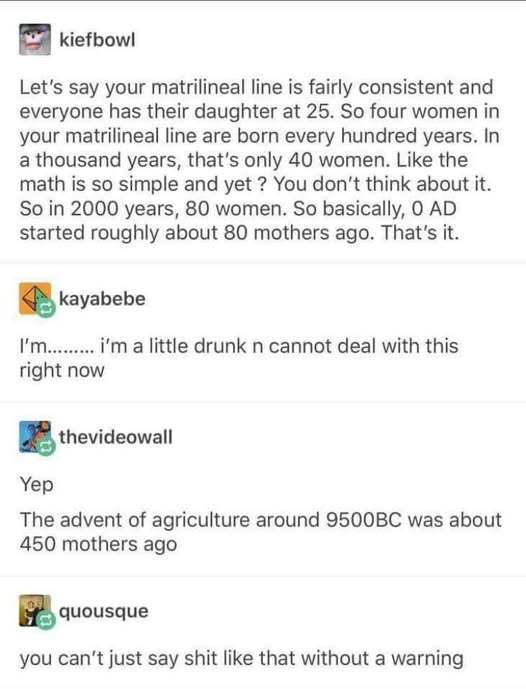
    25 is too old for most mothers the farther back you go.

  • source
  • hideshow 6 child comments
  • [–] 13 points 2 years ago (3 children)
  • [–] 13 points 2 years ago (2 children)

    So from your article, it seems to say the opposite

    The female average age of conception is 23.2, AND this includes a recent rise, so it would be even lower than that when considering older times

    Also, it's unclear if the average also accounts for the fact that there is are significantly more child being given birth to in the very recent past, which would skew the number way up

  • source
  • parent
  • hideshow 2 child comments
  • [–] 10 points 2 years ago

    Every time I see people argue this I always wanna ask, are you considering that people don't stop having kids after 1 or 2? I'd wager that most women had the majority of their kids around that 23ish mark when you include that lady who had 10 kids from 15 to 35

  • source
  • parent
  • load more comments (1 reply)
  • [–] 23 points 2 years ago (3 children)

    I knew my great-grandmother, few people do. My great-great-grandmother is an ancient picture on the wall of my dead grandmother's house, from a time when photography was new, a scant few years past daguerreotypes.

    4 mothers back is all I can summon, only remember 3.

  • source
  • hideshow 3 child comments
  • [–] 7 points 2 years ago

    I knew two of my great grandmothers (yay for really young parents!). I know I met two others but didn't really know them.

    I was told that I met my great great grandmother once when I was a toddler but I don't remember it. She died at age 99.

  • source
  • parent
  • [–] 23 points 2 years ago (2 children)

    Depending on the religion, yes. Otherwise it‘s 12 years per mother, 14 if you’re late.

  • source
  • hideshow 2 child comments
  • That's also assuming you're the first born of the first born of the first born, and so on. And the further back you go, the more individual kids the average mother is likely to have. After all, you had to have like 12 kids just so 3 of them would make it past 9.

    So your greatx12 grandmother might've started having kids at 15, but she still might not have had your ancestor till years later.

  • source
  • parent
  • [–] 21 points 2 years ago (1 child)
  • [–] 20 points 2 years ago

    I was thinking that it's now 81 mothers ago, but then I got distracted by the fact that there was no year 0AD and now I'm thinking that roughly 80 is good enough.

  • source
  • [–] 13 points 2 years ago (4 children)

    And if everyone of your ancestors was unique (so no inbreeding) 80 mothers ago there would had to be 2^80^ = more than 1.2 septillion people on the planet

  • source
  • hideshow 4 child comments
  • load more comments (2 replies)
    [–] 12 points 2 years ago

    Let's push it one step further and frame history since agriculture, 9500 years ago, against the upper limit of a human lifetime now, about 100 years. This would mean recorded times started only less than 100 human lifespans ago. Bleh

  • source
  • [–] 9 points 2 years ago

    Do we have a community for genealogy?

  • source
  • [–] 6 points 2 years ago

    Some of my ancestors came to the United States on the Mayflower and that was only like 8 or 9 mothers ago.

  • source
  • [–] 5 points 2 years ago

    So that's about 13,000 homo sapiens mothers?

  • source
  • [+] 5 points 2 years ago* (last edited 2 years ago)
    [removed by mod]
  • source
  • [–] 5 points 2 years ago* (3 children)

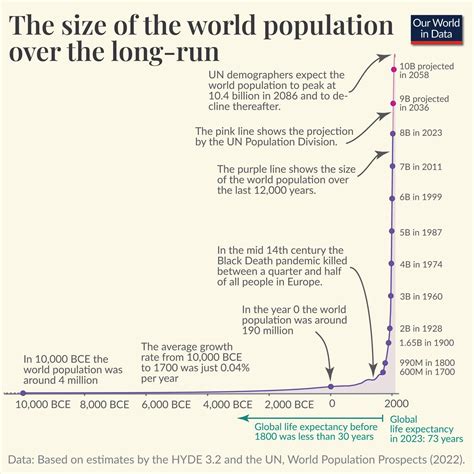
    Yes also this diagram:

    Gives you a clear sense of how quickly things are turning.

    In a geological sense, all of humanity isn't even a heartbeat.

  • source
  • hideshow 3 child comments
  • load more comments (3 replies)
    load more comments
    view more: next ›