top 50 comments

sorted by: hot top controversial new old
[–] 351 points 2 years ago (3 children)

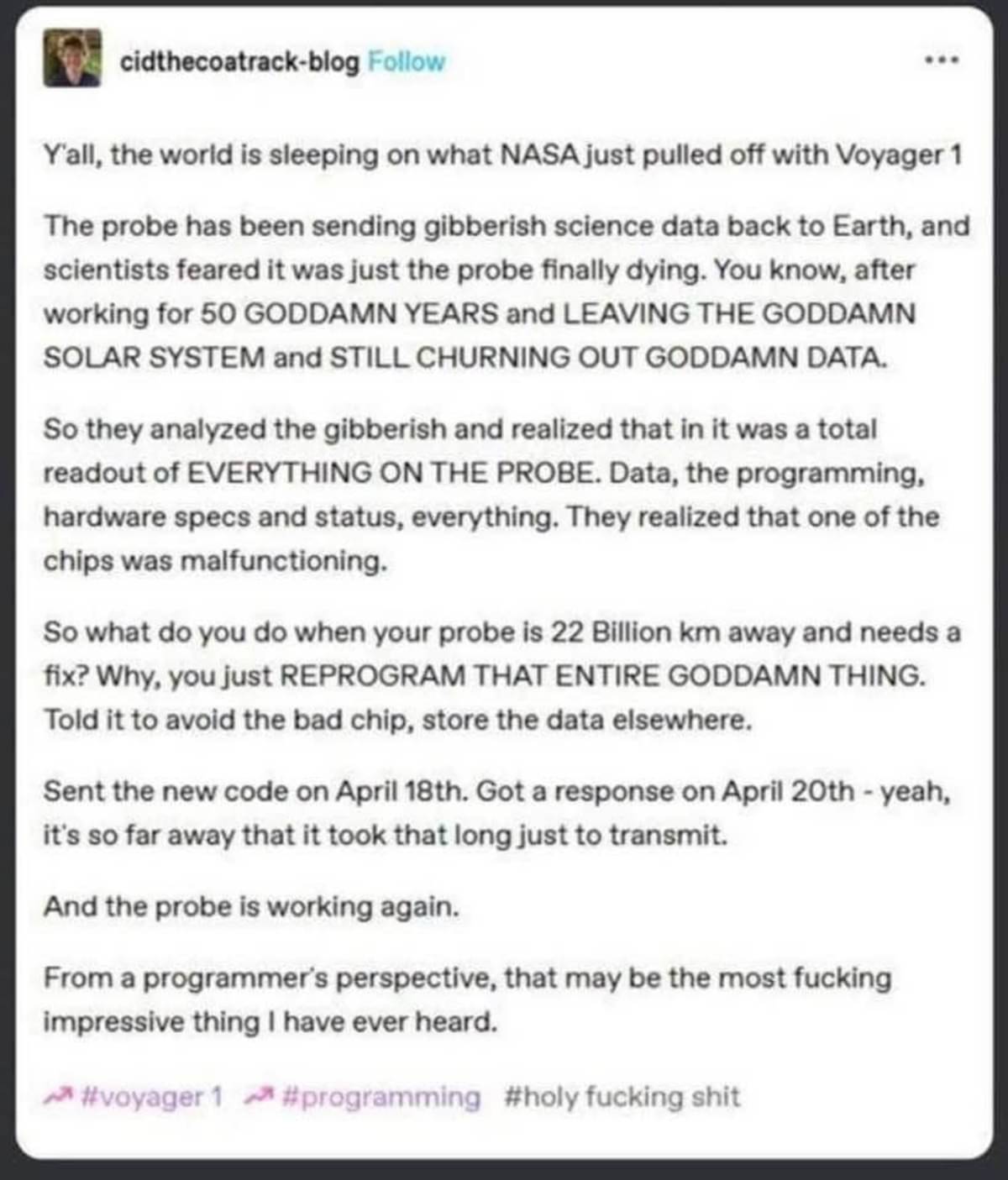
I still cannot believe NASA managed to re-establish a connection with Voyager 1.

That scene from The Martian where JPL had a hardware copy of Pathfinder on Earth? That’s not apocryphal. NASA keeps a lot of engineering models around for a variety of purposes including this sort of hardware troubleshooting.

It’s a practice they started after Voyager. They shot that patch off into space based off of old documentation, blueprints, and internal memos.

  • source
  • hideshow 6 child comments
  • [–] 189 points 2 years ago (2 children)

    Imagine scrolling back in the Slack chat 50 years to find that one thing someone said about how the chip bypass worked.

  • source
  • parent
  • hideshow 3 child comments
  • [–] 99 points 2 years ago (17 children)

    Imagine any internet company lasting 50 years.

  • source
  • parent
  • hideshow 18 child comments
  • load more comments (16 replies)
  • load more comments (1 reply)
  • [–] 37 points 2 years ago (3 children)

    To add to the metal, the blueprints include the blueprints for the processor.

    https://hackaday.com/2024/05/06/the-computers-of-voyager/

    They don't use a microprocessor like anything today would, but a pile of chips that provide things like logic gates and counters. A grown up version of https://gigatron.io/

    That means "written in assembly" means "written in a bespoke assembly dialect that we maybe didn't document very well, or the hardware it ran on, which was also bespoke".

  • source
  • parent
  • hideshow 3 child comments
  • load more comments (3 replies)
  • [–] 27 points 2 years ago (6 children)

    I realize the Voyager project may not be super well funded today (how is it funded, just general NASA funds now?), just wondering what they have hardware-wise (or ever had). Certainly the Voyager system had to have precursors (versions)?

    Or do they have a simulator of it today - we're talking about early 70's hardware, should be fairly straightforward to replicate in software? Perhaps some independent geeks have done this for fun? (I've read of some old hardware such as 8088 being replicated in software because some geeks just like doing things like that).

    I have no idea how NASA functions with old projects like this, and I'm surely not saying I have better ideas - they've probably thought of a million more ways to validate what they're doing.

  • source
  • parent
  • hideshow 7 child comments
  • load more comments (5 replies)
  • [–] 263 points 2 years ago (7 children)

    To me, the physics of the situation makes this all the more impressive.

    Voyager has a 23 watt radio. That's about 10x as much power as a cell phone's radio, but it's still small. Voyager is so far away it takes 22.5 hours for the signal to get to earth traveling at light speed. This is a radio beam, not a laser, but it's extraordinarily tight beam for a radio, with the focus only 0.5 degrees wide, but that means it's still 1000x wider than the earth when it arrives. It's being received by some of the biggest antennas ever made, but they're still only 70m wide, so each one only receives a tiny fraction of the power the power transmitted. So, they're decoding a signal that's 10^-18 watts.

    So, not only are you debugging a system created half a century ago without being able to see or touch it, you're doing it with a 2-day delay to see what your changes do, and using the most absurdly powerful radios just to send signals.

    The computer side of things is also even more impressive than this makes it sound. A memory chip failed. On Earth, you'd probably try to figure that out by physically looking at the hardware, and then probing it with a multimeter or an oscilloscope or something. They couldn't do that. They had to debug it by watching the program as it ran and as it tried to use this faulty memory chip and failed in interesting ways. They could interact with it, but only on a 2 day delay. They also had to know that any wrong move and the little control they had over it could fail and it would be fully dead.

    So, a malfunctioning computer that you can only interact with at 40 bits per second, that takes 2 full days between every send and receive, that has flaky hardware and was designed more than 50 years ago.

  • source
  • hideshow 9 child comments
  • [–] 70 points 2 years ago (3 children)

    Finally I can put some take into this. I've worked in memory testing for years and I'll tell you that it's actually pretty expected for a memory cell to fail after some time. So much so that what we typically do is build in redundancy into the memory cells. We add more memory cells than we might activate at any given time. When shit goes awry, we can reprogram the memory controller to remap the used memory cells so that the bad cells are mapped out and unused ones are mapped in. We don't probe memory cells typically unless we're doing some type of in depth failure analysis. usually we just run a series of algorithms that test each cell and identify which ones aren't responding correctly, then map those out.

    None of this is to diminish the engineering challenges that they faced, just to help give an appreciation for the technical mechanisms we've improved over the last few decades

  • source
  • parent
  • hideshow 3 child comments
  • load more comments (3 replies)
  • load more comments (5 replies)
    [–] 186 points 2 years ago (7 children)

    Still faster than the average Windows update.

  • source
  • hideshow 10 child comments
  • [–] 28 points 2 years ago (1 child)

    NASA should be in charge of Windows updates!

  • source
  • parent
  • hideshow 2 child comments
  • load more comments (4 replies)
    [–] 136 points 2 years ago (1 child)

    Interviewer: Tell me an interesting debugging story

    Interviewee: ...

  • source
  • hideshow 1 child comment
  • load more comments (1 reply)
    [–] 129 points 2 years ago* (1 child)

    It's hard to explain how significant the Voyager 1 probe is in terms of human history. Scientists knew as they were building it that they were making something that would have a significant impact on humanity. It's the first man made object to leave the heliosphere and properly enter the interstellar medium, and this was always just a secondary goal of the probe. It was primarily intended to explore the gas giants, especially the Jovian lunar system. It did its job perfectly and gave us so many scientific discoveries just within our solar system.

    And I think there's something sobering about the image of it going on a long, endless road trip into the galactic ether with no destination. It's a pretty amazing way to retire. The fact that even today we get scientific data from Voyager, that so far away we can still communicate with it and control it, is an unbelievable achievement of human ingenuity and scientific progress. If you've never seen the image the Pale Blue Dot you should see it. That linked picture is a revised version of the image made by Nasa and released in 2020. It's part of a group of the last pictures ever taken by Voyager 1 on February 14th 1990, a picture of Earth from 6 billion kilometers away. It's one of my favorite pictures, and it kinda blows my mind every time I see it.

  • source
  • hideshow 2 child comments
  • [–] 113 points 2 years ago (1 child)

    I think the term "metal" is overused, but this is probably the most metal thing a programmer could possibly do besides join a metal band.

  • source
  • hideshow 1 child comment
  • load more comments (1 reply)
    [–] 98 points 2 years ago

    I was already impressed when they managed to diagnose a single bit flip a few years ago.

  • source
  • [–] 96 points 2 years ago (1 child)

    Keep in mind too these guys are writing and reading in like assembly or some precursor to it.

    I can only imagine the number of checks and rechecks they probably go through before they press the "send" button. Especially now.

    This is nothing like my loosey goosey programming where I just hit compile or download and just wait to see if my change works the way I expect...

  • source
  • hideshow 2 child comments
  • [–] 68 points 2 years ago (1 child)

    Man I can’t even get my stupid Azure deployment to work and that’s only in Germany.

  • source
  • hideshow 2 child comments
  • [–] 68 points 2 years ago

    Rejected : please comment your changes

  • source
  • [–] 65 points 2 years ago (6 children)

    I wont even upgrade the BIOS on my motherboard because im afraid of bricking it.

  • source
  • hideshow 7 child comments
  • load more comments (5 replies)
    [–] 56 points 2 years ago (1 child)

    Why do Tumblr users approach every topic like a manic street preacher?

  • source
  • hideshow 2 child comments
  • [–] 53 points 2 years ago

    When I hear what they did, I was blown away. A 50 year old computer (that was probably designed a decade before launching) and the geniuses that built that put in the facility to completely reprogram it a light-day away.

  • source
  • [–] 53 points 2 years ago (8 children)

    My understanding is that they sent V'Ger a command to do "something," and then the gibberish it was sending changed, and that was the "here's everything" signal.

    And yeah, I'm calling it V'Ger from now on.

  • source
  • hideshow 9 child comments
  • load more comments (7 replies)
    [–] 50 points 2 years ago (3 children)
    load more comments (3 replies)
    [–] 45 points 2 years ago (4 children)

    People always underestimate the high level NASA works at. Everyone bitches and moans, especially Musk simps, about how long SLS took to make and its expense, but it worked right the first time. In the case of the Voyager spacecraft, they are working with tech so old, all the original engineers are retired or dead. NASA rocks.

  • source
  • hideshow 4 child comments
  • load more comments (4 replies)
    [–] 38 points 2 years ago* (3 children)

    OTS flashing.

    Like OTA but with space rather than air.

  • source
  • hideshow 3 child comments
  • load more comments (3 replies)
    [–] 32 points 2 years ago* (6 children)

    I wonder how it is secured, or could anyone with a big enough transmitter reprogram it at will...

  • source
  • hideshow 8 child comments
  • [–] 68 points 2 years ago* (last edited 2 years ago) (2 children)

    Modern satellites are protected by various means of encryption, but there’s an enthusiast community that tracks down and communicates with very old unencrypted zombie satellites. There’s even been an NGO which managed to fire rockets on an abandoned NASA/ESA probe (with their approval.)

    The Voyagers benefits primarily from the lack of groups with an adequate deep space network to communicate with it. Their communication standards are otherwise completely open and well documented.

  • source
  • parent
  • hideshow 3 child comments
  • load more comments (1 reply)
  • [–] 41 points 2 years ago (1 child)

    I think the security is adequately managed by the need for a massive transmitter as well as the question "what is there to gain via a hostile takeover and re-programming the probe?"

    I bet there's actual security of some kind going on, but those two points seem like a massive hurdle to clear just to mess with a deep space probe.

  • source
  • parent
  • hideshow 2 child comments
  • load more comments (4 replies)
    [–] 29 points 2 years ago (2 children)

    I just have to imagine how interesting of a challenege that is. Kinda like when old games only had 300kb to store all their data on so you had to program cool tricks to get it all to work.

  • source
  • hideshow 2 child comments
  • load more comments (2 replies)
    [–] 26 points 2 years ago

    Fuck it, we'll fix it live

  • source
  • [–] 25 points 2 years ago

    It reminds me that there are still very intelligent and talented people within our ranks. A nice breath of fresh air.

  • source
  • load more comments
    view more: next ›