you are viewing a single comment's thread
view the rest of the comments
[–] 351 points 2 years ago (45 children)

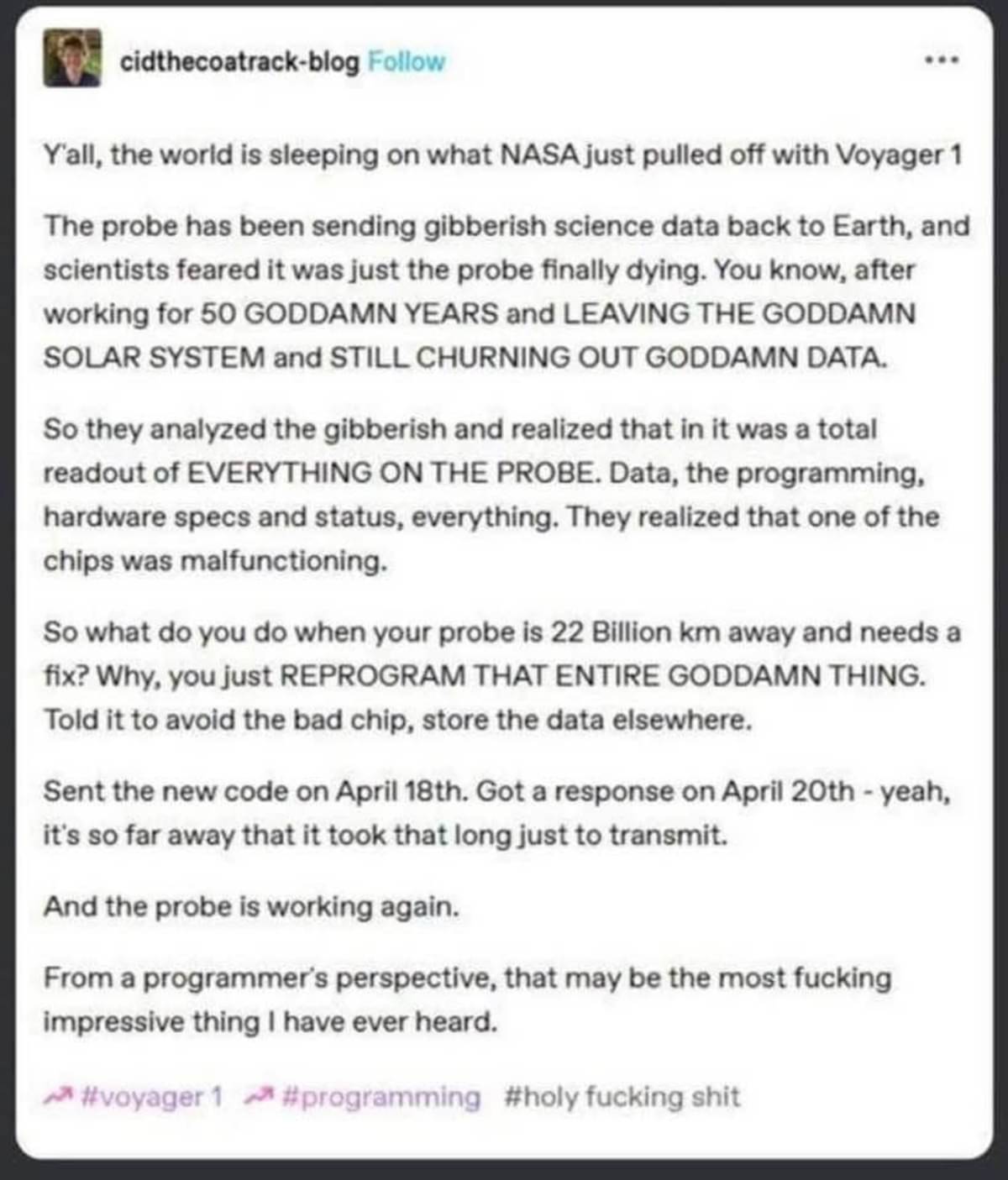
I still cannot believe NASA managed to re-establish a connection with Voyager 1.

That scene from The Martian where JPL had a hardware copy of Pathfinder on Earth? That’s not apocryphal. NASA keeps a lot of engineering models around for a variety of purposes including this sort of hardware troubleshooting.

It’s a practice they started after Voyager. They shot that patch off into space based off of old documentation, blueprints, and internal memos.

  • source
  • hideshow 45 child comments
  • [–] 189 points 2 years ago (27 children)

    Imagine scrolling back in the Slack chat 50 years to find that one thing someone said about how the chip bypass worked.

  • source
  • parent
  • hideshow 27 child comments
  • [–] 99 points 2 years ago (25 children)

    Imagine any internet company lasting 50 years.

  • source
  • parent
  • hideshow 25 child comments
  • [–] 60 points 2 years ago (8 children)

    This is why slack is bullshit. And discord. We should all go back to email. It can be stored and archived and organized and get off my lawn.

  • source
  • parent
  • hideshow 8 child comments
  • [–] 19 points 2 years ago (1 child)

    I mean, unironically, yeah.

    It's not even that we need to go back to email. The problem isn't moving on from outdated forms of communication, it's that the technology being pushed as a replacement for it is throwing out the baby with the bathwater.

    Which is to say nothing of the fact that all of these new platforms are proprietary, walled off, and in some cases don't make controlling the data easy if you're not hosting it (and their searches are trash).

  • source
  • parent
  • hideshow 1 child comment
  • [–] 7 points 2 years ago*

    all of these new platforms are proprietary, walled off, and in some cases don’t make controlling the data easy if you’re not hosting it

    You’ve just discovered their business case. So many new businesses these days only insinuate themselves into an existing process in order to co-opt it and charge rents.

  • source
  • parent
  • [–] 18 points 2 years ago (3 children)

    It's not Slack's fault. It is a good platform for one-off messages. Need a useless bureaucratic form signed? Slack. Need your boss to okay the afternoon off? Slack. Need to ask your lead programmer which data structure you should use and why they're set up that way? Sounds like the answer should be put in a wiki page, not slack.

    All workflows are small components of a larger workplace. Emails also suck for a lot of things. They probably wouldn't have worked in this case, memos are the logical upgrade from emails where you want to make sure everyone receives it and the topic is not up for further discussion.

  • source
  • parent
  • hideshow 3 child comments
  • [–] 0 points 2 years ago

    memos are the logical upgrade from emails where you want to make sure everyone receives it

    uh, email is memos? email is so memos that ibm's proprietary email management solution Lotus Notes calls the transaction "create memo" where outlook calls it "new message".

    and the topic is not up for further discussion.

    bit rude, imo.

  • source
  • parent
  • [–] 23 points 2 years ago (9 children)
  • [–] 20 points 2 years ago (5 children)

    Yeah. Technically I'm not talking about Microsoft, as their primary product is the OS and they are not purely Internet-based. IBM, of course, is much older than that and also has some Internet products, as does every software company.

    In my statement "Internet company" means a company whose only product is SaaS on the Internet; i.e. someone who, if they went away, their product would disappear with them.

  • source
  • parent
  • hideshow 5 child comments
  • [–] 10 points 2 years ago* (last edited 2 years ago) (4 children)

    I guess it is hard to imagine an internet company lasting that long mostly because the hasn't been around that long, it's only been 31 years since it went public. A year later Amazon was formed. I would bet money Amazon and Google easily make it to 50. Along with many many others. A small, not overly commercialized company like slack would be crazy. I wouldn't be surprised if they get gobbled up by a mega Corp as the enshitification continues.

  • source
  • parent
  • hideshow 4 child comments
  • [–] 10 points 2 years ago (2 children)

    Google is actually the sine qua non of what I'm talking about. I'll concede that it's possible Google as a corporate entity will still exist in 2048 (it was founded in 1998). But Google has undergone such a drastic and dystopian management change that it's almost not even the same company now--

    --but that isn't relevant to what I'm actually talking about, which is the products. The proposition that Slack logs would still be around 50 years from now was what catalyzed my quip. Google kills everything it makes, usually quickly. Will we be able to look at Google Reader logs in 2048? Or--even closer to the target--Google Wave logs? Google Podcasts? Google Stadia? (I could go on.)

    At the end of the day it was just a quip, but I fully expect the SaaS companies you currently think of as indestructible titans to be on the dustheap of history in 20 years, let alone 50.

  • source
  • parent
  • hideshow 2 child comments
  • [–] 6 points 2 years ago (5 children)

    IBM is 100, but the Internet didn't exist in 1924, so we'll say the clock starts in 1989. I'm pretty sure at least MS or IBM will be around in 15 years.

  • source
  • parent
  • hideshow 5 child comments
  • [–] 5 points 2 years ago (4 children)

    What does IBM even do anymore? I’m guessing they just support all of their legacy products that customers are locked into.

  • source
  • parent
  • hideshow 4 child comments
  • [–] 3 points 2 years ago (2 children)

    It's basically an investment fund that runs the companies it invests in, like Alphabet, but with a bigger mix of real estate and finance investments thrown in.

  • source
  • parent
  • hideshow 2 child comments
  • [–] 37 points 2 years ago (3 children)

    To add to the metal, the blueprints include the blueprints for the processor.

    https://hackaday.com/2024/05/06/the-computers-of-voyager/

    They don't use a microprocessor like anything today would, but a pile of chips that provide things like logic gates and counters. A grown up version of https://gigatron.io/

    That means "written in assembly" means "written in a bespoke assembly dialect that we maybe didn't document very well, or the hardware it ran on, which was also bespoke".

  • source
  • parent
  • hideshow 3 child comments
  • [–] 23 points 2 years ago (2 children)

    They also released the source code of the Apollo 11 guidance computer. So if you want to fly to the moon, here is one part of how to do it.

  • source
  • parent
  • hideshow 2 child comments
  • [–] 27 points 2 years ago (12 children)

    I realize the Voyager project may not be super well funded today (how is it funded, just general NASA funds now?), just wondering what they have hardware-wise (or ever had). Certainly the Voyager system had to have precursors (versions)?

    Or do they have a simulator of it today - we're talking about early 70's hardware, should be fairly straightforward to replicate in software? Perhaps some independent geeks have done this for fun? (I've read of some old hardware such as 8088 being replicated in software because some geeks just like doing things like that).

    I have no idea how NASA functions with old projects like this, and I'm surely not saying I have better ideas - they've probably thought of a million more ways to validate what they're doing.

  • source
  • parent
  • hideshow 12 child comments
  • [+] 27 points 2 years ago (6 children)
  • [–] 15 points 2 years ago (2 children)

    You sure? The smell off some of the corpses will have been terrible.

    I'm not saying they're all dead, but an intern at the time of launch would now be 70. Anybody who actually designed anything is... Well... The odds of them still being around are low.

  • source
  • parent
  • hideshow 2 child comments
  • [–] 17 points 2 years ago

    The Hard Fork podcast had a pretty good episode recently where they interviewed one of the engineers on the project. They’d troubleshooted the spacecraft enough in the past that they weren’t starting from square one, but it still sounded pretty difficult.

  • source
  • parent
  • [–] 4 points 2 years ago (1 child)

    100% they've got an emulator, they've had dedicated test environments since the moon landing for emulating disaster recovery scenarios since the moon landings, they've likely got at least one functioning hardware replica and very likely can spin up a hardware emulation as a virtual machine at will.

    Source: I made this up, but I have a good understanding of systems admin and have a interest in space stuff so I'm pretty confident they would have this stuff at bare minimum

  • source
  • parent
  • hideshow 1 child comment
  • [–] 2 points 2 years ago

    That's my assumption too, but we're talking about a different era, and I really have no idea how they approached validation and test/troubleshooting.

    I've seen some test environments for manned missions, but that's really for humans to validate what they're doing.

    V'ger was quick 'n dirty by comparison (with no criticism of the process or folks involved...they had one chance to get these missions out there).

  • source
  • parent