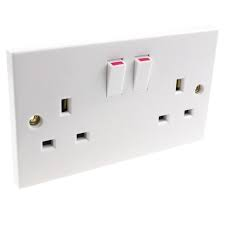
They're like that in this apartment we're renting and I keep seeing them elsewhere. I don't get it.

you are viewing a single comment's thread
view the rest of the comments
[–] 180 points 2 years ago* (last edited 2 years ago) (27 children)

the UK power grid is weird. mostly due to echoes of the war. used to be that, to save copper, the entire house and sometimes multiple houses on a street would be wired as one big loop of wire, no fuse box or anything. that's where the individually fused plugs and switched sockets come from. then, since it turned out to be quite a good idea for safety, they kept doing it.

  • source
  • hideshow 27 child comments
  • [–] 41 points 2 years ago

    This isn't strictly true. Most houses built between WWII and the '90s were built with sockets that didn't have switches on them. It was only later safety regulations / suggestions that made the switches preferable.

    Where I live was built in the late '80s right before switched sockets became more common. All the original sockets have no switch. Some in the kitchen have switches, but it's clear these were added at a later date.

    I'm not sure of the exact rulings and where and when a socket must have a switch, but you can still find switchless sockets for sale at the sorts of retailers who sell those sorts of things, so there are definitely places where those sockets are still allowed.

  • source
  • parent
  • [–] 7 points 2 years ago

    eastern block solution to copper shortages was to wire houses with aluminum instead of copper. this avoided all that bizarre bullshit that brits do, and in principle it's a good idea since aluminum is used for big time power distribution as well. this worked pretty well until it was noticed that under some conditions hot spots can form on connections over time, requiring replacement of connectors. it's still legal to use aluminum wires in some places, but copper is more common now

  • source
  • parent
  • [–] 5 points 2 years ago (8 children)

    So that switch will trip like a breaker?

  • source
  • parent
  • hideshow 8 child comments
  • [–] 26 points 2 years ago* (7 children)

    No - there's fuses in the plugs themselves, the switch is largely for convenience and safety - if you want to unplug something broken and potentially live, it's much safer to switch it off at the wall than risk a shock given the current limit is on the breaker is so high

  • source
  • parent
  • hideshow 7 child comments
  • [–] 6 points 2 years ago (5 children)

    Are folks able to replace the fuses without exposing live parts? I totally get the safety angle.

  • source
  • parent
  • hideshow 5 child comments
  • [–] 24 points 2 years ago (3 children)

    fuse is in plug and accessible only when plug is disconnected

    it's also a very weird thing because fuses are supposed to protect what is downstream of them. so effectively fuse in plug protects cord and appliance only, not the wires in the wall. there's breaker box for this

  • source
  • parent
  • hideshow 3 child comments
  • [–] 1 point 2 years ago (1 child)

    It is safer for the fuse to be in the plug for those people who think they are electricians and end up causing house fires or bzzzt'ing themselves

  • source
  • parent
  • hideshow 1 child comment
  • [–] 4 points 2 years ago (10 children)

    Why are people saying this?

    I've lived in multiple UK houses and never once seen a socket with a fuse. Are you saying this was change way way back in the day?

    All houses have fuse boxes (which then got upgraded to circuit breakers). Not one fuses in sockets. Would be a fucking nightmare to take the socket off and change a fuse.

  • source
  • parent
  • hideshow 10 child comments
  • [–] 8 points 2 years ago* (8 children)

    The fuse is actually in the UK plug (the big brick-like thing with the wire on it), not the socket. But yes, it's a thing, and most of the rest of the world considers it overkill. Also a lot of cheap junky equipment (ironically the stuff where you'd most want the fuse) omits the fuse in the plug, go figure.

  • source
  • parent
  • hideshow 8 child comments
  • [–] 1 point 2 years ago* (7 children)

    Yea I know, I've wired a plug.

    Never seen a fuse in a socket though. That comment is completely wrong and yet it's the most up voted reply.

    Never seen a house without a fuse box either.

  • source
  • parent
  • hideshow 7 child comments
  • [–] 1 point 2 years ago (4 children)

    No fuses in the switch box though, it's a box of circuits breakers

  • source
  • parent
  • hideshow 4 child comments
  • [–] 3 points 2 years ago (1 child)

    The used to be - I had a flat that used an old style fused breaker. Fun times trying to replace a fuse when it had blown...

  • source
  • parent
  • hideshow 1 child comment
  • [–] 3 points 2 years ago

    Lol yeah can only imagine what playing 'hunt the bad device' would've been like back when those boxes had actual fuses on them. (That's the game where the main circuit breaker gets tripped and you have to figure out first what ring it's on, and then which specific item is tripping it)

  • source
  • parent
  • [–] 4 points 2 years ago

    When I bought the apartment I'm living in, the previous owner had refused all modernisation, even legal ones (he had mental problems), so the appartment had the original 1 hot wire going everywhere, you just "tapped" off power where you wanted to to ground. 1959 era.

  • source
  • parent
  • [–] 3 points 2 years ago* (1 child)

    Sorry but I'm going to need a source on that because there is no evidence of that being the reason UK plug sockets have switches

    Other countries have switches on their sockets, Australia being one because I live here

    Switches on sockets do make a ton on sense though for safety reasons for example if you need to quickly isolate electricity from the switch and the breaker hasn't done anything

    Switches also prevent arcing when you pull out a plug if an appliance doesn't have an off switch and you can switch something off that you use commonly say a kettle but don't unplug because you use it commonly so theirs less chance of an electrical fault happening while no one is there and its also the same reason I'll demand an isolation switch be installed on electric stoves just incase the dail on the stove fails and the stove turns on

  • source
  • parent
  • hideshow 1 child comment