
[-] mistermodal@lemmy.ml 26 points 2 weeks ago

He sucks. First of all nobody is "ex-CIA" and antiimperialist media needs to get that through their heads. He lied about being present at the torture of Abu Zubaydah. He was working at places that "tortured some folks", just not, you know, his main claim to fame. A good rubric to apply to whistleblowers is do they condemn the organization, disavow its personnel, cut all ties with it, and ultimately is their critique structural, merely careerist, or is it in fact a controlled self-critique by the org. Johncharlie Kirkiakou is kind of a codifying example of the shitty whistleblower, he is always moaning about how the CIA had never tortured anyone before the Bush administration and it was a Great Shame on the good Amerikan people etc, blow it out your ass "John"!!! They wrote manuals on that shit in the 50s. Fuck that guy read about the Office of Strategic Services, its postwar collaboration with Nazis, and the inextricable links between the CIA (emphasis on central), other first world intelligence agencies, fascist orgs, and private banking.

1
submitted 3 weeks ago by mistermodal@lemmy.ml to c/youtube@lemmy.ml

MINSK, 6 April (BelTA) – The Belarusian Ministry of Foreign Affairs has issued a statement regarding YouTube’s blocking of accounts belonging to Belarusian media outlets, BelTA has learned.

“On 3 April 2026, the YouTube administration arbitrarily removed the channels of the largest Belarusian national media outlets: BelTA, ONT, and STV. These media organizations form the foundation of the country’s information sovereignty and have millions of viewers both inside Belarus and abroad,” the MFA statement reads.

“By its decision, YouTube has effectively blocked millions of citizens and compatriots abroad from accessing legitimate, official content. This is a gross violation of Article 19 of the UN International Covenant on Civil and Political Rights and of the OSCE’s fundamental principles on media freedom,” the document notes.

The ministry emphasized: “What draws particular attention is the deafening silence of international structures. Those that traditionally react quickly and loudly to any, even the most controversial, cases of what they consider ‘restrictions on free speech’ in countries they disagree with are, this time around, conspicuously staying silent.” The ministry considers this a classic example of Western double standards: human rights matter only when the opinion in question is convenient for the West.

The Belarusian side is thoroughly examining all the details of the incident. “We reserve the right to take appropriate measures within the framework of national legislation and international law,” the ministry noted.

14
submitted 3 weeks ago by mistermodal@lemmy.ml to c/science@lemmy.ml

MINSK, 7 April (BelTA) – The National Academy of Sciences of Belarus and the Institute of Optics and Electronics of China plan to open a joint laboratory within the framework of the Belt and Road Initiative. This was discussed at a meeting between First Deputy Chairman of the NASB Presidium Vitaly Zalevsky and Professor Zhu Xiao of the Institute of Optics and Electronics at Huazhong University of Science and Technology on 6 April, the NASB press service told BelTA.

The parties discussed prospects for bilateral scientific and technical cooperation, including in combined material-processing technologies, as well as opportunities for synergy between laser technologies and magnetic-pulse processing, which open new horizons for the creation of high-tech products. They also spoke about joint participation in the competition for flagship Belarus-China scientific and technical projects and in a major optics and electronics exhibition to be held in Wuhan in May 2026.

All cooperation agreements between Huazhong University of Science and Technology and the NASB Physical-Technical Institute were formalized in a protocol signed following the meeting by Zhu Xiao and Igor Smyaglikov, Deputy Director for Research of the Physical-Technical Institute.

Follow us on:

X

2

THE disruption in oil supplies that started with Iran’s closure of the Hormuz Strait in response to US-Israeli bombings, is playing havoc with the world economy. Oil prices have shot up in terms of US dollars, and this in turn has been accompanied by a depreciation of other currencies, especially Asian currencies, vis-à-vis the dollar, causing even higher inflation in the periphery compared to the metropolitan capitalist centres. Since inflation cuts into the purchasing power in the hands of the people, the world economy is threatened with a recession, which again is likely to be even more severe in the peripheral economies. And because of the non-availability of oil, there is a scarcity of fertilizers, which is likely to impact food production, intensifying the distress of the people, especially the working people in the global South.

There is no end to this crisis in sight; and this is because there is no end in sight to the utterly illegal and immoral war that underlies this crisis and that has been unleashed by two “rogue states”, the US and Israel, against an independent and sovereign nation.

It may appear paradoxical that oil is so small a part of the world economy, in the light of this massive disruption of the world economy caused by a rise in oil prices: in fact the total value of crude oil output in the world is so paltry that it is less 3 percent of world GDP (it was actually 2.3 percent in 2023). Oil of course is more important than other raw materials; the value of every other raw material relative to world GDP is even more minuscule. This relatively minuscule share of raw materials in world output had prompted many writers to question the relevance of Marxist theories of imperialism that had put control over raw materials at the centre of their explanation of imperialism.

The answer to these critics that Harry Magdoff (The Age of Imperialism) had given was that, no matter how small the value of raw materials relative to GDP, there could be no manufacturing whatsoever, and hence no tertiary activities associated with manufacturing either, without raw materials; their criticality for the world economy therefore is not diminished one iota because of their low share in world GDP. Put differently, while the exchange value of the raw materials may have been pushed down greatly relative to final goods (which itself is reflective of the phenomenon of imperialism) the use-value of raw materials continues to be of overriding importance.

This understanding is borne out by present developments. Only about 20 percent of the world oil output (this includes not just crude oil but also oil products) passes through the Hormuz Strait, which means, as a rough approximation, about 0.6 percent of world GDP; the fact that a disruption in the passage of 0.6 percent of GDP can cause such a massive crisis in the world economy, only underscores- the critical role that oil continues to play in it.

This role arises because oil is a universal intermediary like none other. In fact, paradoxically, given this universal intermediary nature, the very low proportion of the value of crude oil in total world GDP can be a factor enhancing its disruptive role, making its inflationary impact even more pronounced. If oil accounts for less than 3 percent of world GDP, then one reason for it is likely to be the fact that the number of “layers” through which it must pass before it appears in the form of final products is greater. If the share of oil in world GDP had been 30 percent, then that would have meant that the world GDP consisted substantially of oil refining; that is, the number of “layers” through which oil passed before it came to the final buyers was less, compared to when oil accounts for less than 3 percent. Since at every “layer” there is mark-up pricing in a capitalist economy, the larger the number of “layers” the greater is the cascading effect of an initial rise in oil price and hence the greater is the final increase in the price-level.

A 10 percent increase in crude oil price in other words could cause less of an increase in final goods prices when crude oil passes through fewer “layers” than when it passes through many “layers” at each of which a mark-up is added to the unit prime cost. Hence for any universal intermediary whose use is indispensable, the less its share in total GDP, the greater are the number of “layers” through which it passes and hence the greater the possible inflationary impact of an initial increase.

It is precisely because the impact of an oil price increase in a modern economy can be so magnified by the “layers” through which oil must pass before it comes to the final buyer, that the maintenance of the price of oil in terms of the leading currency becomes so crucial for the stability of the capitalist financial system. Since money is a form in which wealth is held, it is important that the value of money in terms of commodities must be expected to remain reasonably stable. This was in fact the reason why the value of money was tied to gold for so long: since gold prices generally moved in tandem with commodity prices, to have stability in the value  of a currency in terms of gold was a means of ensuring its stability in terms of commodities in general.

The fact that there is no gold backing for any currency any more, not even for the dollar, which is the most commonly used reserve currency in the world today, has made many observers believe not only that all commodity links for all currencies have been given up, but also that such links are unnecessary; this however is erroneous.

The dollar, the world’s most common reserve currency, is tied to the most critical commodity, oil, not explicitly of course, but implicitly. This is not to say that the dollar price of oil is sought to be fixed at a certain level_,_ but that all efforts are made to ensure that any rise in the current dollar price of oil does not give rise to expectations that it would keep rising for a long time. The stability of the dollar as a reserve currency, in other words, depends not just on no other currency being powerful enough to take its place, but also upon the fact that commodity prices, especially the price of the most important universal intermediary, oil, are not expected to rise permanently, or keep rising, in dollar terms. We may not have a Gold Standard today, but we have in effect an “Oil-Dollar Standard”.

The maintenance of such a Standard, which is essential for the financial stability of the system, requires, as far as possible, a stability in oil prices (so that there is no question of any expectations of a permanent rise in oil prices, or of rising oil prices). The need for the maintenance of such a Standard acquires particular urgency today for another reason.

The world at present is awash with dollars because of decades of US balance of payments deficits, which have been financed by printing dollars; and the world has been willing to accept these dollars in expectation of their value remaining stable. To maintain this stability, the oil-dollar link becomes even more crucial today than ever before; and imperialism seeks to maintain this link inter alia through exercising political control over the oil-producing countries.

The US obviously exercises such control over most of the Gulf states; its agenda was to make this control even more comprehensive by bringing Iran and Venezuela within its ambit. It appears to have succeeded in Venezuela and it was supremely confident that it could also bring Iran under its control through a “regime change”. After it had engineered, via Israel, the assassination of Ayatollah Ali Khamenei and other top Iranian leaders, it fully expected a “regime change” to follow that would give it control over Iran’s oil resources and hence even greater control over the world’s oil resources. Ironically however its very efforts to acquire greater control over the world’s oil resources to bolster the position of the dollar, have actually led to an undermining of that position.

It made a serious miscalculation with regard to Iran, because of which it is now caught in a situation where rising oil prices are threatening the stability of the dollar, threatening the world’s economy, and threatening the people of the world with such acute distress that their anger against the system could swell to a point where they even consider turning against it.

6
submitted 3 weeks ago by mistermodal@lemmy.ml to c/green@lemmy.ml

A 7.5-metric ton unmanned cargo aircraft powered by the AEP100, China's independently developed megawatt-class hydrogen-fueled turboprop engine, successfully completed its maiden flight on Saturday at an airport in Zhuzhou, Hunan province, marking the world's first test flight of a megawatt-class hydrogen-fueled aviation turboprop engine.

Throughout the flight, the engine remained in good condition. The aircraft flew for 16 minutes, covering 36 kilometers at a speed of 220 km/hour and at an altitude of 300 meters. After completing its scheduled flight tasks, it returned safely, marking a successful maiden flight, according to the Aero Engine Corporation of China, the developer.

According to experts from AECC, the successful maiden flight represents a significant leap from technological development to engineering application of domestically developed megawatt-class hydrogen-fueled aviation engines. The technology is also expected to drive coordinated upgrades across the industrial chain, including upstream green hydrogen production, midstream storage and refueling infrastructure, and downstream high-end equipment and new materials clusters, promoting the green, low-carbon and high-quality development of the country's aviation industry.

This indicates that China has established a complete technical chain, from core components to full system integration, in the field of hydrogen-fueled aviation engines, verifying the engineering reliability of integrating hydrogen-powered systems with flight platforms. This lays a foundation for the future industrial application of hydrogen energy in aviation and marks an important step in China's transition from technological exploration to engineering practice in green aviation power, the experts said.

They added that as the cost of green hydrogen production continues to decline, the economic and energy security advantages of hydrogen-powered aviation will gradually become more apparent. The technology is expected to be initially applied in low-altitude sectors such as unmanned cargo transport and island logistics, before gradually expanding to regional and eventually trunk passenger aircraft.

1
submitted 3 weeks ago by mistermodal@lemmy.ml to c/ethiopia@lemmy.ml

Addis Ababa, April 4, 2026 (FMC) — Soil is more than an agricultural input in Africa — it underpins food systems, livelihoods, and economic resilience, says Aggie Asiimwe Konde, Director of Communications, Innovations, External Engagements, and Advocacy at the Alliance for a Green Revolution in Africa (AGRA).

In a recent article, Konde highlighted that soil holds untapped potential to address food insecurity, restore ecosystems, and drive economic growth. Yet despite decades of investment, it remains undervalued, limiting productivity and returns across the continent. Smallholder farmers, she notes, invest significant labor, capital, and time each season — preparing land, planting, applying fertilizers, and managing crops through increasingly unpredictable weather. Yet many farms struggle to break even due to costs, market volatility, and post-harvest losses, leaving productivity stagnant and vulnerability high.

“The constraint is not farmer effort,” Konde writes. “It is that soil, the primary productive asset, is rarely managed as one.” For decades, soil has been treated as a passive medium rather than capital. Uniform input approaches on degraded or variable landscapes have produced diminishing returns and weakened biological and physical systems.

Konde emphasizes a “tipping point” in agricultural systems. Below a certain threshold, farms operate at subsistence levels: productivity remains low, soil health declines, and income barely covers costs. External shocks — whether climatic or market-related — push systems deeper into risk.

When soil health improves — nutrients efficiently used, water retained, and biological processes restored — farms cross the break-even threshold. Productivity stabilizes, surplus becomes possible, and agriculture shifts from coping to competing.

Achieving this requires deliberate soil management: rebuilding organic matter, restoring biological activity, and applying inputs according to actual soil needs. Water management, crop selection, and agronomic practices must match local conditions. Integrated soil and landscape restoration projects across Africa show these practices can sustainably boost productivity while reducing degradation.

The benefits compound over time. Farms consistently beyond the break-even point can reinvest in better technologies, diversify into higher-value crops, accumulate soil organic carbon, and reduce reliance on rainfall.

Productivity gains strengthen resilience, stabilize supply chains, and open opportunities in emerging climate and sustainability markets. For businesses, soil health directly affects reliability and trust. “Investing in soil is not a peripheral ESG activity,” Konde writes. “It is a system-level intervention that strengthens productivity, stabilizes supply, mitigates climate risk, and underpins durable growth.”

Companies that recognize soil as a strategic asset are best positioned to capture Africa’s next decade of growth — built from the ground up, she further noted.

2

Darke Country

ᴬᴬᴬᴬᴬᴬᴬᴬᴬᴬᴬᴬ t͓̿̽h̙ᷛᷔe̻ᷗᷤ ᷧ᷋̍w̸᪷᷁o̜ᷬ͟ṙͧ᷇l̩͔ᷕd᷿ᷰ ̴̷ᷦw̵̪͋i͗ᷨ͠t̬̯ͩh᪽̮͠i͖᷑᷍n̠ͫ᷌

this is really good i'm not joking btw frission-inducing. also i hope this demonstrates why the longer dashes are necessary

10
submitted 3 weeks ago by mistermodal@lemmy.ml to c/videos@lemmy.ml
3
submitted 3 weeks ago by mistermodal@lemmy.ml to c/worldnews@lemmy.ml

Disruptions in the Strait of Hormuz, a key global energy shipping route, are causing a sharp decline in global oil flows. Major Gulf oil producers are considering diverting exports through alternative routes outside the Strait of Hormuz, while the Organisation of Petroleum Exporting Countries and its partners (OPEC+) have agreed to increase production quotas to alleviate supply pressure on the oil market.

Conflicts in the Middle East have led to a blockade of the Strait of Hormuz, paralysing exports from OPEC+ member countries, including Saudi Arabia, the United Arab Emirates (UAE), Kuwait, and Iraq.

The disruptions are severe, with exports from Saudi Arabia falling to 4.39 million barrels per day, the UAE to 2.13 million barrels per day, and Iraq to only 561,000 barrels per day. Meanwhile, the other two Gulf nations, Kuwait and Qatar, have virtually disappeared from the export map.

Crude oil exports by sea from Gulf countries (excluding Iran) in March fell by 49% compared to the previous month before the conflict. While alternative routes are insufficient to compensate, Gulf countries must quickly develop "Plan B" solutions for oil and gas flows by diverting exports through the Red Sea, utilising ports outside the Strait of Hormuz, or restoring shipping routes from Iraq via Türkiye and Syria.

The current conflict is forcing Gulf countries to reconsider the construction of new pipelines to avoid the “bottleneck” through the Strait of Hormuz in order to maintain stability in oil and gas export flows.

Saudi Arabia clearly recognises the strategic value of the 1,200km East-West pipeline to the port of Yanbu on the Red Sea, which completely bypasses Hormuz. In the context of the current conflict, this pipeline has become a vital lifeline, transporting approximately 7 million barrels of oil per day, and is currently the primary route being utilised.

Saudi Arabia is considering developing additional export ports on the Red Sea coast, including a deep-water port to serve the Neom project. Meanwhile, the UAE is considering the most feasible option at this time: expanding the East-West route and the existing pipeline from Abu Dhabi to Fujairah Port, thereby increasing transport capacity without building complex cross-border infrastructure.

Regional officials and business leaders believe that new pipelines may be the only viable solution currently available to reduce the long-standing dependence on the easily disrupted shipping route through the Strait of Hormuz.

The oil market has already experienced five weeks of significant volatility due to the confrontation between the US-Israel military alliance and Iran. Concerned that attacks on energy infrastructure would increase volatility in the oil market and negatively impact global supply, OPEC+ members recently agreed to increase oil production quotas by 206,000 barrels per day starting in May.

However, this is a modest, largely symbolic increase as key OPEC+ members are unable to actually increase production due to the impact of the conflict between the US and Israel on Iran. Furthermore, this quota increase is negligible, representing less than 2% of the supply disruptions caused by the blockade of the Strait of Hormuz.

Given the tight flow of crude oil from the Gulf, major producers such as Saudi Arabia, the UAE, Iraq, and Kuwait are forced to cut supply, so OPEC+’s decision is largely theoretical, intended to highlight their intention to restore production as soon as the conflict subsides.

Despite increasing production quotas, OPEC+ also emphasised the vital importance of protecting international sea lanes to ensure uninterrupted energy flows.

Although Gulf countries have attempted to implement temporary solutions to maintain the flow of oil exports, after more than a month of conflict, alternative transport routes such as pipelines and land corridors in the region are only operating at about 40% of their normal capacity, unable to replace the central role of the Strait of Hormuz. In reality, as long as the Hormuz “bottleneck” remains unaddressed, the global “energy choke” will continue to create significant challenges in maintaining oil supplies.

15
submitted 3 weeks ago by mistermodal@lemmy.ml to c/space@lemmy.ml

To start April every year on the Tiangong Space Station, an exhibition of eighty art pieces from young artists across China takes place1, and the Shenzhou-21 crew of Zhang Lu (张陆)2, Wu Fei (武飞)3, and Zhang Hongzhang (张洪章)4 have kept up that tradition for the fifth year in a row, having flown the artworks up with them in October 2025. Alongside the art exhibition, the three taikonauts have kept up their usual work as shown via ‘Tiangong TV’.

Attached below is a translated transcript of the start of the art exhibition and the newest episode:

Fifth Annual Art Exhibition

Hello everyone. With the Earth and sky gazing at each other and the Milky Way as our companion, I am Zhang Lu, a taikonaut on the Shenzhou-21 mission. Right now, I am stationed at the Chinese Space Station, 400 kilometers above Earth, alongside my crewmates Wu Fei and Zhang Hongzhang.

Now we have the first piece of amazing news to share: the Fifth Sky Art Exhibition is about to launch! This is a momentous occasion that young people have been eagerly anticipating.

From the hand-painted artwork ‘Questioning the Heavens’ to the five subsequent exhibitions that continue to illuminate the night sky, every piece sent into space represents a heartfelt dialogue between Earth and the heavens, and a resonance of dreams between young people and the stars.

‘Pioneers and Role Models in My Heart’ is the theme of this art exhibition. Through the paintings, we can deeply sense the emotions the children have imbued in their brushstrokes, emotions that shine brighter than the Milky Way and stretch farther than the sky.

The eighty paintings on display are representative of the outstanding works submitted by more than 15,000 young artists across the country. The young artists used their ideals as ink and colors as brushes to carefully depict the pioneering spirit in their hearts. Their artwork depicts the sincere dedication of veteran scientists who have devoted their lives to the nation, the perseverance of space professionals chasing their dreams in the heavens, and the sense of responsibility shown by those who press forward against the odds. Every stroke of color embodies the unwavering conviction that ‘a strong nation depends on me’, and every painting captures the lofty aspirations of today’s youth.

[

Various artworks onboard the Tiangong Space Station on display for its fifth art exhibition in April 2026.

](https://substackcdn.com/image/fetch/$s_!WXsN!,f_auto,q_auto:good,fl_progressive:steep/https%3A%2F%2Fsubstack-post-media.s3.amazonaws.com%2Fpublic%2Fimages%2Fa47203e2-e1af-43f1-a1d1-ba8e76c7a0bb_1920x1080.png)

Various artworks onboard the Tiangong Space Station on display for its fifth art exhibition in April 2026.

Tiangong TV April 5th 2026

Since arriving at the Chinese Space Station, the Shenzhou-21 crew has been working in orbit for over five months, steadily advancing their various missions with a rigorous approach and efficient teamwork. Let’s take a look at the crew’s weekly log from last week.

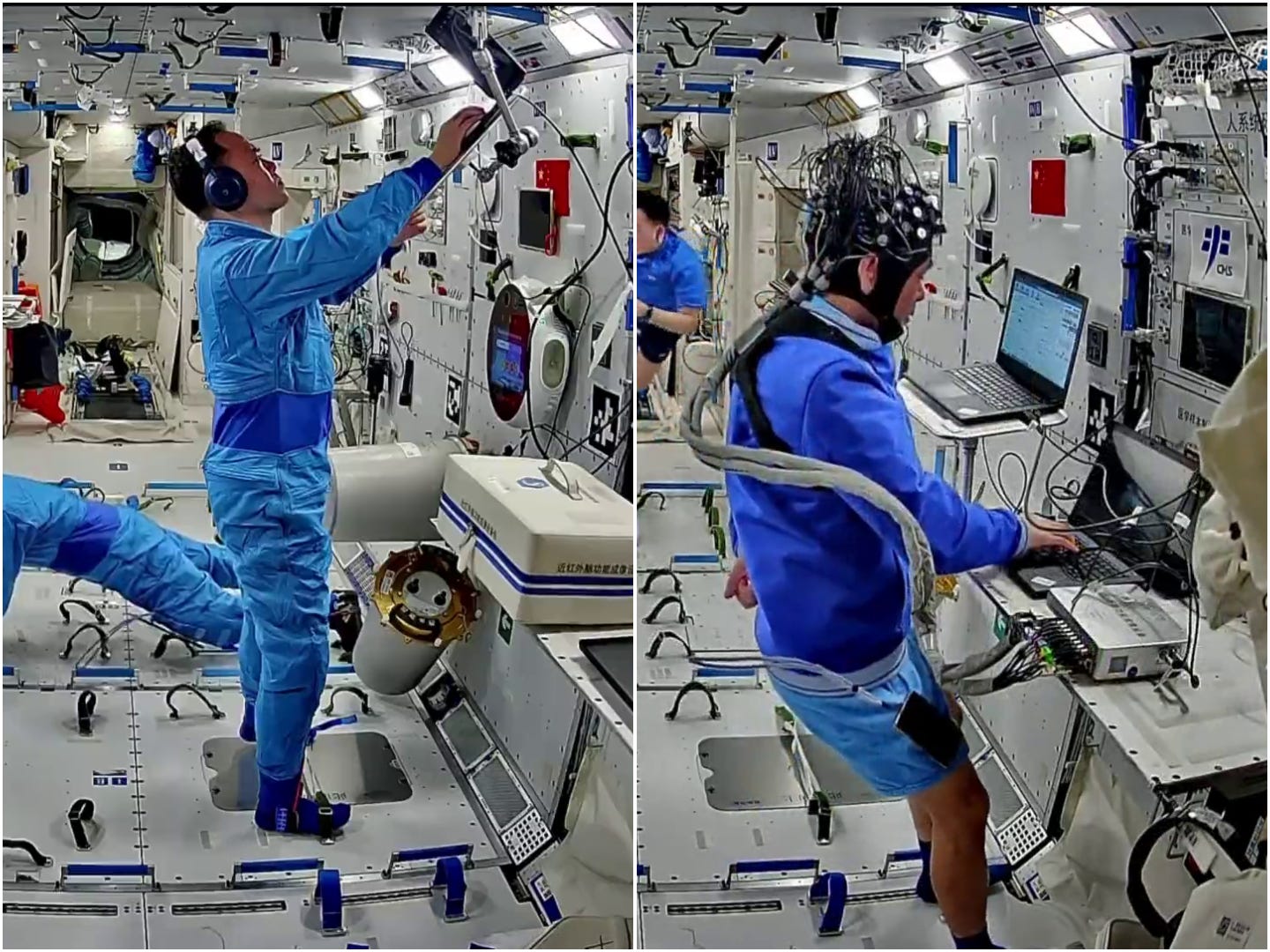
In the field of space medicine experiments, the crew used laptops and related experimental software to conduct experiments related to trust and collaboration mechanisms, human-machine trust in space, and utilized near-infrared brain function imaging equipment to conduct experiments on the real-time characteristics of brain networks in space.

In the field of microgravity physics, the crew carried out tasks in accordance with the experiment schedule, including replacing the ignition heads and sampling covers of the experimental cabinets inside the combustion science cabinet, replacing experimental samples in the fluid physics experiment cabinet, and cleaning samples from the experimental chamber of the containerless experiment cabinet, as well as maintaining the electrodes of the handling mechanism.

Regarding cabin cargo management, the crew completed environmental monitoring tasks such as temperature measurement, wind speed measurement, and dew point testing as planned, and carried out material sorting, regular cleaning, and on-site equipment inspection and maintenance.

In terms of health maintenance and monitoring, the three taikonauts underwent a series of medical examinations, including 12-lead electrocardiograms, non-invasive cardiac function tests, and ambulatory electrocardiogram and blood pressure monitoring. They also used a traditional Chinese medicine diagnostic instrument to monitor and collect data on various health indicators. At the same time, they actively engaged in on-orbit exercise.

If there are any problems with these translations please reach out and correct me.

[

Zhang Lu participating in computer and brain function-based experiments.

](https://substackcdn.com/image/fetch/$s_!V5O1!,f_auto,q_auto:good,fl_progressive:steep/https%3A%2F%2Fsubstack-post-media.s3.amazonaws.com%2Fpublic%2Fimages%2Fc2af00b1-8804-4ba2-9c9e-886d88214660_1440x1080.png)

Zhang Lu participating in computer and brain function-based experiments.

Fifth Annual Art Exhibition and Tiangong TV Episode April 5th 2026 originally from the China Manned Space Agency, cloned to YouTube for archival.

Thanks for reading China in Space! This post is public so feel free to share it.

Share

1

A copy of the artworks are also shown off in museums back in China.

2

Zhang Lu is the Commander and Pilot of the mission for his second spaceflight, having flown for the Shenzhou-15 mission between November 2022 and June 2023. He is from Hanshou County (汉寿县), Hunan (湖南) province, and was selected as part of China’s second taikonaut group in 2010, also being considered a ‘post-70s’ taikonaut having been born in November 1976.

Before becoming a taikonaut, Zhang served in the People’s Liberation Army Air Force and achieved the rank of Senior Colonel. He also joined the Communist Party of China in April 1999. After the Shenzhou-15 mission, Zhang was awarded the Spaceflight Merit Medal (Third Class) along with the honorary title of hero taikonaut.

3

Wu Fei is the Flight Engineer for this mission, which will be his first trip into space. He is from Baotou (包头市 / ᠪᠤᠭᠤᠲᠤᠬᠣᠲᠠ), in the Inner Mongolia Autonomous Region (内蒙古自治区 / ᠥᠪᠥᠷ ᠮᠣᠩᠭᠣᠯ ᠤᠨ ᠤᠨᠥᠪᠡᠷᠲᠡᠭᠨ ᠵᠠᠰᠠᠬᠤ ᠣᠷᠣᠨ), and was selected as part of the third taikonaut group in October 2020, while being considered a ‘post-90s’ taikonaut having been born in 1993.

Before his selection as a taikonaut, Wu was an engineer at the China Aerospace Science and Technology Corporation. He also joined the Communist Party of China in 2015.

4

Zhang Hongzhang is the Payload Expert for this mission, with it being his first trip to space. He is from Binzhou (滨州市), Shandong (山东) province, and was also selected as part of the third taikonaut group in October 2020, while being considered a ‘post-80s’ taikonaut having been born in 1986.

Prior to being selected as a taikonaut, Zhang was a researcher at the Dalian Institute of Chemical Physics, Chinese Academy of Sciences (中国科学院大连化学物理研究所), where he explored new materials and technology for batteries. He also joined the Communist Party of China in 2004.

200
submitted 3 weeks ago* (last edited 3 weeks ago) by mistermodal@lemmy.ml to c/memes@lemmy.ml

it's a meme on a missile. highest stage of posting. https://xcancel.com/iribnews_irib/status/2041206827602345989#m <- this is not a joke and it kicks ass

7
submitted 3 weeks ago* (last edited 3 weeks ago) by mistermodal@lemmy.ml to c/space@lemmy.ml

MOSCOW, April 7. /TASS/. A meeting between Dmitry Bakanov, CEO of Russia’s Roscosmos State Space Corporation, and Administrator of the National Aeronautics and Space Administration (NASA) Jared Isaacman is expected to take place in the summer, Bakanov said in an interview with TASS Director General Andrey Kondrashov.

"Manned spaceflights are not under sanctions, and it is clear why. It is a pragmatic approach, we can be useful to each other. We operate a colossal infrastructure called the International Space Station. And without Russia its operation is impossible now. And the question of what comes next, how this cooperation will continue, is indeed quite relevant. We are beginning discussions with the new NASA chief Jared Isaacman, who was appointed quite recently, a couple of months ago. So far we have only had a brief discussion via video conference, but we plan to meet in person in the summer," he said.

Bakanov noted that the details of the meeting are currently being worked out. "At that meeting, we will discuss the future prospects of our cooperation," he added.

11
submitted 3 weeks ago by mistermodal@lemmy.ml to c/ukraine@lemmy.ml

MOSCOW -- Moscow has issued a warning to the Baltic states following reports of their intention to open their airspace to Ukrainian drones attacking Russia, Russian Foreign Ministry Spokeswoman Maria Zakharova told RIA Novosti on Monday.

"Russia issued a special warning to the Baltic states regarding their decision to open their skies for the passage of Ukrainian UAVs during attacks on the Russian Federation," she said.

She added that if the Baltic states ignore Russia's warning and proceed with such action, they would face retaliatory measures.

Information about the official opening of the airspace of Latvia, Lithuania, and Estonia to Ukrainian drones was reported on March 26 via the Telegram channel Mash.

However, EU foreign policy chief Kaja Kallas, Estonian Interior Minister Igor Taro and the Latvian Defense Ministry have all denied the claims.

[-] mistermodal@lemmy.ml 25 points 1 month ago* (last edited 1 month ago)

Thomas Jefferson raped a 15 year old girl and enslaved her offspring. Scream this at every American you meet. Now that's proper propaganda

[-] mistermodal@lemmy.ml 27 points 5 months ago

I'm glad Ben Norton included the bit about Machado's superrich cousin going to Miami on private jet shopping trips & making fun of how poor Americans were, it was really illustrative of what the comprador elite are like since they're the result of much sharper inequality. Mostly just really funny though

[-] mistermodal@lemmy.ml 24 points 5 months ago

Jesus christ lmao

[-] mistermodal@lemmy.ml 27 points 5 months ago
  • ask a westerner if their elections are rigged too

  • he doesn't understand

  • i pull out a diagram explaining what a bourgeois democracy is versus democratic centralism, chavismo, or anything other than Hitlerian Jokernomics

  • he laughs

  • "it's a free + open democracy sir"

  • look inside

  • bourgeois democracy with pay-to-play elections

[-] mistermodal@lemmy.ml 24 points 6 months ago

I bet these guys actually take credit for China's green energy initiatives. I bet in their minds it was their caterwauling about the emissions from industries they outsourcre to China themselves that changed the world

[-] mistermodal@lemmy.ml 28 points 6 months ago

Bhaskar Sunkara haters never go hungry in fact we are at risk of several serious dietary conditions

[-] mistermodal@lemmy.ml 23 points 6 months ago

Inshallah in 3 years time they will be making the same regime change proclamations to Maduro and Cuba will never be next

[-] mistermodal@lemmy.ml 24 points 6 months ago

Who cares about URL legibility in 2025? 😂 Aren't you guys busy making like 7 different apps where URLs are even less visible?

[-] mistermodal@lemmy.ml 23 points 6 months ago

They don't just do nothing, they're a protest against the very idea of solidarity against ICE, which would involve standing up for each other.

[-] mistermodal@lemmy.ml 30 points 6 months ago

Yeah also if you make a Zim wiki or convert a website into Zim then you can run that stuff too. If you use Emacs it's easy to convert some pages to wikitext for Zim too

[-] mistermodal@lemmy.ml 23 points 6 months ago

Kamala campaigned on being harsher on immigration than Trump. She's the one who threw what should have been the easiest election ever. Nobody like Trump term 1. The dems becoming obsessed with statistics that give them an excuse only to appeal to the white middle class threw the game. You should appeal to VOTERS. But, go ahead and scold. Assume people were acting out of spite, and not the dems who hate us.

view more: ‹ prev next ›

mistermodal

0 post score
0 comment score
joined 6 months ago