Just wait until you look into French numbers.
How different languages say 97:
🇬🇧: 90+7 (ok, there is some jank in English numbers - 13-19 are in line with the Germanic pronunciation, i.e. pronounced "right to left", as a weird hold-over from the more Germanic Old English)
🇪🇸: 90+7
🇩🇪: 7+90
🇫🇷: 4x20+10+7
And if you think that's bad, the Danes actually make the French look sane...
🇩🇰: 7+(-½+5)x20
Even Danes generally don't really know why their numbers are like that, they just remember and go along with it.
"Je voudrais un baguette" I once asked in a parisian boulangerie. I don't think anyone has looked at me with the same level of disgust before as the older lady selling the breads.
"Voilà, une baguette.", the "une" flying through me like an icicle.
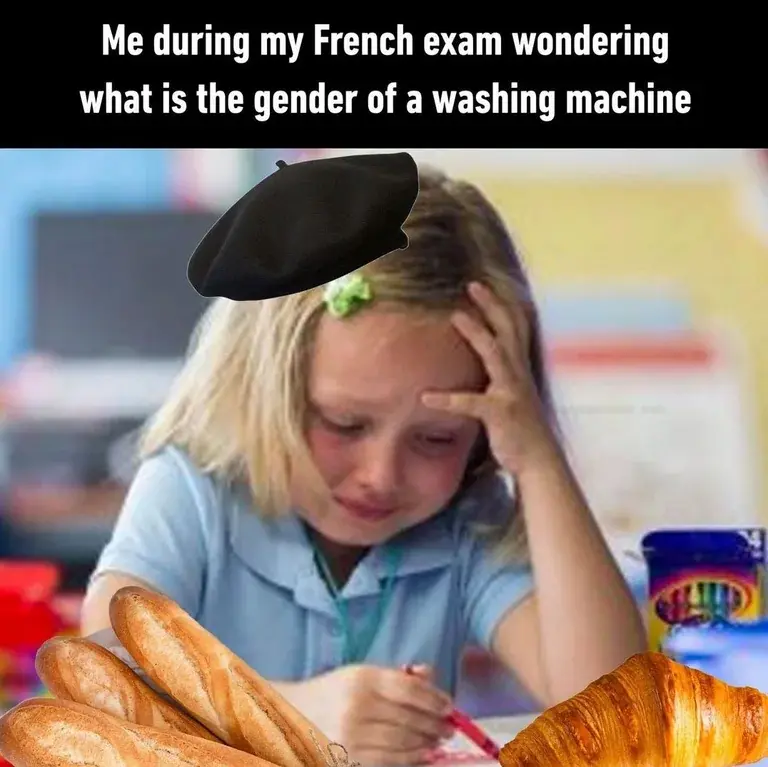
Tfw the washing machine is gender fluid
Me speaking to a French guy last week -
"We've just been the the musée de l'automobile in Mulhouse"
"Sorry, where?"
"Mulhouse"
"Where?"
"Mulhouse"
"Aaaaaah I see! It's pronounced [pronounces Mulhouse *exactly the same FUCKING way I just pronounced it]
😂 Happens very regularly
Female, and I am sure there hides a boomer joke here
Enter German and Gendering: You can not say Programmer to address all Programmers in the room. You have to call them Programmerin und Programmer or Programmer:in or Programmende. And yes, most of these words aren't even German but if you don't use them you are a Grammar Nazi.
And btw, the fact that we address females with "die" does not mean we want them dead, thank you and have a good day.
Due to the increased acceptance of non-conforming identities, it's become more prevalent to either ask for pronouns, tell them to a person you meet, or have them somewhere visible in things like gameshows.
That's quite as silly to me as this whole "what gender is this washing machine" nonsense is to English-speaking people.
Here in Finland, we don't have gendered language. Even with third person pronouns, we usually default to "it" instead of "him/her/they". Except for pets. They always get the proper pronoun "hän". It's just respectful.
So yeah, just like the English wonder why they have to learn different words for something needlessly gendered in France, I too, as a Finn, wonder why I have to learn different words for something needlessly gendered in English.
Polish speaker here. We not only have gendered nouns but also verbs and adjectives.
While gendered nouns are stupid, I at least appreciate Italian because you can just learn the word and get its gender from the end part of the word. In German, however, it's completely random and you have to learn the gender with the word.
crying in German
A washing machine is obviously female because doing laundry is a thing for women.
And now I will sit back and watch how many people get mad at me because they don't understand sarcasm.
intentionally misreading as wholesome - the idea is to subvert the concept of gender.
"You'll never be a real woman!"
"Neither will the chair I'm sitting in but you keep calling it 'her' so maybe stfu."
Die Waschmaschine die
What exactly does gender achieve in a language? Is English missing out on any nuance? Is it literally thinking about nouns as male or female, or is it just a weird name for the concept? Who decides gender when a new noun is made? What about borrowed words from other languages? Do you sound stupid if you speak French without using it, or are you just a language hipster?
Language, dude...
We also don't have 13 different words for I (glances at Japan)
Germany has three genders lmao
Non-neutral nouns have always struck me as odd. They provide no info gain whatsoever outside of actually providing a gender if you're referring to a person or animal (for example, in Spanish, gato -> male cat, gata -> female cat). And in those situations, a short sentence can provide instant clarification if needed in a non-gendered language like English.
It's a language feature built to be helpful in one use case, whilst simultaneously being worse in about a bazillion others. It's a very odd choice.
Cough, Though, Through (+ Threw), Thorough, Rough, Thought, Ought, Tough.
die das der
is that like how you have to memorize every single articels (der, die, das) for every word in german?
I don't know about French, but in Spanish is feminine.
Uh? I'm Portuguese and it works in the same in my language. I don't know what the big deal is. You get the gender by the arti...
Oh...
Say what you will, exam nightmares are real
top 50 comments