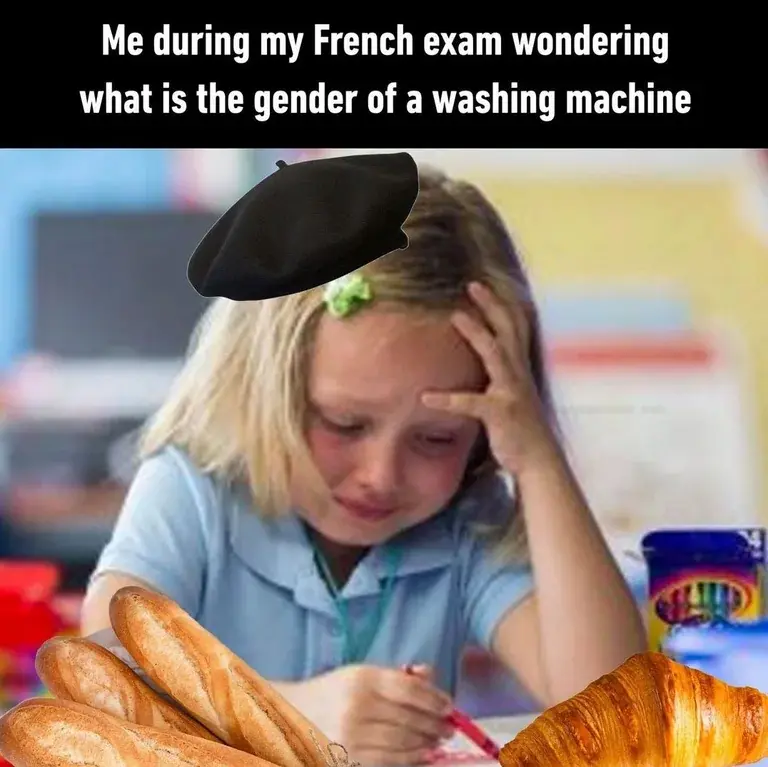
▲ 1429 ▼ English may be a hot mess but at least we don't have to worry about this nonsense (lemmy.world) submitted 2 years ago by robocall@lemmy.world to c/lemmyshitpost@lemmy.world 359 comments fedilink hide all child comments
[–] JusticeForPorygon@lemmy.world 22 points 2 years ago (5 children) Germany has three genders lmao permalink fedilink source hideshow 10 child comments replies: [–] Dkarma@lemmy.world 12 points 2 years ago Of course! Hitler proved all right wing Germans are pussies with dicks. permalink fedilink source parent [–] SuddenDownpour@sh.itjust.works 5 points 2 years ago Only three genders? They need to get with the times. permalink fedilink source parent [–] AngryCommieKender@lemmy.world 3 points 2 years ago* (last edited 2 years ago) (3 children) Technically so does did English, we just stopped using the male gendered pronoun sometime in the Renaissance, Early Modern Period, or Victorian Period, I don't know when. a ton of freaking words that I got mixed up back in Old English Back in Shakespeare's day, woman = female, man = gender neutral, (kinda like the word "Dude" it can be used for both women and wifmen,) and finally wifman = male. Still not sure why the male gendered pronoun fell out of common parlance. Haven't read Shakespeare in 2 decades, sorry. permalink fedilink source parent hideshow 6 child comments replies: [–] Drivebyhaiku@lemmy.world 6 points 2 years ago (1 child) Shakespeare was known to use archaic language for his plays but by his time this was largely codified into what we would recognize as modern usage. You are thinking of old English. It also goes beyond just man (used more or less like we would use the word human) , other gendered words originally had specific meaning independent of gender. You also got it a bit backwards. Wifman is female, wereman is male. Others include. Boy : knave or troublemaker Girl : Neutral word for young child. Basically like "kid" permalink fedilink source parent hideshow 2 child comments replies: [–] AngryCommieKender@lemmy.world 2 points 2 years ago (1 child) Thanks! No wonder his plays were so hard to read. I haven't read Shakespeare in a good 20 years so it's no surprise that I've mixed up the words and usages. permalink fedilink source parent hideshow 2 child comments replies: [–] Drivebyhaiku@lemmy.world 2 points 2 years ago He is an interesting literary figure. And in personal opinion quite frankly kind of a hack. You got to appreciate the audacity of someone who tries to use "Dost" nearly two centuries out of date and then just out of the blue makes up wholesale complete words from scratch to fit iambic pentameter. I love his stuff don't get me wrong but he wasn't exactly highbrow entertainment of his day. Still his early modern English is easily legible. Chaucer's middle english is distinctly more garbled and if you go back to your Old English where these terms originate it's like trying to read another language entirely. Like this is technically English : Hwæt. We Gardena in geardagum, þeodcyninga, þrym gefrunon, hu ða æþelingas ellen fremedon. Oft Scyld Scefing sceaþena þreatum, monegum mægþum, meodosetla ofteah, egsode eorlas. Syððan ærest wearð feasceaft funden, he þæs frofre gebad, weox under wolcnum, weorðmyndum þah, oðþæt him æghwylc þara ymbsittendra ofer hronrade hyran scolde, gomban gyldan. þæt wæs god cyning. permalink fedilink source parent [–] reverendsteveii@lemm.ee 3 points 2 years ago (1 child) wifman = male are you sure you're not thinking of wǣpnedmann? everything I can find about wifman tells me that it means "woman" and the root derivation is "wife person". permalink fedilink source parent hideshow 2 child comments replies: [–] AngryCommieKender@lemmy.world 3 points 2 years ago (1 child) Someone else corrected me, I was thinking of wereman. Haven't read Shakespeare in a couple decades permalink fedilink source parent hideshow 2 child comments replies: [–] reverendsteveii@lemm.ee 4 points 2 years ago* wer and wife TIL the etymology of how we talk about shapeshifters in folk myth. Dope, thank you! "Working late one night in the lab, Guy Fellows was bitten by a radioactive human being. Now he seems like an ordinary person, but under the full moon he undergoes a transformation and become a wereman! All the powers of an adult male human, trapped inside the frail shell of an adult male human, he is Wereman!" permalink fedilink source parent [–] joel_feila@lemmy.world 3 points 2 years ago Technically so does English, we just stopped using the male gendered pronoun sometime in the Renaissance, Early Modern Period, or Victorian Period, I don’t know when. around 900 ad. permalink fedilink source parent [–] SpaceCadet@feddit.nl 2 points 2 years ago (1 child) Dutch even has non-binary words. permalink fedilink source parent hideshow 2 child comments replies: [–] gentooer@programming.dev 2 points 2 years ago I call bullshit on this, e.g. "de aanrecht" sounds just plain wrong. I know that people in the Netherlands are often using the wrong gender, which always sounds weird to me. Words that change meaning with different genders (e.g. "de aas" and "het aas") are kinda cool tho. permalink fedilink source parent [–] uis@lemm.ee 1 point 2 years ago Most gendered languages I know about have three genders. Oh, wait. I got it. Ha! permalink fedilink source parent
[–] Dkarma@lemmy.world 12 points 2 years ago Of course! Hitler proved all right wing Germans are pussies with dicks. permalink fedilink source parent
[–] SuddenDownpour@sh.itjust.works 5 points 2 years ago Only three genders? They need to get with the times. permalink fedilink source parent
[–] AngryCommieKender@lemmy.world 3 points 2 years ago* (last edited 2 years ago) (3 children) Technically so does did English, we just stopped using the male gendered pronoun sometime in the Renaissance, Early Modern Period, or Victorian Period, I don't know when. a ton of freaking words that I got mixed up back in Old English Back in Shakespeare's day, woman = female, man = gender neutral, (kinda like the word "Dude" it can be used for both women and wifmen,) and finally wifman = male. Still not sure why the male gendered pronoun fell out of common parlance. Haven't read Shakespeare in 2 decades, sorry. permalink fedilink source parent hideshow 6 child comments replies: [–] Drivebyhaiku@lemmy.world 6 points 2 years ago (1 child) Shakespeare was known to use archaic language for his plays but by his time this was largely codified into what we would recognize as modern usage. You are thinking of old English. It also goes beyond just man (used more or less like we would use the word human) , other gendered words originally had specific meaning independent of gender. You also got it a bit backwards. Wifman is female, wereman is male. Others include. Boy : knave or troublemaker Girl : Neutral word for young child. Basically like "kid" permalink fedilink source parent hideshow 2 child comments replies: [–] AngryCommieKender@lemmy.world 2 points 2 years ago (1 child) Thanks! No wonder his plays were so hard to read. I haven't read Shakespeare in a good 20 years so it's no surprise that I've mixed up the words and usages. permalink fedilink source parent hideshow 2 child comments replies: [–] Drivebyhaiku@lemmy.world 2 points 2 years ago He is an interesting literary figure. And in personal opinion quite frankly kind of a hack. You got to appreciate the audacity of someone who tries to use "Dost" nearly two centuries out of date and then just out of the blue makes up wholesale complete words from scratch to fit iambic pentameter. I love his stuff don't get me wrong but he wasn't exactly highbrow entertainment of his day. Still his early modern English is easily legible. Chaucer's middle english is distinctly more garbled and if you go back to your Old English where these terms originate it's like trying to read another language entirely. Like this is technically English : Hwæt. We Gardena in geardagum, þeodcyninga, þrym gefrunon, hu ða æþelingas ellen fremedon. Oft Scyld Scefing sceaþena þreatum, monegum mægþum, meodosetla ofteah, egsode eorlas. Syððan ærest wearð feasceaft funden, he þæs frofre gebad, weox under wolcnum, weorðmyndum þah, oðþæt him æghwylc þara ymbsittendra ofer hronrade hyran scolde, gomban gyldan. þæt wæs god cyning. permalink fedilink source parent [–] reverendsteveii@lemm.ee 3 points 2 years ago (1 child) wifman = male are you sure you're not thinking of wǣpnedmann? everything I can find about wifman tells me that it means "woman" and the root derivation is "wife person". permalink fedilink source parent hideshow 2 child comments replies: [–] AngryCommieKender@lemmy.world 3 points 2 years ago (1 child) Someone else corrected me, I was thinking of wereman. Haven't read Shakespeare in a couple decades permalink fedilink source parent hideshow 2 child comments replies: [–] reverendsteveii@lemm.ee 4 points 2 years ago* wer and wife TIL the etymology of how we talk about shapeshifters in folk myth. Dope, thank you! "Working late one night in the lab, Guy Fellows was bitten by a radioactive human being. Now he seems like an ordinary person, but under the full moon he undergoes a transformation and become a wereman! All the powers of an adult male human, trapped inside the frail shell of an adult male human, he is Wereman!" permalink fedilink source parent [–] joel_feila@lemmy.world 3 points 2 years ago Technically so does English, we just stopped using the male gendered pronoun sometime in the Renaissance, Early Modern Period, or Victorian Period, I don’t know when. around 900 ad. permalink fedilink source parent
[–] Drivebyhaiku@lemmy.world 6 points 2 years ago (1 child) Shakespeare was known to use archaic language for his plays but by his time this was largely codified into what we would recognize as modern usage. You are thinking of old English. It also goes beyond just man (used more or less like we would use the word human) , other gendered words originally had specific meaning independent of gender. You also got it a bit backwards. Wifman is female, wereman is male. Others include. Boy : knave or troublemaker Girl : Neutral word for young child. Basically like "kid" permalink fedilink source parent hideshow 2 child comments replies: [–] AngryCommieKender@lemmy.world 2 points 2 years ago (1 child) Thanks! No wonder his plays were so hard to read. I haven't read Shakespeare in a good 20 years so it's no surprise that I've mixed up the words and usages. permalink fedilink source parent hideshow 2 child comments replies: [–] Drivebyhaiku@lemmy.world 2 points 2 years ago He is an interesting literary figure. And in personal opinion quite frankly kind of a hack. You got to appreciate the audacity of someone who tries to use "Dost" nearly two centuries out of date and then just out of the blue makes up wholesale complete words from scratch to fit iambic pentameter. I love his stuff don't get me wrong but he wasn't exactly highbrow entertainment of his day. Still his early modern English is easily legible. Chaucer's middle english is distinctly more garbled and if you go back to your Old English where these terms originate it's like trying to read another language entirely. Like this is technically English : Hwæt. We Gardena in geardagum, þeodcyninga, þrym gefrunon, hu ða æþelingas ellen fremedon. Oft Scyld Scefing sceaþena þreatum, monegum mægþum, meodosetla ofteah, egsode eorlas. Syððan ærest wearð feasceaft funden, he þæs frofre gebad, weox under wolcnum, weorðmyndum þah, oðþæt him æghwylc þara ymbsittendra ofer hronrade hyran scolde, gomban gyldan. þæt wæs god cyning. permalink fedilink source parent
[–] AngryCommieKender@lemmy.world 2 points 2 years ago (1 child) Thanks! No wonder his plays were so hard to read. I haven't read Shakespeare in a good 20 years so it's no surprise that I've mixed up the words and usages. permalink fedilink source parent hideshow 2 child comments replies: [–] Drivebyhaiku@lemmy.world 2 points 2 years ago He is an interesting literary figure. And in personal opinion quite frankly kind of a hack. You got to appreciate the audacity of someone who tries to use "Dost" nearly two centuries out of date and then just out of the blue makes up wholesale complete words from scratch to fit iambic pentameter. I love his stuff don't get me wrong but he wasn't exactly highbrow entertainment of his day. Still his early modern English is easily legible. Chaucer's middle english is distinctly more garbled and if you go back to your Old English where these terms originate it's like trying to read another language entirely. Like this is technically English : Hwæt. We Gardena in geardagum, þeodcyninga, þrym gefrunon, hu ða æþelingas ellen fremedon. Oft Scyld Scefing sceaþena þreatum, monegum mægþum, meodosetla ofteah, egsode eorlas. Syððan ærest wearð feasceaft funden, he þæs frofre gebad, weox under wolcnum, weorðmyndum þah, oðþæt him æghwylc þara ymbsittendra ofer hronrade hyran scolde, gomban gyldan. þæt wæs god cyning. permalink fedilink source parent
[–] Drivebyhaiku@lemmy.world 2 points 2 years ago He is an interesting literary figure. And in personal opinion quite frankly kind of a hack. You got to appreciate the audacity of someone who tries to use "Dost" nearly two centuries out of date and then just out of the blue makes up wholesale complete words from scratch to fit iambic pentameter. I love his stuff don't get me wrong but he wasn't exactly highbrow entertainment of his day. Still his early modern English is easily legible. Chaucer's middle english is distinctly more garbled and if you go back to your Old English where these terms originate it's like trying to read another language entirely. Like this is technically English : Hwæt. We Gardena in geardagum, þeodcyninga, þrym gefrunon, hu ða æþelingas ellen fremedon. Oft Scyld Scefing sceaþena þreatum, monegum mægþum, meodosetla ofteah, egsode eorlas. Syððan ærest wearð feasceaft funden, he þæs frofre gebad, weox under wolcnum, weorðmyndum þah, oðþæt him æghwylc þara ymbsittendra ofer hronrade hyran scolde, gomban gyldan. þæt wæs god cyning. permalink fedilink source parent
[–] reverendsteveii@lemm.ee 3 points 2 years ago (1 child) wifman = male are you sure you're not thinking of wǣpnedmann? everything I can find about wifman tells me that it means "woman" and the root derivation is "wife person". permalink fedilink source parent hideshow 2 child comments replies: [–] AngryCommieKender@lemmy.world 3 points 2 years ago (1 child) Someone else corrected me, I was thinking of wereman. Haven't read Shakespeare in a couple decades permalink fedilink source parent hideshow 2 child comments replies: [–] reverendsteveii@lemm.ee 4 points 2 years ago* wer and wife TIL the etymology of how we talk about shapeshifters in folk myth. Dope, thank you! "Working late one night in the lab, Guy Fellows was bitten by a radioactive human being. Now he seems like an ordinary person, but under the full moon he undergoes a transformation and become a wereman! All the powers of an adult male human, trapped inside the frail shell of an adult male human, he is Wereman!" permalink fedilink source parent
[–] AngryCommieKender@lemmy.world 3 points 2 years ago (1 child) Someone else corrected me, I was thinking of wereman. Haven't read Shakespeare in a couple decades permalink fedilink source parent hideshow 2 child comments replies: [–] reverendsteveii@lemm.ee 4 points 2 years ago* wer and wife TIL the etymology of how we talk about shapeshifters in folk myth. Dope, thank you! "Working late one night in the lab, Guy Fellows was bitten by a radioactive human being. Now he seems like an ordinary person, but under the full moon he undergoes a transformation and become a wereman! All the powers of an adult male human, trapped inside the frail shell of an adult male human, he is Wereman!" permalink fedilink source parent
[–] reverendsteveii@lemm.ee 4 points 2 years ago* wer and wife TIL the etymology of how we talk about shapeshifters in folk myth. Dope, thank you! "Working late one night in the lab, Guy Fellows was bitten by a radioactive human being. Now he seems like an ordinary person, but under the full moon he undergoes a transformation and become a wereman! All the powers of an adult male human, trapped inside the frail shell of an adult male human, he is Wereman!" permalink fedilink source parent
[–] joel_feila@lemmy.world 3 points 2 years ago Technically so does English, we just stopped using the male gendered pronoun sometime in the Renaissance, Early Modern Period, or Victorian Period, I don’t know when. around 900 ad. permalink fedilink source parent
[–] SpaceCadet@feddit.nl 2 points 2 years ago (1 child) Dutch even has non-binary words. permalink fedilink source parent hideshow 2 child comments replies: [–] gentooer@programming.dev 2 points 2 years ago I call bullshit on this, e.g. "de aanrecht" sounds just plain wrong. I know that people in the Netherlands are often using the wrong gender, which always sounds weird to me. Words that change meaning with different genders (e.g. "de aas" and "het aas") are kinda cool tho. permalink fedilink source parent
[–] gentooer@programming.dev 2 points 2 years ago I call bullshit on this, e.g. "de aanrecht" sounds just plain wrong. I know that people in the Netherlands are often using the wrong gender, which always sounds weird to me. Words that change meaning with different genders (e.g. "de aas" and "het aas") are kinda cool tho. permalink fedilink source parent
[–] uis@lemm.ee 1 point 2 years ago Most gendered languages I know about have three genders. Oh, wait. I got it. Ha! permalink fedilink source parent