
top 50 comments

sorted by: hot top controversial new old
[–] 138 points 2 years ago
[–] 58 points 2 years ago (29 children)

It's also a day without using anything he learned in art, or geography, or chemistry, or English literature, or history, or pretty much anything he studied in school after age 10. Why does math get singled out?

  • source
  • hideshow 29 child comments
  • [–] 20 points 2 years ago (15 children)

    Because math is abstract and difficult to relate to. We should be taught practical applications of the abstract concepts, and the exam questions should be more practical.

  • source
  • parent
  • hideshow 15 child comments
  • [–] 17 points 2 years ago*

    I demand only the practical parts of art and history be taught in school.

    Also - the questions that focus on practical applications are called word problems, and they get complained about more than anything else.

  • source
  • parent
  • [–] 10 points 2 years ago (11 children)

    The reason why they're abstract and difficult to relate to is because we're all being taught maths backwards.

    In science, a phenomenon is observed and then maths is used to create a set of equations describe it's behaviour. Then using the equations, other experiments can be designed to prove other hypothesises. This is known as the experimentalist approach to science.

    Engineering is the same but less research and more application focused. For example, I need to design a wooden shelf that is A inches/meters long and supports B lb/kg of weight. How do I do that? Using trigonometry and Newtonian physics to work out the dimensions.

    Finance is often used for basic algebra and calculus.

    However, it is not always helpful to work in the material when using mathematics and the abstract is preferred. This is usually only useful for the theoretical approach in science, in theoretical mathematics, or at the cutting edge of engineering disciplines.

    If we were taught by being presented with a problem first, I think it would make it easier to make the leap into the abstract when required for other applications. And on top of this, it would make it much easier for the majority who only ever need to use mathematics as a tool.

  • source
  • parent
  • hideshow 11 child comments
  • load more comments (11 replies)
  • [–] 6 points 2 years ago

    The biggest thing I learned from math was training yourself to think and problem solve. To always want to learn the next level of whatever you were learning, whether it's math English or whatever.

    I don't think I've ever used much math knowledge in my life ... but it gave me the ability and enthusiasm of wanting to always want to solve a problem no matter how complex it was.

  • source
  • parent
  • load more comments (12 replies)
    [–] 45 points 2 years ago

    I literally, 30 seconds ago, used sin^-1() to calculate the angle for a roof I need to make for my indoor greenhouse, so the asshole cats don't fall through the cheap plastic
  • source
  • [–] 37 points 2 years ago (1 child)
  • [–] 33 points 2 years ago (6 children)

    I make games. I use this shit daily.

  • source
  • hideshow 6 child comments
  • load more comments (1 reply)
    [–] 32 points 2 years ago (3 children)

    I use these functions literally everyday.

  • source
  • hideshow 3 child comments
  • [–] 31 points 2 years ago (1 child)

    I think carpenters, framers, cabinet makers, etc use more math than I do day to day working as a devops engineer with an aerospace degree.

  • source
  • hideshow 1 child comment
  • [–] 9 points 2 years ago

    You use it, but it's all preprogrammed into the software you use, so you can focus on the bigger problems.

    It's a bit like how microprocessors are designed modularly using programming language. No one physically lays out a transistor on a 7nm die, that's all dictated by code, where at the higher levels you just see "memory block" and "arithmetic block" or whatever.

    Finite Element Analysis is some funky shit, though, and often that's done using bespoke software. You need to know the maths to build that, and it helps to have an understanding when interpreting the results. At least, it helps the person writing the report make a good report, though it's not like anyone else will know if they get it wrong.

  • source
  • parent
  • [–] 30 points 2 years ago (2 children)

    This is dumb. Just because you don't use logarithms doesn't mean you never use deduction or process of elimination. Math is not solely about the numbers. The process is far more beneficial in many disciplines.

  • source
  • hideshow 2 child comments
  • [–] 8 points 2 years ago

    The same vain is people arguing that schools should be teaching important things like budgeting, interest rates, taxes etc.

    These things a trivial if you have the maths skills. These things are also subject to change, the maths doesn't.

    Worst of all, these things are all taught (in Scotland), the people complaining about school not teaching them weren't paying attention.

  • source
  • parent
  • [–] 29 points 2 years ago (7 children)

    I use them all the time for game development

  • source
  • hideshow 7 child comments
  • load more comments (5 replies)
    [–] 16 points 2 years ago

    Bro doesn't even use the internet, nor the electricity what a madlad

  • source
  • [–] 14 points 2 years ago

    Machinist, Drafter, all about that SOHCAHTOA Life 🔫🔫😎

  • source
  • [–] 14 points 2 years ago (1 child)

    If you ever have to cut a bit of wood to act as a diagonal brace it's pretty useful to whip out the old tan. So I've used this every time I built a gate.

    That's four times in the last decade, so not exactly daily but I'm glad I knew how to do it or my gates would have sucked.

  • source
  • hideshow 1 child comment
  • load more comments (1 reply)
    [–] 13 points 2 years ago (2 children)

    I had a maths teacher who upon being asked, whats the point in maths? Or whenever he heard I'm not going to use this in the rest of my life! Would break into a ten minute speech. You have to study maths because what it is at it's core is just doing the same thing over and over again with slight variations. -more waffle I can't remember- and after school you will go off to some job where you do the same thing over and over again where you will spend the next 60 years of your life. And then you die.

    It got quite depressing.

  • source
  • hideshow 2 child comments
  • load more comments (1 reply)
    [–] 12 points 2 years ago (1 child)

    You're literally using a device powered by electricity that extensively relies on an understanding, implementation and exploitation of sinusoidal maths.

  • source
  • hideshow 1 child comment
  • load more comments (1 reply)
    [–] 11 points 2 years ago

    I was trying to figure out a problem the other day and realized that if I still remembered how to implement some sort of mathematical concept I learned back in high school I would've been able to do it. Made me want to call up a friend and say something like "it finally happened!"

  • source
  • [–] 10 points 2 years ago

    That man don't need no tan

  • source
  • [–] 10 points 2 years ago

    If you use nothing from school then you’re going about life wrong. Reach higher.

  • source
  • [–] 10 points 2 years ago

    This is the weirdest ad for MATLAB I've seen today

  • source
  • [–] 10 points 2 years ago

    y'all seriously don't SOHCAHTOA everyday?

  • source
  • [–] 9 points 2 years ago

    I mean wasn’t soh cah toa written at that abandoned colony. Bad juju man

  • source
  • [–] 8 points 2 years ago

    Cries in audio programmer.

  • source
  • [–] 7 points 2 years ago (1 child)

    I use a calculated sine wave to generate models of convoluted foam! (I'm a packaging engineer). And multivariable calculus can be used to predict cushion curves!

  • source
  • hideshow 1 child comment
  • load more comments (1 reply)
    [–] 5 points 2 years ago (6 children)

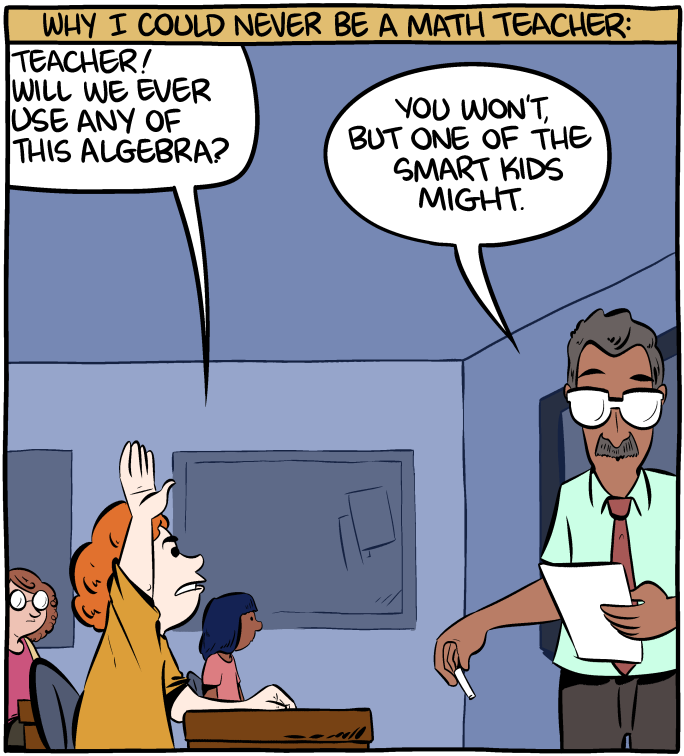
    I always yearned to understand a practical reason to learn calculus. My teacher at college was a German woman that spoke English with a thick accent. Her joy for the course seemed self-evident, but she failed to ever share a real-world reason or application for what we were trying to learn. 45 years later,I still haven’t used what I “learned”, or ever came to understand why we did.
  • source
  • hideshow 6 child comments
  • [–] 8 points 2 years ago

    The thing is, without learning basic math and physics in school, most people would probably be flat earthers or some other type of degenerates.

    Without knowing/understanding that it's possible to go the moon, or understanding why rubbing a stick against another stick makes fire, all the nonsense ideas that are the "easiest" to accept would prevail.

    Let's say I tell you that 2+2=5. If you know that 1+1=2, you can reasonably deduct that what I'm saying is false. If you know or atleast have seen how to do calculations with gravity, you can reasonably understand that it's possible to figure out how to put a rocket in space. You probably won't be able to do it yourself, but you understand that it's possible.

  • source
  • parent
  • [–] 6 points 2 years ago* (1 child)

    I always yearned to understand a practical reason to learn calculus.

    I use my understanding of second and third derivatives and the risks and how they affect the likelihood of black swan events - to choose (strongly influence) who loses when playing a game of "Liars Dice". So there is that, I guess.

    On a more serious note, lots of things in personal finance are a bit easier to understand with a functional understanding of derivatives and integrals. It's not critical, but it makes stuff like the compounding time effect of interest more accessible, I think.

    Edit: If I could change one thing about pubic schools, I think everyone should get a chance to take stats or probability for free. It helps so much with so many areas of life.

  • source
  • parent
  • hideshow 1 child comment
  • load more comments (3 replies)
    [+] 5 points 2 years ago* (last edited 1 year ago) (2 children)
    load more comments (2 replies)
    load more comments
    view more: next ›