top 50 comments

sorted by: hot top controversial new old
[–] 110 points 2 years ago (2 children)

But to answer your question, yes. If an unbiased translation is impossible (which it is), the solution is to have versions with as many contradictory biases as possible, so they hopefully cancel each other out.

  • source
  • hideshow 2 child comments
  • [–] 94 points 2 years ago (27 children)

    As I recently saw in a video about bible translations: Greek used (uses?) generic masculine forms for plurals. So a mixed group of stewarts and stewardesses would be called "these stewarts". If there's no context added, it's impossible to tell whether the group was actually all male or not.

  • source
  • hideshow 27 child comments
  • [–] 86 points 2 years ago (3 children)

    I think that's how a large part of European languages still work.

  • source
  • parent
  • hideshow 3 child comments
  • [–] 13 points 2 years ago (2 children)

    yup, german for example (and i believe all languages that are closely connected to it) assigns gender per articles: der is the masculinum, die for the femininum and das for the neutrum nominative singular, and just "die" for all nominative plural forms. Since the biological and linguistic gender are conflated in ungendered language, it runs into the same issues as the stewards above: everyone except the males become invisible. Also, in spoken language there is the tendency to use just the singular m. form for many professions: "Ich ging zum Arzt" - "I went to the doctor(m)" is used even if the doctor is a woman (which would be "Ich ging zur Ärztin")

    The first form is to just adress both genders: "Die Ärzte und Ärztinnen" translates to "the doctors(m) and doctors(f)". In this form you have still the issue that you name one gender first, which is always the male form - some say this is still discriminatory, and there is no way to adress any other gender.

    The second form is the "Binnen-I" to mark that the word can mean both genders: instead of "die Ärzte", "die ÄrztInnen" is used. Some say that it makes stuff harder to read and looks ugly, but in my experience you get used to it quickly. A derivative of this form which has become the defacto standard (and in my opinion, the most preferable one) is the "Gendersternchen" ("Gender Starlet"): "Ärzt*innen" is inclusive of all genders.

    And then you can try to avoid gendered forms altogether: "Personen mit medizinischer Ausbildung" (People with medical training) avoids using any gendered words at all. As you can see, it can get quite a mouthful in spoken language, and it is very formal, but i quite like it in written language - it's a bit more verbose, but flows nicely when reading.

  • source
  • parent
  • hideshow 2 child comments
  • load more comments (2 replies)
  • [–] 27 points 2 years ago (19 children)
  • [–] 36 points 2 years ago (18 children)

    In many aspects English doesn't distinguish between genders at all.

    I chose the words above specifically because they are gendered. I'm not a native speaker, but as far as I know, teacher, butcher, officer, warrior, president, welder, etc. can each mean male or female. There's maybe a connotation, but the words are not gendered. English also has no concept of a grammatical gender. Articles, adjectives, etc. are gendered in most European languages.

  • source
  • parent
  • hideshow 18 child comments
  • [–] 7 points 2 years ago (10 children)

    English absolutely has grammatical gender, it just defaults to "male" so much people forget there's other options. For example, "teacheress" is a real word, it's just so archaic that the male word now means both, same with how "you" is both singular and plural.

  • source
  • parent
  • hideshow 10 child comments
  • [–] 6 points 2 years ago (5 children)

    Having some feminitives in lexicon is not the same as having grammatical gender. I mean, is having a word for werewolf the same as having a "wolf" gender?

  • source
  • parent
  • hideshow 5 child comments
  • [–] 2 points 2 years ago (4 children)

    "Some feminitives" is disingenuous. It's an Indo-European language, it shares the structure of other IE languages, in some cases pared down and/or in disuse, but they're still there, same as vestigial base-12 counting.

    I don't get why people are so upset about the concept of grammatical gender, though. It's gramatical, it's not actual gender - original division in PIE was "animate" and "inanimate". Hell, I vaguely remember a conlang that had separate genders for terrestrial and aquatic animals, so you could absolutely make one that has a gender for "wolf".

  • source
  • parent
  • hideshow 4 child comments
  • [–] 3 points 2 years ago (6 children)

    Hunter, huntress, huntsman

    Waiter, waitress, waitsman

    Actor, actress, actsman

  • source
  • parent
  • hideshow 6 child comments
  • [–] 10 points 2 years ago (1 child)

    Nobody says waitman or actsman. I had to fight my phone’s autocorrect just to type those.

  • source
  • parent
  • hideshow 1 child comment
  • [–] 3 points 2 years ago*

    No one uses Wifman and Werman anymore either. Doesn't make them any less some of the last gendered nouns for humans, in English, since if one goes back that far man is neutral gendered, and while woman exists, it's for a woman that is a spinster.

  • source
  • parent
  • load more comments (3 replies)
  • [–] 49 points 2 years ago (3 children)

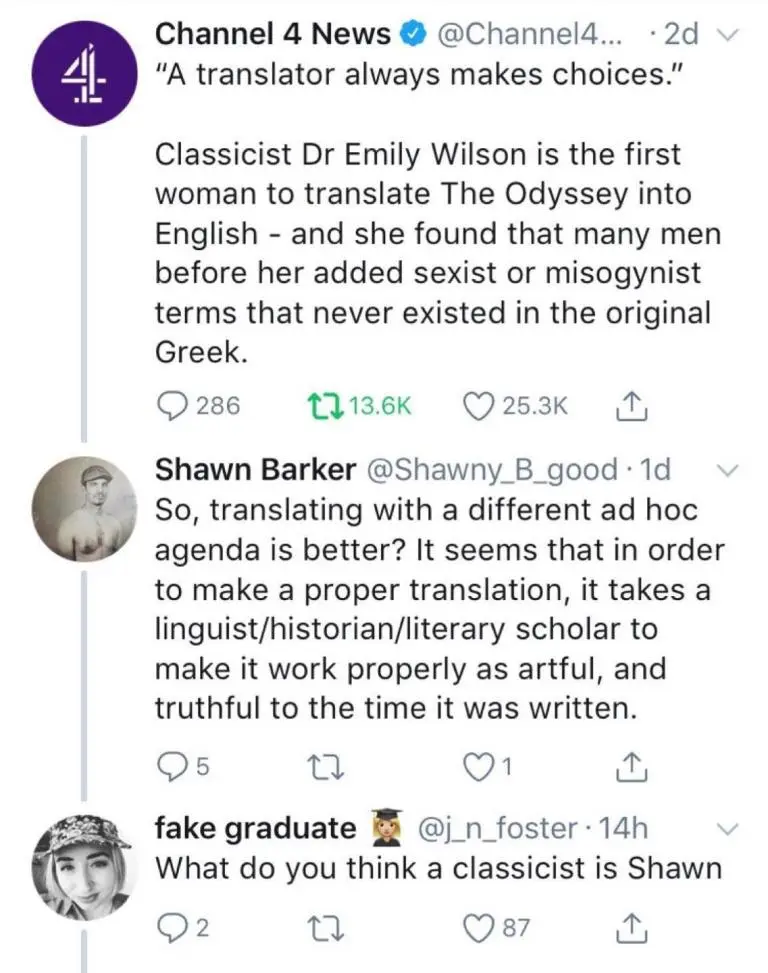
    When you're used to seeing the word classist it takes a second to remember a classicist isn't someone who is prejudiced against ancient Greeks and Romans.

  • source
  • hideshow 3 child comments
  • [–] 37 points 2 years ago

    Ah the agenda of checks notes not adding sexist remarks not included in the original text. What an awful agenda that is.

  • source
  • [–] 34 points 2 years ago (6 children)

    Classicist sounds hyper specific to classical Greece.

  • source
  • hideshow 6 child comments
  • [–] [S] 43 points 2 years ago (5 children)

    Classicism can be broadly applied to Ancient Greece and Ancient Rome, because of how often the sources intermingle (with many older Greek sources transmitted through Roman copies, and many Roman sources themselves written in Greek), but there's usually an element of specialization in one or the other for any given classicist.

  • source
  • parent
  • hideshow 5 child comments
  • [–] 12 points 2 years ago (4 children)

    I like the way we handle it in German, where Klassische Altertumswissenschaft is the study of Ancient Greece and Ancient Rome as pioneered by Friedrich August Wolf in the 1700s, and Altertumswissenschaft is used for the more broad study of antiquity.

  • source
  • parent
  • hideshow 4 child comments
  • [–] 29 points 2 years ago (1 child)

    Reminds me of a story an old friend of mine loved to tell.

    In her undergrad, she majored in classics and archaeology. One summer she was working at a dig on the island of Cyprus. One day she needed to go into town for some supplies. She walks into the store, and suddenly she realizes. "Fuck. I don't speak a word of modern Greek. How am I going to talk to the shopkeeper in this tiny town in rural Cyprus?"

    She decides to just do the best she can, and she tries to talk to him in the only Greek she knows...Ancient Greek.

    The shopkeeper gets befuddled, then looks her dead in the eye and says, in English, "lady, no one has talked like that here in 2000 years!"

  • source
  • hideshow 1 child comment
  • load more comments (1 reply)
    [–] 26 points 2 years ago (7 children)

    Where can I find a unbiased translation?

  • source
  • hideshow 7 child comments
  • [–] 19 points 2 years ago* (last edited 2 years ago) (6 children)

    Does anyone have a link to her actual findings? I tend to be skeptical of headlines like this.

    Also, the first woman? Props to her but I’m quite surprised no one else has done that

  • source
  • hideshow 6 child comments
  • [–] 8 points 2 years ago (3 children)

    Also, the first woman? Props to her but I’m quite surprised no one else has done that

    Yeah, it's indeed false. I didn't even research it actively, but Wilson on her Twitter profile mentioned an Italian translator who translated Homer years before Wilson.

    (To be sure, I just checked Italian Wikipedia. It was Giovanna Bemporad, her translation was published in 1970.)

  • source
  • parent
  • hideshow 3 child comments
  • [–] 7 points 2 years ago* (1 child)

    (To be sure, I just checked Italian Wikipedia. It was Giovanna Bemporad, her translation was published in 1970.)

    Yes, which she translated into Italian... and the very first paragraph of the article linked in this thread indeed notes Wilson is the first woman to translate it into English, just as the Tweet indicates...

    Are you a bot? Or just lazy?

  • source
  • parent
  • hideshow 1 child comment
  • load more comments (1 reply)
  • [–] 15 points 2 years ago

    For a while, I would get YouTube recommendations with “Translators DID IT again - when do they learn???” videos highlighting what they viewed as horrendously biased censorship in translation.

    Every once in a while, I give these idiots a minute of my attention and by their own data they look stupid. Whatever inaccuracy they thought was there pales in comparison to getting the writing to flow well in English.

  • source
  • [–] 10 points 2 years ago*

    Obviously a classicist is someone who studies how the working class can overthrow their divinely mandated white men overlords.

    Right? No other possible thing it could mean.

    Nothing else. Nothing at all.

  • source
  • [–] 6 points 2 years ago

    Shawn is a moron.

  • source
  • load more comments
    view more: next ›