9
In search of the tiny toad that stopped a dam
(news.mongabay.com)
That’s one powerful tail 
KLEINFELTERSVILLE, Pa. (AP) — Birdwatchers gather before dawn at Middle Creek in Pennsylvania to witness thousands of migrating snow geese lifting off from the reservoir in a swirling mass. The display lasts only minutes before the birds fan out to nearby farm fields to feed as they continue their annual spring migration north toward New York and Quebec. For a few short weeks each year, the migration draws crowds of nature lovers to the refuge, which was created decades ago to attract waterfowl and now welcomes about 150,000 visitors annually.


Banner image: Snow geese take off to resume their northern migration after a stopover at the Middle Creek Wildlife Management Area, Friday, March 6, 2026, in Kleinfeltersville, Pa. (AP Photo/Robert F. Bukaty)
Congrats!! 
A true #girlboss #hashtag-girlboss #octothorpe-girlboss
The tiny Amazon molly (Poecilia formosa) has always fascinated researchers because, according to the rules of evolution, it shouldn't have survived as a species, let alone thrive as a species for over 100,000 years. Using advanced genetic mapping and comparison techniques to track how the Amazon molly's DNA has changed over time, a new study set out to uncover the genetic secrets behind this apparent rebellion against evolutionary theory.
The molly undergoes asexual reproduction and gives live birth to its young, which are its clones, because the species is made up entirely of females—much like the all-female Amazonian warriors of Greek mythology, from whom it gets its name, not the Amazon Basin (where it doesn't live).
As per Muller's ratchet, a standard evolutionary theory, they should have gone extinct because clonal organisms accumulate harmful mutations over time due to a lack of genetic diversity.
The genetic evidence from this study, published in Nature, shows that the Amazon molly picks up mutations faster than its sexual relatives, yet somehow avoids the expected genetic decay—the secret behind this surprising act of resilience is gene conversion. This process purges harmful mutations by spotting damaged genes, "copying" a healthy version of the same gene from another part of the fish's own DNA, and "pasting" it over the faulty region to overwrite the mistake.

The Amazon molly didn't slowly evolve into a new species, it was the result of a 100,000-year-old accident. A long time ago, near Tampico, Mexico, a female Poecilia mexicana mated with a male Poecilia latipinna and created the hybrid—the Amazon molly. Every fish of that species alive today traces its lineage back to that single cross.
Unlike hybrid animals like a liger or mule, which are sterile and cannot reproduce, the Amazon molly is fully capable of reproducing asexually. Inside the mother's ovaries are specialized cells that undergo a modified version of meiosis—a type of cell division in sexually reproducing organisms—where the pairing up of chromosomes from two parents and swapping genetic information before dividing doesn't occur.
Instead, the mother produces eggs that already contain a full, double set of DNA that develops into new fish that are genetically identical to the mother. This form of cloning is called apomixis.
For a long time, scientists believed sexual reproduction was essential for long-term survival because it shuffles genes, removing harmful mutations and combining beneficial ones. The Amazon molly, however, gets the same advantages without ever mating.
Previous studies hinted at its high genetic diversity and signs of gene conversion, but detailed, haplotype-resolved genomic data were still missing.

In this study, the researchers filled in this knowledge gap by creating a highly detailed and complete map of the entire genetic code for the Amazon molly and its two parent species using advanced long-read sequencing technology.
The researchers combined Hi-C and trio-binning to unravel the Amazon molly's genome. While Hi-C showed how DNA folds into chromosomes, trio-binning separated the two parental DNA sets, letting them study each lineage independently.
They found widespread presence of gene conversion, which supports two different pathways to reverse or correct unwanted genetic mutations: adaptive, or positive, selection, which promotes beneficial genetic mutations that enhance an organism's fitness, and second is purifying, or negative, selection, which helps reduce the presence of harmful genetic variations within a population.
The team also observed a higher rate of genetic repairs happening near DNA that carry crucial biological instructions, such as immunity or cell signaling.
Another fascinating detail revealed by the genome map was that out of the two sets of DNA present in the Amazon molly, one from each ancestral parent, is that the P. mexicana half of the fish's DNA is mutating and changing faster than the P. latipinna half, with changes mirroring those happening to the original species in the wild.
The study sheds light on long-debated questions about the evolutionary costs of asexual reproduction and establishes gene conversion as a powerful mechanism for effectively offsetting the negative effects. The findings give rise to a new question for future studies to explore: Do other long-lived asexual species avoid Muller's ratchet through the same process or is there something completely different at play?

Because leaves are tasty, right? 
A tropical insect has been found to change color from vivid hot pink to green within a fortnight, which scientists believe may mimic the young leaves of rainforest plants. The findings, published this week in the journal Ecology, focuses on Arota festae, a leaf-masquerading katydid also known as a "bush cricket," native to Panama, Colombia and Suriname.
When researchers spotted an adult female beneath a light at the Smithsonian Tropical Research Institute's field station on Barro Colorado Island, Panama, she was an unmistakable hot pink. Eleven days later, she was completely green.
Scientists from the University of St Andrews, University of Reading, the Smithsonian Tropical Research Institute, and University of Amsterdam, propose that the pink coloration evolved to mimic "delayed greening," a phenomenon in which newly emerged tropical leaves flush vivid shades of pink or red before maturing to green.
On Barro Colorado Island, around one-third of plant species show this trait all year, providing a reliable supply of pink leaves for a camouflaged insect to blend into.
Lead author Dr. Benito Wainwright, of the University of St Andrews, said, "Finding this individual was a genuine surprise. Because it was so rare, we kept it in natural conditions and found it changing color from hot pink to green.
"Rather than a bizarre genetic quirk, this may actually be a finely tuned survival strategy that tracks the life cycle of the rainforest leaves this insect is trying to resemble."

The team reared the individual in captivity for 30 days, photographing her daily. The hot pink faded to pastel after four days, and by day eleven, she was indistinguishable from the common green morph.
She survived to mate before dying naturally the following month.
Pink katydids have been documented in scientific literature since 1878 but were generally considered a rare, disadvantageous mutation. This appears to be the first recorded case of a katydid completing a full color shift within a single life stage.
Dr. Matt Greenwell, of the University of Reading, a co-author of the study, said, "Tropical forests are extraordinarily complex environments, and this discovery hints at just how precisely some animals have evolved to exploit them.
"You would think that a bright pink insect in a mostly green forest would stand out to predators like a worker in a high-vis jacket. The idea that an insect might gradually shift color to keep pace with the leaves it mimics shows how dynamic the rainforest can be, and is a remarkable example of camouflage in action."
Took me a second to parse this, then I realized I’m tipsy.
I should have remembered this earlier, sorry I didn’t - this should be CW: meat and NSFW.
Maybe they just aren’t observant 
It’s a 3 on the Kinsey scale at best.
Hmm, but then if you gave it to the Zionists they couldn’t continue to pretend to be Jewish.
AGI hasn’t been achieved until an AI rents a human to complete captchas for it because it would be bad to misrepresent itself, even though it’s already capable of solving them.
Every animal carries a microscopic community of bacteria, fungi, and other microbes that play a critical role in health. These gut microbes help regulate the immune system, support digestion, and even influence how animals respond to stress. In birds, stress triggers the hormone corticosterone, which helps individuals cope with challenges. But when stress is prolonged or repeated, it can disrupt the balance of microbes in the gut, potentially affecting health in ways that aren't immediately visible.
While scientists have studied these stress–microbiome links extensively in mammals and domestic birds, little is known about how they operate in wild songbirds.
To fill this gap, Florida Atlantic University researchers and their collaborators studied free-living Northern cardinals (Cardinalis cardinalis), a common territorial songbird, to examine how everyday challenges affect gut microbial communities.
The team characterized the birds' microbiomes before and after an 11-day period during which the birds experienced one of three conditions: repeated simulated territorial interactions with other males; a brief holding period following routine capture; or no treatment at all.
Alongside the microbiome, researchers recorded levels of corticosterone, body condition, and beak coloration—a carotenoid-dependent trait that signals diet, health, and fitness.
The results, published in Scientific Reports, reveal that even relatively mild challenges can leave a clear mark on the gut microbiome. Birds exposed to social or environmental stressors showed changes in the composition of their gut bacteria, while the total number of microbial types remained stable.

Notably, birds briefly held after capture exhibited larger and more consistent shifts in microbial communities than those exposed only to simulated social interactions, highlighting how short departures from normal routines can have measurable biological effects.
Findings show that even subtle, everyday challenges can have profound effects on an animal's internal ecosystem. By revealing the hidden links between stress, microbial communities, and indicators of health, the study offers a new perspective on how wild animals navigate the demands of their environment—and how their tiny microbial passengers reflect those experiences.
"These microbial changes were not just abstract numbers. They were closely linked to visible signs of health," said Rindy Anderson, Ph.D., senior author and an associate professor in the Department of Biological Sciences within FAU's Charles E. Schmidt College of Science.
"Birds whose gut microbes shifted the most also showed changes in beak color, stress hormone levels, and body condition. Stress doesn't affect all birds in the same way. Instead, the microbiome may serve as a sensitive indicator of how individual animals are responding to their environment."
The study also uncovered links between specific types of bacteria and measures of health. For instance, males whose beaks became more orange—a signal often tied to condition and diet—also tended to have the largest shifts in their gut microbiome.
Birds exposed to brief captivity showed changes in bacterial groups associated with stress and potential pathogens, whereas increases in beneficial bacteria were associated with better physiological condition. Stress hormone patterns mirrored these microbial shifts: in challenged birds, changes in corticosterone levels were strongly correlated with changes in gut microbes, while untreated birds showed little connection.
"This study shows that the microbiome can act like a biological record of what an animal has experienced," said Morgan C. Slevin, Ph.D., first author and alumnus of the Integrative Biology Ph.D. Program in the FAU Department of Biological Sciences.
"By working with birds in their natural environment, we can see how different challenges—whether social interactions, environmental changes, or brief disruptions—translate into real physiological changes that matter for health and fitness.
"These microbial shifts give us a window into the hidden ways wild animals respond to the world around them, helping us understand their resilience and overall well-being in ways we couldn't see from behavior alone."

By combining microbiome analysis with physiological measures and visual indicators of condition, the study offers one of the first integrated looks at how stress, health, and microbial communities interact in a free-living songbird. The findings underscore the importance of studying animals in their natural habitats, where behaviors and environmental conditions can shape biology in ways that captivity studies may miss.
"The gut microbiome could serve as a sensitive measure of how wild animals respond to environmental changes, urbanization, or other stressors, with potential applications for conservation, wildlife rehabilitation, and understanding population health," said Anderson.
Study co-authors are Jennifer L. Houtz, Ph.D., an assistant professor of ecology and evolutionary biology at Allegheny College; and Maren N. Vitousek, Ph.D., an associate professor, Department of Ecology and Evolutionary Biology, Cornell University.
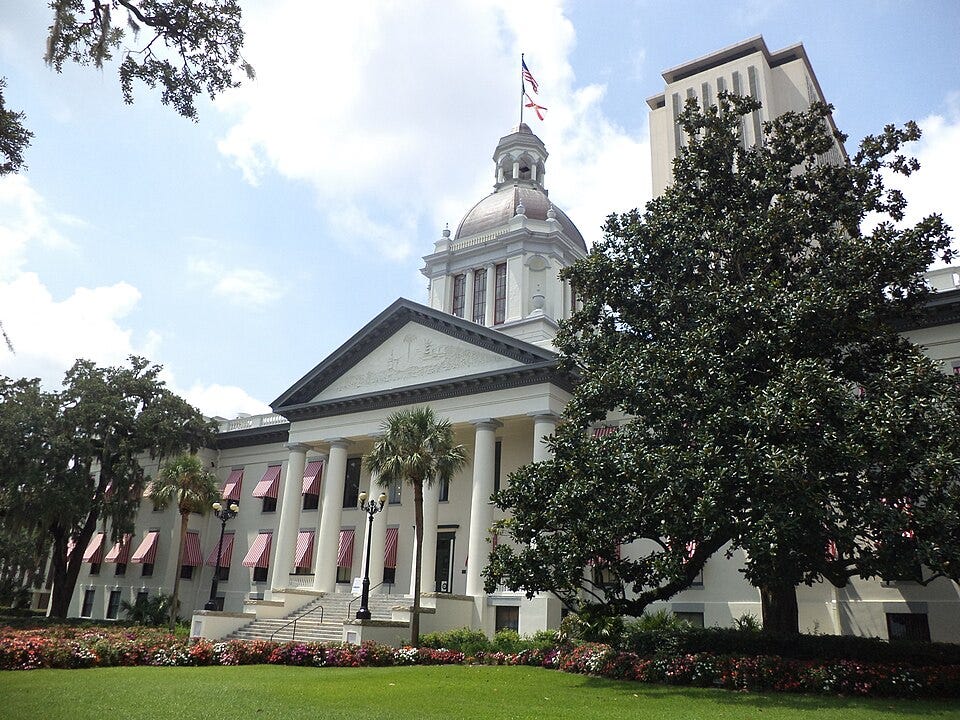
Florida State Capitol // Michael Rivera // Wikimedia Commons
Erin In The Morning is a reader-supported publication. To receive new posts and support my work, consider becoming a free or paid subscriber.
On Tuesday, the Florida legislature passed a bill that would ban all local governments from "promoting" or "adopting" activities related to diversity, equity, and inclusion—and bar any recipients of city contracts or grants from doing the same. The bill explicitly includes gender identity and sexual orientation in its definition of DEI, meaning any official activity "with reference to" LGBTQ+ people could trigger a violation. That could include promoting or supporting local Pride events with any city resources or funding LGBTQ+ community health centers. The bill also contains a novel and extreme enforcement mechanism: any elected official the governor deems in violation would be guilty of "misfeasance in office," which under the Florida Constitution gives Governor DeSantis the power to immediately suspend that official by executive order—without a court hearing. It is a power he has already weaponized twice against elected Democratic state attorneys, and which would now expand to every city commissioner and county official in the state.
The new bill, SB 1134, is sweeping and deliberately vague. It states that any city or county office or official acting in their official capacity cannot "promote or adopt training, programming, or activities designed or implemented with reference to race, color, sex, ethnicity, gender identity, or sexual orientation." It also mandates that local governments not use funds for "contractors, employees, vendors, volunteers, or agents" who will "ascribe to, study, or be instructed" using materials with reference to the same identity categories, which could impact community health centers, hospitals, and nonprofit services in cities across the state.
Importantly, this bill contains an extreme enforcement mechanism. Under Florida's constitution, the governor can suspend elected officials from office for misfeasance—and this does not require a court hearing. The governor can simply issue an executive order, and the official is out. The suspended official's only recourse is an appeal to the Republican-controlled Florida Senate, which holds a 28-12 supermajority. SB 1134 would expand those powers to include declaring support for LGBTQ+ activities or programming in an elected official's official capacity to be an act of misfeasance worthy of removal from office, with DeSantis himself able to use these powers with a stroke of his pen. He has already weaponized this provision twice—suspending Hillsborough County State Attorney Andrew Warren in 2022, in part for pledging not to criminalize gender-affirming healthcare, and suspending Ninth Circuit State Attorney Monique Worrell in 2023. The Florida Supreme Court upheld his authority to do so. This bill would hand him the same power over every city commissioner, county official, and municipal officer in the state.
The bill could have enormous consequences for Pride across the state. While it does not technically ban Pride events, the practical effect on Pride parades may be devastating. Florida's drag ban, which was recently put back into effect by the 11th U.S. Circuit Court of Appeals in December, has already been interpreted to potentially bar parades that include drag performers—which is most Pride parades—from allowing minors to attend. When the drag ban first passed in 2023, Port St. Lucie canceled its Pridefest parade entirely, and Tampa Pride canceled all 2026 events citing the political climate, loss of corporate sponsorships, and the "discontinuation of DEI programs." Now, SB 1134, should it be signed by the governor, would extend the assault even further, barring any city from co-sponsoring, funding, or officially promoting Pride events.
Under broad interpretations of the bill's language, this could prohibit cities from displaying Pride flags on government property, sending official city delegations to march in parades, posting Pride events on city websites or social media, issuing proclamations recognizing Pride Month, or providing city resources like water trucks and staff time to support festivals. These are not hypotheticals—the City of Wilton Manors currently spends $50,000 in direct funding and an additional $48,000 in city services to co-sponsor Stonewall Pride, a large Pride event in the state. The bill arrives in the context of an escalating war on LGBTQ+ visibility in Florida: the state already forced cities across South Florida to remove Pride rainbow crosswalks last summer under a separate law, including the rainbow crosswalk outside the Pulse nightclub memorial in Orlando where 49 people were murdered. City officials in Key West, Fort Lauderdale, and Delray Beach who fought to preserve their crosswalks would, under SB 1134, now risk being removed from elected office for doing so.
"This bill is dangerous, vague by design, and part of a broader political agenda of censorship and government overreach," said Stratton Pollitzer, executive director of Equality Florida, in a statement following the bill's passage. "Once again, Florida lawmakers have manufactured a sweeping anti-LGBTQ law—legislation intended to bully local governments and have a chilling effect on how they celebrate and support the diverse communities they serve. Florida's LGBTQ community knows all too well how to fight back against unjust laws. Just as we did following the passage of Florida's notorious 'Don't Say Gay or Trans' law, we will fight every step of the way to limit the impact of this legislation, including in the courts."
Florida is not the first place to attempt this. Under Prime Minister Viktor Orbán—whose anti-LGBTQ+ policies DeSantis's office has openly acknowledged as a model for Florida's Don't Say Gay law—Hungary banned Pride outright last year, even amending its constitution to block legal challenges. When Budapest Mayor Gergely Karácsony defied the ban by designating Pride as an official city event and leading 200,000 people through the streets, the government filed criminal charges against him. SB 1134 creates a strikingly similar mechanism on American soil: a local official who uses their office to support Pride commits misfeasance, and the governor can suspend them unilaterally. In Hungary, the mayor faces a fine. In Florida, DeSantis wouldn't even need to go to court.
The bill now heads to Governor DeSantis's desk. Given his record on LGBTQ+ issues—including signing Don't Say Gay, a drag ban, and the ban on gender-affirming care for trans youth—a veto is virtually inconceivable. If signed, the bill takes effect January 1, 2027, at which point any existing local ordinances, resolutions, programs, or policies deemed to relate to LGBTQ+ people and other “DEI” activities would be immediately void. The bill is likely to face court challenges, though the 11th Circuit Court and Florida’s Supreme Court have both been among the most hostile courts towards LGBTQ+ people.
Erin In The Morning is a reader-supported publication. To receive new posts and support my work, consider becoming a subscriber.
From Erin In The Morning via This RSS Feed.
Do all children have a right to an education? As educator Mariluz Arriaga tells us, the Mexican Constitution of 1917 was clear: yes, they do!
In contrast, the US Constitution makes no mention of education, and the Supreme Court has always ruled that education is not a fundamental right. If a state decided to provide public education, the only federal requirement was the 14th Amendment, passed after the abolition of slavery, which required states to give everyone, regardless of race or citizenship, the right to be included in any public program.
Many states tried to get around that law. For decades, Native, Black, Latino and Asian students students were sent to separate and unequal schools. It would take legal suits under the 14th Amendment to pry open white school doors. The most famous case, won by Black parents in 1954, was Brown vs. Board of Education, when the Supreme Court ruled that racial segregation was unconstitutional.
But that was not the first case! In 1947, Gonzalo and Felicitas Mendez, Mexican farmers in California, tried to enroll their daughter in the local school. The Westminster School Board told them she had to go to a separate school for Mexican Americans. Refusing to send their child to a shack with broken-down desks and raggedy old books, they gathered four other Mexican families and sued the school district. They won. Mendez vs. Westminster laid the groundwork for the Brown family’s case.
Arriaga tells us about Mexican educators’ courageous commitment to supporting justice for their students’ communities. In the US, parents like the Mendezes and Browns demonstrate how ordinary people can transform entire educational systems. Public education has been and continues to be a critical arena of social struggle. What and how children are taught must be contested, because education is the bedrock of democracy.

Girls school in Mexico, c. 1900
María de la Luz Arriaga Lemus, a classroom teacher before joining the economics faculty at Mexico City’s revered National Autonomous University of Mexico, has been a long-time union activist. In 1993, she co-founded the Trinational Coalition in Defense of Public Education with her US and Canadian counterparts. Six years later, she helped launch, on a broader scale, the Social Network for Public Education in the Americas. Her latest effort: the Casa Obrero Socialista Jose Antonio Vital. Arriaga, all told, has spent half a century defending public education as a social right in Mexico and beyond.

May Day, 2023
How did Mexican teachers come to play an important role in Mexican history?
In the Mexican Revolution’s 1917 constitution, education was guaranteed as a social — not an individual — right. It affirmed that education must be public, universal, secular and free, a constitutional right that was unique in Latin America. Mexico doesn’t have a Ministry of Education; it has a Ministry of Public Education.
After 1917, President Carranza faced a monumental task: to educate children in every corner of the country. To prepare new teachers, the government built hundreds of free normal schools where the future teachers lived together, many of them children of laborers and peasants. They grew their own food and kept a few cows and took care of the school’s domestic chores. Their backgrounds made them sensitive to the poor and rural communities from which they came.
The villages had three important people: the teacher, the doctor and the priest. During the 1930s and 1940s, when the progressive President Lázaro Cárdenas del Río was redistributing land, educators had the skills to draft petitions to obtain communal lands. They became revolutionary fighters, supporting the demands of the poor, especially in the Southern region, where today the teachers remain the most militant and continue to play a leading role for radical change.

Image from a 1939 Proletarian Liberation Primer produced by Mexico’s Ministry of Public Education’s literacy campaign during the Presidency of Lázaro Cárdenas.
What was the agenda of educational reform under neoliberalism?
Neoliberalism seeks to turn everything into a consumer product, bought and sold on the private market and to eliminate social rights such as health, education and pensions. It replaces social responsibility with individual responsibility — each for themselves alone.
In Mexico, neoliberals attempted to change the consciousness of teachers and students, pressuring them to conform. For students, their revised textbooks removed the history of Mexican resistance and eliminated important legends. In a story about the Niños Héroes (Boy Heroes), set in the Mexican-American War, military cadets jumped off a cliff to their deaths rather than allow invading US forces to capture the Mexican flag. While not a fully factual historical event, it inspired young students with Mexican national pride and anti-imperialist consciousness.
Private school tuition was made tax-deductible so that, in effect, the public paid for private education. Education had been free from preschool through college. In the 1980s and 1990s, the government attempted several times to defund public universities, impose quotas on the number of university students and charge tuition. A massive student revolt protested this — 500,000 students took to the streets.
For teachers, in the past, after you finished teachers college, you were guaranteed a job. Enrique Pena Nieto eliminated that policy.
His funding cuts led to worsening working conditions. Salaries became based on “merit” and “performance,” contradicting the constitutional right to equal pay for equal work. Now, only a third of a teacher’s salary was guaranteed as base pay.
Inequality increased, and the incentive to compete replaced teacher cooperation. University professors focused more on publishing than on teaching.
How was teacher performance measured? Through standardized tests — a plague on the profession! The tests covered all subjects, so a history teacher had to pass the science section, and those subjects change a lot over decades! If you failed for three years, even with 30 years of teaching experience, you were dismissed or removed from teaching duties. Obviously, these tests don’t measure the level of teacher preparation or the quality of the education provided to students.

Children waiting for the afternoon bell at the Albino Corzo primary school in Mexico. Photo: Nina Lakhani
How was the Trinational Coalition in Defense of Public Education formed?
Neoliberal reforms began as early as 1973 in Chile under the dictator Augusto Pinochet and in Mexico and the United States in the 1980s and were then fully institutionalized in the North American Free Trade Agreement (NAFTA) of 1993.
Dan Leahy, from Evergreen State College in the State of Washington, organized a trinational conference with more than 200 people, 40 of them Mexican.
It wasn’t a union meeting, although many union activists participated; we didn’t meet to defend wages and contracts.
We issued a declaration in defense of education as a right, fundamental to building democratic societies. Dan from the US, myself from Mexico and Larry Kuehn from Canada initially formed the Coalition in 1993-1994. In our conferences, US, Mexican and Canadian educators share the realities of each country and support each other as equals.
After his 2018 election, President López Obrador directly attacked neoliberalism. Did he change the education system?
His social programs improved many people’s standard of living. The stipends, for students aged 5 to 17, have helped the poorest; some families use that money to buy food. It’s hard for children to learn if they’re hungry. All the “social welfare” programs are universal for their target populations — senior citizens, single mothers and children with disabilities — creating a more stable home environment for children.
The distribution of millions of free textbooks continues — and they are wonderful! Many are in Indigenous languages, and historical accuracy has been restored. Of course, the far right, such as the oligarch Ricardo Salinas Pliego, calls for the books to be burned because they are “communist!”
However, AMLO’s promise to completely reverse Peña Nieto’s reforms wasn’t kept. The worst policies, such as the punitive teacher evaluation system and the threat of dismissal, were eliminated. But the evaluation mechanisms for access to employment, promotion and inclusion in merit- or productivity-based pay programs remain.
The business-oriented concept of education, where students and exam scores are products, still underlies the system — quantitative, not qualitative, measures are valued.
AMLO’s administration did initiate something different — the New Mexican School, which reorients basic education to a model of radical critical pedagogy. It replaces teaching separate subjects with students participating in project-based learning. They work collectively on real-life projects that require information and skills from mathematics, science, research and other subjects to be utilized together.
Teachers from the CNTE (National Coordinator of Education Workers) were already employing this methodology, primarily in Oaxaca and Michoacán, and soon in Guerrero, where collective approaches are essential to the indigenous cultures that predominate in the southern region. Indigenous teachers are able to develop projects of decolonization rather than assimilation and to develop their own curricula and methodologies.
What is the current agenda of the Trinational Coalition, which amazingly has continued for 35 years?
Since the attack on public education goes beyond the USMCA countries, in 1999 we expanded to create a continental coalition: Initiative For Democratic Education in the Americas, the IDEA Network. The Trinational Coalition became an affiliate.
Today, it’s not just neoliberalism, we must confront the rise of neo-fascism. As US hegemony wanes, it has become more desperate. Led by Trump, the US exerts power through violence and terror. Our mission is to explain the new situation to the public and to shape an alternative consciousness.
To that end, we must affirm the principle of education as a social right — public, free, universal, and secular — as it was guaranteed by that still revolutionary document: the 1917 Mexican Constitution.

Image from a 1939 Proletarian Liberation Primer produced by Mexico’s Ministry of Public Education’s literacy campaign during the Presidency of Lázaro Cárdenas.
Meizhu Lui’s experiences as the daughter of Chinese immigrants and as a single mom led her to focus on addressing inequalities based on race, gender, and immigration status. A hospital kitchen worker, she was elected president of her AFSCME local. She coordinated the national Closing the Racial Wealth Gap Initiative, and co-authored The Color of Wealth: The Story Behind the U.S. Racial Wealth Divide. Liberation Road, a socialist organization, has been her political home.

March 12, 2026
With the 40-hour workweek reform, if a worker were to work the 36 extra hours per month at double pay, they would only receive 1,206 pesos more per month than they would under the previous mandatory 48-hour workweek.

March 12, 2026March 12, 2026
An interview with María de la Luz Arriaga Lemus, a teacher, long-time union activist, co-founder of the Trinational Coalition in Defense of Public Education, the Social Network for Public Education in the Americas, who works with Casa Obrero Socialista Jose Antonio Vital.

March 12, 2026March 11, 2026
Mexican sugar exports face quotas in the US, but US corn syrup and high fructose corn syrup have no import restrictions in Mexico, a situation even worse than the original NAFTA agreement.
The post In Defense of Universal Public Education appeared first on Mexico Solidarity Media.
From Mexico Solidarity Media via This RSS Feed.
Across the animal kingdom, sound is more than communication—it's a signal of survival and success. From birds and primates to insects, fish, and amphibians, animals broadcast acoustic "advertisements" to defend territory, attract mates, and reveal their physical condition. Because these calls can reflect traits such as body size, strength, or health, they play a powerful role in sexual selection and help shape how species compete and reproduce.
Parasites can influence these mating signals. Infections drain energy and trigger immune responses that weaken the body, altering traits tied to mating success, such as stamina and the quality of acoustic calls, sometimes disrupting how sounds are produced or perceived.
Adding to the complexity, some parasites infect hosts through predator-prey interactions. This means individuals that are larger or more effective at foraging—qualities often preferred by potential mates—may actually face a higher risk of infection. However, studies in amphibians have produced mixed results.
To explore this paradox, Florida Atlantic University researchers studied green treefrogs (Dryophytes cinereus) and oral frog tongueworm parasites (Halipegus occidualis) that live in the mouth and throat of frogs, to test whether food-web–transmitted parasites influence mating calls and female mate choice in a natural population.
During the breeding season, male green treefrogs gather in loud choruses around ponds, inflating their vocal sacs to produce repeated "honking" calls from nearby vegetation. Females use these calls to choose mates, typically favoring lower-frequency, faster, and sometimes longer calls—traits that often signal a larger or healthier male. Pulse patterns in the calls also help females recognize their own species.
Researchers recorded the calls of male green treefrogs in the wild and counted the number of tongueworm parasites in each frog's mouth. They then analyzed the recordings using audio software to measure features of the calls, such as frequency, length, and pulse structure. They aggregated calls into three infection categories: uninfected, moderately infected (five to eight adult worms), and heavily infected (more than nine adult worms).
To see how females responded, the team conducted two-choice playback experiments, broadcasting pairs of male calls and observing which one they approached.
Results of the study, published in the journal Current Zoology, suggest that choosy female green treefrogs may face a croak conundrum: the call traits they prefer—such as lower frequencies—are typically produced by larger males, which may also be more likely to carry parasites.

Tongueworm infections do influence the calls males use to attract mates, but not in the simple way scientists expected. Rather than just weakening signals, the parasites altered several call traits, creating a complex pattern that can change how females evaluate potential partners.
"Parasites don't always tell a simple story about health or weakness," said Sarah R. Goodnight, Ph.D., first author, a Ph.D. graduate of FAU Harbor Branch, and a postdoctoral fellow at the Smithsonian Environmental Research Center. "In this system, the frogs most successful at finding food may also be the ones most likely to pick up parasites. That means females are evaluating signals that can simultaneously advertise both strength and risk."
The findings challenge the long-standing Hamilton–Zuk hypothesis, which predicts that parasites reduce the quality of sexual signals and that females should prefer less-infected males. Instead, the pattern was more complex.
Larger male frogs—typically favored by females—also carried more tongueworm parasites, likely because males that eat more prey accumulate infections over time. Parasites subtly reshaped male calls: heavily infected frogs produced lower-frequency calls, a trait females usually prefer, but their calls were shorter, which can signal lower stamina.
Playback experiments revealed a similar pattern. Females avoided the most heavily infected males but often preferred males with moderate infections over uninfected ones, suggesting they weigh multiple signals at once—balancing traits linked to size and attractiveness against the risk of parasite infection.
Call duration appeared to play a particularly important role in this decision-making. Longer calls generally come from males with fewer parasites and greater energetic reserves, signaling vigor and lower infection risk. However, the relationship wasn't entirely straightforward: some moderately infected males produced longer calls than uninfected males, possibly because successful foragers accumulated both energy reserves and parasites.
"Mate choice is rarely based on a single trait," said Michael W. McCoy, Ph.D., co-author, associate director, FAU School of Environmental, Coastal, and Ocean Sustainability, and professor of quantitative ecology, Department of Biological Sciences, FAU Charles E. Schmidt College of Science and FAU Harbor Branch Oceanographic Institute.
"Our results show that parasites can reshape the information animals use when choosing partners by subtly changing multiple aspects of a male's call. Females may be responding to several signals at once, some linked to desirable traits like size and others hinting at infection. Understanding that complexity is critical for explaining how sexual selection actually works in natural populations."
The study reveals that parasites influence mate selection by altering multiple traits in male calls, creating a complex signal environment. Rather than just diminishing attractiveness, infections introduce nuanced cues that females must interpret, revealing how parasites subtly guide mating decisions and shape sexual selection in wild populations.
The study co-author is Ellen F. Titus with The Nature Conservancy.

Oh! I nearly missed it because it got shared a while back, but is this when we actually learn Cecile’s name?