It would be foolish to say, definitively, that after only three half-hour episodes I’m certain that this is by far the best on-screen adaption of any of George Martin’s work.

But it is.

I liked season one of HOTD well enough, but I had constant reservations about the show throughout. At first it was just little things, like I thought the tone or pacing or scripting in this or that scene were just a little off. Then there were some bigger missteps but it was never enough to overshadow the good parts of the season. Season two was a considerable drop in the quality of the writing, but the rest of the production held fast. Taking the two seasons together, if they were the sum of HOTD I’d say the show ranks somewhere between season 4 and 5 (S4 and S5) of GOT. The highs of HOTD are never quite as good as S4 but they are better than those of S5, and an inverse relationship for the lows. And of course GOT itself can be ranked sequentially best to worst, 1 to 8, except you swap 2 and 3 around because Qarth is quite bad in season 2.

But AKOTSK… I have a lot of fondness for GOT S1–3, but you can tell there are a lot of compromises made that alter the feel of the work overall. Whereas A Knight… is just hitting on all cylinders. The tone, the acting, the action, the score, the COSTUMES. It really feels like Martin’s vision come to life.

[-] Coca_Cola_but_Commie@hexbear.net 79 points 2 months ago

Incredible play to release these after capitulating totally on the shutdown. If I didn’t know better, I’d almost say the democrats feigned helplessness in order to destroy the ACA and then put this story out to distract from their supposed incompetence. But they wouldn’t do something like that, they’re the true party of the American working class.

[-] Coca_Cola_but_Commie@hexbear.net 44 points 3 months ago* (last edited 3 months ago)

This guy was a Blackwater mercenary as recently as 2018. At the very least, his decision-making ability is totally compromised and the man shouldn’t be trusted in a leadership position. I wouldn’t trust the guy even as a fellow rank-and-file member of an org.

At the worst, the guy’s an op.

Then again, in a choice between voting for a guy who might be a cryptofascist trying to infiltrate a nascent national leftist movement or the fucking centrist Governor of Maine for US senate, sorta a toss up.

Edit: lol. Claiming that there is no “conspiracy to infiltrate white supremacist in the Marine Corps.” Less of a conspiracy, more of a “comes with the territory.” It’s the raison d’etre of the entire Armed Forces, the entire fucking country even.

1

https://xcancel.com/BretDevereaux/status/1896592119093240204

What's that famous quote about statistics? Oh, yeah I think it's "statistics are completely truthful measures of objective reality and can't be easily warped to suit a narrative."

I'm a fan of Devereaux's ancient history blog A Collection of Unmitigated Pedantry. But any time he comments on contemporary history and events its always stuff like this. It always leads to the conclusion that the post-WWII US-led liberal world order is the best thing to ever happen.

Also I'm pretty sure he is about 40, which means he was born a mere forty years removed from the most destructive conflict in human history. Even if this graph, and the statement that he is replying to, are correct and the last 80 years are the safest years in human history I think it's a little early to be counting your chickens.

Does it really count as a long peace just because post-WWII conflicts haven't had a comparable death toll? What about the various campaigns of ethnic cleansing and displacement and other assorted horrors that this graph conveniently doesn't include? Also fails to account for the fact that at no other time in history has the very real possibility of nuclear apocalypse hung over all our heads. Is that peace?

19

Post I saw about this.

I couldn't think of a meme template to do this with. Also I won't watch another movie etc.

Obviously Alex Jones is an evil man who should be buried in sand with his head exposed and left to die of exposure. But it would be extremely fitting for him to be US Press Secretary. He's already the character of American US Propaganda Chief ripped from the most unsubtle political satire ever written.

43
submitted 1 year ago* (last edited 1 year ago) by Coca_Cola_but_Commie@hexbear.net to c/doomer@hexbear.net

Don't know if this site or its analysis of this study are reliable, this is just something I saw on Twitter. In fact I don't know if the study itself is reliable. I just think it would be morbidly funny if human driven climate changed wiped out enough of the major oxygen producing organisms to cause a reverse Great Oxidation Event.

God talking to humankind:"Heyy you loving that oxygen? Pretty sweet isn't it? Wanna know how I did it? It's really clever, you're going to love this. See, at the beginning I crafted the rules that underpin everything, yadda yadda yadda, some bacteria in an anaerobic world gain crude photosynthesis and BAM, complex multicellular life is possible. Those godless scientists call it the G-O-E, it even kinda sounds like my name. You must be pretty grateful. I mean, without, you wouldn't exist or be around to ponder the nature of the universe and we wouldn't be talking. Ha ha—

Hey, what the fuck? Don't do that. Do not do that. No. You can't kill those. You cannot kill- well there they fucking go. Now I have to wait another six billion years for complex life to evolve somewhere else. This game sucks. It should be way more hands on. Can we re-enable divine intervention?"

It would be so easy to win a national election against Trump. Watch. "I, your democratic candidate, pledge to fight the supermarket, pharmacological, and healthcare cartels that are artificially inflating consumer prices for their own gain."

But democrats don't want to do that.

44

Obviously I’m not a fan of Dawkins. I haven’t read any of his work, but from the various clips and quotes of his I’ve seen over the years he strikes me as an incurious bigot with a blinkered worldview. But I have no reason to doubt that he is a smart man.

So it’s very funny to see him realize that he’s debating a genuinely delusional person, as Peterson makes some bizarre epistemological argument that dragons are literally real because we use the concept of predator as a shorthand for animals that kill other animals. Except Peterson seems to expand the definition of predator to “anything that can kill a person” when he argues that fire is a predator.

I spoke to a conservative family member the other day who said they didn't like Walz because "he's a total socialist." I know words like socialist don't have much meaning to most Americans, but what the hell is that supposed to mean?

I asked that, in nicer terms, but didn't get a meaningful response. I called Walz a moderate, and said that he hasn't even called for any New Deal style programs to be added to the democratic platform, much less socialism.

Think they made Walz turn down his rhetoric because they want to run a center-right campaign to attract would-be Republican voters that are put off by Trump? If that's right it's got to be one of the worst electoral strategies, maybe ever.

Hearing and reading libs says shit like "See, Dick Cheney knows that Trump is even worse than he was, that's why we have to vote blue" is infuriating. How can't they see what's really happening here?

18
53

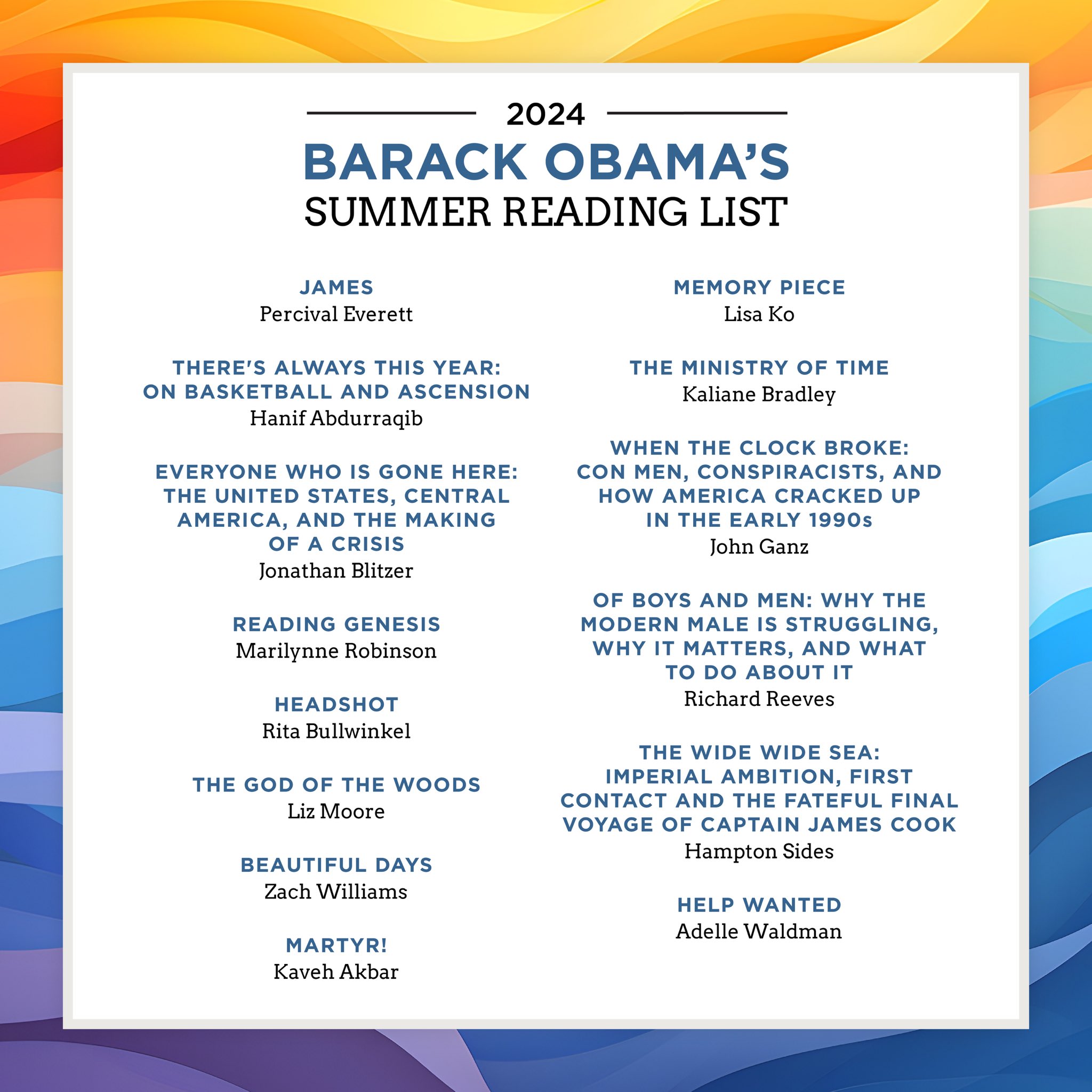
that Obama wouldn't have included the novel Headshot by Rita Bullwinkel in his 2024 Summer Reading List?

lol at Ganz being on Obama's list.

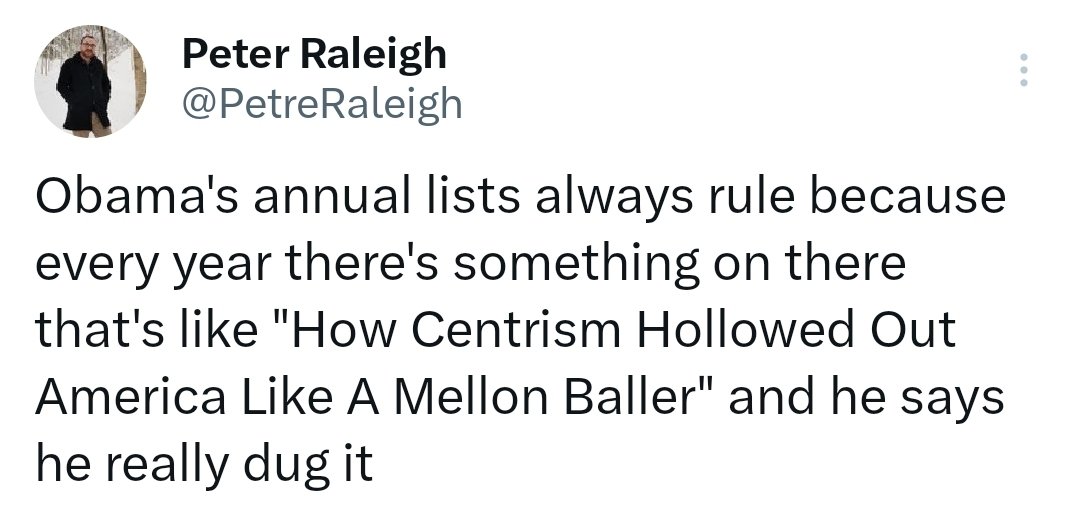
Also see: https://twitter.com/PetreRaleigh/status/1823107090035925472

[-] Coca_Cola_but_Commie@hexbear.net 52 points 2 years ago

THEY’RE ARGUING ABOUT THEIR GOLF GAMES!

14
submitted 2 years ago* (last edited 2 years ago) by Coca_Cola_but_Commie@hexbear.net to c/history@hexbear.net

The Asiatic Mind: How Ancient Babylon Took the Holy Land from the Globalists by Larry McFuckface New York Times bestseller and soon to be major motion picture

vs

The Ace of Spades: Syncretism in the Neo-Babylonian Empire c. 1300 BC by Dr. Robin Dozois and William Harrington (University of Sydney Press Books) Has never been scanned and uploaded online. The only surviving copy is in the stacks of a private research university.

[-] Coca_Cola_but_Commie@hexbear.net 72 points 2 years ago

I don't know about this one chapos. I mean, can you imagine what it would be like to live under a dictatorship? They'd probably do crazy shit like ban bodily autonomy, ban protesting, make it illegal to criticize regimes that are in league with the dictator, ban mass communication platforms, crack down on immigration, allow friendly corporations to operate their own mafias they'd use to kill whistleblowers, and just generally crush poor and working people. I wouldn't want to live under a rule like that.

102
What (hexbear.net)

The fuck? I've been holding down a finger and trying to scroll to the right spot (which usually fucks up when I release the hold) for years.

[-] Coca_Cola_but_Commie@hexbear.net 56 points 2 years ago

John Bolton must be in an insane blood-rage today. Hope he never gets what he wants.

2
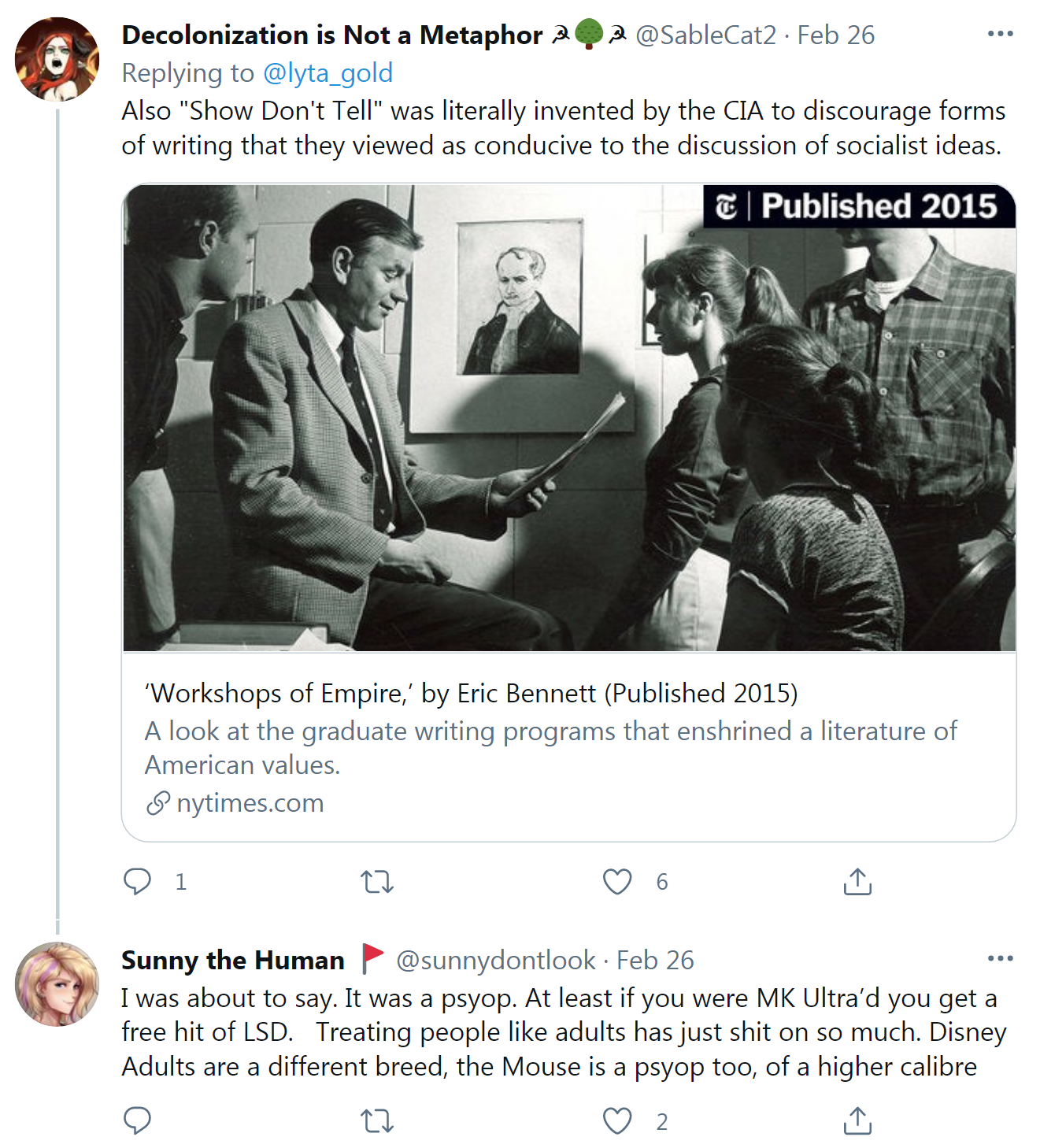
Your MFA is a psyop (hexbear.net)

Link to parent tweet

Text of the NYT Article:

By Timothy Aubry

Nov. 25, 2015

Less than a lifetime ago, reputable American writers would occasionally start fistfights, sleep in ditches and even espouse Communist doctrines. Such were the prerogatives and exigencies of the artist’s existence, until M.F.A. programs arrived to impose discipline and provide livelihoods. Whether the professionalization of creative writing has been good for American literature has set off a lot of elegantly worded soul-searching and well-mannered debate recently, much of it in response to Mark McGurl’s seminal study, “The Program Era.” What Eric ­Bennett’s “Workshops of Empire” contributes is an understanding of how Cold War politics helped to create the aesthetic standards that continue to rule over writing workshops today.

Sponsored by foundations dedicated to defeating Communism, creative-­writing programs during the postwar period taught aspiring authors certain rules of propriety. Good literature, students learned, contains “sensations, not doctrines; ­experiences, not dogmas; memories, not philosophies.” The goal, according to Bennett, was to discourage the abstract theorizing and systematic social critiques to which the radical literature of the 1930s had been prone, in favor of a focus on the personal, the concrete and the individual. While workshop administrators like Paul Engle and Wallace Stegner wanted to spread American values, they did not want to be caught imposing a particular ideology on their students, for fear of appearing to use the same tactics as the communists. Thus they presented their aesthetic principles as a non­political, universally valid means of cultivating writerly craft. The continued status of “show, don’t tell” as a self-evident truth, dutifully dispensed to anyone who ventures into a creative-­writing class, is one proof of their success.

Bennett’s argument is a persuasive reminder that certain seemingly timeless criteria of good writing are actually the product of historically bound political agendas, and it will be especially useful to anyone seeking to expand the repertoire of stylistic strategies taught within creative-writing programs. That said, some sections are better researched than others. His chapters on Stegner, Hemingway and Henry James lack the detailed ­institutional machinations that make his account of Engle’s career so compelling. Moreover, he uses the early history to support his claim that creative-writing programs continue to bolster a pro-­capitalist worldview today. But a chess move made to solve specific problems can serve unexpected purposes when the situation on the board has changed. Whether or not the aesthetic doctrines currently championed by writing workshops perform the same political function they once did, now that the very conflict responsible for their emergence has ended, is a question that requires further study.

Finally, despite Bennett’s misgivings about creative-writing workshops, his book is itself a convincing argument in their favor. A graduate of the Iowa M.F.A. program, Bennett has produced a literary history far more enjoyable than the typical academic monograph, for all the reasons one might guess. It features a winning protagonist, Engle, the ebullient poet-huckster and early director of the Iowa Writers’ Workshop, who, according to Bennett, “moved too quickly through the airports and boardroom offices to bother with the baggage of complex beliefs.” Here and elsewhere, Bennett never tells when he can show. The 1920s, under his scrutiny, consists not of trends, but of “racy advertisements, voting mothers, unruly daughters, smoking debutants, migrating Negroes, Marx, Marxists, Freud, Freudians and the unsettling monstrosity of canvasses and symphonies from Europe.” Wallace Stegner, he observes, “wrote at length about not sleeping with people.” Whether novelists and poets should make room in their work for the intellectual abstractions that prevail within academic scholarship, the academy would be better off if more of its members could attend to concrete particulars with the precision and wit that Bennett brings to his subject. Indeed, they might even benefit from taking a creative-writing class or two.

WORKSHOPS OF EMPIRE

Stegner, Engle, and American Creative Writing During the Cold War

Link to the article

view more: next ›

Coca_Cola_but_Commie

0 post score
0 comment score
joined 5 years ago