this post was submitted on 29 Feb 2024
169 points (99.4% liked)
traaaaaaannnnnnnnnns
1493 readers
191 users here now
Welcome to /c/traaaaaaannnnnnnnnns, an anti-capitalist meme community for transgender and gender diverse people.
-
Please follow the Hexbear Code of Conduct
-
Selfies are not permitted for the personal safety of users.
-
No personal identifying information may be posted or commented.
-
Stay on topic (trans/gender stuff).
-
Bring a trans friend!
-
Any image post that gets 200 upvotes with "banner" or "rule 6" in the title becomes the new banner.
-
Posts about dysphoria/trauma/transphobia should be NSFW tagged for community health purposes.
-
When made outside of NSFW tagged posts, comments about dysphoria/traumatic/transphobic material should be spoiler tagged.
-
Arguing in favor of transmedicalism is unacceptable. This is an inclusive and intersectional community.
-
While this is mostly a meme community, we allow most trans related posts as we grow the trans community on the fediverse.
If you need your neopronouns added to the list, please contact the site admins.
Remember to report rulebreaking posts, don't assume someone else has already done it!
Matrix Group Chat:
Suggested Matrix Client: Cinny
https://rentry.co/tracha (Includes rules and invite link)
WEBRINGS:
🏳️⚧️ Transmasculine Pride Ring 🏳️⚧️

founded 3 years ago
MODERATORS
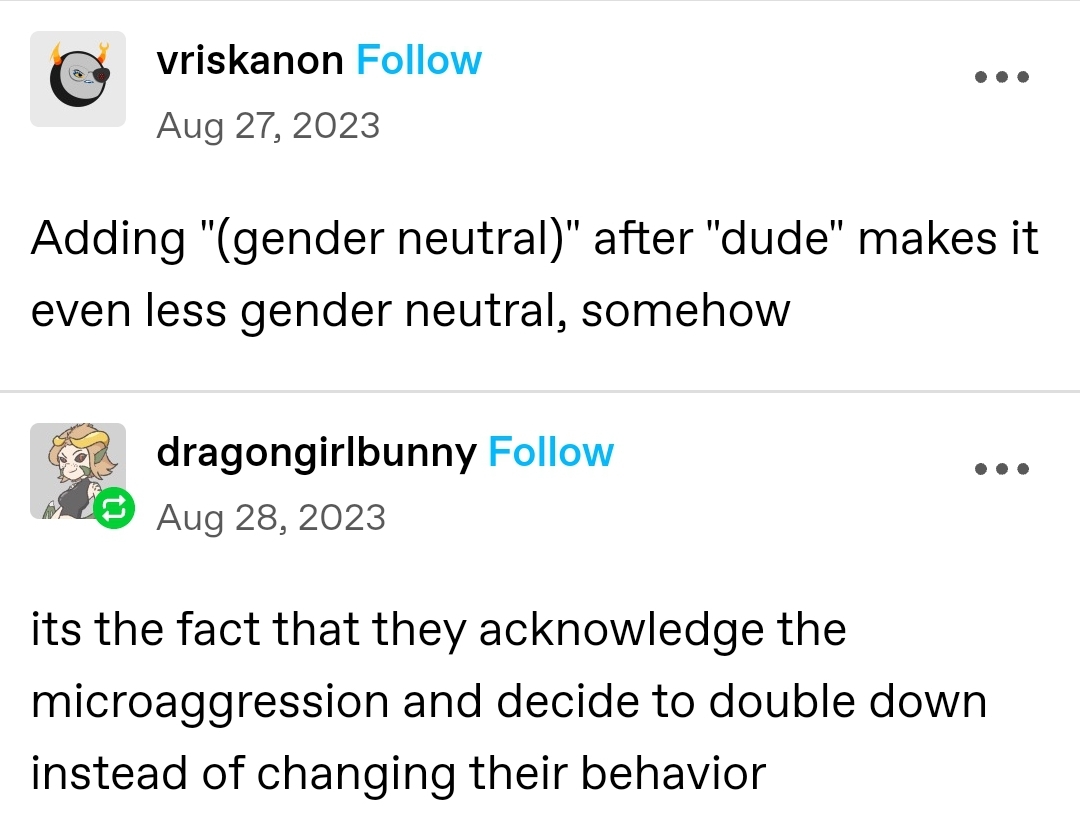
Like so many conversations, people are confusing is with ought.
Is:
"Dude" is gender neutral if used as a discourse marker because discourse markers aren't about addressing a particular person, but used in managing the flow of a discussion. It shares commonality with words and phrases like "well," "oh," "I mean," "I guess," "yeah," and so on. Notice how words like "man" and "bruh" can also be used as discourse markers. I suspect what happened was dude/man/bruh was originally just a way to address a male listener and through grammaticalization, it acquired an additional use as discourse markers. But the older way of using dude/man/bruh in order to address a male listener still exists. Ultimately, it's the difference between saying "man, let's get something to eat" and "man, this room is so big." But even then, there's also ambiguous cases like, "man, I'm hungry" which can go both ways as either a discourse marker "man, I'm hungry, I shouldn't've skipped breakfast" or directly addressing a male listener "man, I'm hungry, let's go out to eat."
Ought:
"Dude" ought to not be used as a discourse marker because there are ambiguous cases which causes confusion whether it's being used as a discourse marker or as a form of address. The consequence of this confusion is that non-male people risk being misgendered. It also can be weaponized by transphobes as well. I would say the easiest words to replace them with would be either "homie," which strictly speaking came from "homeboy" although "homegirl" has long since been adopted as well, or "cuz" from "cousin." The main obstacle is that both words are from AAVE and should these words be adopted for general use, it's going to be yet another case of non-Black people stealing words from Black people.
However, it's not just the case of not using "dude" as a discourse marker. It has to be replaced with another word. And in a sense, "dude" itself was the replacement word for "man." "Man, this sofa is fucking heavy." -> "Dude, this sofa is fucking heavy." But what does man/dude/bruh convey in those sentences? I suspect it's to be emphatic, the English equivalent of Japanese よ. Consider "this sofa is X," where X can be any appropriate adjective (heavy, cheap, brown, and so on)
To hesitantly or cautiously express that the sofa is X:
I guess the sofa is X.
I mean, the sofa is X.
Uh, the sofa is X.
To emphatically express that the sofa is X:
Man, the sofa is X.
Dude, the sofa is X.
Bruh, the sofa is X.
To make the sentence sound more natural, you add an appropriate adverb before X to get:
To hesitantly or cautiously express that the sofa is X:
I guess the sofa is kinda X.
I mean, the sofa is kinda X.
Uh, the sofa is kinda X.
To emphatically express that the sofa is X:
Man, the sofa is fucking X.
Dude, the sofa is fucking X.
Bruh, the sofa is fucking X.
Perhaps it's because man/dude/bruh originate as words for addressing men that it acquired its alternative use as a discourse maker used when you want to sound more assertive.
the linguistic angle here is genuinely fascinating, and relevant to a lot of this discussion. i think that even when used as discourse markers there's an amount of gender that remains attached, but i see what you're saying
i have to say though, that isn't the biggest issue the post was about. it was about being actually called a dude or a guy by people. a lot of the discussion here was about discourse markers but the og post is about people saying like. "hey dude, i'm not misgendering you" in reference to calling a trans woman "this guy" (real example!). very different problem, though i do appreciate your comment for putting a lot of ideas into words
Yes, absolutely. It's a case of linguistically defaulting to a masculine form. Not gramatically (grammatical gender is largely vestigial in contemporary English outside of personal pronouns), but semantically. This has been mentioned downthread, the original critique of these terms did not come from trans people, but ironically from radfems who opposed this default masculinity under a linguistic determinism angle, much moreso outside of the Anglosphere. For example, this is a major culture war issue in Germany, where reactionaries pretend that grammatically masculine terms, which are still commonly the default in German, are "gender neutral", whereas feminist and trans activists work on establishing actually gender neutral grammar as a new default.