[-] Trying2KnowMyself@lemmy.ml 8 points 10 hours ago

will likely be undercutting existing brands on price

We have data that supports consumer interest

bad for consumers

thonk

Oh, right! Because it perpetuates a culture that necessitates car ownership, right? anakin-padme-4

[-] Trying2KnowMyself@lemmy.ml 25 points 2 days ago* (last edited 2 days ago)

When have the Democrats actually defended abortion? They’ve had plenty of opportunities to codify it as a right, but they don’t actually want to do that. Their abortion policy is worse than Republicans because they’re dishonest about wanting to protect it, while the Republicans are honest about being assholes who don’t believe women should have rights.

[-] Trying2KnowMyself@lemmy.ml 27 points 2 days ago

People reflexively downvote Cowbee because they’re scared they might accidentally learn something.

[-] Trying2KnowMyself@lemmy.ml 11 points 2 days ago

I just wanna squish those cheeks so his mouth goes fish-shaped! juche-rose

[-] Trying2KnowMyself@lemmy.ml 22 points 2 days ago

The problem with Korea is that Kim is waaay too cute.

31
submitted 1 week ago by Trying2KnowMyself@lemmy.ml to c/usa@lemmy.ml

Reading by Tim Foley:

Subscribe now

There is nothing you can say to me to convince me that US regime change interventionism in the middle east is a swell idea.

There is nothing you can say to convince me that the Trump administration is telling us the truth about Iran.

There is nothing you can say to convince me that the mass media are telling us the truth about Iran.

There is nothing you can say to convince me the people who just spent two years incinerating Gaza have kind-hearted intentions for the Iranian people.

There is nothing you can say to convince me that protecting Israel is a good and desirable thing that westerners should support.

There is nothing you can say to convince me that the empire-like globe-spanning power alliance that is loosely centralized around Washington should be in charge of our world.

There is nothing you can say to convince me that I should help the US and Israel manufacture consent for a regime change war by criticizing the Iranian government in the middle of a frenzied war propaganda campaign.

It is not okay to be a grown adult in the year 2026 and still believe US regime change interventionism in the middle east will lead to positive outcomes.

It is not okay to live in a post-Iraq invasion world and still not understand that we are being lied to about Iran.

It is not okay to have lived through what these monsters did to Libya and still believe forcibly toppling the Iranian government is a moral and just cause to get behind.

It is not okay to have just watched these freaks turn Gaza into a gravel parking lot pervaded by the smell of rotting corpses and believe they have noble intentions for the people of Iran.

I don’t care if you are making your pro-regime change arguments from a right wing anti-Islam perspective, from a liberal humanitarian pro-democracy perspective, from a left-wing “solidarity with our Persian comrades” perspective, or from an “oppose all tyranny equally” anarchist perspective. Your arguments are shit, and your position is wrong.

The agenda to oust the Iranian government is about dominating the planet in general and the middle east in particular. You might think it’s about something else, but you are wrong. It’s about power and control, and all your fanciful notions about freedom and democracy for the Iranian people will be instantly subordinated to those goals. If this isn’t obvious to you, you’re an idiot.

The goal is not to bring freedom and democracy to the Iranian people. The US and Israel do not permit democracy to thrive in the middle east unless they can control its outcomes, as they are working to do right now in Iraq. The US and Israel are not popular enough in the middle east for the people to be allowed to control their own government.

The goal is to either install a puppet regime in Tehran, or to balkanize the nation into multiple independent states which can be easily controlled, or to plunge the entire state into unmanageable chaos like they did in Libya. None of these plans advance the interests of the Iranian people.

If you support Trump’s regime change agendas in Iran, then you support inflicting this upon the Iranian people. That’s what you get under the best-case scenario. Under the worst-case scenario, you get a hot war between the US and Iran which unleashes horrors you cannot possibly imagine. It will make the Iraq invasion and all the fallout therefrom look like an episode of Spongebob.

There is nothing you can say to me to cause me to support this. Call me a traitor. Call me a dictator lover. Call me an antisemite. Tell me all you want to tell me about how mean and bad Iran’s leadership is. I won’t care. I will dismiss you, because you are my enemy.

Anyone who supports war with Iran is my enemy. Anyone who would want to inflict such horrors upon the human species is an enemy of humanity.

I promise I will not be moved on this. I like to keep an open mind, as the saying goes, but not so open my brain falls out.

______________

Caitlin’s Newsletter is a reader-supported publication. To receive new posts and support my work, consider becoming a free or paid subscriber.

The best way to make sure you see everything I write is to get on my free mailing list. My work is entirely reader-supported, so if you enjoyed this piece here are some options where you can toss some money into my tip jar if you want to. Click here for links for my social media, books, merch, and audio/video versions of each article. All my work is free to bootleg and use in any way, shape or form; republish it, translate it, use it on merchandise; whatever you want. All works co-authored with my husband Tim Foley.

Bitcoin donations: 1Ac7PCQXoQoLA9Sh8fhAgiU3PHA2EX5Zm2

Feature image via Adobe Stock.


From Caitlin’s Newsletter via This RSS Feed.

6

Disabled Students

A new report has found that UK universities still aren’t doing enough to support disabled students. The 2025 Access Insights report from Disabled Students UK found that 63% of disabled students have gone without adjustments.

Disabled students

Disabled Students UK surveyed over 1,000 students from over 100 universities about their experiences. This is the third year the study has run and the largest into Higher Education accessibility in the UK. It’s particularly relevant now with the government focusing on getting young disabled people into education.

So you’d think with the push to get disabled people into education that it would at least be accessible, right? Wrong.

As the report says

Disabled students are not new in Higher Education. What is new is the growing body of evidence that shows, year after year, where and how our systems continue to fail them.

Attitudes improving, but access worsening

One good thing discovered in the survey is that attitudes from staff are better than in previous years. There’s also seemingly a greater understanding of disability now. However, 20% have been made to feel unwelcome by staff. As the report notes, this goes alongside structural barriers that stop disabled people from progressing and doing as well as their nondisabled peers.

The report found that although support can be agreed by staff, it isn’t necessarily delivered. Less than half of those surveyed said their approved adjustments were consistently implemented. 63% of disabled students ended up studying without their adjustments. A big reason for this is that chasing them up repeatedly takes too much time and energy. Just 44% said that all their agreed adjustments had been followed through with.

The amount of disabled students being able to get official personalised support from Disability Services fell last year. 66% of disabled students had a support plan, down from 77% in 2024. The proportion of declared students with a support plan fell from 77% in 2024 to 66% in 2025 and fewer students met with a Disability Advisor, suggesting a shift towards more informal or automated models of support under growing capacity pressure.

Disabled students can’t physically get to class

Many students were concerned that measures which came into place at the start of the COVID pandemic are now being rolled back. These of course made studying more accessible for disabled students. The survey found that remote or hybrid lectures are being stopped. Even measures such as lecture recording don’t happen as much.

As the report says:

These decisions are frequently justified as restoring educational quality or campus experience, yet they disproportionately exclude already marginalised students.

This represents a failure to learn from evidence. Universities have seen that these measures work. Choosing not to retain them is a choice that prioritises convenience or tradition over accessibility.

On top of this, students are still struggling to physically access lectures. Disabled students are still struggling against inaccessible buildings, unsuitable teaching spaces and inflexible timetabling.

Accessible uni accommodation also a problem. Students report that this is limited and often more expensive than other accommodation options. 47% of disabled students said they had to pay extra for accessible student housing.

Access fails make disabled students feel unsafe

Scarily, the report found a “significant proportion” are not confident that they would be able to safely evacuate their university buildings in a fire.

The report also found that despite all the access failures, many students did not feel safe or confident enough to challenge decisions or chase up support. Awareness of the complaints support is also low, so many do not report issues. Some who did complain said that their treatment had worsened afterwards.

Students also reported that complex systems were hard to navigate. This means those with less capacity for these tasks are less likely to seek help for access failures.

As a result, failures are not formally recorded, so universities are unaware of them. And the only people who face consequences are the disabled people whose lives are made worse by access failures.

Despite this, students said that staff are more supportive and understanding. However lack of training and being unclear about their responsibilities towards disabled students undermined this.

What needs to happen

Disabled Students UK have some recommendations for UK universities to make studying easier for disabled students

They say that agreed support must be met, and this should be monitored across the students’ time at uni. There should also be consequences when needs are not met. DSUK also says the administrative burden on students must be reduced. Disability Services should also work alongside other parts of the university, as opposed to being there to compensate for inaccessibility. It must also be easier and safer for disabled students to raise issues, without fear of mistreatment.

The organisation wants universities to take clear ownership of accessibility. It also expresses how important it is that any cost-cutting exercises are assessed on how they would impact disabled students. They also want universities to avoid rolling back measures that clearly help disabled students.

Labour once again proves they don’t care about disabled people.

Let’s not forget that this is all happening while the government is obsessed with young disabled people who are Not in Employment, Education or Training (NEET). You’d think then that they’d be investing more to ensure that disabled people can actually get into education. But that would assume that they actually want to help disabled people into education, instead of just demonising us.

Because it’s far easier to call disabled young people lazy, than it is to actually support them to thrive.

Featured image via Studying in the UK

By Rachel Charlton-Dailey


From Canary via This RSS Feed.

39

Budapest Pride

Erin In The Morning is a reader-supported publication. To receive new posts and support my work, consider becoming a subscriber.

Mayor Gergely Karácsony of Budapest did not ask for permission. He led by example, standing alongside hundreds of thousands of Hungarians pouring into the streets of his city for the 30th annual Pride Month celebration last year.

Meanwhile, the country’s authoritarian right-wing government made public displays of queerness illegal.

Now, Mayor Karácsony is being charged for organizing an unlawful assembly despite a prohibition order, PBS reports. The Budapest Chief Prosecutor’s Office said it will seek to impose fines without a trial.

“I refuse to be intimidated or silenced,” Karácsony wrote in a Jan. 28 post on X. “I will never accept that standing up for freedom, free speech, or love can be treated as a crime. Despite threats or punishment, I will continue to fight. Freedom and love cannot be banned!”

Ahead of the March 2025 Pride event, Hungarian authorities threatened organizers with years of imprisonment. They also said they would deploy facial recognition software against attendees to track them and impose fines, but after 350,000 people marched on Budapest (as per organizers, although crowd estimates vary), police backtracked.

Earlier that month, the country’s authoritarian right-wing party, shepherded by Prime Minister Viktor Orbán, passed a law barring any public assembly that “promotes and displays deviations from the gender identity corresponding to the sex at birth, gender change, and homosexuality.”

In April, a constitutional amendment was added in a similar vein, enshrining the right of children’s “moral development” as the foremost law of the land, superseding nearly every other right.

In reality, this rhetorical cudgel wherein extremists pearl-clutch about “the children” is, as it is in many authoritarian regimes, a convenient scapegoat. The real goal is to attack the LGBTQ community, and to repress free speech more broadly.

“The spurious justification for the passing of this law—that events and assemblies would be ‘harmful to children’—is based on harmful stereotypes and deeply entrenched discrimination, homophobia and transphobia,” said Dávid Vig, Director of Amnesty International Hungary at the time.

But organizers are maintaining a defiant tone. In emails with Erin in the Morning, they said they’ll be coming back this year for Pride 2026, this time in June.

“At Budapest Pride, we will continue to stand firm in our support of the fundamental freedoms that everyone is entitled to,” a spokesperson said. “We stand up for ourselves, we stand up for each other, because we want to live in a free, peaceful and equal country.”

Hungary has been in the news a great deal recently due to its anti-LGBTQ policies, as it was the first contemporary EU country to enact a Pride ban. Romania soon followed.

“For the first time in its 13-year history, setbacks in human rights of trans people across Europe and Central Asia now clearly outweigh progress,” a TGEU (Trans Europe and Central Asia) report found in May. “This regression signals more than just a crisis for trans communities—it is a broader crisis of democracy and fundamental rights across the region.”

Furthermore, Orbán has become a disturbing fixture in American politics, helping lawmakers here in the States pioneer new and creative ways to antagonize LGBTQ people.

“About the Don’t Say Gay law, it was in fact modeled in part on what Hungary did,” Rod Dreher, an editor at the American Conservative magazine, said during a panel interview in Budapest. Vox first reported this story.

“I was told this by a conservative reporter who […] said he talked to the press secretary of Governor Ron DeSantis of Florida and she said, ‘Oh yeah, we were watching the Hungarians, so yay Hungary.’”

Meanwhile, CPAC—the Conservative Political Action Conference, a highly influential yearly gathering of (largely American) conservatives—was co-hosted last year by Hungary and Poland. The headlining keynote speaker was Prime Minister Orbán.

“The Trump tsunami swept through the entire world,” Orbán said. “We are no longer suffocating in the woke sea.”

The risks facing LGBTQ people across the world in this political moment are dire. At the same time, the fact remains that authoritarians—no matter the continent—rule by fear.

As seen at Budapest Pride, many of their threats cannot be carried out to scale. There’s more of us than there are of them.

Erin In The Morning is a reader-supported publication. To receive new posts and support my work, consider becoming a subscriber.


From Erin In The Morning via This RSS Feed.

[-] Trying2KnowMyself@lemmy.ml 45 points 1 week ago

You can go back to brunch now. You’re welcome.

25

Nearly two weeks after finally being freed from the Israeli military prison Neve Tzedek, 18-year-old conscientious objector Yuval Peleg forcefully called out the Israel Defense Forces in a Monday statement shared by Amnesty International.

"After five times being imprisoned and a total of 130 days spent in military prison for refusing to enlist in the IDF, I have finally been released and exempt from army service. I am incredibly happy to be out of prison," said Peleg, who was released January 6.

Even though Peleg made his objection to compulsory enlistment clear through the refusal process by the conscientious objector network Mesarvot, and to IDF representatives at the recruitment center in Ramat Gan last year, the military initially declared his refusal to be disobedience. Amnesty has advocated for the release of Peleg and other "prisoners of conscience."

The video below was shared by Mesarvot in November, when Peleg was released from his fourth stint behind bars.

Yuval Peleg was released today after 100 days in military prison and is expected to return in the coming days for a fifth term of imprisonment.

Hear his words to @amnesty about his refusal to serve in the IDF: https://t.co/4mZqG8bFOJ pic.twitter.com/jFk1iYqiX1
— Mesarvot מסרבות (@Mesarvot_) November 19, 2025

"It was a difficult experience, and lasted longer than I had hoped," Peleg said Monday, "but I want to thank everyone at Amnesty International for the support—it was incredibly strengthening to know that even though I'm imprisoned there are people all over the world who support my actions and are pushing for my release, and without them I'm not sure how I would have gotten through it."

"As difficult as this was, I do not regret refusing the draft and would do so again," he continued. "The IDF has proven itself to be a despicable, criminal organization, and there is no excuse for joining it. I, and many others, will continue to fight and oppose it as long as is necessary. I would like to remind everyone that while I have finally been freed, there are still two other conscientious objectors in prison currently, and another that might be sent back. I hope they all get released as soon as possible, and support them throughout their incarceration."

"Most importantly, the criminal actions of the IDF and state of Israel have not ceased," Peleg stressed, pointing to the Israeli assault on the Gaza Strip launched after the Hamas-led October 7, 2023 attack. Since then, Israeli forces have killed at least 71,550 Palestinians in Gaza and wounded 171,365, according to local health officials. Global experts warn the true toll is likely far higher.

The IDF's killing has continued despite a ceasefire agreement between Hamas and Israel in October. Since then, the Gaza Health Ministry said Monday, Israel has killed 465 Palestinians and injured 1,287, plus 713 bodies have been found beneath the rubble.

Scholars, world leaders, human rights groups—including Amnesty—and other critics like Peleg call the Israeli assault genocide. The conscientious objector noted Monday that "the genocide in Gaza is ongoing despite the facetious 'ceasefire' and the now almost 60-year occupation of the West Bank keeps accelerating, to add to the campaign of ethnic cleansing carried out by the Zionists since even before 1948."

"This is what truly must be fought against," he said, "and as long as it continues, so will the resistance to it."

Peleg's comments came after Reuters reported Friday that not only are Palestinians in Gaza suffering "a volcano" of psychological trauma, but also Israel's Defense Ministry has recorded a nearly 40% increase in post-traumatic stress disorder among its troops since September 2023, with 60% of the 22,300 people being treated for war wounds experiencing PTSD.

"An Israeli parliamentary committee found in October that 279 soldiers had attempted suicide in the period from January 2024 to July 2025, a sharp increase from previous years," according to the news agency. "The report found that combat soldiers comprised 78% of all suicide cases in Israel in 2024."

The US 988 Suicide & Crisis Lifeline—which offers 24/7, free, and confidential support—can be reached by calling or texting 988, or through chat at 988lifeline.org. For the Veterans Crisis Line, dial 988, then press 1, or text 838255.


From Common Dreams via This RSS Feed.

52
“Fuck I.C.E.” - No$hu (noshumusic.bandcamp.com)
submitted 3 weeks ago* (last edited 3 weeks ago) by Trying2KnowMyself@lemmy.ml to c/music@lemmy.ml
13

cross-posted from: https://news.abolish.capital/post/19017

By Nikos Mottas

The widespread claim that recent imperialist bluntness, epitomized by the Trump doctrine, has “destroyed international law” rests on a false premise: that such a law ever existed as a binding, neutral framework above imperialism.

From a Marxist-Leninist standpoint, this belief is not an error of detail but a fundamental ideological illusion. Imperialism has never been restrained by international law. On the contrary, what is called “international law” has always been a secondary product of imperialist relations, tolerated only insofar as it served monopoly interests and discarded whenever it ceased to do so.

The present moment, marked by open treaty violations, contempt for institutions, and unapologetic coercion, does not signal a descent into barbarism. It signals the collapse of the ideological form through which barbarism was previously administered.

Any serious discussion must begin with the Marxist theory of law itself. Lenin, following Marx and Engels, rejected the liberal notion of law as a neutral arbiter. In The State and Revolution, he dismantles this illusion at its root:

“The state is a product and a manifestation of the irreconcilability of class antagonisms. The state arises where, when and insofar as class antagonisms objectively cannot be reconciled. And, conversely, the existence of the state proves that the class antagonisms are irreconcilable.”

And further:

“The state is an organ of class rule, an organ for the oppression of one class by another; it creates ‘order’, which legalizes and perpetuates this oppression by moderating the collision between the classes.”

Law, therefore, is not a universal moral code. It is a political instrument, inseparable from state power and class domination. What law does domestically for the bourgeois state, so-called international law does globally for imperialist powers: it legalizes domination, stabilizes exploitation, and disguises coercion as order.

There is no supranational authority standing above classes and states. There is only the world system of capitalism, and at its highest stage, imperialism.

Lenin’s masterpiece Imperialism, the Highest Stage of Capitalism provides the decisive theoretical framework. Imperialism, he explains, is not merely aggressive foreign policy but a structural phase of capitalism defined by monopolies, export of capital, and the division of the world among great powers.

Within this system, treaties and legal frameworks cannot be stable or binding. As Lenin demonstrated, agreements between imperialist powers are nothing more than temporary truces between wars.

And even more decisively he writes:

“Peaceful alliances prepare the ground for wars, and in their turn grow out of wars; the one conditions the other, producing alternating forms of peaceful and non-peaceful struggle on one and the same basis of imperialist connections and relations.”

This passage alone renders the concept of a permanent, rules-based international legal order under imperialism theoretically impossible. If agreements are merely truces, then law is merely a momentary crystallization of force.

International law does not restrain imperialism; it registers its temporary balance.

The historical record fully confirms Lenin’s analysis. Imperialism has never hesitated to annihilate its own legal frameworks when they conflicted with strategic or economic interests. World War I destroyed every existing treaty system in the struggle for colonial redistribution. The atomic bombings of Hiroshima and Nagasaki obliterated entire cities without any legal or moral justification. The Vietnam War involved systematic violations of humanitarian law on a massive scale. The NATO bombing of Yugoslavia in 1999 was conducted without UN authorization. The invasion of Iraq in 2003 proceeded despite the absence of any legal mandate. The destruction of Libya in 2011 transformed a limited resolution into regime change and permanent chaos. Sanctions regimes in the 21st century institutionalize collective punishment of civilian populations in direct contradiction to proclaimed legal norms.

These are not exceptions. They are the normal functioning of imperialism.

For long periods, imperialism preferred to rule behind legal and humanitarian rhetoric. Institutions, courts, and treaties were useful tools for managing rivalries, disciplining weaker states, and integrating reformist forces into imperialist governance. Law functioned as ideological cement, not as restraint.

As Stalin emphasized, “the equality of nations under capitalism is a deceptive phrase”, since alongside formal equality there exists “actual inequality in economic and political development, inequality in strength”, an inequality that “determines everything.”

This is not cynicism. It is materialism.

What distinguishes recent imperialist conduct is not its content but its form. As contradictions sharpened — economic stagnation, intensified inter-imperialist competition, internal social polarization — the ideological value of legal language declined. Open coercion replaced ritualized justification.

Lenin warned against mistaking changes of form for changes of essence. In Left-Wing Communism: An Infantile Disorder, he stressed that communists must judge governments not by their words or declarations, but by their deeds

Judged by deeds, imperialism today behaves exactly as it always has. What has changed is merely the degree of ideological camouflage.

This analysis must not removed into moral denunciation of one state or leader. Imperialism is not a national pathology; it is a global system. Multilateralism does not abolish imperialist domination — it coordinates it.

Lenin made this point unequivocally:

“The bourgeoisie of all countries is united against the proletariat, but this does not eliminate the struggle among the bourgeoisie of different countries for domination and for markets.”

Whether domination is exercised unilaterally or multilaterally is irrelevant to the oppressed. The substance remains exploitation, coercion, and subordination.

International law functions most efficiently against those without power. Liberation movements are criminalized. Independent economic policies are punished. Whole populations are sanctioned. Law becomes a weapon wielded selectively, binding the weak and dissolving before the strong.

This is not a betrayal of international law. It is its real content under imperialism.

Marxism-Leninism does not advocate a return to “respect for international law.” That demand presupposes that imperialism can be regulated ethically. Lenin rejected this outright. In Socialism and War, he stated unambiguously:

“So long as capitalism exists, wars are inevitable. Wars are a necessary and inevitable result of capitalism.”

Where war is inevitable, law cannot rule. The task of communists, therefore, is not to repair imperialist legality but to abolish the material conditions that render legality impossible: monopoly ownership, capitalist exploitation, and imperialist competition.

The exposure of imperialism’s naked face is not a loss for humanity. It is a gain in clarity. The collapse of legal illusions forces a confrontation with reality.

There is no international law under imperialism. In reality, there is only force, temporarily codified, and power, briefly legalized.

Only the overthrow of imperialism itself can make genuine equality between peoples possible. Until then, “international law” will remain what it has always been: the handwriting of the powerful — erased the moment it ceases to serve them.

* Nikos Mottas is the Editor-in-Chief of In Defense of Communism.


From In Defense of Communism via This RSS Feed.

[-] Trying2KnowMyself@lemmy.ml 58 points 1 month ago

First good cop doggo-matapacos

11
55

The Atlantic recently published an article about Albert Einstein’s brilliant politics. This is not that article. Instead, it’s one by Einstein.

Is it advisable for one who is not an expert on economic and social issues to express views on the subject of socialism? I believe for a number of reasons that it is.

Let us first consider the question from the point of view of scientific knowledge. It might appear that there are no essential methodological differences between astronomy and economics: scientists in both fields attempt to discover laws of general acceptability for a circumscribed group of phenomena in order to make the interconnection of these phenomena as clearly understandable as possible. But in reality such methodological differences do exist. The discovery of general laws in the field of economics is made difficult by the circumstance that observed economic phenomena are often affected by many factors which are very hard to evaluate separately. In addition, the experience which has accumulated since the beginning of the so-called civilized period of human history has—as is well known—been largely influenced and limited by causes which are by no means exclusively economic in nature. For example, most of the major states of history owed their existence to conquest. The conquering peoples established themselves, legally and economically, as the privileged class of the conquered country. They seized for themselves a monopoly of the land ownership and appointed a priesthood from among their own ranks. The priests, in control of education, made the class division of society into a permanent institution and created a system of values by which the people were thenceforth, to a large extent unconsciously, guided in their social behavior.

But historic tradition is, so to speak, of yesterday; nowhere have we really overcome what Thorstein Veblen called “the predatory phase” of human development. The observable economic facts belong to that phase and even such laws as we can derive from them are not applicable to other phases. Since the real purpose of socialism is precisely to overcome and advance beyond the predatory phase of human development, economic science in its present state can throw little light on the socialist society of the future.

Second, socialism is directed towards a social-ethical end. Science, however, cannot create ends and, even less, instill them in human beings; science, at most, can supply the means by which to attain certain ends. But the ends themselves are conceived by personalities with lofty ethical ideals and—if these ends are not stillborn, but vital and vigorous—are adopted and carried forward by those many human beings who, half unconsciously, determine the slow evolution of society.

For these reasons, we should be on our guard not to overestimate science and scientific methods when it is a question of human problems; and we should not assume that experts are the only ones who have a right to express themselves on questions affecting the organization of society.

Innumerable voices have been asserting for some time now that human society is passing through a crisis, that its stability has been gravely shattered. It is characteristic of such a situation that individuals feel indifferent or even hostile toward the group, small or large, to which they belong. In order to illustrate my meaning, let me record here a personal experience. I recently discussed with an intelligent and well-disposed man the threat of another war, which in my opinion would seriously endanger the existence of mankind, and I remarked that only a supra-national organization would offer protection from that danger. Thereupon my visitor, very calmly and coolly, said to me: “Why are you so deeply opposed to the disappearance of the human race?”

I am sure that as little as a century ago no one would have so lightly made a statement of this kind. It is the statement of a man who has striven in vain to attain an equilibrium within himself and has more or less lost hope of succeeding. It is the expression of a painful solitude and isolation from which so many people are suffering in these days. What is the cause? Is there a way out?

It is easy to raise such questions, but difficult to answer them with any degree of assurance. I must try, however, as best I can, although I am very conscious of the fact that our feelings and strivings are often contradictory and obscure and that they cannot be expressed in easy and simple formulas.

Man is, at one and the same time, a solitary being and a social being. As a solitary being, he attempts to protect his own existence and that of those who are closest to him, to satisfy his personal desires, and to develop his innate abilities. As a social being, he seeks to gain the recognition and affection of his fellow human beings, to share in their pleasures, to comfort them in their sorrows, and to improve their conditions of life. Only the existence of these varied, frequently conflicting, strivings accounts for the special character of a man, and their specific combination determines the extent to which an individual can achieve an inner equilibrium and can contribute to the well-being of society. It is quite possible that the relative strength of these two drives is, in the main, fixed by inheritance. But the personality that finally emerges is largely formed by the environment in which a man happens to find himself during his development, by the structure of the society in which he grows up, by the tradition of that society, and by its appraisal of particular types of behavior. The abstract concept “society” means to the individual human being the sum total of his direct and indirect relations to his contemporaries and to all the people of earlier generations. The individual is able to think, feel, strive, and work by himself; but he depends so much upon society—in his physical, intellectual, and emotional existence—that it is impossible to think of him, or to understand him, outside the framework of society. It is “society” which provides man with food, clothing, a home, the tools of work, language, the forms of thought, and most of the content of thought; his life is made possible through the labor and the accomplishments of the many millions past and present who are all hidden behind the small word “society.”

It is evident, therefore, that the dependence of the individual upon society is a fact of nature which cannot be abolished—just as in the case of ants and bees. However, while the whole life process of ants and bees is fixed down to the smallest detail by rigid, hereditary instincts, the social pattern and interrelationships of human beings are very variable and susceptible to change. Memory, the capacity to make new combinations, the gift of oral communication have made possible developments among human being which are not dictated by biological necessities. Such developments manifest themselves in traditions, institutions, and organizations; in literature; in scientific and engineering accomplishments; in works of art. This explains how it happens that, in a certain sense, man can influence his life through his own conduct, and that in this process conscious thinking and wanting can play a part.

Man acquires at birth, through heredity, a biological constitution which we must consider fixed and unalterable, including the natural urges which are characteristic of the human species. In addition, during his lifetime, he acquires a cultural constitution which he adopts from society through communication and through many other types of influences. It is this cultural constitution which, with the passage of time, is subject to change and which determines to a very large extent the relationship between the individual and society. Modern anthropology has taught us, through comparative investigation of so-called primitive cultures, that the social behavior of human beings may differ greatly, depending upon prevailing cultural patterns and the types of organization which predominate in society. It is on this that those who are striving to improve the lot of man may ground their hopes: human beings are not condemned, because of their biological constitution, to annihilate each other or to be at the mercy of a cruel, self-inflicted fate.

If we ask ourselves how the structure of society and the cultural attitude of man should be changed in order to make human life as satisfying as possible, we should constantly be conscious of the fact that there are certain conditions which we are unable to modify. As mentioned before, the biological nature of man is, for all practical purposes, not subject to change. Furthermore, technological and demographic developments of the last few centuries have created conditions which are here to stay. In relatively densely settled populations with the goods which are indispensable to their continued existence, an extreme division of labor and a highly-centralized productive apparatus are absolutely necessary. The time—which, looking back, seems so idyllic—is gone forever when individuals or relatively small groups could be completely self-sufficient. It is only a slight exaggeration to say that mankind constitutes even now a planetary community of production and consumption.

I have now reached the point where I may indicate briefly what to me constitutes the essence of the crisis of our time. It concerns the relationship of the individual to society. The individual has become more conscious than ever of his dependence upon society. But he does not experience this dependence as a positive asset, as an organic tie, as a protective force, but rather as a threat to his natural rights, or even to his economic existence. Moreover, his position in society is such that the egotistical drives of his make-up are constantly being accentuated, while his social drives, which are by nature weaker, progressively deteriorate. All human beings, whatever their position in society, are suffering from this process of deterioration. Unknowingly prisoners of their own egotism, they feel insecure, lonely, and deprived of the naive, simple, and unsophisticated enjoyment of life. Man can find meaning in life, short and perilous as it is, only through devoting himself to society.

The economic anarchy of capitalist society as it exists today is, in my opinion, the real source of the evil. We see before us a huge community of producers the members of which are unceasingly striving to deprive each other of the fruits of their collective labor—not by force, but on the whole in faithful compliance with legally established rules. In this respect, it is important to realize that the means of production—that is to say, the entire productive capacity that is needed for producing consumer goods as well as additional capital goods—may legally be, and for the most part are, the private property of individuals.

For the sake of simplicity, in the discussion that follows I shall call “workers” all those who do not share in the ownership of the means of production—although this does not quite correspond to the customary use of the term. The owner of the means of production is in a position to purchase the labor power of the worker. By using the means of production, the worker produces new goods which become the property of the capitalist. The essential point about this process is the relation between what the worker produces and what he is paid, both measured in terms of real value. Insofar as the labor contract is “free,” what the worker receives is determined not by the real value of the goods he produces, but by his minimum needs and by the capitalists’ requirements for labor power in relation to the number of workers competing for jobs. It is important to understand that even in theory the payment of the worker is not determined by the value of his product.

Private capital tends to become concentrated in few hands, partly because of competition among the capitalists, and partly because technological development and the increasing division of labor encourage the formation of larger units of production at the expense of smaller ones. The result of these developments is an oligarchy of private capital the enormous power of which cannot be effectively checked even by a democratically organized political society. This is true since the members of legislative bodies are selected by political parties, largely financed or otherwise influenced by private capitalists who, for all practical purposes, separate the electorate from the legislature. The consequence is that the representatives of the people do not in fact sufficiently protect the interests of the underprivileged sections of the population. Moreover, under existing conditions, private capitalists inevitably control, directly or indirectly, the main sources of information (press, radio, education). It is thus extremely difficult, and indeed in most cases quite impossible, for the individual citizen to come to objective conclusions and to make intelligent use of his political rights.

The situation prevailing in an economy based on the private ownership of capital is thus characterized by two main principles: first, means of production (capital) are privately owned and the owners dispose of them as they see fit; second, the labor contract is free. Of course, there is no such thing as a pure capitalist society in this sense. In particular, it should be noted that the workers, through long and bitter political struggles, have succeeded in securing a somewhat improved form of the “free labor contract” for certain categories of workers. But taken as a whole, the present day economy does not differ much from “pure” capitalism.

Production is carried on for profit, not for use. There is no provision that all those able and willing to work will always be in a position to find employment; an “army of unemployed” almost always exists. The worker is constantly in fear of losing his job. Since unemployed and poorly paid workers do not provide a profitable market, the production of consumers’ goods is restricted, and great hardship is the consequence. Technological progress frequently results in more unemployment rather than in an easing of the burden of work for all. The profit motive, in conjunction with competition among capitalists, is responsible for an instability in the accumulation and utilization of capital which leads to increasingly severe depressions. Unlimited competition leads to a huge waste of labor, and to that crippling of the social consciousness of individuals which I mentioned before.

This crippling of individuals I consider the worst evil of capitalism. Our whole educational system suffers from this evil. An exaggerated competitive attitude is inculcated into the student, who is trained to worship acquisitive success as a preparation for his future career.

I am convinced there is only one way to eliminate these grave evils, namely through the establishment of a socialist economy, accompanied by an educational system which would be oriented toward social goals. In such an economy, the means of production are owned by society itself and are utilized in a planned fashion. A planned economy, which adjusts production to the needs of the community, would distribute the work to be done among all those able to work and would guarantee a livelihood to every man, woman, and child. The education of the individual, in addition to promoting his own innate abilities, would attempt to develop in him a sense of responsibility for his fellow men in place of the glorification of power and success in our present society.

Nevertheless, it is necessary to remember that a planned economy is not yet socialism. A planned economy as such may be accompanied by the complete enslavement of the individual. The achievement of socialism requires the solution of some extremely difficult socio-political problems: how is it possible, in view of the far-reaching centralization of political and economic power, to prevent bureaucracy from becoming all-powerful and overweening? How can the rights of the individual be protected and therewith a democratic counterweight to the power of bureaucracy be assured?

Clarity about the aims and problems of socialism is of greatest significance in our age of transition. Since, under present circumstances, free and unhindered discussion of these problems has come under a powerful taboo, I consider the foundation of this magazine to be an important public service.

[-] Trying2KnowMyself@lemmy.ml 46 points 1 month ago

First honest cop?

[-] Trying2KnowMyself@lemmy.ml 37 points 1 month ago

IMO exceptions are sometimes necessary.

Eat the rich.

[-] Trying2KnowMyself@lemmy.ml 90 points 1 month ago

5 years ago

2012

yells-at-cloud

6
134
Tag Yourself (lemmy.ml)
20
submitted 1 month ago by Trying2KnowMyself@lemmy.ml to c/usa@lemmy.ml

https://archive.ph/Obwjc

I thought they had to quickly reverse course on this after they announced it? Apparently not.

10

cross-posted from: https://news.abolish.capital/post/13873

Talking Point: “Communism/socialism sounds good on paper, but it doesn’t work in the real world. It goes against human nature. It’s a nice theory that always fails in practice.”

Summary:

Historic.ly is a reader-supported publication. To receive new posts and support my work, consider becoming a free or paid subscriber.

This is perhaps the single-most common dismissal used by capitalists against socialist governments. This is repeated ubiquitously against across all capitalist and conservative sources as an Axiom. This aphorism appears in countless forms but rarely with specific attribution - it’s treated as received wisdom that needs no justification. The argument implies that:

  1. The theory is internally consistent and appealing,
  2. BUT human nature or practical realities make it impossible,
  3. Every attempt has failed, proving it can’t work,
  4. Advocates are naive idealists ignoring reality.

Variants:

  • “Real communism has never been tried” (mockery of defenders)
  • “It’s utopian thinking”
  • “Sounds good, doesn’t work”
  • “Nice idea, wrong species”
  • “Human nature makes it impossible”
  • “You can’t change human nature”

The rhetorical function allows the person making the argument seem reasonable (”I understand the appeal...”) while dismissing the actual counterpoint entirely. Positions capitalism as “realistic” and “practical” vs. socialism as “idealistic” and “theoretical.” It frames issue as settled empirical fact rather than debatable question and it functions as a thought-stopping cliché that ends discussion before it begins.

Sources:

  • Pervasive across Cato Institute, Mises Institute, TPUSA, PragerU materials
  • Repeated by Milton Friedman, Thomas Sowell, and other prominent conservatives
  • Standard conservative talking point found in political discourse, social media, and casual conversation
  • Hoover Institution: “The False Appeal of Socialism” (2020)
  • Frequently cited without attribution as “common knowledge”

The genius (and weakness) of this argument is that it’s designed to be unattributable - it masquerades as universal wisdom rather than ideological propaganda.

Rebuttal

CAPITALISM DOESN’T EVEN WORK IN THEORY!

This argument is designed to masquerade as universal wisdom instead of an ideological propaganda. “It’s repeated everywhere precisely because it’s a thought-stopping cliché, not an actual analysis.” Everyone who makes this argument always advocate for another system: Capitalism.

It is meant to paint defenders of socialism and communism as idealists living in a utopian society while defenders of capitalism are painted as “realists” who understand the inner workings of the real world. However, nothing can be further from the truth.

While these anti-communists do concede to the fact that communism works in theory, they seem to forget that capitalism, doesn’t even work in theory, let alone in practice.

Why Capitalism Fails in Theory:

Contrary to popular belief, capitalism isn’t when people sell “things” or commodities, which is basically a thing of value that can be traded. Traditionally, people used money to buy commodities such as sugar or rice, and the majority would then consume most of it. However, around the 1600s something changed:industrialization. Commodities that were locally produced and sold, were now produced on a mass scale and sold non-locally in mass quantities. People who were already wealthy were able to use their money in order to trade for commodities in large quantities, not to use or acquire these commodities, but to resell it in order to acquire surplus value. Marx labeled this process the M-C-M’ cycle:

For example, if someone invests €100,000 to buy five cars and register them for ride-sharing services like Uber, the cars are not purchased for personal transportation, rather they are bought as capital. Drivers are hired to operated them. The cars are kept on the roads as much as possible. After a year, the entrepreneur has earned €160,000 in fares and commissions. This is the classic M–C–M′ cycle in modern form:

M (Money): €100,000 capital outlay

C (Commodity): Cars, app registrations, and labor time

M′ (More Money): €160,000 — the original sum plus surplus value extracted through the drivers’ work

The point isn’t that society gains more mobility — the cars’ use-value — but that money has returned to its owner augmented. The drivers’ labor and the vehicles’ wear are just the intermediaries through which money begets more money.

In Marx’s analysis, this raised a crucial question: where does that “more money” actually come from? It cannot come from the mere act of exchange, since every trade in a market swaps equivalents — €1,000 worth of goods for €1,000 in cash. The capitalist doesn’t create new value by buying and selling alone. To find the source of profit, Marx followed the chain backward and found it in the one place where something new is produced: the worker’s labor. The capitalist purchases labor power for less than the value it creates. The difference between what the worker is paid and the value their labor adds to the final product is the surplus value — and this, Marx argued, is where exploitation truly begins.

Which begets the first contradiction of capitalism: there’s only so much you can squeeze workers’ wages before the system begins to undermine itself. The more labor is exploited to maximize profit, the fewer people there are with the purchasing power to buy what capitalism produces. In other words, by impoverishing its own consumers, capital saws off the very branch it sits on. This creates a crisis of underconsumption. Capitalism ends up undermining its own market base.

The second way capitalism fails theoretically is that if there are multiple firms that produce the same commodity, each firm must expand their output to flush the competition out of business. But, when all the firms end up doing that simultaneously, the market becomes saturated and the price of the goods drop exponentially. This leads to periodic cycles of bankruptcies, layoffs and and boom and bust cycles. Many of which, we have witnessed in our lifetimes (depending on our age).

During these recurring crises, weaker firms collapse while stronger ones buy up their competitors. This process leads to the consolidation of ownership — both horizontally, when companies absorb rivals within the same industry, and vertically, when they expand control up and down the supply chain. Over time, this turns competitive markets into a handful of monopolies and cartels, exactly as Lenin described in Imperialism, the Highest Stage of Capitalism. What begins as a system of competition ends as a hierarchy of concentrated power.

As Lenin demonstrated in Imperialism: The Highest Stage of Capitalism, by 1907 just 0.9% of German enterprises controlled over half of all industrial workers and the majority of total output. What Marx had theorized as the concentration of capital had already become measurable reality.

Unfortunately, the contradictions and pitfalls don’t end there. As a handful of cartels and monopolies dominate production, their need for profit and raw materials grows insatiable. To keep their factories running and capital expanding, they must look beyond their own borders. Hence begins the drive to colonize the world — to seize new territories, control resources, and secure cheap labor. To keep their factories running and profits rising, they expand outward —colonizing the world. Colonialism reconfigured entire societies for extraction: in India, the British East India Company replaced food crops with tea, opium, and indigo; in Cuba, only sugar could be grown; in Rwanda, fertile farmland was seized for industrial coffee under German and Belgian rule. The result was the same everywhere — famine, dependence, and the destruction of local industry. Colonies that had once fed themselves were forced to import basic food from the imperial core, enriching the same corporations that had robbed them.

As Lenin explained in Imperialism: The Highest Stage of Capitalism, German enterprises entered the colonial race late. By the early 20th century, Britain and France had already divided most of the globe into their own spheres of exploitation. To secure access to raw materials and markets essential for its survival, German capital had only one option left — to seize colonies by force. Thus, imperial rivalry transformed into military conflict, culminating in the First World War: a struggle not of nations, but of capitalist powers fighting over a world that had already been divided.

Capitalism Fails in Practice

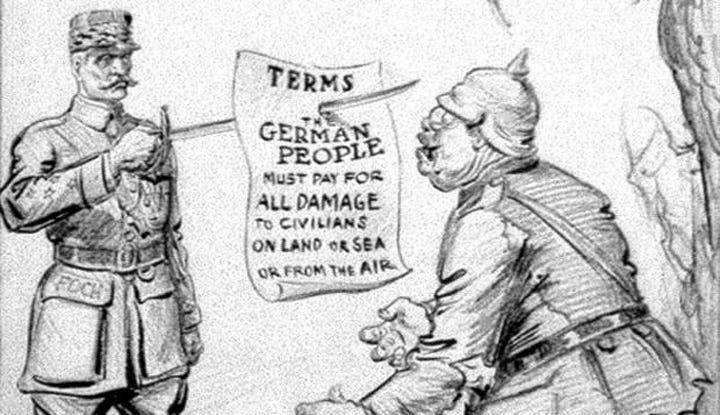
When the First World War ended, the map of empire changed, but its logic remained. The victors didn’t simply punish Germany for aggression — they neutralized an economic competitor. The Treaty of Versailles makes perfect sense when viewed through the lens of capitalist rivalry, not morality. France and Britain sought to permanently weaken Germany’s industrial base, which by 1914 had already surpassed both in steel production, chemical research, and machine manufacturing.

By stripping Germany of its colonies, restricting its military, seizing patents, and imposing astronomical reparations, the Allies ensured that German capital could not re-enter global markets as an equal competitor. Versailles wasn’t about peace; it was about market control. It froze the world’s hierarchy of production — guaranteeing that France and Britain would continue extracting from their colonies while German capital was deliberately handicapped.

Treaty of Versailles as Explained by a Satirical Cartoon of the time

The tragedy of Weimar Germany was not that fascism overpowered democracy, but that centrism surrendered to it. The ruling class, terrified of socialism and unwilling to sacrifice profits, preferred to dismantle democracy rather than risk redistribution. By the early 1930s, parliament had already hollowed itself out through emergency decrees, wage cuts, and deference to capital. Hitler did not overthrow the system; he inherited it.

As I wrote in The Economy of Evil, fascism did not emerge from chaos or irrationality. It was a rational response of a ruling class cornered by its own contradictions. When capitalism could no longer rule by consent, it ruled by coercion. Fascism became the mechanism through which industrialists preserved their property, destroyed unions, and restructured production under the guise of national renewal.

Parenti called it “capitalism in extremis” — the system defending itself with violence when ideology and markets fail. What began as economic crisis under Hindenburg and Brüning matured into political extermination under Hitler. Capital’s contradictions had finally produced their ultimate form: a state that openly fuses corporate, military, and nationalist power to annihilate class opposition.

In the end, the familiar refrain that “communism works only in theory but fails in practice” collapses under scrutiny, because capitalism has failed on both counts. Its theoretical foundations — competition, equilibrium, self-regulation — implode the moment they are practiced. Each stage of capitalist “progress” has revealed a deeper contradiction: the wage squeeze that undermines consumption, the overproduction that destroys markets, the imperial expansion that breeds world wars, and finally, the fascist synthesis that fuses capital with the state. These are not accidents of mismanagement but the logical outcomes of a system that can sustain itself only through crisis, conquest, and coercion. History’s lesson is not that communism failed to live up to its ideals — it is that capitalism inevitably lives down to its own.

Check out all the other arguments as I build the talking points:

Historic.ly is a reader-supported publication. To receive new posts and support my work, consider becoming a free or paid subscriber.


From Historic.ly via This RSS Feed.

[-] Trying2KnowMyself@lemmy.ml 84 points 1 month ago

uBlock Origin doesn’t work on radio, but it’s been a long time since I’ve had to endure ads on YouTube.

view more: next ›

Trying2KnowMyself

0 post score
0 comment score
joined 2 months ago