[–] 1 point 3 days ago* (1 child)

I like it, and its scaling difficulty is smart.


HexHunt #13 · 610/1400 · top 22%

🇯🇵 🇨🇳 🇸🇭 🇰🇪 🇵🇾 🇪🇬 🇧🇷
3 first-guess · 13/21 guesses used

  • source
  • [–] 1 point 1 week ago (3 children)

    Cloudflare gives its 522 error, but I can load via IPv6 from the same city. I've also found the issue with Cf in front of servers I run on a different continent, so I've been able to do some good testing and have spent plenty of time looking into it. I haven't found any other Cloudflare locations with the problem, but there's plenty of them.

  • source
  • parent
  • context
  • [–] 4 points 1 week ago* (last edited 1 week ago) (5 children)

    Personally, my local Cloudflare seems to have some problem with IPv6 and some sites won't load. On my desktop I've set Firefox to use IPv4 for such sites, but on my phone I need to use mobile data (which doesn't support IPv6). I don't think it's a common problem, but you did ask.

  • source
  • parent
  • context
  • [–] 39 points 1 month ago (2 children)

    I don't think having a textual article auto-scrolled and voiced adds anything at all, and people who do want that can do it themselves, and have it set to their choice of accent, speed, etc.

    Video links tend to do worse than text links on Lemmy, so you'd probably have been better off all round just posting your original blog post.

  • source
  • parent
  • context
  •  

    I enjoyed this article by Lars Wirzenius, who has known Linus Torvalds since the 80s.

    Thus, mine was the first PC where Linux was ever installed. While this was happening, I was taking a nap, and I recommend this method of installing Linux: napping, while Linus does the hard work.


    Alas, early Linux networking code was occasionally a little rough, having been written from scratch. At one point, Linux would send some broken packets that took down all of the Sun machines on the network. As it was difficult to get the Sun kernel fixed, Linux was banned from the university network until its bug was fixed. Not having Usenet access from one's desk is a great motivator.

    submitted 8 months ago* (last edited 8 months ago) by to c/advent_of_code@programming.dev
     

    I think you fellow solvers will find this talk interesting. There's a few minutes of the usual who am I and what is AoC but there's some good stuff about growing pains, the puzzle design process and why he likes to throw in a hard puzzle in an early day.

    edit: bah, I see it was already posted - the Lemmy search doesn't seem to find it unless you limit the search to URL...


    I'm gutted to hear this - I'm a big fan of Crucial memory and SSDs and all of my systems have at least one thing from them.

    Micron will keep shipping Crucial products until the end of February 2026 and provide “continued warranty service and support.”

    So only a few month left, plus however long they stay on retailers' shelves.

    submitted 2 years ago* (last edited 2 years ago) by to c/xkcd@lemmy.world
     

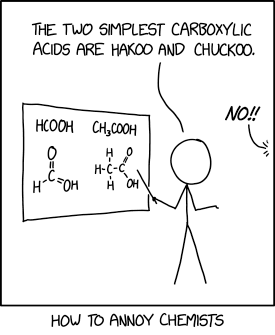
    Title text:

    Can you pass the nackle?

    Transcript:

    [Cueball is holding a pointer and gesturing towards a whiteboard that shows the chemical formulas HCOOH and CH₃COOH. Below these, respectively, are classic diagramatic representations of formic/methanoic acid [with an apparently accidental doubled bond between the carbon and the hydroxy group] and acetic/ethanoic acid; being, in turn, a single- and double-carbon chain molecule with a double-bonded oxygen (carbonyl group) plus an oxygen-hydrogen (hydroxy) upon one carbon of each, to form the full carboxyl grouping, and hydrogens completing all other expected bonds.]
    Cueball: The two simplest carboxylic acids are hakoo and chuckoo.
    Off-panel voice: No!!

    [Caption below the panel:]
    How to annoy chemists

    Source: https://xkcd.com/3040/
    explainxkcd for #3040


    cross-posted from: https://programming.dev/post/21363946

    The normal complaint new Zellij users have is that it has a lot of keybindings which are likely to conflict with programs like nvim or Helix that use a lot themselves. Before, the workflow was to lock Zellij with ctrl-g which let input go through to the focused shell/program.

    The new mode has most of the keybindings behind the ctrl-g lock, e.g. a new tab is ctrl-g t n (instead of ctrl-t n). You can still use alt-(cursor) for changing focus and alt-n/alt-f for a new tiled/floating pane, but all other key presses get passed along.

    You can switch between default and unlock-first (non-colliding) modes so if you need those alt shortcuts you can lock everything as before.

    Plus some other nice features like being able to change modifier keys while running (via the Kitty Keyboard Protocol), and autoloading the new config when you edit the file.


    The normal complaint new Zellij users have is that it has a lot of keybindings which are likely to conflict with programs like nvim or Helix that use a lot themselves. Before, the workflow was to lock Zellij with ctrl-g which let input go through to the focused shell/program.

    The new mode has most of the keybindings behind the ctrl-g lock, e.g. a new tab is ctrl-g t n (instead of ctrl-t n). You can still use alt-(cursor) for changing focus and alt-n/alt-f for a new tiled/floating pane, but all other key presses get passed along.

    You can switch between default and unlock-first (non-colliding) modes so if you need those alt shortcuts you can lock everything as before.

    Plus some other nice features like being able to change modifier keys while running (via the Kitty Keyboard Protocol), and autoloading the new config when you edit the file.

    view more: next ›