top 50 comments

sorted by: hot top controversial new old
[–] 85 points 2 years ago (7 children)

Ingesting gasoline is deadly in far smaller doses due to something called hydrocarbon pneumonia. My dad very nearly died as a result of having a tiny amount get past his throat while siphoning gas to a small engine's tank.

If you must siphon gas, go buy a cheap "pump siphon" from Canadian Tire.

  • source
  • hideshow 7 child comments
  • [–] 31 points 2 years ago* (6 children)

    I dont have any canadian tire near me as I live in europe. What do you advice?

  • source
  • parent
  • hideshow 6 child comments
  • [–] 19 points 2 years ago

    This is what I was referring to. There are a number of variations on the theme.

    If you are really in a pinch:

    1. Feed a length of hose into the source until only a small amount is left clear of the liquid.

    2. Put your thumb over the exposed end, or otherwise make the end as close to airtight as possible.

    3. Rapidly pull the hose out of the liquid, moving the end down to the destination container. The end must be below the top surface of the source, the further the better.

    4. Release your thumb/seal. If you've done it all correctly, the hose will be nearly filled with liquid and enough of it will be below the surface of the source to start the siphoning process.

    If the source liquid is too far below the opening for this to work with the length of hose you have, you can manually pump it far enough to start a siphon, by rapidly submerging and lifting the hose while alternating the closing of the top. Open top while submerging, closed top while lifting. You have to push down faster than what gravity pulls the liquid back down. Ideally, you're lifting fast enough to get some help from the liquid's own inertia when you reverse course.

  • source
  • parent
  • load more comments (4 replies)
  • [–] 64 points 2 years ago (10 children)

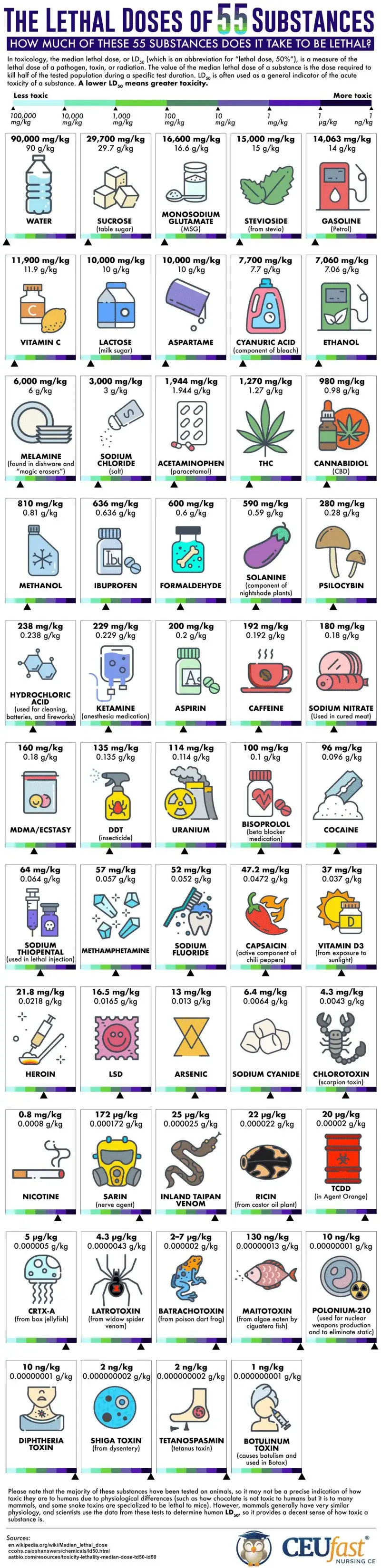
    So drinking gasoline is pretty safe

  • source
  • hideshow 10 child comments
  • [–] 12 points 2 years ago (3 children)

    Fuckin right? If you're 300lbs, you could apparently drink almost 4kg of gasoline and have a 50/50 shot of survival? Yeah right

  • source
  • parent
  • hideshow 3 child comments
  • load more comments (1 reply)
  • load more comments (2 replies)
    [–] 53 points 2 years ago (2 children)

    Damn, I can drink a lot more gasoline than I thought

  • source
  • hideshow 2 child comments
  • load more comments (1 reply)
    [–] 46 points 2 years ago (8 children)

    They don't specify the route of administration, so none of these numbers are worth anything.

  • source
  • hideshow 8 child comments
  • load more comments (8 replies)
    [–] 27 points 2 years ago (5 children)

    This is hilariously bad.

    It doesn't take into account so many things, and it's extremely misleading.

    Most of these chemicals don't ever appear in products in their pure form, so there's so much here that simply isn't relevant.

    There's also consideration here that everything is by weight, and it makes sense to create that as a standard, but many of the pure forms of these items are far more dense than you would expect. One that stands out is uranium. A gram of it would be incredibly small, approximately 0.05 cm cubed. 1 lb is around 1.45" cubed (for my American friends).

    So it would be an insanely small amount. Meanwhile water is insanely light by comparison. While also safer per gram, so it's an insanely large amount of water before any damage can be done while a relatively small rock of uranium can tear your DNA apart.

    The whole chart is wildly misleading. It might be accurate, though, I have no idea if it is, but the fact is that it makes it seem like normal every day compounds like vitamin B will kill you at lower doses than uranium. While technically true based on weight, it makes uranium seem relatively safe by comparison and bluntly it's not. Even the smallest amount of pure uranium, which this chart would regard as "safe", would cause you to become incredibly sick for a very long time.

    I hope nobody gathers "new" information from this chart and decides to do something stupid; but honestly, there's a lot of idiots in the world, and if anyone is that dumb, I wonder if the average intelligence of the planet might increase a bit.

  • source
  • hideshow 5 child comments
  • load more comments (5 replies)
    [–] 21 points 2 years ago* (last edited 2 years ago)

    🍆

    0.59 g/kg

    Looks like I can barely survive mine

  • source
  • [–] 21 points 2 years ago (3 children)

    Where's the 55th substance?

  • source
  • hideshow 3 child comments
  • load more comments (2 replies)
    [–] 21 points 2 years ago (23 children)

    Yeah, I don't buy this shit at all.

    How many people die each year from acetaminophen overdoses? Versus how many die from THC?

    This whole infographic is a crock of shit

  • source
  • hideshow 23 child comments
  • [–] 60 points 2 years ago* (last edited 2 years ago) (2 children)

    You're confusing 50% lethal dose (medical property of a substance in relation to the body) with death rate (property of a death cause, obtained statistically from a population at a specific time). This is pure medical data which still may be slightly inaccurate, but you can easily check relevant scientific papers for their estimate of the LD₅₀. I think all values presented here are correct within a factor of 2, unless you find a reputable journal stating a very different result. Each substance is available in different concentrations and humans’ exposure to them also varies. You can get lots of pure water, sugar or gasoline easily but not a gram of viruses. Nobody would voluntarily consume a substantial amount of gasoline but nanograms of viruses come and go in the air all the time.

    It is somewhat misleading to group poisons, radioactive isotopes and viruses as they work in very different ways, but the gist is correct. And yes, the LD₅₀ is still a statistical estimate dependent on the humans studied, but not on society etc. like the death rate.

    Edit: some substances will be ejected by the body relatively fast (water), some bioaccumulate (heavy metals) and some "biomutiply" (viruses). This is why you haven't died despite having drunk lots of water.

  • source
  • parent
  • hideshow 2 child comments
  • [–] 11 points 2 years ago* (last edited 2 years ago) (1 child)

    It is somewhat misleading to group poisons, radioactive isotopes and viruses

    Far as I can tell there aren't any viruses in there? There's a few bacterial toxins, but they're… well, toxins.

    Also, the grouping isn't misleading. Not only is eg. plutonium fairly toxic (because it's a heavy metal) in addition to giving off ionizing radiation, but calculating an LD50 for something doesn't require it to be toxic, just that some dose of it kills. There's some µg/kg ingested (or inhaled or whatever) dose of polonium that will kill 50% of a study animal population dead, regardless of what the mechanism that kills them actually is

  • source
  • parent
  • hideshow 1 child comment
  • load more comments (1 reply)
  • [–] 27 points 2 years ago (3 children)

    For the THC though it would be grams of pure THC, not grams of weed

  • source
  • parent
  • hideshow 3 child comments
  • [–] 18 points 2 years ago (2 children)

    I legit cannot imagine consuming 1g of THC let alone 1g/kg, you'd literally be eating thousands of gummies if you're doing edibles (10mg seems to be the strongest edibles I can get) which would be really expensive, rough for a 70kg person would be nearly 9000 10mg gummies which are like $4 cad each, would cost $36,000.

    I guess you could do it, but practically, no one is going to do that much

  • source
  • parent
  • hideshow 2 child comments
  • load more comments (2 replies)
  • [–] 23 points 2 years ago (2 children)

    It's probably all correct, but super misleading. There's probably no way to overdose on THC other than drinking loads of highly concentrated oil. Just like there's no way to overdose on LSD, since it gets taken smaller doses.

    You consume grams of salt, milligrams of meth, vitamin D, …, and micrograms of acid.

    So the important part is “how close is the usual dose people take to the lethal dose, and will your body rebel before you get there (e.g. it's hard to eat that much salt or drink much water)” or in other words “how likely is it to accidentally overdose”.

  • source
  • parent
  • hideshow 2 child comments
  • load more comments (2 replies)
  • [–] 19 points 2 years ago (4 children)

    Keep in mind: a single extra strength Tylenol is 500mg. A standard dose for a headache is 2 pills, or 1000mg.

    Weed gummies come in doses of 1mg to 100mg. 1mg is a microdose people might take for mild pain or stress, while 50+mg is a dose for cancer patients often take. A standard dose for occasional recreational highs is 5mg; they recommend first timers start at 2.5mg.

    LD50 compares things by weight, rather than dose. By weight, THC is slightly more toxic than acetaminophen. But in terms of the number of therapeutic doses it takes to kill you, it's way, way safer.

  • source
  • parent
  • hideshow 4 child comments
  • load more comments (4 replies)
  • [–] 9 points 2 years ago* (last edited 2 years ago)

    Death rate is society-dependent. If we only paid with lead coins and never washed our hands, cases of lead poisoning would skyrocket even if the element and our bodies remained the same (and so would LD₅₀). Thankfully, our society knows about the danger and limits the intake of lead to small amounts and/or small concentrations.

  • source
  • parent
  • load more comments (4 replies)
    [–] 20 points 2 years ago (8 children)

    Why omit fentanyl? It should be pretty high in the rankings. Also curious about puffer fish.

  • source
  • hideshow 8 child comments
  • [–] 21 points 2 years ago (5 children)

    This "cool guide" is trash and shouldn't be taken seriously.

  • source
  • parent
  • hideshow 5 child comments
  • load more comments (2 replies)
    [–] 17 points 2 years ago* (last edited 2 years ago) (1 child)

    This looks like a quite useless guide. All these substances appear in vastly different doses in the environment, so it in no way shows what is more likely to kill you or accurately shows what you are supposed to be careful with.

  • source
  • hideshow 1 child comment
  • [–] 14 points 2 years ago (12 children)

    Vitamin C more harmful than gasoline is an interesting one.

  • source
  • hideshow 12 child comments
  • load more comments (10 replies)
    [–] 12 points 2 years ago (1 child)

    Thanks. This will come in useful when I finally have enough.

  • source
  • hideshow 1 child comment
  • load more comments (1 reply)
    [–] 9 points 2 years ago (2 children)

    I think I have enough capsaicin to kill a person. I don't know how to feel about that.

  • source
  • hideshow 2 child comments
  • load more comments
    view more: next ›