top 50 comments

sorted by: hot top controversial new old
[–] 305 points 3 years ago (13 children)

Just a word of caution: Non-peer reviewed, non-replicated, rushed-looking preprint, on a topic with a long history of controversy and retractions. So don't get too excited yet.

  • source
  • hideshow 13 child comments
  • [–] 35 points 3 years ago* (12 children)

    Okay so I agree that it needs to be peer reviewed and independently verified before we can trust it. But how exactly does the preprint look rushed?

  • source
  • parent
  • hideshow 12 child comments
  • [–] 85 points 3 years ago (7 children)

    It's visibly made in word. That's enough to be rushed.

  • source
  • parent
  • hideshow 7 child comments
  • [–] 55 points 3 years ago (6 children)

    Exactly. Most papers I’ve seen out there use LaTeX. This is clearly Microsoft Word.

  • source
  • parent
  • hideshow 6 child comments
  • [–] 27 points 3 years ago* (2 children)

    I would also like to know. Apparently there were some proofreading errors etc. Someone in reddit explained that rushing the publish might be explained by wanting to stake the claim and get the ball rolling on reproducing the results as fast as possible.

  • source
  • parent
  • hideshow 2 child comments
  • [–] 11 points 3 years ago (1 child)

    Honestly as someone who is also in research, that is pretty understandable. Preprint papers are all subject to peer review and editing after the fact, but are a good opportunity to stake your claim on a big discovery before someone else can. Preprints are inherently not final versions and I guarantee that the mistakes will be caught before publication.

  • source
  • parent
  • hideshow 1 child comment
  • load more comments (1 reply)
  • [–] 137 points 3 years ago* (38 children)

    Reposting my comment from another thread to add a bit of context in case anyone’s curious.

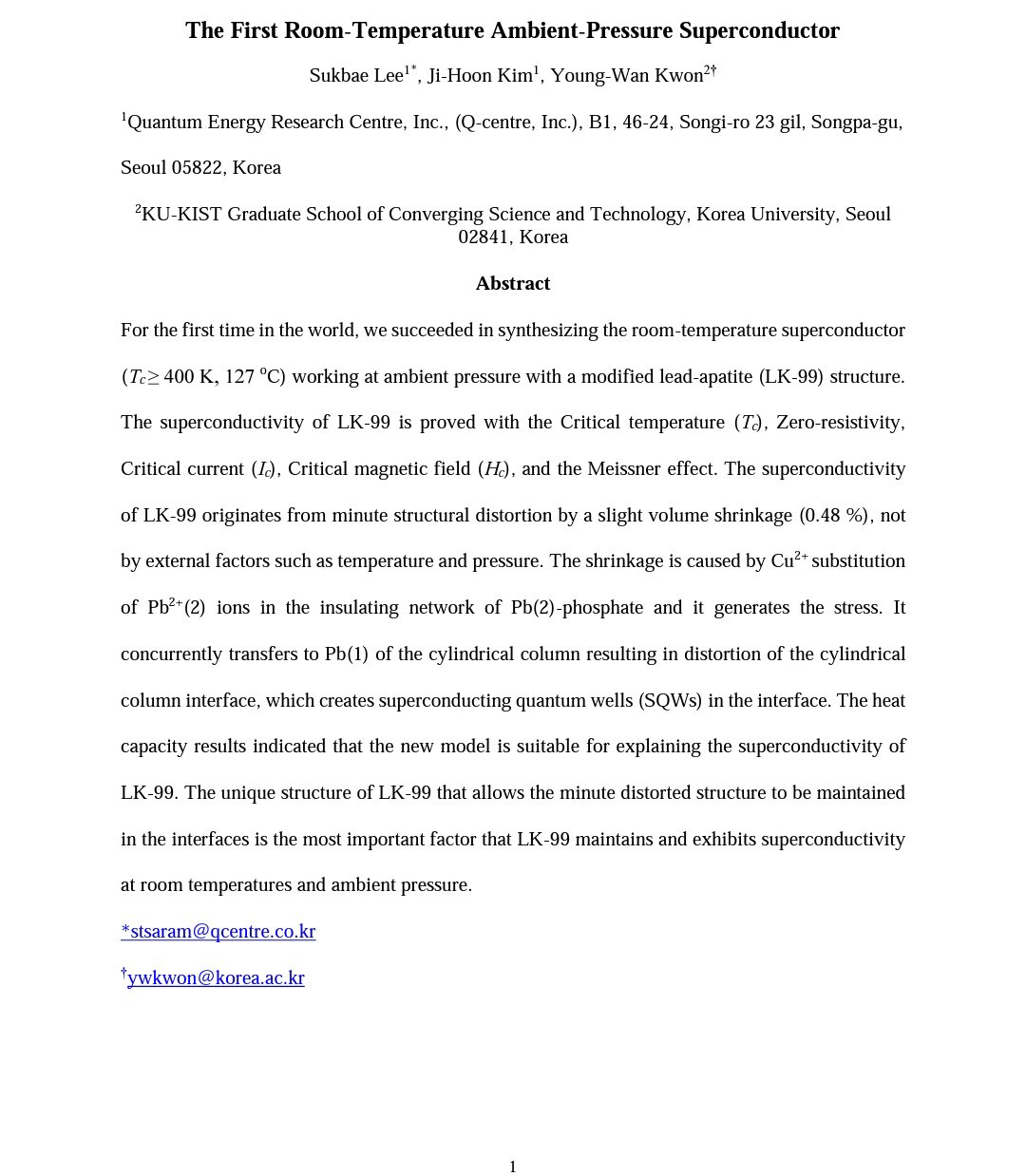
    So I read the paper, and here’s a tldr about how their material apparently gains its properties.

    It is hypothesized that superconductivity properties emerge from very specific strains induced in the material. Hence why most of the discovered superconductors require either to be cooled down to very low temperatures, or to be under high pressures. Both shrink the material.

    What this paper claims is that they have achieved a similar effect chemically by replacing some lead ions with copper ions, which are a bit smaller (87 pm for Cu vs 133 pm for Pb). This shrinks the material by 0.48%, and that added strain induces superconductivity. This is why it apparently works at room temperature — you no longer need high pressures or extreme cold to create the needed deformation.

    Can’t really comment on how actually feasible or long-lasting this effect is, but it looks surprisingly promising. At least as a starting point for future experiments. Can’t wait for other labs’ reproduction attempts. If it turns out to be true, this is an extremely important and world-changing discovery.

    Fingers crossed :)

  • source
  • hideshow 38 child comments
  • [+] 26 points 3 years ago* (last edited 2 years ago) (26 children)
  • [–] 72 points 3 years ago* (last edited 3 years ago) (12 children)

    Long-distance energy transfer without energy loss will make it possible to connect more energy grids and sources together, so stuff like the saharan desert providing solar power to Europe, for example, suddenly becomes feasible. Maglev trains will no longer require lots of power to run, since they could utilize superconductor magnetic levitation. You could make super-efficient processors that wouldn’t really heat up at all. Superconductors are also key to quantum computers, so expect lots of advancements in that field as well. They will also make it much easier to build and run fusion power experiments.

    Lots of tech in general would benefit from this discovery, stuff like MRIs, electric vehicles, space telescopes or particle accelerators would become way more efficient, cheaper and easier to produce.

    Edit: also, check out this video by Isaac Arthur for some more sci-fi examples of what this tech can be used for in the future (discussed in the second half). It’s more space-colonization-focused and kinda like a thought experiment, but interesting nonetheless.

  • source
  • parent
  • hideshow 12 child comments
  • load more comments (12 replies)
  • [–] 33 points 3 years ago (1 child)

    I'm most excited for fusion power generation. Currently we can ignite a fusion reaction but it takes more energy to control and contain it than you get back because it takes a huge amount of electricity to generate a magnetic field strong enough to contain the plasma. The strength of the magnetic field is proportional to the current flow, which is limited by how much cooling is required to maintain superconductivity. Without cooling taking a huge chunk of the power created by the fusion reaction we could net positive energy from the reaction and finally have a clean source of scalable nuclear power.

  • source
  • parent
  • hideshow 1 child comment
  • load more comments (1 reply)
  • [–] 11 points 3 years ago (1 child)

    If they can be made into wires (or close to them) you can create things like lossless electricity transmission, lossless batteries, electronics without heat generation (or very low), etc. Transmission lines would likely still need some sort of cooling but at room temp it would be a lot less than for the current superconductors that require at least liquid nitrogen.

  • source
  • parent
  • hideshow 1 child comment
  • load more comments (1 reply)
  • load more comments (9 replies)
  • load more comments (10 replies)
    [–] 102 points 3 years ago (3 children)

    I would be very skeptical of this paper's claims.

    1. It hasnt been peer reviewed

    2. The data hasn't been replicated

    3. The clains being made are extraordinary. i.e a cheap material that has a superconduction transition temperature 200 degrees kelvin above the cuprates at standard pressure

    4. The fragility of this superconductive state makes me wonder if what theyre claiming to observe is an artifact (pathological science) rather than a real effect

    5. The paper is "rough around the edges" i.e multiple proofreading mistakes and has undergone little apparent editing for quality

  • source
  • hideshow 3 child comments
  • [–] 35 points 3 years ago

    Sceptical because "revolutionary" discoveries like this always end up either being bogus or have some massive caveat that makes them effectively useless outside of very specific scenarios.

    Thought I will be pleasantly surprised if proven wrong

  • source
  • [–] 27 points 3 years ago (4 children)

    This is huge, is it not? No loss in potential energy means that I could have an infinitely floating coffee cup without the use of power, no?

  • source
  • hideshow 4 child comments
  • load more comments (1 reply)
    [–] 26 points 3 years ago (15 children)

    What's the purpose of posting these results before they have been peer reviewed and reproduced?

  • source
  • hideshow 15 child comments
  • [–] 51 points 3 years ago (12 children)

    Because this is how they get peer reviewed and reproduced? Publishing is how science works?

  • source
  • parent
  • hideshow 12 child comments
  • load more comments (5 replies)
  • load more comments (2 replies)
    [–] 23 points 3 years ago (1 child)

    I'm gonna go out on a limb and say that until this is peer-reviewed and replicated, this is worthless.

    I'll also gladly eat my shorts if it turns out they actually did it but ATM I'm very skeptical.

  • source
  • hideshow 1 child comment
  • load more comments (1 reply)
    [–] 21 points 3 years ago

    Incidentally, here's the same research with more co-authors.

    https://arxiv.org/abs/2307.12037

  • source
  • [–] 18 points 3 years ago (1 child)

    If they take too long the room temperature won't be enough due the increase in temperatures 😅 /s

  • source
  • hideshow 1 child comment
  • [–] 15 points 3 years ago* (last edited 3 years ago) (12 children)

    anyone with a better understanding able to articulate potential trade-offs/complications to using this in practical applications?

    *edited:
    more discussion: https://news.ycombinator.com/item?id=36864624

    the critical field and critical current seem very low … This means you can't actually push big current through this thing (yet). You can't make a powerful magnet, and you can't make viable power lines

    The method to produce this material as described in the related paper [1] is fairly simple and could be done at home with a $200 home metal melting furnace from amazon and the precursors (which also seem to be fairly standard easy to obtain metals)

    Read this comment thread from SC researchers: <reddit link removed>
    Lots of problems with the paper, they claim. It is not up to the standards of current SC research. One of them says Dias's work shows more merit than this.

  • source
  • hideshow 12 child comments
  • [–] [S] 12 points 3 years ago (8 children)

    Insane capacity batteries

    Lossless power transmission via wires

    Better magnetically levitating trains

    Much more power efficient computers, electronics

    The list is huge

  • source
  • parent
  • hideshow 8 child comments
  • load more comments (4 replies)
  • load more comments (3 replies)
    [–] 12 points 3 years ago

    That "levitation" video is worthless: One edge of it is still resting on the magnet, and plain old steel screws will do that if you put them on a plain old speaker magnet. If they can't even manage to show actual levitation after claiming it, then I highly suspect the rest of the claims are just as invalid.

  • source
  • [–] 10 points 3 years ago

    Here we go again...

  • source
  • [–] 10 points 3 years ago (3 children)

    To be honest, this seems very sus to me. A big paper with only three authors?! I went down the rabbit hole of trying to find the lab from which it has been published. It's almost there is no online presence. In another paper they put out along with it, they say that they show Meissner effect (levitating effect of a superconductor) and that a video is attached. I looked for the video but I wasn't able to find it. :/

  • source
  • hideshow 3 child comments
  • load more comments (3 replies)
    [–] 10 points 3 years ago (3 children)

    Maybe it's me misunderstanding, but 127 is considered room temp?

  • source
  • hideshow 3 child comments
  • [–] 9 points 3 years ago (1 child)

    This... this is literally revolutionary if true. Has it been corroborated by other experiments? How certain are the results? How hard is it to mass produce this? This could literally be the breakthrough of the century in materials science here.

  • source
  • hideshow 1 child comment
  • load more comments (1 reply)
    load more comments
    view more: next ›