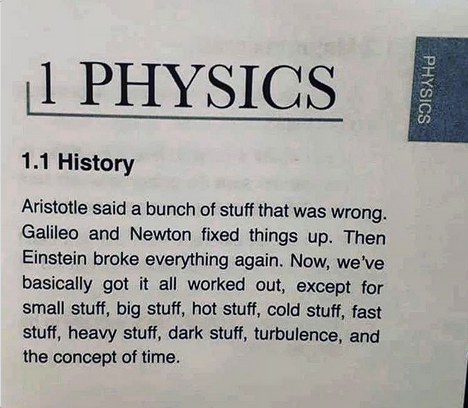
So, basically, we don't know that much on anything besides understanding it's really complex and difficult to figure out.
post
The answer is 42, guys.
Yes, yes, I'm quite sure, it's 42!
The question is if it will still be 42 when we look away.
I highly recommend the book "We Have No Idea" by Jorge Cham and Daniel Whitesom. Great explanations of what we know about the universe (with hilarious comic illustrations) and a profound message of just how much we don't know.
Thanks for this recommendation! I love books that show me how little I truly know about anything.
Like all of Randall Monroe's books (xckd guy).
Any more book recommendations?
Tide goes in, tide goes out... You can't explain that.

Copernicus deserves a mention. Galileo's problems resulted (in part) from him being a proponent of Copernicism after the church had declared it heresy.
Heliocentrism was suggested by Copernicus and Galileo built on that, including developing physics to the point where he couldn't believe otherwise.
The heliocentric models predicted the orbits worse than epicyclic geocentric ones and that is the reason Galileo was told to shut up, the court transcript is like 99% science and then a single subordinate clause saying "it also contradicts the bible".
Galileo insisted on circular orbits which was his downfall, ironically "because circles are perfect and god would furnish the universe perfect": That kind of religious language while also being worse science than what was already established did him in. Kepler, based on Brahe's data, was the first one to get a heliocentric model right and more accurate than the epicyclic ones.
Also earth doesn't revolve around the sun. If anything both revolve around their shared centre of gravity but really it's a matter of your frame of reference. Paraphrasing Archimedes: Give me a fixed point in the universe and I will move all your models.
Relevant alt-text https://xkcd.com/1489/

I know I'm stupid but how do you see the alt text?
On mobile: long press on the comic itself
And gravitational stuff. We kinda know it does it, but not how to do anything about it.
Surely that's "heavy stuff"?
And maybe also "big stuff". I suppose those two overlap quite a lot?
I can't wrap my head around time being anything other than the measurement of movement, and until someone can prove otherwise, that's where I'll be.
I'm going to take your definition just a step further and say it's a measurement of causality specifically.
A definition I saw recently that I like is that time is the direction of entropy. You follow time one direction and you get the big bang where everything is chaotic and happening, and in the other direction you get the heat death of the universe, where everything has settled into a base state and nothing's happening.
I think high level degree holders know a lot more than the average man thinks we know, in fact I doubt the majority of people even know US High school level stuff like that we've discovered a gravitational constant and about the inverse square law as it applies to gravity.
The sad reason for that is that it's a conversation killer. I would love to go back and forth for hours on things like the uncanny similarity between universal gravitation and Coulomb's law. But, when I speak to someone with a similar background to mine it's all...work-work-work-how-is-it-applied??, and when I speak to someone without that background it's all yawns.
It's a shame because in either case I think science is the most interesting topic. It's just as edifying to dive casually into the philosophy as it is to dive rigourously into the maths. I learn more per unit time from either type of conversation than from studying papers. And, it's a passion, but one whose expression is stymied either by explaining it in terms of football fields per dolphin or by making it marketable. Interaction with other minds is the most valuable type of learning.
I feel like I may come off as a bit of an elitist writing this, but the problem really is the opposite: I wish more people would get involved!
Edit: the responses to this have made my day you guys. This is why I left Reddit.
I’m a person without that background and I’ll talk about it. What’s the uncanny similarity you mentioned?
Well that's lovely, thank you 😊 So Newton's law of universal gravitation is:
F= G×M×m/r^2
which is simple enough to be able to say it in a sentence: "the force of gravity F on two masses M and m is proportional to their masses and square of the distance between them, r " so the heavier and closer planets/suns/black holes are, the greater the gravitationnel pull.
Coulomb's law is:
F= k×Q×q/r^2
which is pretty much exactly the same as you have probably noticed: "the force of electrical attraction F on two charged particles Q and q is proportional to their charges and the square of the distance between them, r "
So the exact same rule applies to planets and atoms. Their behaviour can be explained in the same way. It's called an "inverse square law", it's got a name because they happen everywhere. And it's just, like... Why? Why does the universe work that way? You're not really encouraged to ask that sort of question as a science student, because it "goes nowhere" and doesn't lead to actionable results. But I think it quite spooky. There are loads of weird results like that in science and maths (see quantum theory for abundant examples!) but it's unusual to be able to sit and think about it. There is, for the inverse square law, a pretty elegant mathematical explanation for why they're so common, but it doesn't quite scratch the itch for me, it just raises more questions
Edit sorry for text wall. This is probably why I shouldn't do this!
I get it...but at the same time I also get why you're not going to be the life of the party with material like that.
I think a big part of this is because it's already a super, super niche topic, but then you're adding the extra layer of wanting to stick to a largely theoretical/conceptual tone of discussion, ruling out most of what few were still interested when you started into the topic. And once you're that far down the rabbit hole, I feel like there's going to be hyper specific topics that dominate, and unless your conversation partner not only has that knowledge but also wants to have that conversation...well the conversation isn't really going to happen at all.
It's also a very brain-power intense set of topics for a leisure time get together where most people have the goal of not having to think too hard on anything.
I think we got the fast stuff under control (special relativity), when you mix it it with like small stuff (quantum field theory), and I guess big stuff (general relativity), it is also OK, but mixing it with anything more than that causes a problem.
This is from science abridged beyond the point of usefulness right? I have that book.
Edit: yes it is
Shit's on fire, yo. But does that fire only produce positive vibes or are there like 90% bad vibes, you know, bro?
Motion is indeed, tricky. - Zeno of Elea
Can't explain better than this🤯 Repost in !science_memes@mander.xyz

top 50 comments