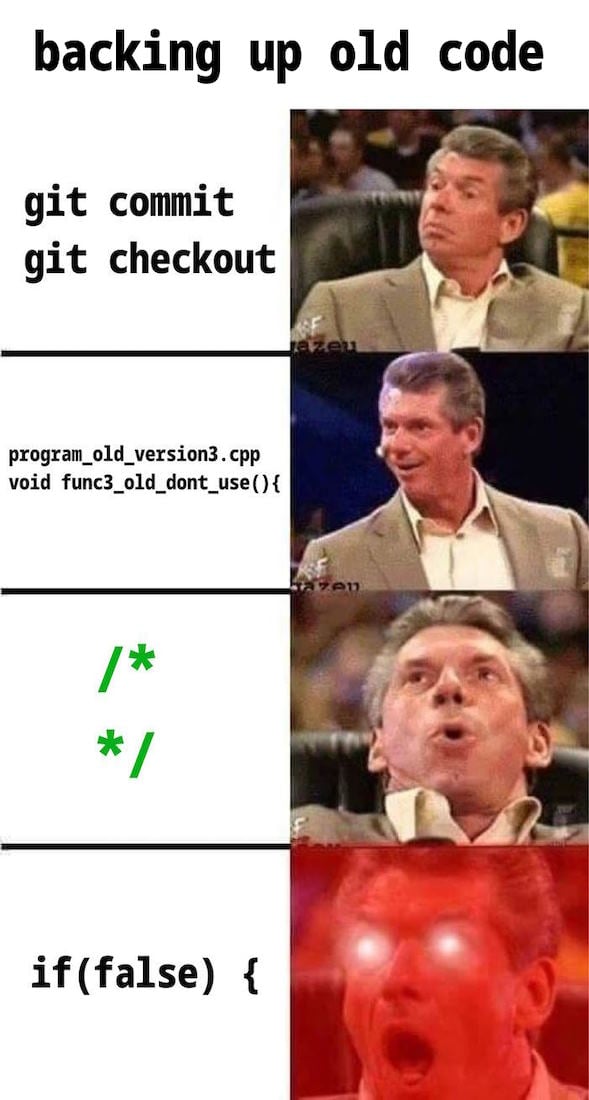
Very disappointing not to see an #if 0 (my personal go-to for decades) in this meme. 😞
I was going through some js code a few months ago and every function in a module had return; as its first line. And that module was imported into 4 or 5 scripts.
You folks have clearly not met first year CS students. Screenshots code
laughing in #if 0:
#include

int main()
{
#if 0
        std::cout << "Look at this" << std::endl;
#else
        std::cout << "ugly abomination." << std::endl;
#endif
}
If you're in a language that supports it, please don't use if (false) use if ($disallowAllUsers = false && $whateverTheRealConditionIs)
bonus points if you use a different variable every file so they have to go through and change every instance if they want to make changes
[Ctrl-V]69jI// [Esc]
I don't see the need for an if block or renaming the function and leaving it there. It is extra unnecessary work for the compiler. Comments are probably the best way. Might also copy the current file, put the original in some folder like "old", and delete the old code inside the new copy.
what about relying on the persistent undo history in vim?
In Python you put it in a multiline string, since it has those but not multiline comments.
all 34 comments