How long did it take to download 45 years of updates?
post
It works but my polish PAL tv doesn't seem to like it very much, it took a lot of tuning to get this wonderful image.
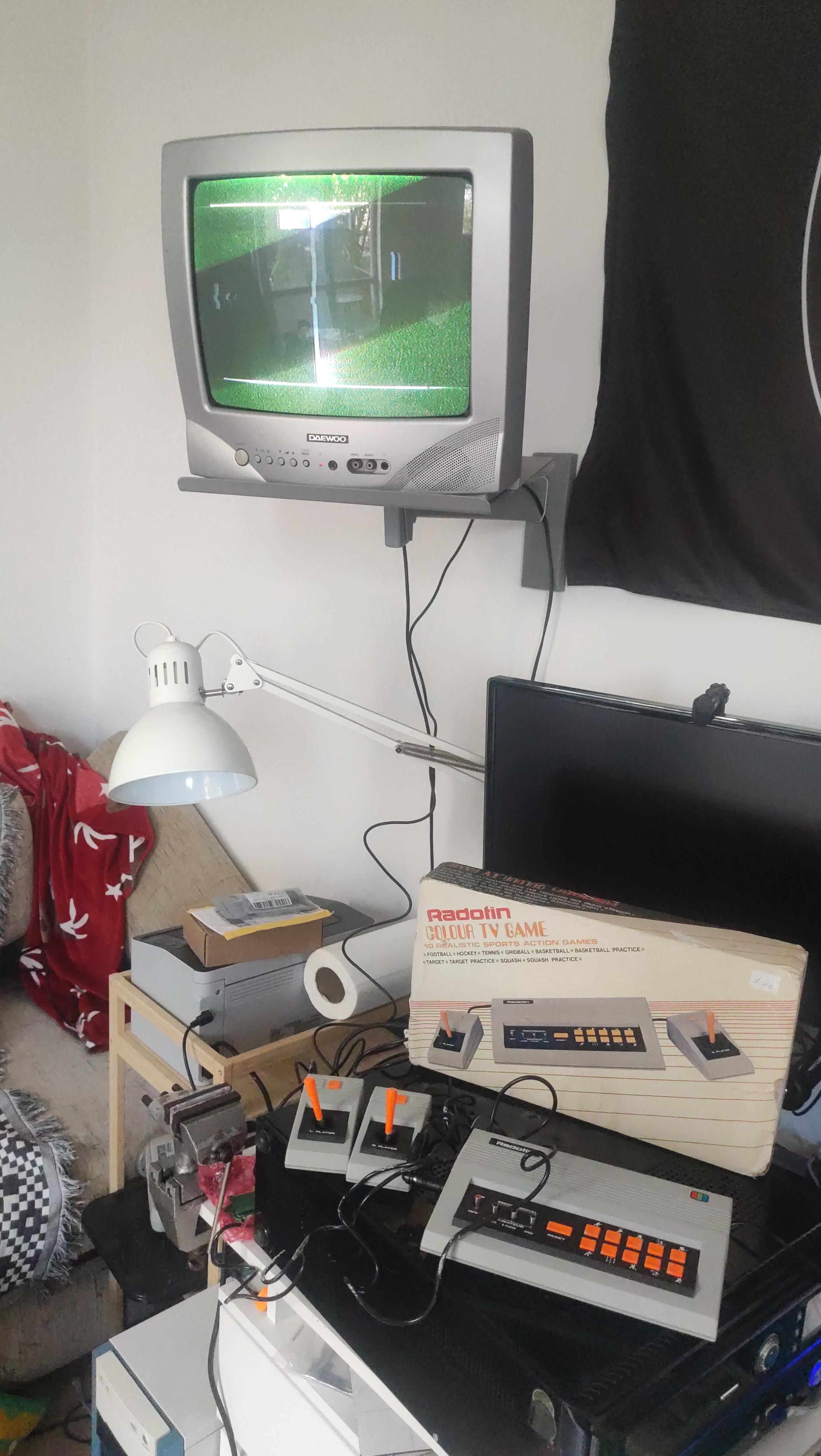


Mmm... realistic
Colour is also not very accurate... unless they mean a single colour, green.
They probably did. It's not exactly honest, but the system is technically outputting a colour signal, and it was released at a time when that wasn't a given. They didn't say "full colour" anywhere on the box, did they?
Let's call it a mix of lower expectations for the time, and a bit of marketing deception.
Was it meant to run on an NTSC TV?
Unlikely. It is spelled "Colour" on the box, implying this would be for the UK market.
Found in an Edinburgh charity shop, so while it's not impossible, it's unlikely.
EDIT: Also, an NTSC signal on a plain PAL TV would be black and white (not even false colours) even if you got an otherwise stable picture.
It's easy to forget, but these old systems didn't connect to the TV with composite RCA connectors, but via RF. So we're not just dealing with straight PAL, but with PAL over a broadcast system. Scotland was using PAL-I for broadcast, while Poland seems to have used a combination of PAL-D and PAL-K. Differences in channel ranges and bandwidths, and sound channel offsets, could make it difficult to tune a TV set designed for one system to a signal from another, especially if it's a more modern set designed for automatic operation, as OP's set appears to be.
That might have Pong but it isn't Pong.

Obviously but it is a Pong Console, it's the category started by the original Pong.
This one has a bunch of additional games too.
we had an all black console that is like halfway between that the whats in the OP. it had wired controllers and 4 versions that you cycled through to choose. I think it was pong, doubles pong, hockey, doubles hockey. hockey being pong where you had to get it in the goal in the 20% of the middle of your opponents end but the other 80% was just like the side walls.
Was not expecting to see my city here.
Honestly, I envy you, Edinburgh is incredible.
Btw, there's a second pong console for a similar price in that charity shop, if you're interested and if nobody's got it yet :)
Thank you, Edinburgh is a beautiful and lovely little city, i reslly hope you enjoyed it. Which charity shop was it may I ask?
I sure did! It really is beatiful, one of my favorite cities of Europe! Also the thrifting possibilities are incredible.
Here's the address: https://nominatim.openstreetmap.org/ui/details.html?osmtype=N&osmid=5600831836&class=shop
What do you mean, Edinburgh? The city in question is Prague. See the console brand, it's from Prague 16 (Radotín).

Edit: /s
BTW the Czechoslovak electronics brand TESLA also made a crappy Pong console using a presumably stolen chip design.
Read the post title again
I wonder about the "Colour". Did they actually use the different video outputs of the AY-3-8500 chip for controlling different colour signals instead just joining them as a luminance signal?
For those too young to know: The AY-3-8500 (or AY-3-8500-1 fo NTSC) chip is at the heart of almost all of those pong-type consoles. It has a number of different (but synchronized) video outputs for left player, right player, ball, numbers, and playing field, and most consoles just or'ed them together into luminance (Y) to make a simple B&W image. You could route some signals to the R-Y and/or the B-Y signal to give them some basic color, e.g. if you sent the "ball" signal both to the luminance and the red (R-Y) channel, you would get a red ball. All this needs are a handful of simple logic gates.
If it's any indication, the manual says:

It basically tells you that you can basically tone the "colourness" (i.e. the brightness of the colours) up and down, which was a normal control (like brightness and contrast) back then. This is not about being able to make a red playing field green by some setting on the TV. You just had some potentiometers to play with the pre-amplification of the luminance and colour signals.
What could be in the instructions would an explanation of the games telling you that e.g. the playing field is green and the ball is red or somesuch, then they actually did a (rare) "colour implementation" of the circuit.
If you are interested, there is a number of interesting documentations on this pong chip on the net.
I had a black and white version of this.
All the games were basically the same apart from the target shooting game.
No I mean it literally, it was wrapped in all the factory plastics and has literally zero wear and tear. It might have been taken out of the box and maybe used once or not at all.
Damn. If you'd kept it wrapped, you might have been able to sell that for a LOT of money
These "home pong" consoles were very common at the time. They don't really do much, so their main value is historical interest, and this isn't a particularly famous model. A quick eBay search seems to indicate it might go for GBP 80 at most, but probably more like GBP 20-40. So OP got a good deal, but they didn't find a lost Vermeer. :)
Nah, it's a cheap pong clone, it doesn't have that much collector's value. Also I can just pack everything back up, it wasn't sealed just wrapped in plastic.
all 48 comments