top 50 comments

sorted by: hot top controversial new old
[–] 263 points 2 years ago (4 children)

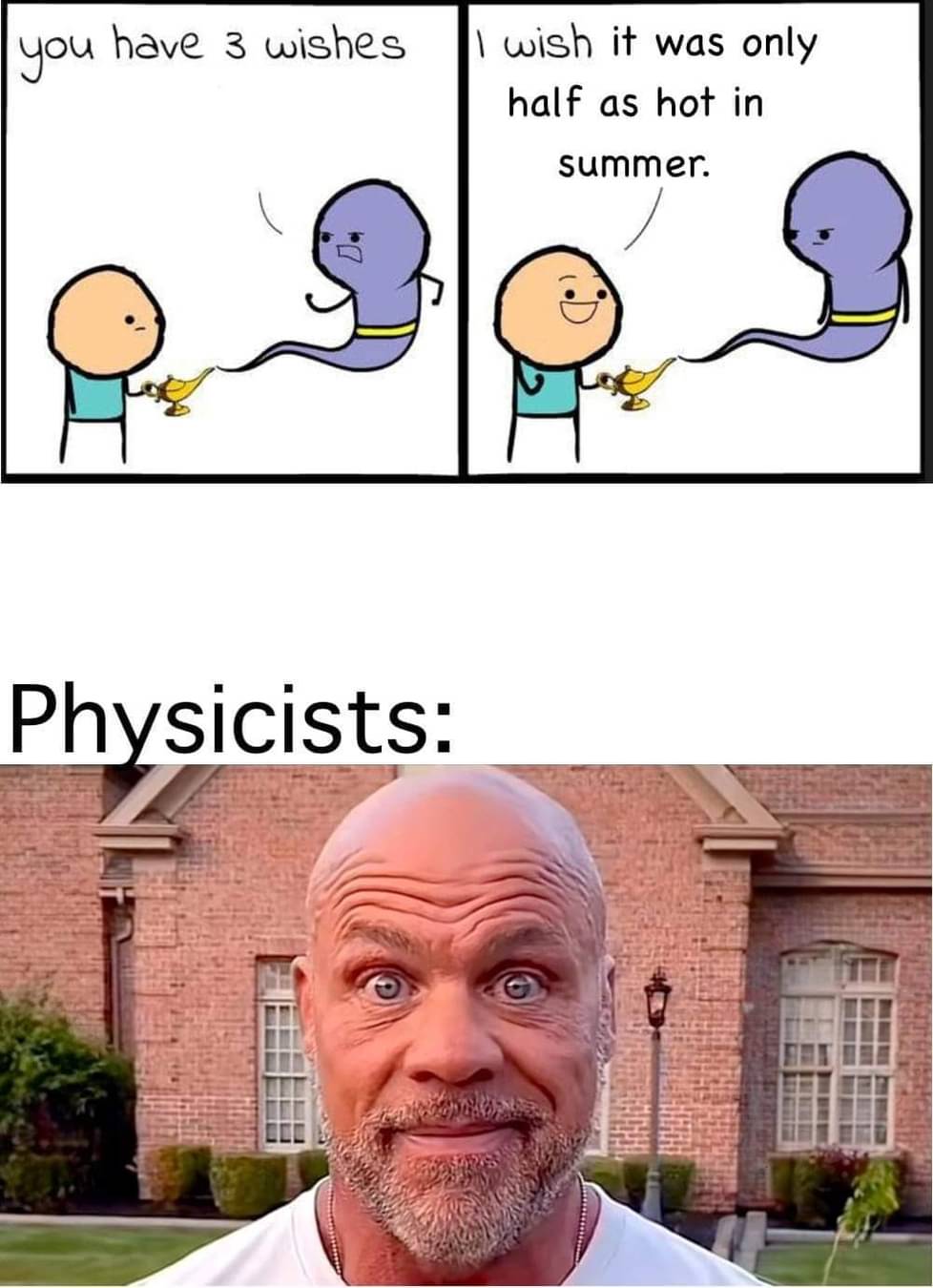
30°C is 303 Kelvin. Half of that is 151 Kelvin, which translates into a fairly mild -122°C!

Takes out hockey stick

  • source
  • hideshow 7 child comments
  • [–] 46 points 2 years ago (4 children)

    New strategy to prevent global warming: just freeze all of the CO2 out of the air!

  • source
  • parent
  • hideshow 7 child comments
  • [–] 6 points 2 years ago (2 children)

    That's one of the ways proposed for terraforming Venus. Put in a sun shield to freeze the planet, let the CO2 snow down, then process the CO2 into something that can sequester it away so it doesn't just go back into the atmosphere after removing the sun shield.

    Of course none of that is technically possible right now, but it's a lot easier on a planet that has no (known) life to destroy while working through the process.

  • source
  • parent
  • hideshow 2 child comments
  • load more comments (2 replies)
  • load more comments (1 reply)
  • [–] 8 points 2 years ago (2 children)

    Wait, does it? Are joules in thermal energy per kelvin a purely linear relationship?

  • source
  • parent
  • hideshow 4 child comments
  • [–] 12 points 2 years ago* (1 child)

    For the most part, it varies by material and state of matter, but assuming the chemical composition doesnt change and no material changes phase, then it is pretty close to linear in most materials.

  • source
  • parent
  • hideshow 2 child comments
  • [–] 7 points 2 years ago* (last edited 2 years ago)

    Fun fact: gas pressure changes linearly with temperature. If you make one of these plots at mild conditions you can extrapolate the line down to zero pressure and measure where absolute zero temperature is

  • source
  • parent
  • load more comments (1 reply)
    [–] 67 points 2 years ago* (last edited 2 years ago) (6 children)

    Granted. Celsius now range from 0 to 50

    Edit: ... or whatever unit you prefer. It's still the same

  • source
  • hideshow 7 child comments
  • [–] 33 points 2 years ago (1 child)

    Oh, it's way better than the alternative interpretation.

  • source
  • parent
  • hideshow 2 child comments
  • load more comments (5 replies)
    [–] 54 points 2 years ago

    Reminds me of a time one of my friends was happy that it was going to warm up and said something like "it's going to be twice as warm tomorrow". It was going from maybe 20F to 40F or something.

    That led to an interesting discussion.

  • source
  • [–] 48 points 2 years ago (5 children)

    This knowledge comes in handy with marketing BS around CPU coolers. If an aftermarket cooler gets a CPU to 35C when the stock cooler is at 70C, marketing will sometimes claim it cut temperatures in half.

  • source
  • hideshow 6 child comments
  • [–] 10 points 2 years ago* (last edited 2 years ago) (5 children)

    I mean.... that's literally half though

    edit: I am not a science man and I am in over my head in this argument

  • source
  • parent
  • hideshow 9 child comments
  • [–] 16 points 2 years ago

    But it's not.

    Celsius and Faernheit are interval scales, not rational scales. The absolute change from one number to the next is consistent, but since you can go into the negatives, 1 is not double 2.

    Kelvin and Rankine are rational because they use an absolute zero.

  • source
  • parent
  • [–] 11 points 2 years ago (1 child)

    If you convert those temperatures to Kelvin, they become 308K and 343K. Since Kelvin is absolute and we're measuring the same material, this tells you how much more thermal energy is there and their actual proportion to each other.

  • source
  • parent
  • hideshow 2 child comments
  • load more comments (1 reply)
  • load more comments (4 replies)
    [–] 36 points 2 years ago (18 children)

    I use this as an example for interval vs ratio; you can't halve Celsius because it's an interval scale where zero is arbitrary. Kelvin is ratio as it has an absolute zero-- you very much can halve it and doom near the entire planet next summer

  • source
  • hideshow 18 child comments
  • load more comments (18 replies)
    [–] 35 points 2 years ago* (2 children)

    Careful, half of what, kelvin?

  • source
  • hideshow 4 child comments
  • [–] 34 points 2 years ago (2 children)

    Obviously we'd all die but I wonder how exactly. This would make a good question for Randall Munroe.

  • source
  • hideshow 2 child comments
  • load more comments (2 replies)
    [–] 17 points 2 years ago (6 children)

    A good genie would instantly invent a metric of "number of degrees in excess of room temperature"

  • source
  • hideshow 7 child comments
  • [–] 28 points 2 years ago (1 child)

    I think it's fairly well known that there are no good genies. But otherwise, true.

  • source
  • parent
  • hideshow 2 child comments
  • [–] 6 points 2 years ago (3 children)

    For a present, I think it would be fun to have a contract lawyer draft up an ironclad 3 wishes contract

  • source
  • parent
  • hideshow 4 child comments
  • load more comments (2 replies)
  • load more comments (5 replies)
    [–] 13 points 2 years ago* (3 children)

    Is the temperature scale directly proportional to the heat energy? I think the amount of energy needed to raise water by 1 degree is the same no matter the starting temperature for example. Is 100°K double the heat energy of 50°K?

  • source
  • hideshow 5 child comments
  • [–] 5 points 2 years ago

    Well at some point you encounter a phase change, which complicates things, but mostly the heat capacity (how much energy it takes to raise the temperature) is fairly constant. In an ideal gas it is exactly constant, but that is a bit of an approximation, even if it works quite well for most gases.

  • source
  • parent
  • load more comments (1 reply)
    [–] 8 points 2 years ago (1 child)

    Could someone please explain?

  • source
  • hideshow 2 child comments
  • [–] 22 points 2 years ago (1 child)

    Let's say the summer average is 30⁰C or 303.15 Kelvin

    The absolute coldest possible temperature is -273.15⁰C, or 0K.

    Halfway between absolute zero and 30⁰C/303.15K is somewhere around -121⁰C/152K

    So if it were half as hot in the summer, it would be colder than ever recorded on earth.

  • source
  • parent
  • hideshow 2 child comments
  • [–] 12 points 2 years ago (14 children)

    In short, you don't want to use a temperature scale with an arbitrary starting point for doing calculations like this. The freezing point of water is no more or less arbitrary than the freezing point of oxygen or sodium or anything else. It's just one that's somewhat useful for everyday use. When handling calculations for multiplying temperature, you want an absolute scale like Kelvin.

    Or Rankine if you're that kind of pervert.

  • source
  • parent
  • hideshow 14 child comments
  • load more comments (14 replies)
  • load more comments
    view more: next ›