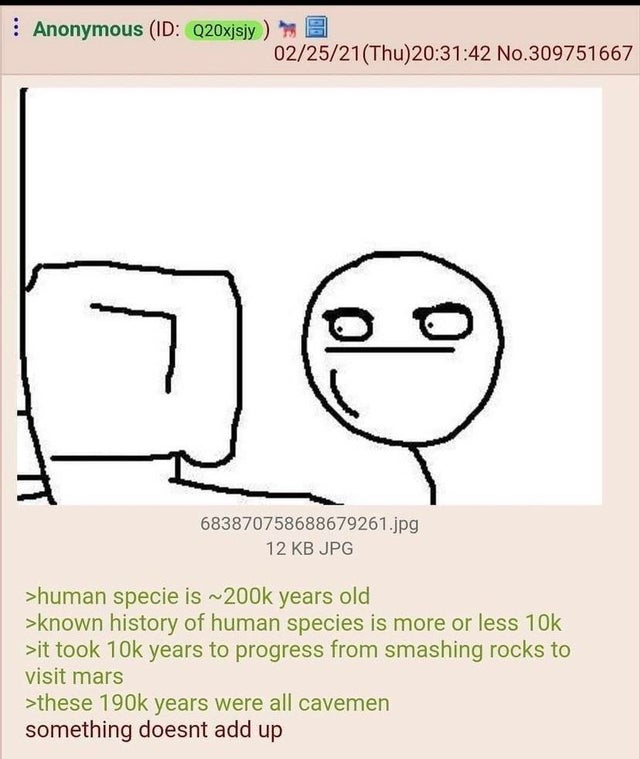
Exponential growth, thats about all there is to it. Advancing from clacking rocks to hunting deer is actually already a huge advancement.
Those 190k years in caves however werent non-advancing. A lot of advancements happened over those years.
Fires, wheels, knot tying, ceramics, pottery, grains, hunting, animal husbandry, medicine, language, art, music, rope...
Also, 10k years is after we gained writing of various forms to store information.
Keep in mind thats at the stage of shit like egypt, the great pyramids, etc. We were waaaaay beyond "cavemen" at that point. We already had trade routes, cities, nations, countless languages, doctors, etc.
The big issue was before that point, all our forms of storing information were just not able to stand the test of time very well, is all. We stopped being "cavemen" way before that mark though.
"something doesn't add up"
yes it does. that's exactly what it is you're describing. all of it adding up. as always people struggle with exponential growth because it's not very intuitive.
my favorite way to demonstrate the unintuitive nature of exponential growth is this question:
there's a pond, and a lily pad on it. the number of lily pads double every day on the pond. so on day 1 there's one, day 2 there's two, and on day 3 there's four... etc.
if it takes 120 days for the pond to get completely covered in lily pads, what day was only half of it covered?
!the answer is 119.!<
anon assumes development of science and tech is linear
start rolling down hill
going slow
go faster
hmm
That most people spend most of their time passively reading celebrity news on tiny black rectangle tells you everything you need to know about the rate of human progress.
Shit can get pretty wild when you start writing stuff down
The answer is probably language. Before advanced language was developed, there wasn't a good way to pass along any knowledge that was gained by an individual.
language => written down language => widespread literacy => affordable information (printing press) => internet => hypertext websites => search engines.
we went from struggeling to keep our knowledge arround to having access to almost the entire sum of human knowledge in a mostly convenient manner.
The Pleistocene (2,580,000 - 11,700 years ago) was fucking crazy cold and had a hella unstable climate. Not a nice predictable environment.
A lot of the comments are talking about writing being the game changer but it took generations of selective breeding crops and livestock to make them viable for domestication. We haven't found any evidence of domestication prior to about 12k years ago in archeology or genetics. There were many civilizations who built large cities and never needed a writing system.
you know how sometimes you're trying to solve a puzzle but you're stuck at the very beginning? You can spend hours looking at the puzzle and get nowhere. But then you spot it! the one step or the one logical conclusion you needed to advance, and you start blasting through the puzzle
it's that
We didn’t have writing for 190k years
It's mostly population density and specialization. You don't have time to think when you're doing everything yourself. The biggest advances come when we're able to fund the best and brightest to basically do nothing but think.
After getting into writing some hard science fiction futurism, I find it much more interesting that we have so very little perspective about where we exist within the present. Our technology is crap, we're poor as fuck, there is enormous wealth that dwarfs all the wealth on Earth and a whole lot of it is quite accessible if we tried, while we haven't even scratched the surface of the technology available within biology. Our medicine and healthcare practices are primarily based on anecdotal or correlative nonsense, low sigma test results, and cherry picked terrible science. Many of us here, myself included, are outliers that the present healthcare system fails to help. We have it better than some people in history, but worse than others. It feels like our culture has this mindset like we are the end game; no vision of the future. The only stories told are those of dystopianism. We should change that.
Hey man, there are plenty of animals on this planet that have been around longer than human beings, and I don't see any of them writing an award winning Netflix limited series...
Yep. For most of human history technological progress amounted to getting a little bit better at smashing slightly sharper rocks over the course of hundreds of years.
Yeah well. We kind of had to deal with bears the size of a fucking house for a while. At least until we wiped out their main food source. And rival hominids with at least spears.
When I think about how long it took me to realize that you're supposed to pour tetra packs with the spout on top, I find no fault in pre modern man
My own line of reasoning is that the speed of progress of technological advancement is dependent on the amount of people who can dedicate their lives to doing stuff other than trying to gather enough food and shelter to survive. So for the longest of times basically everyone had to just try to survive and maybe have an idea or two every now and then. Low human population and no-one able to dedicate themselves to innovation means extremely low innovation rate. But those rare times something really useful was developed and passed on to the next generation led to freeing more people to be able to dedicate themselves to innovation and thus increasing the amount of people one human can support with their work effort. This is a positive feedback loop so it has exponentially grown to today where one person's work can support multiple people making theoretically most of humanity free to advance technology.
We haven't even hit the steep bit of the curve yet, wait until you see where we are by the end of this century!
top 50 comments