(I know this is about Rifftrax, but we don't have a Rifftrax community.)
top 50 comments

sorted by: hot top controversial new old
[–] 68 points 2 years ago (39 children)

Have we checked all food to see if exploding them makes them into something better or did we just stop with corn?

  • source
  • hideshow 39 child comments
  • [–] 67 points 2 years ago* (last edited 2 years ago) (18 children)

    Let me tell you a little story about brassicas... broccoli, cabbage, bok choi, cauliflower, kohlrabi, canola oil. They're all this little guy. Edit: Shit! I missed the exploding part. gracile green plant with small yellow leaves that looks nothing like broccoli

  • source
  • parent
  • hideshow 18 child comments
  • load more comments (6 replies)
  • [–] 11 points 2 years ago (14 children)

    Potatoes Apples Marijuana Bananas Tulips Etc...

  • source
  • parent
  • hideshow 14 child comments
  • [–] [S] 30 points 2 years ago (11 children)

    Bananas are a similar one to corn too. Take something almost entirely inedible and cultivate it into something edible. Makes you wonder what convinced them to start.

  • source
  • parent
  • hideshow 11 child comments
  • [–] 27 points 2 years ago (9 children)

    Starvation was probably a good motivator

  • source
  • parent
  • hideshow 9 child comments
  • [–] [S] 14 points 2 years ago (8 children)

    Could be. We still don't know why people became sedentary farmers over hunter-gatherers, but it's happened many times in history.

    Somehow, farming happened independently but around the same time around the world, between 8000 and 10000 years ago. This is everywhere from Europe to the Americas to New Guinea, all apparently independently of each other!

  • source
  • parent
  • hideshow 8 child comments
  • load more comments (6 replies)
  • load more comments (1 reply)
  • load more comments (2 replies)
  • load more comments (3 replies)
    [–] 59 points 2 years ago (28 children)
  • [–] [S] 22 points 2 years ago (17 children)

    It's not worth it if you don't make an effort.

  • source
  • parent
  • hideshow 17 child comments
  • [–] 20 points 2 years ago* (4 children)

    ITS BEEN A LOOOOOONG ROAD GETTIN FROM THERE TO HERE

  • source
  • parent
  • hideshow 4 child comments
  • load more comments (1 reply)
  • load more comments (9 replies)
    [–] 58 points 2 years ago (111 children)

    This is what these non GMO types always seem to forget: we've been modifying the crap out of everything for the past thousands of years. We're now justuch more efficient and smart about it.

  • source
  • hideshow 111 child comments
  • [–] 11 points 2 years ago (42 children)

    They always picture someone in a lab with syringes and special machines to "modify DNA". Most of the time it's just a couple of potted plants under a lamp and a cotton swab. For fruit trees, you're pretty much just replacing a branch with another branch. Tape and staples might be involved.

  • source
  • parent
  • hideshow 42 child comments
  • [–] 10 points 2 years ago (41 children)

    Genetically modified plants is very different from selective breeding. Selective breeding mimics the natural evolution process, removing natural selection and replacing it with human decisions.

    Using a separate root stock from your fruiting trees isn't genetic modification or breeding. It's just taking desirable size features from a root stock and growing your desired fruit from that. It still remains two different plant, with two different DNAs. The fruit would produce a child of the fruit tree, the same as if it was grown from seed. If the root tree was allowed to flower it would create a seed the same as if it were never grafted.

    GMO are an extremely useful technology. When well regulated and tested will help produce food for the growing world population. The big problems with it are the consequences of it. Plant have been modified to tolerate high doses of weed killer, pesticides and fertilisers. These all help increase the productivity of the land, but the impacts are terrible on the local environment. Residual weed killer and pesticide may pose a risk to human as well.

  • source
  • parent
  • hideshow 41 child comments
  • load more comments (41 replies)
  • load more comments (67 replies)
    [–] 30 points 2 years ago

    uh-maize-ing

  • source
  • [–] 24 points 2 years ago

    ( ͡° ͜ʖ ͡°) tireless breeding

  • source
  • [–] 23 points 2 years ago

    Sorry, i don't eat gmo /s

  • source
  • [–] 21 points 2 years ago (12 children)

    I don't know if tireless is the right word, I'm sure they had time to sleep.

  • source
  • hideshow 12 child comments
  • [–] [S] 26 points 2 years ago (9 children)

    They never came up with the wheel. Of course they were tireless.

  • source
  • parent
  • hideshow 9 child comments
  • load more comments (5 replies)
  • [–] 20 points 2 years ago (17 children)

    What about all of the other varieties of corn? Are they not relatives to each other?

  • source
  • hideshow 17 child comments
  • load more comments (2 replies)
    [–] 19 points 2 years ago (1 child)

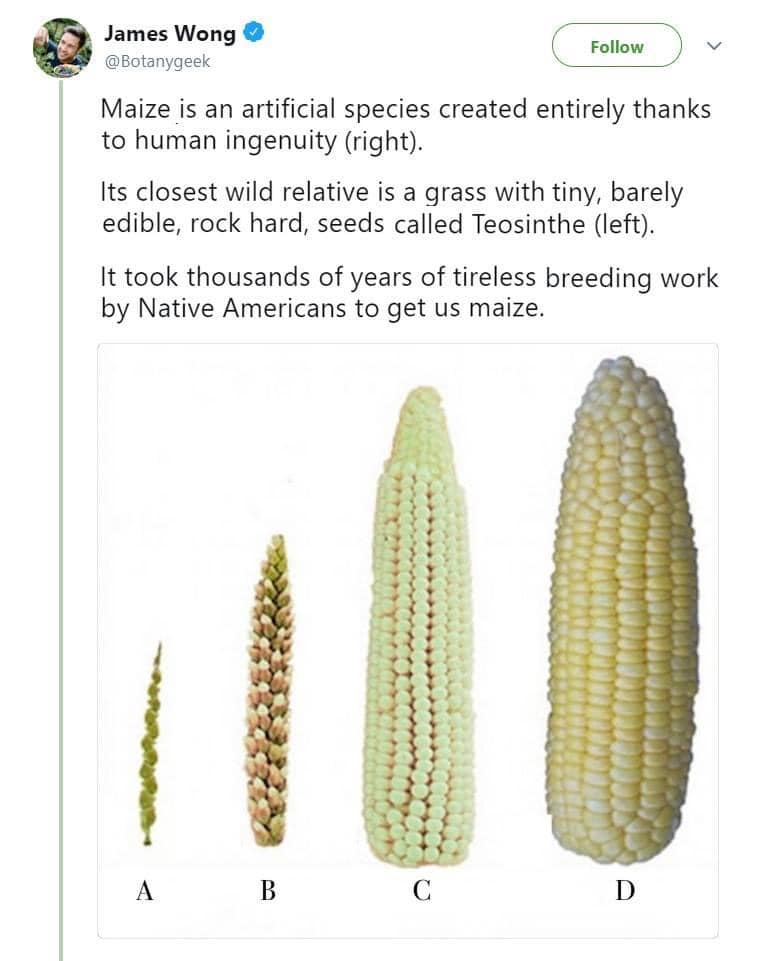
    I have seen this image many times in my uni courses.

    • when european first reached the continent, the breeding of the plant was heavily advance, somewhat on the right side of thr image

    • this is one of the staple crops without which we could not survive.

    • the current varieties are so productive, but they require all modern farming methods, which can be impactful

    • if you want to apply biological agriculture, the mkst recent varieties are not a good pick, unless they actively support that

    • that image also serve as a quick explaination as to how our food systems evolved. When you read ancient folk tales, or even when you read about these plants in Biblical texts, imagine the one on the mid left. A small plant capable of supporting a limited amount of people

  • source
  • hideshow 1 child comment
  • [–] [S] 11 points 2 years ago

    What I think is more interesting in terms of New World staples is what the indigenous people of the Andes did with the potato. Not only did the cultivate dozens of varieties, they also learned how to freeze-dry them for long-term storage. That's amazing for people who just barely entered the bronze age by the time of European contact.

  • source
  • parent
  • [–] 15 points 2 years ago

    Damn I've never seen the evolution of corn like this before. Really interesting stuff!

  • source
  • [–] 13 points 2 years ago*

    For real tho - any estimations on how many gens/years it took/takes to get from A to at least C?

  • source
  • [–] 11 points 2 years ago

    But is it non-GMO? /s

  • source
  • [–] 9 points 2 years ago

    I seem to remember Bill posting a iscorngrass.com (or similar) site on twitter back when the riff was first popular. I'm not finding it if it still exists.

  • source
  • load more comments
    view more: next ›