People who joke about legos haven't stepped on this bad boy
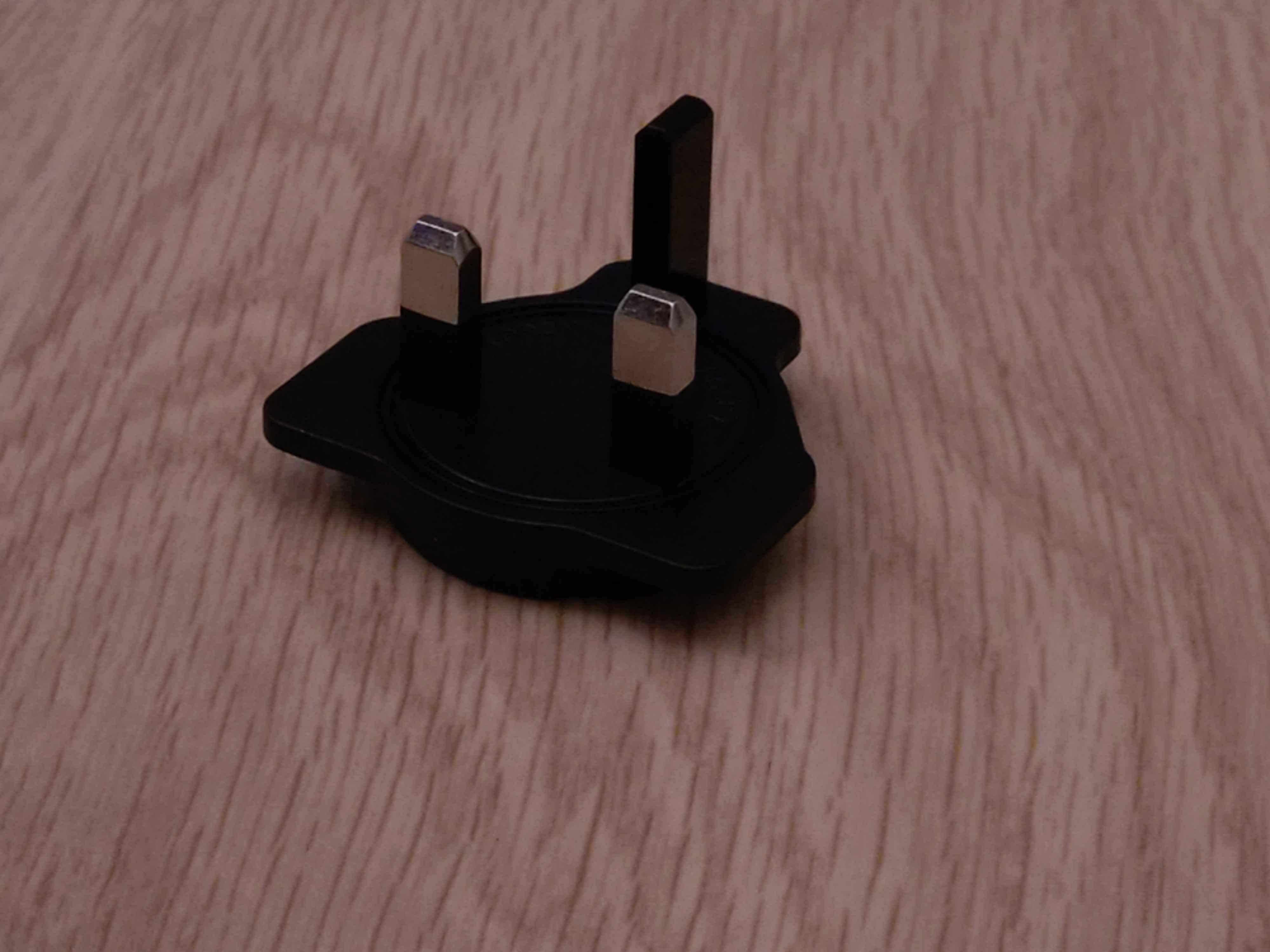
People who joke about legos haven't stepped on this bad boy
The higher voltage has nothing whatsoever to do with ring circuits. The UK runs on the same 220-240V AC as all of mainland Europe. And Africa. And most of mainland Asia. And South America. And Oceania. And most of the middle east. So not quite “higher than any other country”
240V @ 30A is the highest on the planet. You consistently ignored current rating, despite recognizing that without the special, overengineered fused plugs, appliances would be exposed to them. Your inclusion of this is dishonest.
~Also those two claims are diametrically opposed to each other. Unless UK people use over twice the amount of electricity than Americans, the higher voltage will lead to LOWER total current.
The claim you're rebutting is not the claim that was made. The claim that was made was that each UK circuit has higher current than a comparable North American circuit. Which is true. A UK household circuit is at 30A, while Canadian/US/Mexican is at 15/20A. American and UK homes use roughly the same amount of total power, but the American home typically distributes that power with roughly 4 times as many, lower-current circuits.
And the current a conductor can pass has nothing whatsoever to do with it’s safety.
Both of us have rebutted that several times already, in recognizing that a low-current wire is a fire hazard when connected to a high-current household circuit. You make that argument yourself, below.
The Japanese plugs are basically the same as American. You can literally get an electric shock if you hold them wrong whilst unplugging. There’s exposed live contacts from when you start unplugging until the prongs break their connection to the outlet.
Conceded. The insulated prongs on the UK sockets are not "overengineering". Such prongs are used on Europlugs as well. That leaves the extremely large size of the contacts, necessitating the shutters.
Basically everything you said is demonstrably false. I’ve rarely seen someone be this confident and this incorrect about something.
Everything? Really? My "rebuttal" is to ignore this ad hom.
~That is utterly irrelevant. Circuit breakers and fuses are designed for the exclusive and sole purpose of protecting the circuit from being overloaded. A 100 amp circuit with a 100 Amp fuse is exactly as safe as a 20 amp circuit with a 20 amp fuse or a 5 amp circuit with a 5 amp fuse. If the voltage is above 100-200V, all 3 of these are hundreds of times the amount of current it would take to deliver a fatal electric shock, and none of those fuses would trip from you getting shocked.
The rest of the world safely uses unfused plugs. Every argument you make that requires fuses supports my contention.
And a dead short on a 240V network will literally trip everything. UK ring circuits are fused at 30 Amps. A dead short at 240V with only the internal resistance of copper wiring would pull current in the neighborhood of 1000 amps. 1000, somewhat famously, being slightly larger than 30, making this another lie there.
You're assuming the internal resistance of a wire of sufficient gauge. An undersized wire - such as a power cord intended to be used on a 16A EU appliance - may not be capable of drawing 30A, let alone 1000, without catching fire. It may only draw 28A while it is glowing red hot. That same unfused power cable is perfectly acceptable and perfectly safe on a 16A EU circuit, but is unsafe on a UK household circuit without that special UK plug.
And even if it weren’t a lie, how on earth does the location of the fuse make a difference in safety here ? If it’s in the wall or in the plug, as long as it’s there and does it’s job both would be equally safe.
You're ignoring the original point and arguing something tangential and irrelevant. The rest of the world safely uses unfused plugs. Which means that their power cables are simpler in design and construction, but necessitates that their power cable must be able to survive the full rated household current. The UK does not use this "unfused plug" design philosophy. The reason they don't use it is because it would necessitate that their power cables be capable of surviving 30A faults, rather than the 16A in the EU.
The UK does not restrict their household supply circuits to 16A. They allow their household circuits to carry 30A. That standardization decision necessitates the fused plug that the rest of the world simply doesn't need.
The function provided by those shutters is achieved in the Japanese wiring by lower voltage, narrow holes in receptacles (allowable because they don’t need as large a contact to safely carry the lower rated current) and whole-house AFCI/GFCI.
No it isn’t. 110V is still dangerous to a child, and if you think otherwise I hope to god you aren’t, or ever become a parent. Also, as I stated, your plugs literally allow for an electric shock to happen whilst unplugging them because they’re so terrible. As for whole house GFCI, that is by necessity included in a ring circuit that wants GFCI on any outlet at all.
Again, conceded: The sleeved contacts are not part of the "overengineering" of the plug. The EU plug uses a similar design. American and Japanese plugs are deficient in this aspect.
Also you seem to fundamentally misunderstand the relationship of current and voltage. For a given electrical appliance, with a given wattage, a lower voltage means it needs to draw more current, not less. That’s why the US Japan need to have 20A household breakers, whereas in the EU 16A branches are more than enough, whilst still providing a higher load handling capability than a 20A Japanese fuse. A 1000 Watt microwave plugged into a Japanese socket will draw over twice as much current as a 1000 Watt microwave plugged into an EU or UK socket (which also means it produces 4 times the amount of electrical waste energy as heat, though that is generally negligible for short household cable runs either way. Can make a difference on the scale of a country though).
Not an accurate observation of my understanding at all, and not particularly relevant to the discussion. The topic of discussion is the relationship of plugs to household wiring.
For a given voltage, the outcome of recieving a shock on a 20A fused circuit is literally indistinguishable and fully identical to that of receiving a shock on a 100A fused circuit. Identical. Literally.
Conceded, with the caveat that the RCD/AFCI/GFCI device for the 20A circuit will be more sensitive and allow lower current to pass than the equivalent RCD/AFCI/GFCI device on the 100A circuit.
No it isn’t. I literally just told you you can buy 15A rated extension cords in Japan in the comment you’re replying to. 15, is in fact less than 20, just fyi.
The 15A extension cord in Japan is designed to be plugged into a Japanese outlet. This is the same bullshit historical and technical issue that we have in our NEC code, where identical components often have different nameplate ratings. That 15A extension cord is specifically designed for use on circuits protected by 20A breakers.
Wrong. Again. The current limit imposed by the internal resistance of your body at voltages in the range of 100-200 is a few hundred milliamps. Maybe an amp or two if you stick electrodes inside yourself, and anything higher than 100 mA going through your heart is already lethal anyway. You’re gonna be dead 200 times over waiting for your 20A fuse to save you. The power that will pass through your body depends exclusively and solely on the voltage. The capacity and fusing of the circuit is utterly irrelevant, unless it’s fused at like 40 MILLI amps.
Conceded, and irrelevant to the issue at hand.
ANY cable being driven above it’s rated load is a fire hazard. There are healthy margins in those ratings, so going slightly over is likely not going to have any affect, but those margins are for good reason (namely people like you thinking it’s fine to plug a 15A cable into a 20A circuit without external fusing or current limiting), and deliberately overloading any part of an electric circuit is ALWAYS dangerous and stupid.
I addressed this with my diatribe against the NEC's position on 15A vs 20A components. The 15A extension cord is specifically designed for use in a circuit protected by a 20A breaker. It's an asinine provision, but it is there.
And what about 7A cables you can get in japan ? you can explicitly get 0.75mm² cables, which are only rated to 7Amps. Just as confident of blasting 20A through those ? Almost 9 times the amount of waste heat being generated in the core than at it’s max rated load.
I suspect that those cables actually do have a fuse in them, much like the fused plugs used on North American Christmas decorations.
~~Your device could slowly be melting itself into a pile of burning plastic, as long as it’s drawing less than 16 Amps to do so, the breakers will not trip. As I’ve pointed outñ
Yes, exactly. Which is why the unfused portions of that device have to be designed to handle at least 16A.
And in fact, the fused plugs actually make it way MORE likely for something to trip on a device side fault in the UK, because the current only has to be like 3Amps to kill the fuse. In every other place of the world, current needs to be at least 16A before anything trips.
Agreed. I've repeatedly made that exact argument in support of my point.
I address that point, quite literally, in a later a paraph where I write
Maybe an amp or two if you stick electrodes inside yourself
So what happened here ? Did you not read my comment ? Did you not understand it ? Or did you read it understand, and then continue to pretend like I haven’t already explicitly addressed this anyway ?
I confess, I didn't read it. As It wasn't and isn't particularly relevant to the core issue, I'm happy to concede the point.