you are viewing a single comment's thread
view the rest of the comments
[–] 11 points 2 years ago (4 children)

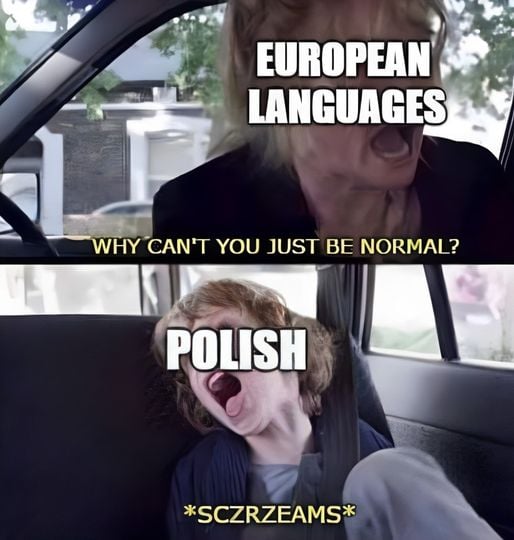
I wonder if we had ž etc like Czechs would it make it easier for foreigners to read

  • source
  • hideshow 8 child comments
  • [–] 7 points 2 years ago (2 children)

    Fun fact: The Czech adopted š, č and ž to look less German. The Lithuanians adopted it to look less Polish.

  • source
  • parent
  • hideshow 4 child comments
  • [–] 1 point 2 years ago* (last edited 2 years ago) (2 children)

    I'm learning Polish, and spelling (rz dz sz cz ł and ą ę ż ś) is all fine for me-- the thing I struggle with is the grammatical cases. The fact that the ending of everything changes is what has caused me to give up twice 🥺

    I will pick it up again, but I sucked at the Masculine/Feminine thing with French, and this is a lot more difficult.

    CAT:

    • KOT
    • KOTA
    • KOTU
    • KOTEM
    • KOCIE <--- (This is where I quit: Locative case took the T away WTF?!)

    Przepraszam moja drogi!!

  • source
  • parent
  • hideshow 4 child comments
  • [–] 2 points 2 years ago (1 child)

    Looks weired but a sound of C and T has to be somehow connected, at least it feels like they are to me. Based on my experience, sound of Polish Ć and Czech Ť are transitional between Polish/Czech T/C. Proper linguist might put some more light on it than just my speculation.

  • source
  • parent
  • hideshow 2 child comments
  • [–] 2 points 2 years ago (1 child)

    Our C is reffered in IPA as joined "TS" sound, so there is definitely some merit to that

  • source
  • parent
  • hideshow 2 child comments
  • [–] 1 point 2 years ago

    Polish C is also described as /t͡s/ (e.g. co /t͡sɔ/). According to wiki both are dental and voiceless although one is plosive and the other affricate. As I've read their descriptions on wiki, they made a lot of sense - /t͡s/ starts with a blockade of airway (just as /t/) but the air is released slightly differently thus making the difference in sound produced.

  • source
  • parent
  • [–] 1 point 2 years ago

    The T turning into C is called somehow, I don't remember how, but it's used quite often. For example, "expensive" and "more expensive" would be "drogo" and "drożej". I think there were even some tables for all the transformations, but I might misremember things

  • source
  • parent