▲ 1537 ▼ Breast Cancer (mander.xyz) submitted 2 years ago by fossilesque@mander.xyz to c/science_memes@mander.xyz 257 comments fedilink hide all child comments
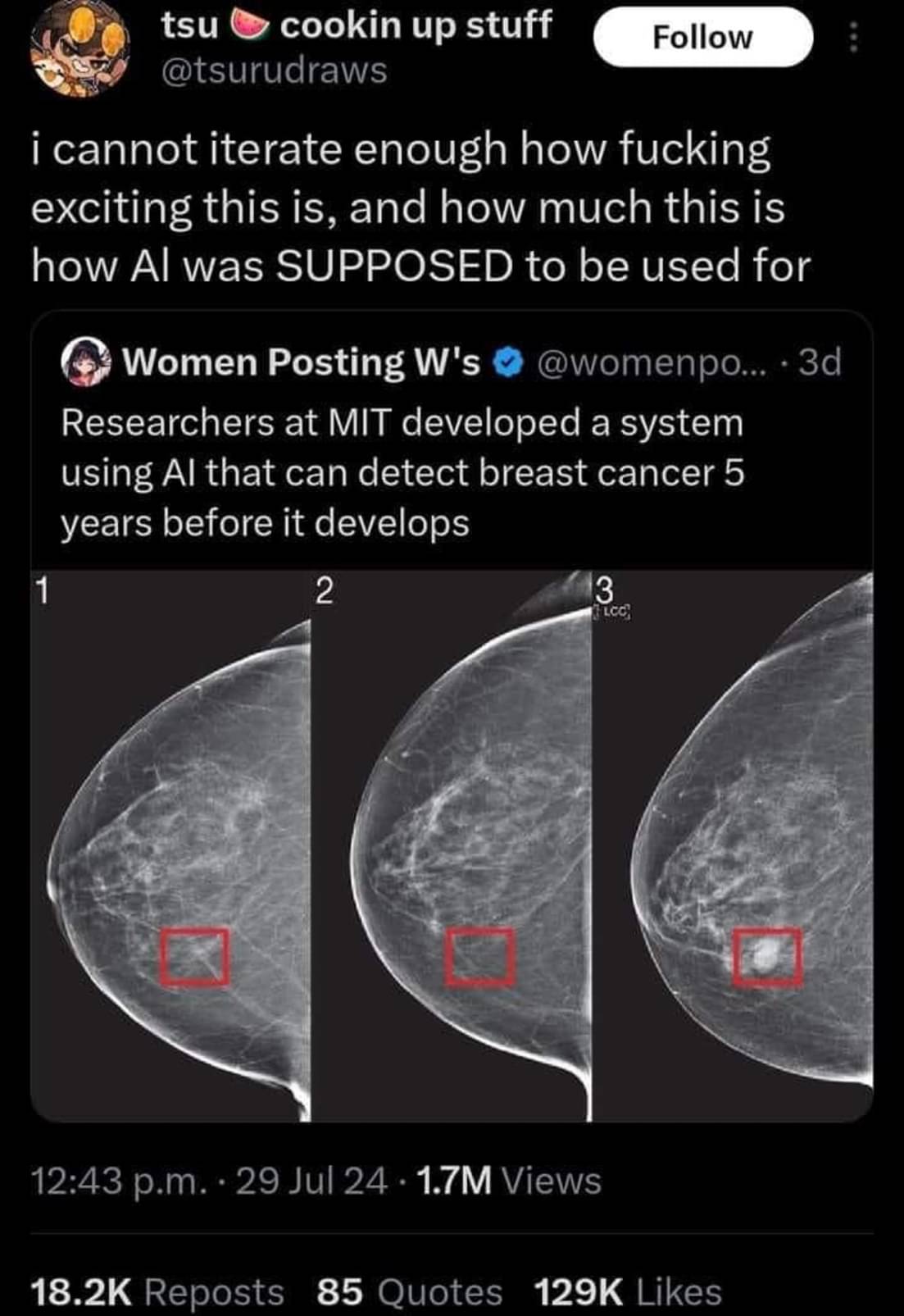
[+] parpol@programming.dev 209 points 2 years ago (26 children) [deleted] permalink fedilink source hideshow 26 child comments replies: [–] FierySpectre@lemmy.world 128 points 2 years ago* (22 children) Using AI for anomaly detection is nothing new though. Haven't read any article about this specific 'discovery' but usually this uses a completely different technique than the AI that comes to mind when people think of AI these days. permalink fedilink source parent hideshow 22 child comments replies: [–] Johanno@feddit.org 77 points 2 years ago (16 children) That's why I hate the term AI. Say it is a predictive llm or a pattern recognition model. permalink fedilink source parent hideshow 16 child comments replies: [–] PM_ME_VINTAGE_30S@lemmy.sdf.org 65 points 2 years ago (6 children) Say it is a predictive llm According to the paper cited by the article OP posted, there is no LLM in the model. If I read it correctly, the paper says that it uses PyTorch's implementation of ResNet18, a deep convolutional neural network that isn't specifically designed to work on text. So this term would be inaccurate. or a pattern recognition model. Much better term IMO, especially since it uses a convolutional network. But since the article is a news publication, not a serious academic paper, the author knows the term "AI" gets clicks and positive impressions (which is what their job actually is) and we wouldn't be here talking about it. permalink fedilink source parent hideshow 6 child comments replies: [–] BeliefPropagator@discuss.tchncs.de 40 points 2 years ago (2 children) That performance curve seems terrible for any practical use. permalink fedilink source parent hideshow 2 child comments replies: [–] loonsun@sh.itjust.works 20 points 2 years ago Yeah that's an unacceptably low ROC curve for a medical usecase permalink fedilink source parent [–] PM_ME_VINTAGE_30S@lemmy.sdf.org 9 points 2 years ago Good catch! permalink fedilink source parent [–] FierySpectre@lemmy.world 9 points 2 years ago (2 children) Well, this is very much an application of AI... Having more examples of recent AI development that aren't 'chatgpt'(/transformers-based) is probably a good thing. permalink fedilink source parent hideshow 2 child comments replies: [–] wewbull@feddit.uk 3 points 2 years ago (1 child) Op is not saying this isn't using the techniques associated with the term AI. They're saying that the term AI is misleading, broad, and generally not desirable in a technical publication. permalink fedilink source parent hideshow 1 child comment replies: [–] FierySpectre@lemmy.world 6 points 2 years ago Op is not saying this isn't using the techniques associated with the term AI. Correct, also not what I was replying about. I said that using AI in the headline here is very much correct. It is after all a paper using AI to detect stuff. permalink fedilink source parent [–] steventhedev@lemmy.world 23 points 2 years ago (1 child) The correct term is "Computational Statistics" permalink fedilink source parent hideshow 1 child comment replies: [–] spechter@lemmy.ml 24 points 2 years ago* Stop calling it that, you're scaring the venture capital permalink fedilink source parent [–] 0laura@lemmy.world -3 points 2 years ago (6 children) it's a good term, it refers to lots of thinks. there are many terms like that. permalink fedilink source parent hideshow 6 child comments replies: [–] wewbull@feddit.uk 9 points 2 years ago (4 children) it refers to lots of thinks So it's a bad term. permalink fedilink source parent hideshow 4 child comments replies: [–] 0laura@lemmy.world 1 point 2 years ago the word program refers to even more things and no one says it's a bad word. permalink fedilink source parent [–] GetOffMyLan@programming.dev -1 points 2 years ago* (2 children) It's literally the name of the field of study. Chances are this uses the same thing as LLMs. Aka a neutral network, which are some of the oldest AIs around. It refers to anything that simulates intelligence. They are using the correct word. People just misunderstand it. permalink fedilink source parent hideshow 2 child comments replies: [–] wewbull@feddit.uk 2 points 2 years ago (1 child) If people consistently misunderstand it, it's a bad term for communicating the concept. permalink fedilink source parent hideshow 1 child comment replies: [–] GetOffMyLan@programming.dev 1 point 2 years ago* It's the correct term though. It's like when people get confused about what a scientific theory is. We still call it the theory of gravity. permalink fedilink source parent [–] Ephera@lemmy.ml 3 points 2 years ago The problem is that it refers to so many and constantly changing things that it doesn't refer to anything specific in the end. You can replace the word "AI" in any sentence with the word "magic" and it basically says the same thing... permalink fedilink source parent [–] PM_ME_VINTAGE_30S@lemmy.sdf.org 11 points 2 years ago (4 children) Haven't read any article about this specific 'discovery' but usually this uses a completely different technique than the AI that comes to mind when people think of AI these days. From the conclusion of the actual paper: Deep learning models that use full-field mammograms yield substantially improved risk discrimination compared with the Tyrer-Cuzick (version 8) model. If I read this paper correctly, the novelty is in the model, which is a deep learning model that works on mammogram images + traditional risk factors. permalink fedilink source parent hideshow 4 child comments replies: [–] FierySpectre@lemmy.world 7 points 2 years ago* (last edited 2 years ago) (2 children) For the image-only DL model, we implemented a deep convolutional neural network (ResNet18 [13]) with PyTorch (version 0.31; pytorch.org). Given a 1664 × 2048 pixel view of a breast, the DL model was trained to predict whether or not that breast would develop breast cancer within 5 years. The only "innovation" here is feeding full view mammograms to a ResNet18(2016 model). The traditional risk factors regression is nothing special (barely machine learning). They don't go in depth about how they combine the two for the hybrid model, so it's probably safe to assume it is something simple (merely combining the results, so nothing special in the training step). edit: I stand corrected, commenter below pointed out the appendix, and the regression does in fact come into play in the training step As a different commenter mentioned, the data collection is largely the interesting part here. I'll admit I was wrong about my first guess as to the network topology used though, I was thinking they used something like auto encoders (but that is mostly used in cases where examples of bad samples are rare) permalink fedilink source parent hideshow 2 child comments replies: [–] PM_ME_VINTAGE_30S@lemmy.sdf.org 5 points 2 years ago* (last edited 2 years ago) They don't go in depth about how they combine the two for the hybrid model Actually they did, it's in Appendix E (PDF warning) . A GitHub repo would have been nice, but I think there would be enough info to replicate this if we had the data. Yeah it's not the most interesting paper in the world. But it's still a cool use IMO even if it might not be novel enough to deserve a news article. permalink fedilink source parent [–] errer@lemmy.world 3 points 2 years ago ResNet18 is ancient and tiny…I don’t understand why they didn’t go with a deeper network. ResNet50 is usually the smallest I’ll use. permalink fedilink source parent [–] llothar@lemmy.ml 3 points 2 years ago I skimmed the paper. As you said, they made a ML model that takes images and traditional risk factors (TCv8). I would love to see comparison against risk factors + human image evaluation. Nevertheless, this is the AI that will really help humanity. permalink fedilink source parent [–] SomeGuy69@lemmy.world 18 points 2 years ago It's really difficult to clean those data. Another case was, when they kept the markings on the training data and the result was, those who had cancer, had a doctors signature on it, so the AI could always tell the cancer from the not cancer images, going by the lack of signature. However, these people also get smarter in picking their training data, so it's not impossible to work properly at some point. permalink fedilink source parent [–] EatATaco@lemm.ee 14 points 2 years ago Citation please? permalink fedilink source parent [–] earmuff@lemmy.dbzer0.com 2 points 2 years ago That’s the nice thing about machine learning, as it sees nothing but something that correlates. That’s why data science is such a complex topic, as you do not see errors this easily. Testing a model is still very underrated and usually there is no time to properly test a model. permalink fedilink source parent
[–] FierySpectre@lemmy.world 128 points 2 years ago* (22 children) Using AI for anomaly detection is nothing new though. Haven't read any article about this specific 'discovery' but usually this uses a completely different technique than the AI that comes to mind when people think of AI these days. permalink fedilink source parent hideshow 22 child comments replies: [–] Johanno@feddit.org 77 points 2 years ago (16 children) That's why I hate the term AI. Say it is a predictive llm or a pattern recognition model. permalink fedilink source parent hideshow 16 child comments replies: [–] PM_ME_VINTAGE_30S@lemmy.sdf.org 65 points 2 years ago (6 children) Say it is a predictive llm According to the paper cited by the article OP posted, there is no LLM in the model. If I read it correctly, the paper says that it uses PyTorch's implementation of ResNet18, a deep convolutional neural network that isn't specifically designed to work on text. So this term would be inaccurate. or a pattern recognition model. Much better term IMO, especially since it uses a convolutional network. But since the article is a news publication, not a serious academic paper, the author knows the term "AI" gets clicks and positive impressions (which is what their job actually is) and we wouldn't be here talking about it. permalink fedilink source parent hideshow 6 child comments replies: [–] BeliefPropagator@discuss.tchncs.de 40 points 2 years ago (2 children) That performance curve seems terrible for any practical use. permalink fedilink source parent hideshow 2 child comments replies: [–] loonsun@sh.itjust.works 20 points 2 years ago Yeah that's an unacceptably low ROC curve for a medical usecase permalink fedilink source parent [–] PM_ME_VINTAGE_30S@lemmy.sdf.org 9 points 2 years ago Good catch! permalink fedilink source parent [–] FierySpectre@lemmy.world 9 points 2 years ago (2 children) Well, this is very much an application of AI... Having more examples of recent AI development that aren't 'chatgpt'(/transformers-based) is probably a good thing. permalink fedilink source parent hideshow 2 child comments replies: [–] wewbull@feddit.uk 3 points 2 years ago (1 child) Op is not saying this isn't using the techniques associated with the term AI. They're saying that the term AI is misleading, broad, and generally not desirable in a technical publication. permalink fedilink source parent hideshow 1 child comment replies: [–] FierySpectre@lemmy.world 6 points 2 years ago Op is not saying this isn't using the techniques associated with the term AI. Correct, also not what I was replying about. I said that using AI in the headline here is very much correct. It is after all a paper using AI to detect stuff. permalink fedilink source parent [–] steventhedev@lemmy.world 23 points 2 years ago (1 child) The correct term is "Computational Statistics" permalink fedilink source parent hideshow 1 child comment replies: [–] spechter@lemmy.ml 24 points 2 years ago* Stop calling it that, you're scaring the venture capital permalink fedilink source parent [–] 0laura@lemmy.world -3 points 2 years ago (6 children) it's a good term, it refers to lots of thinks. there are many terms like that. permalink fedilink source parent hideshow 6 child comments replies: [–] wewbull@feddit.uk 9 points 2 years ago (4 children) it refers to lots of thinks So it's a bad term. permalink fedilink source parent hideshow 4 child comments replies: [–] 0laura@lemmy.world 1 point 2 years ago the word program refers to even more things and no one says it's a bad word. permalink fedilink source parent [–] GetOffMyLan@programming.dev -1 points 2 years ago* (2 children) It's literally the name of the field of study. Chances are this uses the same thing as LLMs. Aka a neutral network, which are some of the oldest AIs around. It refers to anything that simulates intelligence. They are using the correct word. People just misunderstand it. permalink fedilink source parent hideshow 2 child comments replies: [–] wewbull@feddit.uk 2 points 2 years ago (1 child) If people consistently misunderstand it, it's a bad term for communicating the concept. permalink fedilink source parent hideshow 1 child comment replies: [–] GetOffMyLan@programming.dev 1 point 2 years ago* It's the correct term though. It's like when people get confused about what a scientific theory is. We still call it the theory of gravity. permalink fedilink source parent [–] Ephera@lemmy.ml 3 points 2 years ago The problem is that it refers to so many and constantly changing things that it doesn't refer to anything specific in the end. You can replace the word "AI" in any sentence with the word "magic" and it basically says the same thing... permalink fedilink source parent [–] PM_ME_VINTAGE_30S@lemmy.sdf.org 11 points 2 years ago (4 children) Haven't read any article about this specific 'discovery' but usually this uses a completely different technique than the AI that comes to mind when people think of AI these days. From the conclusion of the actual paper: Deep learning models that use full-field mammograms yield substantially improved risk discrimination compared with the Tyrer-Cuzick (version 8) model. If I read this paper correctly, the novelty is in the model, which is a deep learning model that works on mammogram images + traditional risk factors. permalink fedilink source parent hideshow 4 child comments replies: [–] FierySpectre@lemmy.world 7 points 2 years ago* (last edited 2 years ago) (2 children) For the image-only DL model, we implemented a deep convolutional neural network (ResNet18 [13]) with PyTorch (version 0.31; pytorch.org). Given a 1664 × 2048 pixel view of a breast, the DL model was trained to predict whether or not that breast would develop breast cancer within 5 years. The only "innovation" here is feeding full view mammograms to a ResNet18(2016 model). The traditional risk factors regression is nothing special (barely machine learning). They don't go in depth about how they combine the two for the hybrid model, so it's probably safe to assume it is something simple (merely combining the results, so nothing special in the training step). edit: I stand corrected, commenter below pointed out the appendix, and the regression does in fact come into play in the training step As a different commenter mentioned, the data collection is largely the interesting part here. I'll admit I was wrong about my first guess as to the network topology used though, I was thinking they used something like auto encoders (but that is mostly used in cases where examples of bad samples are rare) permalink fedilink source parent hideshow 2 child comments replies: [–] PM_ME_VINTAGE_30S@lemmy.sdf.org 5 points 2 years ago* (last edited 2 years ago) They don't go in depth about how they combine the two for the hybrid model Actually they did, it's in Appendix E (PDF warning) . A GitHub repo would have been nice, but I think there would be enough info to replicate this if we had the data. Yeah it's not the most interesting paper in the world. But it's still a cool use IMO even if it might not be novel enough to deserve a news article. permalink fedilink source parent [–] errer@lemmy.world 3 points 2 years ago ResNet18 is ancient and tiny…I don’t understand why they didn’t go with a deeper network. ResNet50 is usually the smallest I’ll use. permalink fedilink source parent [–] llothar@lemmy.ml 3 points 2 years ago I skimmed the paper. As you said, they made a ML model that takes images and traditional risk factors (TCv8). I would love to see comparison against risk factors + human image evaluation. Nevertheless, this is the AI that will really help humanity. permalink fedilink source parent
[–] Johanno@feddit.org 77 points 2 years ago (16 children) That's why I hate the term AI. Say it is a predictive llm or a pattern recognition model. permalink fedilink source parent hideshow 16 child comments replies: [–] PM_ME_VINTAGE_30S@lemmy.sdf.org 65 points 2 years ago (6 children) Say it is a predictive llm According to the paper cited by the article OP posted, there is no LLM in the model. If I read it correctly, the paper says that it uses PyTorch's implementation of ResNet18, a deep convolutional neural network that isn't specifically designed to work on text. So this term would be inaccurate. or a pattern recognition model. Much better term IMO, especially since it uses a convolutional network. But since the article is a news publication, not a serious academic paper, the author knows the term "AI" gets clicks and positive impressions (which is what their job actually is) and we wouldn't be here talking about it. permalink fedilink source parent hideshow 6 child comments replies: [–] BeliefPropagator@discuss.tchncs.de 40 points 2 years ago (2 children) That performance curve seems terrible for any practical use. permalink fedilink source parent hideshow 2 child comments replies: [–] loonsun@sh.itjust.works 20 points 2 years ago Yeah that's an unacceptably low ROC curve for a medical usecase permalink fedilink source parent [–] PM_ME_VINTAGE_30S@lemmy.sdf.org 9 points 2 years ago Good catch! permalink fedilink source parent [–] FierySpectre@lemmy.world 9 points 2 years ago (2 children) Well, this is very much an application of AI... Having more examples of recent AI development that aren't 'chatgpt'(/transformers-based) is probably a good thing. permalink fedilink source parent hideshow 2 child comments replies: [–] wewbull@feddit.uk 3 points 2 years ago (1 child) Op is not saying this isn't using the techniques associated with the term AI. They're saying that the term AI is misleading, broad, and generally not desirable in a technical publication. permalink fedilink source parent hideshow 1 child comment replies: [–] FierySpectre@lemmy.world 6 points 2 years ago Op is not saying this isn't using the techniques associated with the term AI. Correct, also not what I was replying about. I said that using AI in the headline here is very much correct. It is after all a paper using AI to detect stuff. permalink fedilink source parent [–] steventhedev@lemmy.world 23 points 2 years ago (1 child) The correct term is "Computational Statistics" permalink fedilink source parent hideshow 1 child comment replies: [–] spechter@lemmy.ml 24 points 2 years ago* Stop calling it that, you're scaring the venture capital permalink fedilink source parent [–] 0laura@lemmy.world -3 points 2 years ago (6 children) it's a good term, it refers to lots of thinks. there are many terms like that. permalink fedilink source parent hideshow 6 child comments replies: [–] wewbull@feddit.uk 9 points 2 years ago (4 children) it refers to lots of thinks So it's a bad term. permalink fedilink source parent hideshow 4 child comments replies: [–] 0laura@lemmy.world 1 point 2 years ago the word program refers to even more things and no one says it's a bad word. permalink fedilink source parent [–] GetOffMyLan@programming.dev -1 points 2 years ago* (2 children) It's literally the name of the field of study. Chances are this uses the same thing as LLMs. Aka a neutral network, which are some of the oldest AIs around. It refers to anything that simulates intelligence. They are using the correct word. People just misunderstand it. permalink fedilink source parent hideshow 2 child comments replies: [–] wewbull@feddit.uk 2 points 2 years ago (1 child) If people consistently misunderstand it, it's a bad term for communicating the concept. permalink fedilink source parent hideshow 1 child comment replies: [–] GetOffMyLan@programming.dev 1 point 2 years ago* It's the correct term though. It's like when people get confused about what a scientific theory is. We still call it the theory of gravity. permalink fedilink source parent [–] Ephera@lemmy.ml 3 points 2 years ago The problem is that it refers to so many and constantly changing things that it doesn't refer to anything specific in the end. You can replace the word "AI" in any sentence with the word "magic" and it basically says the same thing... permalink fedilink source parent
[–] PM_ME_VINTAGE_30S@lemmy.sdf.org 65 points 2 years ago (6 children) Say it is a predictive llm According to the paper cited by the article OP posted, there is no LLM in the model. If I read it correctly, the paper says that it uses PyTorch's implementation of ResNet18, a deep convolutional neural network that isn't specifically designed to work on text. So this term would be inaccurate. or a pattern recognition model. Much better term IMO, especially since it uses a convolutional network. But since the article is a news publication, not a serious academic paper, the author knows the term "AI" gets clicks and positive impressions (which is what their job actually is) and we wouldn't be here talking about it. permalink fedilink source parent hideshow 6 child comments replies: [–] BeliefPropagator@discuss.tchncs.de 40 points 2 years ago (2 children) That performance curve seems terrible for any practical use. permalink fedilink source parent hideshow 2 child comments replies: [–] loonsun@sh.itjust.works 20 points 2 years ago Yeah that's an unacceptably low ROC curve for a medical usecase permalink fedilink source parent [–] PM_ME_VINTAGE_30S@lemmy.sdf.org 9 points 2 years ago Good catch! permalink fedilink source parent [–] FierySpectre@lemmy.world 9 points 2 years ago (2 children) Well, this is very much an application of AI... Having more examples of recent AI development that aren't 'chatgpt'(/transformers-based) is probably a good thing. permalink fedilink source parent hideshow 2 child comments replies: [–] wewbull@feddit.uk 3 points 2 years ago (1 child) Op is not saying this isn't using the techniques associated with the term AI. They're saying that the term AI is misleading, broad, and generally not desirable in a technical publication. permalink fedilink source parent hideshow 1 child comment replies: [–] FierySpectre@lemmy.world 6 points 2 years ago Op is not saying this isn't using the techniques associated with the term AI. Correct, also not what I was replying about. I said that using AI in the headline here is very much correct. It is after all a paper using AI to detect stuff. permalink fedilink source parent
[–] BeliefPropagator@discuss.tchncs.de 40 points 2 years ago (2 children) That performance curve seems terrible for any practical use. permalink fedilink source parent hideshow 2 child comments replies: [–] loonsun@sh.itjust.works 20 points 2 years ago Yeah that's an unacceptably low ROC curve for a medical usecase permalink fedilink source parent [–] PM_ME_VINTAGE_30S@lemmy.sdf.org 9 points 2 years ago Good catch! permalink fedilink source parent
[–] loonsun@sh.itjust.works 20 points 2 years ago Yeah that's an unacceptably low ROC curve for a medical usecase permalink fedilink source parent
[–] PM_ME_VINTAGE_30S@lemmy.sdf.org 9 points 2 years ago Good catch! permalink fedilink source parent
[–] FierySpectre@lemmy.world 9 points 2 years ago (2 children) Well, this is very much an application of AI... Having more examples of recent AI development that aren't 'chatgpt'(/transformers-based) is probably a good thing. permalink fedilink source parent hideshow 2 child comments replies: [–] wewbull@feddit.uk 3 points 2 years ago (1 child) Op is not saying this isn't using the techniques associated with the term AI. They're saying that the term AI is misleading, broad, and generally not desirable in a technical publication. permalink fedilink source parent hideshow 1 child comment replies: [–] FierySpectre@lemmy.world 6 points 2 years ago Op is not saying this isn't using the techniques associated with the term AI. Correct, also not what I was replying about. I said that using AI in the headline here is very much correct. It is after all a paper using AI to detect stuff. permalink fedilink source parent
[–] wewbull@feddit.uk 3 points 2 years ago (1 child) Op is not saying this isn't using the techniques associated with the term AI. They're saying that the term AI is misleading, broad, and generally not desirable in a technical publication. permalink fedilink source parent hideshow 1 child comment replies: [–] FierySpectre@lemmy.world 6 points 2 years ago Op is not saying this isn't using the techniques associated with the term AI. Correct, also not what I was replying about. I said that using AI in the headline here is very much correct. It is after all a paper using AI to detect stuff. permalink fedilink source parent
[–] FierySpectre@lemmy.world 6 points 2 years ago Op is not saying this isn't using the techniques associated with the term AI. Correct, also not what I was replying about. I said that using AI in the headline here is very much correct. It is after all a paper using AI to detect stuff. permalink fedilink source parent
[–] steventhedev@lemmy.world 23 points 2 years ago (1 child) The correct term is "Computational Statistics" permalink fedilink source parent hideshow 1 child comment replies: [–] spechter@lemmy.ml 24 points 2 years ago* Stop calling it that, you're scaring the venture capital permalink fedilink source parent
[–] spechter@lemmy.ml 24 points 2 years ago* Stop calling it that, you're scaring the venture capital permalink fedilink source parent
[–] 0laura@lemmy.world -3 points 2 years ago (6 children) it's a good term, it refers to lots of thinks. there are many terms like that. permalink fedilink source parent hideshow 6 child comments replies: [–] wewbull@feddit.uk 9 points 2 years ago (4 children) it refers to lots of thinks So it's a bad term. permalink fedilink source parent hideshow 4 child comments replies: [–] 0laura@lemmy.world 1 point 2 years ago the word program refers to even more things and no one says it's a bad word. permalink fedilink source parent [–] GetOffMyLan@programming.dev -1 points 2 years ago* (2 children) It's literally the name of the field of study. Chances are this uses the same thing as LLMs. Aka a neutral network, which are some of the oldest AIs around. It refers to anything that simulates intelligence. They are using the correct word. People just misunderstand it. permalink fedilink source parent hideshow 2 child comments replies: [–] wewbull@feddit.uk 2 points 2 years ago (1 child) If people consistently misunderstand it, it's a bad term for communicating the concept. permalink fedilink source parent hideshow 1 child comment replies: [–] GetOffMyLan@programming.dev 1 point 2 years ago* It's the correct term though. It's like when people get confused about what a scientific theory is. We still call it the theory of gravity. permalink fedilink source parent [–] Ephera@lemmy.ml 3 points 2 years ago The problem is that it refers to so many and constantly changing things that it doesn't refer to anything specific in the end. You can replace the word "AI" in any sentence with the word "magic" and it basically says the same thing... permalink fedilink source parent
[–] wewbull@feddit.uk 9 points 2 years ago (4 children) it refers to lots of thinks So it's a bad term. permalink fedilink source parent hideshow 4 child comments replies: [–] 0laura@lemmy.world 1 point 2 years ago the word program refers to even more things and no one says it's a bad word. permalink fedilink source parent [–] GetOffMyLan@programming.dev -1 points 2 years ago* (2 children) It's literally the name of the field of study. Chances are this uses the same thing as LLMs. Aka a neutral network, which are some of the oldest AIs around. It refers to anything that simulates intelligence. They are using the correct word. People just misunderstand it. permalink fedilink source parent hideshow 2 child comments replies: [–] wewbull@feddit.uk 2 points 2 years ago (1 child) If people consistently misunderstand it, it's a bad term for communicating the concept. permalink fedilink source parent hideshow 1 child comment replies: [–] GetOffMyLan@programming.dev 1 point 2 years ago* It's the correct term though. It's like when people get confused about what a scientific theory is. We still call it the theory of gravity. permalink fedilink source parent
[–] 0laura@lemmy.world 1 point 2 years ago the word program refers to even more things and no one says it's a bad word. permalink fedilink source parent
[–] GetOffMyLan@programming.dev -1 points 2 years ago* (2 children) It's literally the name of the field of study. Chances are this uses the same thing as LLMs. Aka a neutral network, which are some of the oldest AIs around. It refers to anything that simulates intelligence. They are using the correct word. People just misunderstand it. permalink fedilink source parent hideshow 2 child comments replies: [–] wewbull@feddit.uk 2 points 2 years ago (1 child) If people consistently misunderstand it, it's a bad term for communicating the concept. permalink fedilink source parent hideshow 1 child comment replies: [–] GetOffMyLan@programming.dev 1 point 2 years ago* It's the correct term though. It's like when people get confused about what a scientific theory is. We still call it the theory of gravity. permalink fedilink source parent
[–] wewbull@feddit.uk 2 points 2 years ago (1 child) If people consistently misunderstand it, it's a bad term for communicating the concept. permalink fedilink source parent hideshow 1 child comment replies: [–] GetOffMyLan@programming.dev 1 point 2 years ago* It's the correct term though. It's like when people get confused about what a scientific theory is. We still call it the theory of gravity. permalink fedilink source parent
[–] GetOffMyLan@programming.dev 1 point 2 years ago* It's the correct term though. It's like when people get confused about what a scientific theory is. We still call it the theory of gravity. permalink fedilink source parent
[–] Ephera@lemmy.ml 3 points 2 years ago The problem is that it refers to so many and constantly changing things that it doesn't refer to anything specific in the end. You can replace the word "AI" in any sentence with the word "magic" and it basically says the same thing... permalink fedilink source parent
[–] PM_ME_VINTAGE_30S@lemmy.sdf.org 11 points 2 years ago (4 children) Haven't read any article about this specific 'discovery' but usually this uses a completely different technique than the AI that comes to mind when people think of AI these days. From the conclusion of the actual paper: Deep learning models that use full-field mammograms yield substantially improved risk discrimination compared with the Tyrer-Cuzick (version 8) model. If I read this paper correctly, the novelty is in the model, which is a deep learning model that works on mammogram images + traditional risk factors. permalink fedilink source parent hideshow 4 child comments replies: [–] FierySpectre@lemmy.world 7 points 2 years ago* (last edited 2 years ago) (2 children) For the image-only DL model, we implemented a deep convolutional neural network (ResNet18 [13]) with PyTorch (version 0.31; pytorch.org). Given a 1664 × 2048 pixel view of a breast, the DL model was trained to predict whether or not that breast would develop breast cancer within 5 years. The only "innovation" here is feeding full view mammograms to a ResNet18(2016 model). The traditional risk factors regression is nothing special (barely machine learning). They don't go in depth about how they combine the two for the hybrid model, so it's probably safe to assume it is something simple (merely combining the results, so nothing special in the training step). edit: I stand corrected, commenter below pointed out the appendix, and the regression does in fact come into play in the training step As a different commenter mentioned, the data collection is largely the interesting part here. I'll admit I was wrong about my first guess as to the network topology used though, I was thinking they used something like auto encoders (but that is mostly used in cases where examples of bad samples are rare) permalink fedilink source parent hideshow 2 child comments replies: [–] PM_ME_VINTAGE_30S@lemmy.sdf.org 5 points 2 years ago* (last edited 2 years ago) They don't go in depth about how they combine the two for the hybrid model Actually they did, it's in Appendix E (PDF warning) . A GitHub repo would have been nice, but I think there would be enough info to replicate this if we had the data. Yeah it's not the most interesting paper in the world. But it's still a cool use IMO even if it might not be novel enough to deserve a news article. permalink fedilink source parent [–] errer@lemmy.world 3 points 2 years ago ResNet18 is ancient and tiny…I don’t understand why they didn’t go with a deeper network. ResNet50 is usually the smallest I’ll use. permalink fedilink source parent [–] llothar@lemmy.ml 3 points 2 years ago I skimmed the paper. As you said, they made a ML model that takes images and traditional risk factors (TCv8). I would love to see comparison against risk factors + human image evaluation. Nevertheless, this is the AI that will really help humanity. permalink fedilink source parent
[–] FierySpectre@lemmy.world 7 points 2 years ago* (last edited 2 years ago) (2 children) For the image-only DL model, we implemented a deep convolutional neural network (ResNet18 [13]) with PyTorch (version 0.31; pytorch.org). Given a 1664 × 2048 pixel view of a breast, the DL model was trained to predict whether or not that breast would develop breast cancer within 5 years. The only "innovation" here is feeding full view mammograms to a ResNet18(2016 model). The traditional risk factors regression is nothing special (barely machine learning). They don't go in depth about how they combine the two for the hybrid model, so it's probably safe to assume it is something simple (merely combining the results, so nothing special in the training step). edit: I stand corrected, commenter below pointed out the appendix, and the regression does in fact come into play in the training step As a different commenter mentioned, the data collection is largely the interesting part here. I'll admit I was wrong about my first guess as to the network topology used though, I was thinking they used something like auto encoders (but that is mostly used in cases where examples of bad samples are rare) permalink fedilink source parent hideshow 2 child comments replies: [–] PM_ME_VINTAGE_30S@lemmy.sdf.org 5 points 2 years ago* (last edited 2 years ago) They don't go in depth about how they combine the two for the hybrid model Actually they did, it's in Appendix E (PDF warning) . A GitHub repo would have been nice, but I think there would be enough info to replicate this if we had the data. Yeah it's not the most interesting paper in the world. But it's still a cool use IMO even if it might not be novel enough to deserve a news article. permalink fedilink source parent [–] errer@lemmy.world 3 points 2 years ago ResNet18 is ancient and tiny…I don’t understand why they didn’t go with a deeper network. ResNet50 is usually the smallest I’ll use. permalink fedilink source parent
[–] PM_ME_VINTAGE_30S@lemmy.sdf.org 5 points 2 years ago* (last edited 2 years ago) They don't go in depth about how they combine the two for the hybrid model Actually they did, it's in Appendix E (PDF warning) . A GitHub repo would have been nice, but I think there would be enough info to replicate this if we had the data. Yeah it's not the most interesting paper in the world. But it's still a cool use IMO even if it might not be novel enough to deserve a news article. permalink fedilink source parent
[–] errer@lemmy.world 3 points 2 years ago ResNet18 is ancient and tiny…I don’t understand why they didn’t go with a deeper network. ResNet50 is usually the smallest I’ll use. permalink fedilink source parent
[–] llothar@lemmy.ml 3 points 2 years ago I skimmed the paper. As you said, they made a ML model that takes images and traditional risk factors (TCv8). I would love to see comparison against risk factors + human image evaluation. Nevertheless, this is the AI that will really help humanity. permalink fedilink source parent
[–] SomeGuy69@lemmy.world 18 points 2 years ago It's really difficult to clean those data. Another case was, when they kept the markings on the training data and the result was, those who had cancer, had a doctors signature on it, so the AI could always tell the cancer from the not cancer images, going by the lack of signature. However, these people also get smarter in picking their training data, so it's not impossible to work properly at some point. permalink fedilink source parent
[–] earmuff@lemmy.dbzer0.com 2 points 2 years ago That’s the nice thing about machine learning, as it sees nothing but something that correlates. That’s why data science is such a complex topic, as you do not see errors this easily. Testing a model is still very underrated and usually there is no time to properly test a model. permalink fedilink source parent