you are viewing a single comment's thread
view the rest of the comments
[+] 95 points 3 years ago* (last edited 3 years ago) (55 children)
  • [–] 64 points 3 years ago* (37 children)

    A modern home ACs can only cool about 20f below the outside temperature. 50c to 35c is 27 degrees so that's pretty damn good for a fancy unpowered swamp cooler

  • source
  • parent
  • hideshow 37 child comments
  • [–] 57 points 3 years ago (10 children)

    Yeah, the thing is the "unpowered" part. Look how much energy an AC chugs to achieve that cooling. This tower uses wind power to do it's thing.

  • source
  • parent
  • hideshow 10 child comments
  • [–] 10 points 3 years ago (7 children)

    well technically it is powered, just directly by wind and water kinetic energy, probably(?) much more efficiently than if it had been converted to electricity first

  • source
  • parent
  • hideshow 7 child comments
  • load more comments (1 reply)
  • [–] 24 points 3 years ago (5 children)

    What’s your source for this? It routinely gets over 100 here and buildings aren’t 80 degrees inside.

  • source
  • parent
  • hideshow 5 child comments
  • [–] 14 points 3 years ago* (2 children)

    We're talking celsius, I hope for your sake it doesn't routinely get to 100 C where you are. :)

    Edit: The user actually said 20 F, I got confused by the mix of units. "50c to 35c is 27 degrees" didn't make sense to me, but I figured I'd let it slide. No idea what's going on here. :)

  • source
  • parent
  • hideshow 2 child comments
  • [+] 3 points 3 years ago (1 child)
  • [–] 2 points 3 years ago*

    Yes, that sounds about right - the relative effect of the tower probably depends a lot on various factors like how windy it is, if extreme heat occurs only for a day or if it has been ongoing so that the water under ground is heated as well, etc.

    These comments were in response to @Gangreless, who stated that a modern AC "can only cool about 20f below the outside temperature". I didn't catch that it was fahrenheit first, and now that I know I am happily backing off rather than having to think in terms of freedom units.

  • source
  • parent
  • [–] 14 points 3 years ago

    They're full of it, that's it. Maybe in their house which lacks sufficient insulation. Heat pumps (i.e. air conditioning) are/is extremely efficient at moving heat around, there's not really a practical limit on it, particularly if you go geothermal.

  • source
  • parent
  • [–] 3 points 3 years ago* (last edited 3 years ago)

    20 degrees is just a rule of thumb most ACs have a specific temperature change they're designed to do. You can go past it, that's just what the intented to do and it might not work as well or be able to do it. Fwiw I'd always heard 30 degrees farenheight for most window units. Had an hvac guy explain it to me years ago but fucked if I remember how it works

    E: not sure why I'm getting downvotes this is like a very common thing. Google it https://frederickair.com/home-comfort/reduce-the-stress-on-your-ac-with-the-20-degree-rule/

  • source
  • parent
  • [–] 23 points 3 years ago (4 children)

    pretty sure 50c to 35c is 15 degrees

  • source
  • parent
  • hideshow 4 child comments
  • [–] 26 points 3 years ago* (2 children)

    I wonder how he got his number, it makes no sense.

    EDIT: oh, he just randomly mixed °C and °F, because why not...

  • source
  • parent
  • hideshow 2 child comments
  • [–] 9 points 3 years ago (3 children)

    What do you mean modern AC can only cool by 20F?

    I’m in Florida and it’s routinely 95-98F outside. My AC is set to 65F.

    Did you mean 20C? Either way, that’s also false. AC units are limited to their rating and BTU. Many may not cool below 60F, but there’s no delta limit.

  • source
  • parent
  • hideshow 3 child comments
  • [–] 2 points 3 years ago* (1 child)

    Heat pump doesn't do that for us. We set it at 78-79f in the summer and it feels cool enough & keeps the house from molding.

    Evaporative systems like the one pictured only work in the desert though. So if you have lots of water, it's humid and you can't use evaporation to cool, but in places you can use evaporative cooling, water is scarce. It's still very cool tech, and everywhere can benefit from more intentional design of buildings.

  • source
  • parent
  • hideshow 1 child comment
  • [–] 6 points 3 years ago

    Your heat pump will definitely do it, it’ll just take a long time.

    The 20 degree figure everyone is throwing around is actually supposed to be the difference between the return air temperature and the supply air inside your home

    If you have 80 degree air in your house, 60 degree air should be coming out of your vents. Once the 60 degree air has cooled down the house to 70 degrees or so, 50 degree air should be coming out of your vents. And that’s about the theoretical limit for home air conditioning, as anything lower means the cooling coil is below freezing and will get damaged by ice, there’s usually a safety switch that prevents things from getting too cold.

    Now the outside coil needs to be hotter than the surrounding air to actually push that heat out of the coil and cool off. Most places around me are designed for a 95 degree summer day, so will have a refrigerant temperature of about 120 degrees, in order to move that heat. Your compressor needs to be able to compress the refrigerant from your cooling coil until it’s about 30 degrees F hotter than the outside air. The hotter it is outside, the harder it is on the compressor. But it will eventually do it if you let it run long enough. Whether or not you want to pay for all that electricity is another thing entirely.

  • source
  • parent
  • [–] 5 points 3 years ago (5 children)

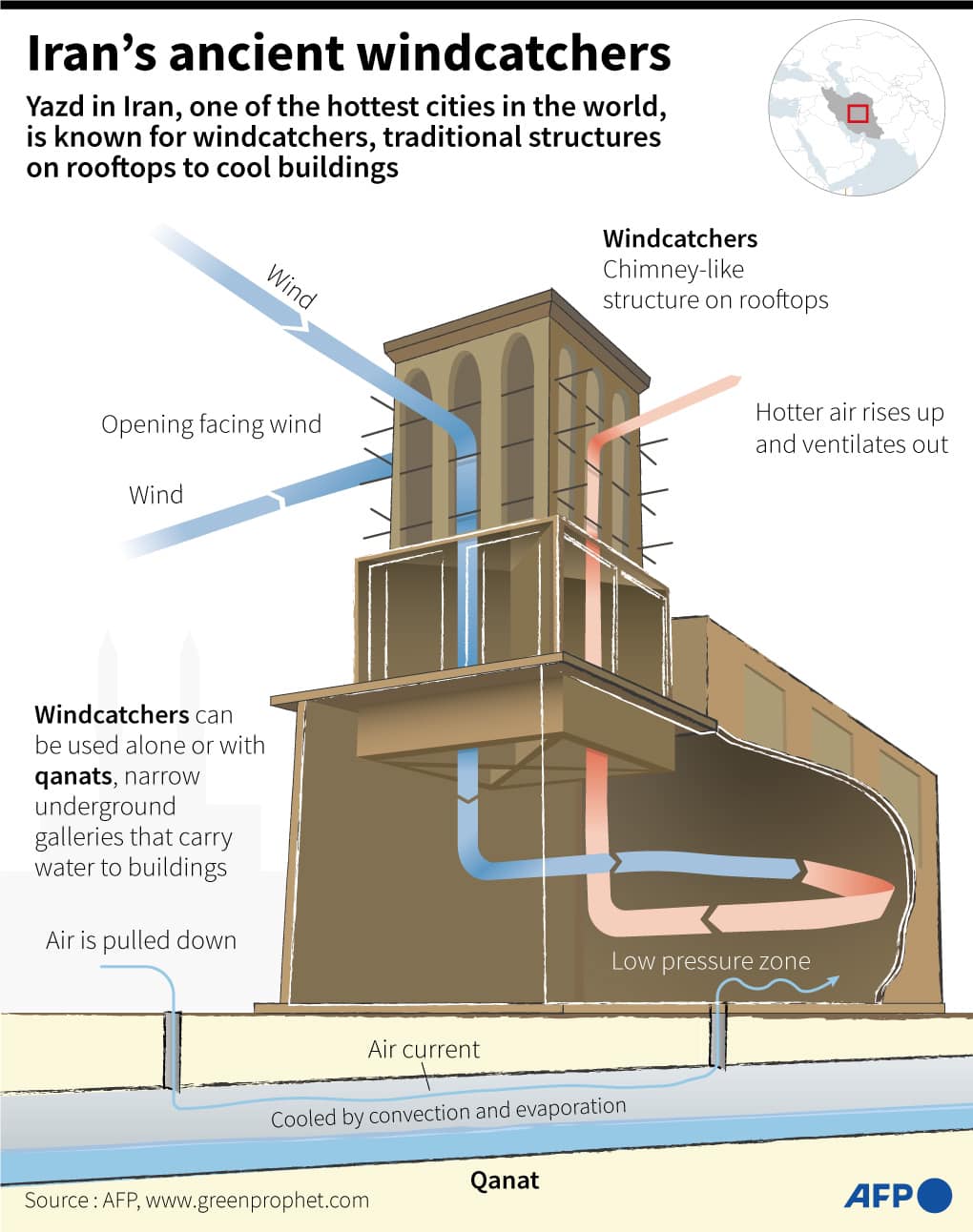
    ok, but the cost of building a quanat is still pretty high and is not trivial to achieve.

    Can't have water flowing everywhere in a country for this to work.

  • source
  • parent
  • hideshow 5 child comments
  • [–] 5 points 3 years ago (2 children)

    Most countries in the world quite literally have water flowing everywhere already.

  • source
  • parent
  • hideshow 2 child comments
  • [–] 3 points 3 years ago (1 child)

    Don't you have water to drink at home? Or in the bathroom?

  • source
  • parent
  • hideshow 1 child comment
  • [–] 2 points 3 years ago* (last edited 3 years ago)

    Modern plumbing uses pressurized pipes that are completely full of water, and can thus flow uphill, as long as the elevation gain doesn't exceed the head pressure from the water tower or pumps. That makes such pipe systems relatively cheap and easy to build.

    In contrast, qanats require large conduits with space above for the air to flow through, using open channel flow. That means the entire system needs to be designed with a gentle downhill monotonic slope. That's doable (the wastewater and stormwater sewer systems are designed that way, for example), but it's more expensive and would require a lot of re-work if you wanted to convert over the existing water distribution system.

  • source
  • parent
  • [–] 5 points 3 years ago (2 children)

    You've got a lot of great replies on how you're a wrong. But it is even simpler - your freezer works the same way as air con. And it's at -18°C even if your room is at +35°. That's all you need to know about air cons and their capabilities.

  • source
  • parent
  • hideshow 2 child comments
  • [–] 25 points 3 years ago* (last edited 3 years ago) (4 children)

    10 degrees is incredible though.

    These days in Yazd the average warmest temperature in July is 40 degrees, so if what you're saying is correct they'd be able to cool it down to a liveable 30 degrees even in the warmest part of the day. And at night temperatures still dip to 26, so the indoors temperature probably wouldn't quite reach 40 even without this system. So it might make the difference between 40 degrees outdoors and high 20s indoors, which is fantastic.

    Would be interesting to know if average temperatures got up to 40 in the summer around the time they were built as well, or if average temperatures in the region have been rising.

  • source
  • parent
  • hideshow 4 child comments
  • [–] 6 points 3 years ago (2 children)

    I do wonder what the humidity is. The drawing shows that the new air is mixed with air coming from the water canals below which I assume is very humid.

    Looks like its essentially a swamp cooler.

    So I wonder how the 30 with humidity feels compared to 40 without.

    Im now at a 32 but with the current humidity it feels like fucking 38!

  • source
  • parent
  • hideshow 2 child comments
  • [–] 7 points 3 years ago

    Iran's traditional desert architecture masterfully navigates extreme temperatures through a combination of smart design and local building materials like mud-brick or adobe, which possess low thermal conductivity similar to sand. The thick walls of these houses act as a thermal mass, absorbing the intense daytime heat and slowly releasing it during the cooler night, regulating temperature swings inside the dwelling. This principle, paired with the utilization of design features like wind towers and qanat systems, helps to maintain a comfortable indoor climate. Some structures are even partially or completely built underground, using the earth as a natural insulator and benefiting from the surrounding cool sand. Consequently, it's this strategic interplay of materials, design, and the desert environment that enables these homes to remain cool during scorching days and warm during chilly desert nights. This is a gross oversimplification of thermal dynamics but it's the gist of it. It would be quite comfortable inside is what I am getting at.

  • source
  • parent
  • [–] 6 points 3 years ago*

    You can literally go there and witness these for yourself. It works. People live in Yazd right now in these old buildings. Newer constructions have air conditioning because building huge thermal mass retaining walls out of mud bricks is expensive. They keep ice all winter in buildings there from a thousand years ago cooled like this.

  • source
  • parent