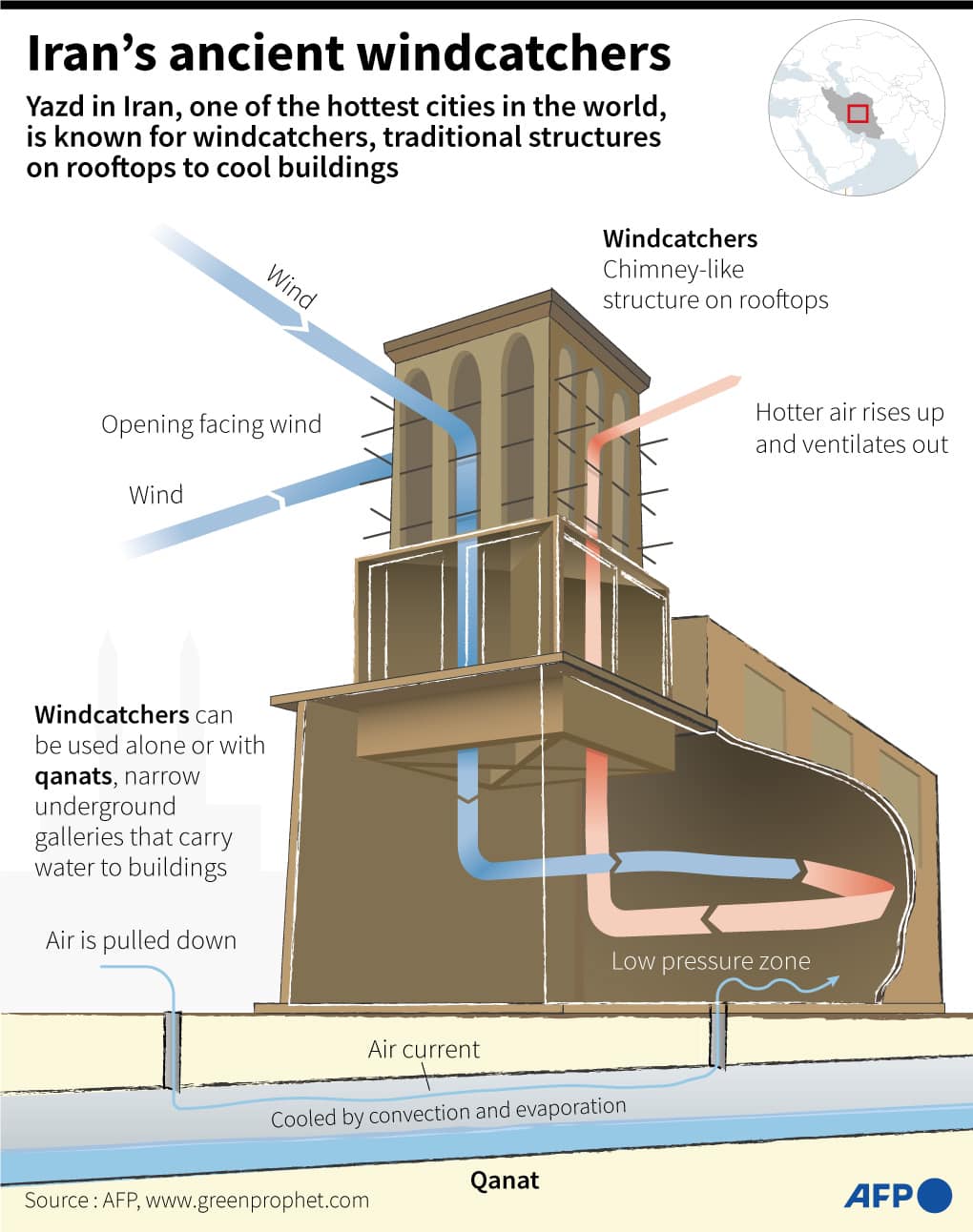
▲ 1906 ▼ Ancient Iran had air conditioning (lemmy.world) submitted 3 years ago by FlyingSquid@lemmy.world to c/mildlyinteresting@lemmy.world 213 comments fedilink hide all child comments
[–] Gangreless@lemmy.world 64 points 3 years ago* (37 children) A modern home ACs can only cool about 20f below the outside temperature. 50c to 35c is 27 degrees so that's pretty damn good for a fancy unpowered swamp cooler permalink fedilink source parent hideshow 37 child comments replies: [–] Norgur@kbin.social 57 points 3 years ago (10 children) Yeah, the thing is the "unpowered" part. Look how much energy an AC chugs to achieve that cooling. This tower uses wind power to do it's thing. permalink fedilink source parent hideshow 10 child comments replies: [–] Duder167@lemmy.world 42 points 3 years ago The AC is also small compared to a literal building with a sewer underneath and doesn't require a windy day. Trade offs permalink fedilink source parent [–] janus2@lemmy.sdf.org 10 points 3 years ago (7 children) well technically it is powered, just directly by wind and water kinetic energy, probably(?) much more efficiently than if it had been converted to electricity first permalink fedilink source parent hideshow 7 child comments replies: [–] Shikadi@lemmy.sdf.org 7 points 3 years ago (6 children) Do we know it's more efficient? Has anyone done the math? permalink fedilink source parent hideshow 6 child comments replies: [+] irmoz@reddthat.com -7 points 3 years ago (5 children) Are you joking? permalink fedilink source parent hideshow 5 child comments replies: [–] Shikadi@lemmy.sdf.org 11 points 3 years ago (4 children) No, I'm being genuine. It's theoretical and all, but if you were to put up a windmill in the same spot instead of a tower, it's possible traditional air conditioners would be able to cool the building to the same degree while also providing surplus electricity. It's also possible that you wouldn't, and I don't know the answer. It would also be interesting to compare it in different ways as well, like rather than asking "If a windmill was here" we could ask "The energy removed from the wind by the tower", because that would indicate scalability problems if one windmill was indeed able to cool one building, but maybe 100 wouldn't be able to cool 100. All hypothetical, but air conditioners/heat pumps are actually very efficient, so it's possible an active design could be more efficient than a passive one in this situation. At least, until someone does the math permalink fedilink source parent hideshow 4 child comments replies: [–] hamid@lemmy.world 4 points 3 years ago (2 children) Another thing to note, to your point, is that a windmill breaks down and requires energy to repair. These wind towers in Yazd are still there and doing the same thing from hundreds of years ago permalink fedilink source parent hideshow 2 child comments replies: [–] janus2@lemmy.sdf.org 3 points 3 years ago Very true. The best machines have the fewest moving parts permalink fedilink source parent [–] Shikadi@lemmy.sdf.org 2 points 3 years ago True, and it wasn't meant as an attack at all, just a question out of curiosity. The towers are super cool permalink fedilink source parent [–] janus2@lemmy.sdf.org 3 points 3 years ago Exactly, I have no idea. The "probably(?)" in my comment should have been a "maybe," probably maybe. permalink fedilink source parent [–] Lev_Astov@lemmy.world 0 points 3 years ago AC really doesn't consume that much if designed and sized properly. It's nothing like the energy consumption of standard heating. The problem is all these people going out and buying the cheapest floor unit or undersized window unit they can find, then the wheezing thing just sits there chugging 100% of the time because it can't keep up with their space. That's super wasteful. permalink fedilink source parent [–] manillaface@kbin.social 24 points 3 years ago (5 children) What’s your source for this? It routinely gets over 100 here and buildings aren’t 80 degrees inside. permalink fedilink source parent hideshow 5 child comments replies: [–] sab@kbin.social 14 points 3 years ago* (2 children) We're talking celsius, I hope for your sake it doesn't routinely get to 100 C where you are. :) Edit: The user actually said 20 F, I got confused by the mix of units. "50c to 35c is 27 degrees" didn't make sense to me, but I figured I'd let it slide. No idea what's going on here. :) permalink fedilink source parent hideshow 2 child comments replies: [+] argh_another_username@lemmy.ca 3 points 3 years ago (1 child) [deleted] permalink fedilink source parent hideshow 1 child comment replies: [–] sab@kbin.social 2 points 3 years ago* Yes, that sounds about right - the relative effect of the tower probably depends a lot on various factors like how windy it is, if extreme heat occurs only for a day or if it has been ongoing so that the water under ground is heated as well, etc. These comments were in response to @Gangreless, who stated that a modern AC "can only cool about 20f below the outside temperature". I didn't catch that it was fahrenheit first, and now that I know I am happily backing off rather than having to think in terms of freedom units. permalink fedilink source parent [–] Dark_Arc@lemmy.world 14 points 3 years ago They're full of it, that's it. Maybe in their house which lacks sufficient insulation. Heat pumps (i.e. air conditioning) are/is extremely efficient at moving heat around, there's not really a practical limit on it, particularly if you go geothermal. permalink fedilink source parent [–] ezmack@lemmy.ml 3 points 3 years ago* (last edited 3 years ago) 20 degrees is just a rule of thumb most ACs have a specific temperature change they're designed to do. You can go past it, that's just what the intented to do and it might not work as well or be able to do it. Fwiw I'd always heard 30 degrees farenheight for most window units. Had an hvac guy explain it to me years ago but fucked if I remember how it works E: not sure why I'm getting downvotes this is like a very common thing. Google it https://frederickair.com/home-comfort/reduce-the-stress-on-your-ac-with-the-20-degree-rule/ permalink fedilink source parent [–] sci@feddit.nl 23 points 3 years ago (4 children) pretty sure 50c to 35c is 15 degrees permalink fedilink source parent hideshow 4 child comments replies: [–] pfannkuchen_gesicht@lemmy.one 26 points 3 years ago* (2 children) I wonder how he got his number, it makes no sense. EDIT: oh, he just randomly mixed °C and °F, because why not... permalink fedilink source parent hideshow 2 child comments replies: [–] yeather@lemmy.ca 6 points 3 years ago (1 child) Fucking Americans permalink fedilink source parent hideshow 1 child comment replies: [–] MrBakedBeansOnToast@lemmy.world 1 point 3 years ago It’s the Mars Climate Orbiter all over again. permalink fedilink source parent [–] Duder167@lemmy.world 14 points 3 years ago 50c is 122f, 35c is 95f so he went 50c-35c = 122f-95f = 27f because why the fuck not. permalink fedilink source parent [–] WhiteTiger@lemmy.world 10 points 3 years ago That's just not true, a modern home can be at 70f or below when its 110f outside. Air comes out at 50-55 even at those outside temps. permalink fedilink source parent [–] monz@pawb.social 9 points 3 years ago (3 children) What do you mean modern AC can only cool by 20F? I’m in Florida and it’s routinely 95-98F outside. My AC is set to 65F. Did you mean 20C? Either way, that’s also false. AC units are limited to their rating and BTU. Many may not cool below 60F, but there’s no delta limit. permalink fedilink source parent hideshow 3 child comments replies: [–] dingus@lemmy.world 4 points 3 years ago Are you my brother? Whenever I go to his place I feel like I'm going to get hypothermia lol permalink fedilink source parent [–] RBWells@lemmy.world 2 points 3 years ago* (1 child) Heat pump doesn't do that for us. We set it at 78-79f in the summer and it feels cool enough & keeps the house from molding. Evaporative systems like the one pictured only work in the desert though. So if you have lots of water, it's humid and you can't use evaporation to cool, but in places you can use evaporative cooling, water is scarce. It's still very cool tech, and everywhere can benefit from more intentional design of buildings. permalink fedilink source parent hideshow 1 child comment replies: [–] Zron@lemmy.world 6 points 3 years ago Your heat pump will definitely do it, it’ll just take a long time. The 20 degree figure everyone is throwing around is actually supposed to be the difference between the return air temperature and the supply air inside your home If you have 80 degree air in your house, 60 degree air should be coming out of your vents. Once the 60 degree air has cooled down the house to 70 degrees or so, 50 degree air should be coming out of your vents. And that’s about the theoretical limit for home air conditioning, as anything lower means the cooling coil is below freezing and will get damaged by ice, there’s usually a safety switch that prevents things from getting too cold. Now the outside coil needs to be hotter than the surrounding air to actually push that heat out of the coil and cool off. Most places around me are designed for a 95 degree summer day, so will have a refrigerant temperature of about 120 degrees, in order to move that heat. Your compressor needs to be able to compress the refrigerant from your cooling coil until it’s about 30 degrees F hotter than the outside air. The hotter it is outside, the harder it is on the compressor. But it will eventually do it if you let it run long enough. Whether or not you want to pay for all that electricity is another thing entirely. permalink fedilink source parent [–] Aux@lemmy.world 5 points 3 years ago (2 children) You've got a lot of great replies on how you're a wrong. But it is even simpler - your freezer works the same way as air con. And it's at -18°C even if your room is at +35°. That's all you need to know about air cons and their capabilities. permalink fedilink source parent hideshow 2 child comments replies: [–] WhiteTiger@lemmy.world 1 point 3 years ago (1 child) And get it has way more upvotes than down, just like reddit. permalink fedilink source parent hideshow 1 child comment replies: [–] Aux@lemmy.world 1 point 3 years ago Reddit is sipping here at a rapid pace... permalink fedilink source parent [–] hairinmybellybutt@lemmy.world 5 points 3 years ago (5 children) ok, but the cost of building a quanat is still pretty high and is not trivial to achieve. Can't have water flowing everywhere in a country for this to work. permalink fedilink source parent hideshow 5 child comments replies: [–] egonallanon@lemm.ee 5 points 3 years ago (2 children) Most countries in the world quite literally have water flowing everywhere already. permalink fedilink source parent hideshow 2 child comments replies: [–] dingus@lemmy.world 2 points 3 years ago (1 child) But don't "swamp cooling" systems like the one in the OP not work well in humid environments? Sure, I have running water at home, but I also live in an incredibly humid climate. permalink fedilink source parent hideshow 1 child comment replies: [–] egonallanon@lemm.ee 1 point 3 years ago I was more imagine something like the opposite of a district heating system and then using colling ponds or towers to disappate the heat from the system.. permalink fedilink source parent [–] bouh@lemmy.world 3 points 3 years ago (1 child) Don't you have water to drink at home? Or in the bathroom? permalink fedilink source parent hideshow 1 child comment replies: [–] grue@lemmy.world 2 points 3 years ago* (last edited 3 years ago) Modern plumbing uses pressurized pipes that are completely full of water, and can thus flow uphill, as long as the elevation gain doesn't exceed the head pressure from the water tower or pumps. That makes such pipe systems relatively cheap and easy to build. In contrast, qanats require large conduits with space above for the air to flow through, using open channel flow. That means the entire system needs to be designed with a gentle downhill monotonic slope. That's doable (the wastewater and stormwater sewer systems are designed that way, for example), but it's more expensive and would require a lot of re-work if you wanted to convert over the existing water distribution system. permalink fedilink source parent [+] deus@lemmy.world 1 point 3 years ago [deleted] permalink fedilink source parent
[–] Norgur@kbin.social 57 points 3 years ago (10 children) Yeah, the thing is the "unpowered" part. Look how much energy an AC chugs to achieve that cooling. This tower uses wind power to do it's thing. permalink fedilink source parent hideshow 10 child comments replies: [–] Duder167@lemmy.world 42 points 3 years ago The AC is also small compared to a literal building with a sewer underneath and doesn't require a windy day. Trade offs permalink fedilink source parent [–] janus2@lemmy.sdf.org 10 points 3 years ago (7 children) well technically it is powered, just directly by wind and water kinetic energy, probably(?) much more efficiently than if it had been converted to electricity first permalink fedilink source parent hideshow 7 child comments replies: [–] Shikadi@lemmy.sdf.org 7 points 3 years ago (6 children) Do we know it's more efficient? Has anyone done the math? permalink fedilink source parent hideshow 6 child comments replies: [+] irmoz@reddthat.com -7 points 3 years ago (5 children) Are you joking? permalink fedilink source parent hideshow 5 child comments replies: [–] Shikadi@lemmy.sdf.org 11 points 3 years ago (4 children) No, I'm being genuine. It's theoretical and all, but if you were to put up a windmill in the same spot instead of a tower, it's possible traditional air conditioners would be able to cool the building to the same degree while also providing surplus electricity. It's also possible that you wouldn't, and I don't know the answer. It would also be interesting to compare it in different ways as well, like rather than asking "If a windmill was here" we could ask "The energy removed from the wind by the tower", because that would indicate scalability problems if one windmill was indeed able to cool one building, but maybe 100 wouldn't be able to cool 100. All hypothetical, but air conditioners/heat pumps are actually very efficient, so it's possible an active design could be more efficient than a passive one in this situation. At least, until someone does the math permalink fedilink source parent hideshow 4 child comments replies: [–] hamid@lemmy.world 4 points 3 years ago (2 children) Another thing to note, to your point, is that a windmill breaks down and requires energy to repair. These wind towers in Yazd are still there and doing the same thing from hundreds of years ago permalink fedilink source parent hideshow 2 child comments replies: [–] janus2@lemmy.sdf.org 3 points 3 years ago Very true. The best machines have the fewest moving parts permalink fedilink source parent [–] Shikadi@lemmy.sdf.org 2 points 3 years ago True, and it wasn't meant as an attack at all, just a question out of curiosity. The towers are super cool permalink fedilink source parent [–] janus2@lemmy.sdf.org 3 points 3 years ago Exactly, I have no idea. The "probably(?)" in my comment should have been a "maybe," probably maybe. permalink fedilink source parent [–] Lev_Astov@lemmy.world 0 points 3 years ago AC really doesn't consume that much if designed and sized properly. It's nothing like the energy consumption of standard heating. The problem is all these people going out and buying the cheapest floor unit or undersized window unit they can find, then the wheezing thing just sits there chugging 100% of the time because it can't keep up with their space. That's super wasteful. permalink fedilink source parent
[–] Duder167@lemmy.world 42 points 3 years ago The AC is also small compared to a literal building with a sewer underneath and doesn't require a windy day. Trade offs permalink fedilink source parent
[–] janus2@lemmy.sdf.org 10 points 3 years ago (7 children) well technically it is powered, just directly by wind and water kinetic energy, probably(?) much more efficiently than if it had been converted to electricity first permalink fedilink source parent hideshow 7 child comments replies: [–] Shikadi@lemmy.sdf.org 7 points 3 years ago (6 children) Do we know it's more efficient? Has anyone done the math? permalink fedilink source parent hideshow 6 child comments replies: [+] irmoz@reddthat.com -7 points 3 years ago (5 children) Are you joking? permalink fedilink source parent hideshow 5 child comments replies: [–] Shikadi@lemmy.sdf.org 11 points 3 years ago (4 children) No, I'm being genuine. It's theoretical and all, but if you were to put up a windmill in the same spot instead of a tower, it's possible traditional air conditioners would be able to cool the building to the same degree while also providing surplus electricity. It's also possible that you wouldn't, and I don't know the answer. It would also be interesting to compare it in different ways as well, like rather than asking "If a windmill was here" we could ask "The energy removed from the wind by the tower", because that would indicate scalability problems if one windmill was indeed able to cool one building, but maybe 100 wouldn't be able to cool 100. All hypothetical, but air conditioners/heat pumps are actually very efficient, so it's possible an active design could be more efficient than a passive one in this situation. At least, until someone does the math permalink fedilink source parent hideshow 4 child comments replies: [–] hamid@lemmy.world 4 points 3 years ago (2 children) Another thing to note, to your point, is that a windmill breaks down and requires energy to repair. These wind towers in Yazd are still there and doing the same thing from hundreds of years ago permalink fedilink source parent hideshow 2 child comments replies: [–] janus2@lemmy.sdf.org 3 points 3 years ago Very true. The best machines have the fewest moving parts permalink fedilink source parent [–] Shikadi@lemmy.sdf.org 2 points 3 years ago True, and it wasn't meant as an attack at all, just a question out of curiosity. The towers are super cool permalink fedilink source parent [–] janus2@lemmy.sdf.org 3 points 3 years ago Exactly, I have no idea. The "probably(?)" in my comment should have been a "maybe," probably maybe. permalink fedilink source parent
[–] Shikadi@lemmy.sdf.org 7 points 3 years ago (6 children) Do we know it's more efficient? Has anyone done the math? permalink fedilink source parent hideshow 6 child comments replies: [+] irmoz@reddthat.com -7 points 3 years ago (5 children) Are you joking? permalink fedilink source parent hideshow 5 child comments replies: [–] Shikadi@lemmy.sdf.org 11 points 3 years ago (4 children) No, I'm being genuine. It's theoretical and all, but if you were to put up a windmill in the same spot instead of a tower, it's possible traditional air conditioners would be able to cool the building to the same degree while also providing surplus electricity. It's also possible that you wouldn't, and I don't know the answer. It would also be interesting to compare it in different ways as well, like rather than asking "If a windmill was here" we could ask "The energy removed from the wind by the tower", because that would indicate scalability problems if one windmill was indeed able to cool one building, but maybe 100 wouldn't be able to cool 100. All hypothetical, but air conditioners/heat pumps are actually very efficient, so it's possible an active design could be more efficient than a passive one in this situation. At least, until someone does the math permalink fedilink source parent hideshow 4 child comments replies: [–] hamid@lemmy.world 4 points 3 years ago (2 children) Another thing to note, to your point, is that a windmill breaks down and requires energy to repair. These wind towers in Yazd are still there and doing the same thing from hundreds of years ago permalink fedilink source parent hideshow 2 child comments replies: [–] janus2@lemmy.sdf.org 3 points 3 years ago Very true. The best machines have the fewest moving parts permalink fedilink source parent [–] Shikadi@lemmy.sdf.org 2 points 3 years ago True, and it wasn't meant as an attack at all, just a question out of curiosity. The towers are super cool permalink fedilink source parent [–] janus2@lemmy.sdf.org 3 points 3 years ago Exactly, I have no idea. The "probably(?)" in my comment should have been a "maybe," probably maybe. permalink fedilink source parent
[+] irmoz@reddthat.com -7 points 3 years ago (5 children) Are you joking? permalink fedilink source parent hideshow 5 child comments replies: [–] Shikadi@lemmy.sdf.org 11 points 3 years ago (4 children) No, I'm being genuine. It's theoretical and all, but if you were to put up a windmill in the same spot instead of a tower, it's possible traditional air conditioners would be able to cool the building to the same degree while also providing surplus electricity. It's also possible that you wouldn't, and I don't know the answer. It would also be interesting to compare it in different ways as well, like rather than asking "If a windmill was here" we could ask "The energy removed from the wind by the tower", because that would indicate scalability problems if one windmill was indeed able to cool one building, but maybe 100 wouldn't be able to cool 100. All hypothetical, but air conditioners/heat pumps are actually very efficient, so it's possible an active design could be more efficient than a passive one in this situation. At least, until someone does the math permalink fedilink source parent hideshow 4 child comments replies: [–] hamid@lemmy.world 4 points 3 years ago (2 children) Another thing to note, to your point, is that a windmill breaks down and requires energy to repair. These wind towers in Yazd are still there and doing the same thing from hundreds of years ago permalink fedilink source parent hideshow 2 child comments replies: [–] janus2@lemmy.sdf.org 3 points 3 years ago Very true. The best machines have the fewest moving parts permalink fedilink source parent [–] Shikadi@lemmy.sdf.org 2 points 3 years ago True, and it wasn't meant as an attack at all, just a question out of curiosity. The towers are super cool permalink fedilink source parent [–] janus2@lemmy.sdf.org 3 points 3 years ago Exactly, I have no idea. The "probably(?)" in my comment should have been a "maybe," probably maybe. permalink fedilink source parent
[–] Shikadi@lemmy.sdf.org 11 points 3 years ago (4 children) No, I'm being genuine. It's theoretical and all, but if you were to put up a windmill in the same spot instead of a tower, it's possible traditional air conditioners would be able to cool the building to the same degree while also providing surplus electricity. It's also possible that you wouldn't, and I don't know the answer. It would also be interesting to compare it in different ways as well, like rather than asking "If a windmill was here" we could ask "The energy removed from the wind by the tower", because that would indicate scalability problems if one windmill was indeed able to cool one building, but maybe 100 wouldn't be able to cool 100. All hypothetical, but air conditioners/heat pumps are actually very efficient, so it's possible an active design could be more efficient than a passive one in this situation. At least, until someone does the math permalink fedilink source parent hideshow 4 child comments replies: [–] hamid@lemmy.world 4 points 3 years ago (2 children) Another thing to note, to your point, is that a windmill breaks down and requires energy to repair. These wind towers in Yazd are still there and doing the same thing from hundreds of years ago permalink fedilink source parent hideshow 2 child comments replies: [–] janus2@lemmy.sdf.org 3 points 3 years ago Very true. The best machines have the fewest moving parts permalink fedilink source parent [–] Shikadi@lemmy.sdf.org 2 points 3 years ago True, and it wasn't meant as an attack at all, just a question out of curiosity. The towers are super cool permalink fedilink source parent [–] janus2@lemmy.sdf.org 3 points 3 years ago Exactly, I have no idea. The "probably(?)" in my comment should have been a "maybe," probably maybe. permalink fedilink source parent
[–] hamid@lemmy.world 4 points 3 years ago (2 children) Another thing to note, to your point, is that a windmill breaks down and requires energy to repair. These wind towers in Yazd are still there and doing the same thing from hundreds of years ago permalink fedilink source parent hideshow 2 child comments replies: [–] janus2@lemmy.sdf.org 3 points 3 years ago Very true. The best machines have the fewest moving parts permalink fedilink source parent [–] Shikadi@lemmy.sdf.org 2 points 3 years ago True, and it wasn't meant as an attack at all, just a question out of curiosity. The towers are super cool permalink fedilink source parent
[–] janus2@lemmy.sdf.org 3 points 3 years ago Very true. The best machines have the fewest moving parts permalink fedilink source parent
[–] Shikadi@lemmy.sdf.org 2 points 3 years ago True, and it wasn't meant as an attack at all, just a question out of curiosity. The towers are super cool permalink fedilink source parent
[–] janus2@lemmy.sdf.org 3 points 3 years ago Exactly, I have no idea. The "probably(?)" in my comment should have been a "maybe," probably maybe. permalink fedilink source parent
[–] Lev_Astov@lemmy.world 0 points 3 years ago AC really doesn't consume that much if designed and sized properly. It's nothing like the energy consumption of standard heating. The problem is all these people going out and buying the cheapest floor unit or undersized window unit they can find, then the wheezing thing just sits there chugging 100% of the time because it can't keep up with their space. That's super wasteful. permalink fedilink source parent
[–] manillaface@kbin.social 24 points 3 years ago (5 children) What’s your source for this? It routinely gets over 100 here and buildings aren’t 80 degrees inside. permalink fedilink source parent hideshow 5 child comments replies: [–] sab@kbin.social 14 points 3 years ago* (2 children) We're talking celsius, I hope for your sake it doesn't routinely get to 100 C where you are. :) Edit: The user actually said 20 F, I got confused by the mix of units. "50c to 35c is 27 degrees" didn't make sense to me, but I figured I'd let it slide. No idea what's going on here. :) permalink fedilink source parent hideshow 2 child comments replies: [+] argh_another_username@lemmy.ca 3 points 3 years ago (1 child) [deleted] permalink fedilink source parent hideshow 1 child comment replies: [–] sab@kbin.social 2 points 3 years ago* Yes, that sounds about right - the relative effect of the tower probably depends a lot on various factors like how windy it is, if extreme heat occurs only for a day or if it has been ongoing so that the water under ground is heated as well, etc. These comments were in response to @Gangreless, who stated that a modern AC "can only cool about 20f below the outside temperature". I didn't catch that it was fahrenheit first, and now that I know I am happily backing off rather than having to think in terms of freedom units. permalink fedilink source parent [–] Dark_Arc@lemmy.world 14 points 3 years ago They're full of it, that's it. Maybe in their house which lacks sufficient insulation. Heat pumps (i.e. air conditioning) are/is extremely efficient at moving heat around, there's not really a practical limit on it, particularly if you go geothermal. permalink fedilink source parent [–] ezmack@lemmy.ml 3 points 3 years ago* (last edited 3 years ago) 20 degrees is just a rule of thumb most ACs have a specific temperature change they're designed to do. You can go past it, that's just what the intented to do and it might not work as well or be able to do it. Fwiw I'd always heard 30 degrees farenheight for most window units. Had an hvac guy explain it to me years ago but fucked if I remember how it works E: not sure why I'm getting downvotes this is like a very common thing. Google it https://frederickair.com/home-comfort/reduce-the-stress-on-your-ac-with-the-20-degree-rule/ permalink fedilink source parent
[–] sab@kbin.social 14 points 3 years ago* (2 children) We're talking celsius, I hope for your sake it doesn't routinely get to 100 C where you are. :) Edit: The user actually said 20 F, I got confused by the mix of units. "50c to 35c is 27 degrees" didn't make sense to me, but I figured I'd let it slide. No idea what's going on here. :) permalink fedilink source parent hideshow 2 child comments replies: [+] argh_another_username@lemmy.ca 3 points 3 years ago (1 child) [deleted] permalink fedilink source parent hideshow 1 child comment replies: [–] sab@kbin.social 2 points 3 years ago* Yes, that sounds about right - the relative effect of the tower probably depends a lot on various factors like how windy it is, if extreme heat occurs only for a day or if it has been ongoing so that the water under ground is heated as well, etc. These comments were in response to @Gangreless, who stated that a modern AC "can only cool about 20f below the outside temperature". I didn't catch that it was fahrenheit first, and now that I know I am happily backing off rather than having to think in terms of freedom units. permalink fedilink source parent
[+] argh_another_username@lemmy.ca 3 points 3 years ago (1 child) [deleted] permalink fedilink source parent hideshow 1 child comment replies: [–] sab@kbin.social 2 points 3 years ago* Yes, that sounds about right - the relative effect of the tower probably depends a lot on various factors like how windy it is, if extreme heat occurs only for a day or if it has been ongoing so that the water under ground is heated as well, etc. These comments were in response to @Gangreless, who stated that a modern AC "can only cool about 20f below the outside temperature". I didn't catch that it was fahrenheit first, and now that I know I am happily backing off rather than having to think in terms of freedom units. permalink fedilink source parent
[–] sab@kbin.social 2 points 3 years ago* Yes, that sounds about right - the relative effect of the tower probably depends a lot on various factors like how windy it is, if extreme heat occurs only for a day or if it has been ongoing so that the water under ground is heated as well, etc. These comments were in response to @Gangreless, who stated that a modern AC "can only cool about 20f below the outside temperature". I didn't catch that it was fahrenheit first, and now that I know I am happily backing off rather than having to think in terms of freedom units. permalink fedilink source parent
[–] Dark_Arc@lemmy.world 14 points 3 years ago They're full of it, that's it. Maybe in their house which lacks sufficient insulation. Heat pumps (i.e. air conditioning) are/is extremely efficient at moving heat around, there's not really a practical limit on it, particularly if you go geothermal. permalink fedilink source parent
[–] ezmack@lemmy.ml 3 points 3 years ago* (last edited 3 years ago) 20 degrees is just a rule of thumb most ACs have a specific temperature change they're designed to do. You can go past it, that's just what the intented to do and it might not work as well or be able to do it. Fwiw I'd always heard 30 degrees farenheight for most window units. Had an hvac guy explain it to me years ago but fucked if I remember how it works E: not sure why I'm getting downvotes this is like a very common thing. Google it https://frederickair.com/home-comfort/reduce-the-stress-on-your-ac-with-the-20-degree-rule/ permalink fedilink source parent
[–] sci@feddit.nl 23 points 3 years ago (4 children) pretty sure 50c to 35c is 15 degrees permalink fedilink source parent hideshow 4 child comments replies: [–] pfannkuchen_gesicht@lemmy.one 26 points 3 years ago* (2 children) I wonder how he got his number, it makes no sense. EDIT: oh, he just randomly mixed °C and °F, because why not... permalink fedilink source parent hideshow 2 child comments replies: [–] yeather@lemmy.ca 6 points 3 years ago (1 child) Fucking Americans permalink fedilink source parent hideshow 1 child comment replies: [–] MrBakedBeansOnToast@lemmy.world 1 point 3 years ago It’s the Mars Climate Orbiter all over again. permalink fedilink source parent [–] Duder167@lemmy.world 14 points 3 years ago 50c is 122f, 35c is 95f so he went 50c-35c = 122f-95f = 27f because why the fuck not. permalink fedilink source parent
[–] pfannkuchen_gesicht@lemmy.one 26 points 3 years ago* (2 children) I wonder how he got his number, it makes no sense. EDIT: oh, he just randomly mixed °C and °F, because why not... permalink fedilink source parent hideshow 2 child comments replies: [–] yeather@lemmy.ca 6 points 3 years ago (1 child) Fucking Americans permalink fedilink source parent hideshow 1 child comment replies: [–] MrBakedBeansOnToast@lemmy.world 1 point 3 years ago It’s the Mars Climate Orbiter all over again. permalink fedilink source parent
[–] yeather@lemmy.ca 6 points 3 years ago (1 child) Fucking Americans permalink fedilink source parent hideshow 1 child comment replies: [–] MrBakedBeansOnToast@lemmy.world 1 point 3 years ago It’s the Mars Climate Orbiter all over again. permalink fedilink source parent
[–] MrBakedBeansOnToast@lemmy.world 1 point 3 years ago It’s the Mars Climate Orbiter all over again. permalink fedilink source parent
[–] Duder167@lemmy.world 14 points 3 years ago 50c is 122f, 35c is 95f so he went 50c-35c = 122f-95f = 27f because why the fuck not. permalink fedilink source parent
[–] WhiteTiger@lemmy.world 10 points 3 years ago That's just not true, a modern home can be at 70f or below when its 110f outside. Air comes out at 50-55 even at those outside temps. permalink fedilink source parent
[–] monz@pawb.social 9 points 3 years ago (3 children) What do you mean modern AC can only cool by 20F? I’m in Florida and it’s routinely 95-98F outside. My AC is set to 65F. Did you mean 20C? Either way, that’s also false. AC units are limited to their rating and BTU. Many may not cool below 60F, but there’s no delta limit. permalink fedilink source parent hideshow 3 child comments replies: [–] dingus@lemmy.world 4 points 3 years ago Are you my brother? Whenever I go to his place I feel like I'm going to get hypothermia lol permalink fedilink source parent [–] RBWells@lemmy.world 2 points 3 years ago* (1 child) Heat pump doesn't do that for us. We set it at 78-79f in the summer and it feels cool enough & keeps the house from molding. Evaporative systems like the one pictured only work in the desert though. So if you have lots of water, it's humid and you can't use evaporation to cool, but in places you can use evaporative cooling, water is scarce. It's still very cool tech, and everywhere can benefit from more intentional design of buildings. permalink fedilink source parent hideshow 1 child comment replies: [–] Zron@lemmy.world 6 points 3 years ago Your heat pump will definitely do it, it’ll just take a long time. The 20 degree figure everyone is throwing around is actually supposed to be the difference between the return air temperature and the supply air inside your home If you have 80 degree air in your house, 60 degree air should be coming out of your vents. Once the 60 degree air has cooled down the house to 70 degrees or so, 50 degree air should be coming out of your vents. And that’s about the theoretical limit for home air conditioning, as anything lower means the cooling coil is below freezing and will get damaged by ice, there’s usually a safety switch that prevents things from getting too cold. Now the outside coil needs to be hotter than the surrounding air to actually push that heat out of the coil and cool off. Most places around me are designed for a 95 degree summer day, so will have a refrigerant temperature of about 120 degrees, in order to move that heat. Your compressor needs to be able to compress the refrigerant from your cooling coil until it’s about 30 degrees F hotter than the outside air. The hotter it is outside, the harder it is on the compressor. But it will eventually do it if you let it run long enough. Whether or not you want to pay for all that electricity is another thing entirely. permalink fedilink source parent
[–] dingus@lemmy.world 4 points 3 years ago Are you my brother? Whenever I go to his place I feel like I'm going to get hypothermia lol permalink fedilink source parent
[–] RBWells@lemmy.world 2 points 3 years ago* (1 child) Heat pump doesn't do that for us. We set it at 78-79f in the summer and it feels cool enough & keeps the house from molding. Evaporative systems like the one pictured only work in the desert though. So if you have lots of water, it's humid and you can't use evaporation to cool, but in places you can use evaporative cooling, water is scarce. It's still very cool tech, and everywhere can benefit from more intentional design of buildings. permalink fedilink source parent hideshow 1 child comment replies: [–] Zron@lemmy.world 6 points 3 years ago Your heat pump will definitely do it, it’ll just take a long time. The 20 degree figure everyone is throwing around is actually supposed to be the difference between the return air temperature and the supply air inside your home If you have 80 degree air in your house, 60 degree air should be coming out of your vents. Once the 60 degree air has cooled down the house to 70 degrees or so, 50 degree air should be coming out of your vents. And that’s about the theoretical limit for home air conditioning, as anything lower means the cooling coil is below freezing and will get damaged by ice, there’s usually a safety switch that prevents things from getting too cold. Now the outside coil needs to be hotter than the surrounding air to actually push that heat out of the coil and cool off. Most places around me are designed for a 95 degree summer day, so will have a refrigerant temperature of about 120 degrees, in order to move that heat. Your compressor needs to be able to compress the refrigerant from your cooling coil until it’s about 30 degrees F hotter than the outside air. The hotter it is outside, the harder it is on the compressor. But it will eventually do it if you let it run long enough. Whether or not you want to pay for all that electricity is another thing entirely. permalink fedilink source parent
[–] Zron@lemmy.world 6 points 3 years ago Your heat pump will definitely do it, it’ll just take a long time. The 20 degree figure everyone is throwing around is actually supposed to be the difference between the return air temperature and the supply air inside your home If you have 80 degree air in your house, 60 degree air should be coming out of your vents. Once the 60 degree air has cooled down the house to 70 degrees or so, 50 degree air should be coming out of your vents. And that’s about the theoretical limit for home air conditioning, as anything lower means the cooling coil is below freezing and will get damaged by ice, there’s usually a safety switch that prevents things from getting too cold. Now the outside coil needs to be hotter than the surrounding air to actually push that heat out of the coil and cool off. Most places around me are designed for a 95 degree summer day, so will have a refrigerant temperature of about 120 degrees, in order to move that heat. Your compressor needs to be able to compress the refrigerant from your cooling coil until it’s about 30 degrees F hotter than the outside air. The hotter it is outside, the harder it is on the compressor. But it will eventually do it if you let it run long enough. Whether or not you want to pay for all that electricity is another thing entirely. permalink fedilink source parent
[–] Aux@lemmy.world 5 points 3 years ago (2 children) You've got a lot of great replies on how you're a wrong. But it is even simpler - your freezer works the same way as air con. And it's at -18°C even if your room is at +35°. That's all you need to know about air cons and their capabilities. permalink fedilink source parent hideshow 2 child comments replies: [–] WhiteTiger@lemmy.world 1 point 3 years ago (1 child) And get it has way more upvotes than down, just like reddit. permalink fedilink source parent hideshow 1 child comment replies: [–] Aux@lemmy.world 1 point 3 years ago Reddit is sipping here at a rapid pace... permalink fedilink source parent
[–] WhiteTiger@lemmy.world 1 point 3 years ago (1 child) And get it has way more upvotes than down, just like reddit. permalink fedilink source parent hideshow 1 child comment replies: [–] Aux@lemmy.world 1 point 3 years ago Reddit is sipping here at a rapid pace... permalink fedilink source parent
[–] Aux@lemmy.world 1 point 3 years ago Reddit is sipping here at a rapid pace... permalink fedilink source parent
[–] hairinmybellybutt@lemmy.world 5 points 3 years ago (5 children) ok, but the cost of building a quanat is still pretty high and is not trivial to achieve. Can't have water flowing everywhere in a country for this to work. permalink fedilink source parent hideshow 5 child comments replies: [–] egonallanon@lemm.ee 5 points 3 years ago (2 children) Most countries in the world quite literally have water flowing everywhere already. permalink fedilink source parent hideshow 2 child comments replies: [–] dingus@lemmy.world 2 points 3 years ago (1 child) But don't "swamp cooling" systems like the one in the OP not work well in humid environments? Sure, I have running water at home, but I also live in an incredibly humid climate. permalink fedilink source parent hideshow 1 child comment replies: [–] egonallanon@lemm.ee 1 point 3 years ago I was more imagine something like the opposite of a district heating system and then using colling ponds or towers to disappate the heat from the system.. permalink fedilink source parent [–] bouh@lemmy.world 3 points 3 years ago (1 child) Don't you have water to drink at home? Or in the bathroom? permalink fedilink source parent hideshow 1 child comment replies: [–] grue@lemmy.world 2 points 3 years ago* (last edited 3 years ago) Modern plumbing uses pressurized pipes that are completely full of water, and can thus flow uphill, as long as the elevation gain doesn't exceed the head pressure from the water tower or pumps. That makes such pipe systems relatively cheap and easy to build. In contrast, qanats require large conduits with space above for the air to flow through, using open channel flow. That means the entire system needs to be designed with a gentle downhill monotonic slope. That's doable (the wastewater and stormwater sewer systems are designed that way, for example), but it's more expensive and would require a lot of re-work if you wanted to convert over the existing water distribution system. permalink fedilink source parent
[–] egonallanon@lemm.ee 5 points 3 years ago (2 children) Most countries in the world quite literally have water flowing everywhere already. permalink fedilink source parent hideshow 2 child comments replies: [–] dingus@lemmy.world 2 points 3 years ago (1 child) But don't "swamp cooling" systems like the one in the OP not work well in humid environments? Sure, I have running water at home, but I also live in an incredibly humid climate. permalink fedilink source parent hideshow 1 child comment replies: [–] egonallanon@lemm.ee 1 point 3 years ago I was more imagine something like the opposite of a district heating system and then using colling ponds or towers to disappate the heat from the system.. permalink fedilink source parent
[–] dingus@lemmy.world 2 points 3 years ago (1 child) But don't "swamp cooling" systems like the one in the OP not work well in humid environments? Sure, I have running water at home, but I also live in an incredibly humid climate. permalink fedilink source parent hideshow 1 child comment replies: [–] egonallanon@lemm.ee 1 point 3 years ago I was more imagine something like the opposite of a district heating system and then using colling ponds or towers to disappate the heat from the system.. permalink fedilink source parent
[–] egonallanon@lemm.ee 1 point 3 years ago I was more imagine something like the opposite of a district heating system and then using colling ponds or towers to disappate the heat from the system.. permalink fedilink source parent
[–] bouh@lemmy.world 3 points 3 years ago (1 child) Don't you have water to drink at home? Or in the bathroom? permalink fedilink source parent hideshow 1 child comment replies: [–] grue@lemmy.world 2 points 3 years ago* (last edited 3 years ago) Modern plumbing uses pressurized pipes that are completely full of water, and can thus flow uphill, as long as the elevation gain doesn't exceed the head pressure from the water tower or pumps. That makes such pipe systems relatively cheap and easy to build. In contrast, qanats require large conduits with space above for the air to flow through, using open channel flow. That means the entire system needs to be designed with a gentle downhill monotonic slope. That's doable (the wastewater and stormwater sewer systems are designed that way, for example), but it's more expensive and would require a lot of re-work if you wanted to convert over the existing water distribution system. permalink fedilink source parent
[–] grue@lemmy.world 2 points 3 years ago* (last edited 3 years ago) Modern plumbing uses pressurized pipes that are completely full of water, and can thus flow uphill, as long as the elevation gain doesn't exceed the head pressure from the water tower or pumps. That makes such pipe systems relatively cheap and easy to build. In contrast, qanats require large conduits with space above for the air to flow through, using open channel flow. That means the entire system needs to be designed with a gentle downhill monotonic slope. That's doable (the wastewater and stormwater sewer systems are designed that way, for example), but it's more expensive and would require a lot of re-work if you wanted to convert over the existing water distribution system. permalink fedilink source parent