top 50 comments

sorted by: hot top controversial new old
[–] 149 points 3 years ago (32 children)

This isn't just mildly interesting. We should be considering methods of air cooling that do not use any carbon in order to avoid aircon usage becoming a contributor to the climate problem as things get hotter and hotter.

  • source
  • hideshow 32 child comments
  • [–] 111 points 3 years ago* (14 children)

    I agree with you that we should be exploring alternatives, but aircon is extremely energy efficient for how much thermal energy it moves (reaching 400% efficiency in some cases) . The problem isn't aircon itself, but what is being used to power it (coal/natural gas power plants)

    In fact the technology behind aircon can be expanded into a heat pump to both heat and cool, being more efficient than electro-resistive or gas heating. There's even water heaters that will actually cool the area they're in and use the heat they gather from the space to heat the water.

    Technology Connections has a great series of videos that go in depth on both heat pumps and aircon.

  • source
  • parent
  • hideshow 14 child comments
  • [–] 18 points 3 years ago (5 children)

    Yeah, "air conditioning powered by solar/wind/hydro" can feel like it's one big Rube Goldberg machine to make air cool, but the reality is that it comes together to make something that can scale really easily. I can't imagine coming up with a design like what's in OP for an apartment complex or condo building.

    Source: just made it up, but also a Technology Connections fan. All that's to say, feel free to correct me with a little data

  • source
  • parent
  • hideshow 5 child comments
  • [–] 11 points 3 years ago* (last edited 3 years ago) (3 children)

    They actively use this design in large buildings (with a modern twist). Its known as a chilled water system: https://hvactrainingshop.com/how-a-chilled-water-system-works/

    Or you have ones that do not run at all during the day, and only chill/freeze the water at night on excess power/cheap power: https://www.buildinggreen.com/news-article/making-ice-night-cool-buildings

    The second system I linked would then let the ice slow melt over the day as its way of actively chilling air passing through its exchanger.

    These systems work by chilling water instead of air, which has a much higher heat capacity. Meaning, it can accept much more thermal energy per unit mass before raising its temperature by 1 kelvin. You are able to build a single, very well designed, and efficient refridgeration unit that can provide HVAC services to up to multiple high rise buildings. This reduces waste and reduces the usage of coolant/refridgerant.

    This system can be reversed in the winter (heating the water instead of chilling) with geothermal heat, solar heat, or if no "green" options are readily available, natural gas direct fire heat can be extremely efficient compared to electric coil

  • source
  • parent
  • hideshow 3 child comments
  • load more comments (3 replies)
  • load more comments (1 reply)
  • load more comments (8 replies)
  • [–] 17 points 3 years ago (8 children)

    This would be a great idea if you want everyone in that building to file humidity complaints every single day. Air conditioners work by using mechanical work (compressor) to exploit evaporation in order to pull heat from one location to another and exhaust it away, in turn cooling the first location (this could be air, water, etc.)

    This system works by using ground temp water as a heatsink to suck heat out of the air passing over it. When it does this, it humidifies the air. In the desert...who cares? In an office building...who cares? Every single worker who is stuck there all day

    If you're saying we need better systems than the AC unit you grew up with, fear not! Many office buildings have been moving away from it (same with other large venues) they use a chilled water system. They use the best of both these systems to get WAY more performance out of way less wattage. You only need a fraction of the cooling power with a chilled water system because the water can absorb much more heat per unit mass than air and can be sized to never run during the day, but only at night when the grid is least in use

  • source
  • parent
  • hideshow 8 child comments
  • [–] 20 points 3 years ago (6 children)

    AC unit you grew up with

    Lmao grew up with? Most of us have never used AC at all in europe. Here in the UK no homes have AC. The issue is that people are installing it now because of climate change and the result is massively higher energy use.

  • source
  • parent
  • hideshow 6 child comments
  • [–] 10 points 3 years ago (1 child)

    Not necessarily in your house. I'm talking about the design of the units from when you were a child (Many public buildings in the EU have AC regardless of houses not having it). AC was invented in 1901, and has come a very long way since then, and we have begun combining it with old principles to extract the best of both solutions

    Combining modern refrigeration/cooling techniques with well designed passive systems that exploit material properties (Heat capacities, transfer coefficients, etc.) to their advantage is the future of HVAC. It started with CFCs and knowing we could exploit their boiling point with mechanical force to chill air beyond the outside air temperature. Who knows where science and engineering may take us next!

  • source
  • parent
  • hideshow 1 child comment
  • load more comments (1 reply)
  • load more comments (4 replies)
  • load more comments (1 reply)
  • load more comments (8 replies)
    [+] 95 points 3 years ago* (last edited 3 years ago) (55 children)
  • [–] 64 points 3 years ago* (37 children)

    A modern home ACs can only cool about 20f below the outside temperature. 50c to 35c is 27 degrees so that's pretty damn good for a fancy unpowered swamp cooler

  • source
  • parent
  • hideshow 37 child comments
  • [–] 57 points 3 years ago (10 children)

    Yeah, the thing is the "unpowered" part. Look how much energy an AC chugs to achieve that cooling. This tower uses wind power to do it's thing.

  • source
  • parent
  • hideshow 10 child comments
  • load more comments (1 reply)
  • [–] 24 points 3 years ago (5 children)

    What’s your source for this? It routinely gets over 100 here and buildings aren’t 80 degrees inside.

  • source
  • parent
  • hideshow 5 child comments
  • [–] 14 points 3 years ago

    They're full of it, that's it. Maybe in their house which lacks sufficient insulation. Heat pumps (i.e. air conditioning) are/is extremely efficient at moving heat around, there's not really a practical limit on it, particularly if you go geothermal.

  • source
  • parent
  • load more comments (1 reply)
  • [–] 23 points 3 years ago (4 children)

    pretty sure 50c to 35c is 15 degrees

  • source
  • parent
  • hideshow 4 child comments
  • load more comments (10 replies)
  • [–] 25 points 3 years ago* (last edited 3 years ago) (4 children)

    10 degrees is incredible though.

    These days in Yazd the average warmest temperature in July is 40 degrees, so if what you're saying is correct they'd be able to cool it down to a liveable 30 degrees even in the warmest part of the day. And at night temperatures still dip to 26, so the indoors temperature probably wouldn't quite reach 40 even without this system. So it might make the difference between 40 degrees outdoors and high 20s indoors, which is fantastic.

    Would be interesting to know if average temperatures got up to 40 in the summer around the time they were built as well, or if average temperatures in the region have been rising.

  • source
  • parent
  • hideshow 4 child comments
  • load more comments (3 replies)
  • load more comments (12 replies)
    [–] 54 points 3 years ago (16 children)

    I love passive systems. The more passive the better.

  • source
  • hideshow 16 child comments
  • load more comments (16 replies)
    [+] 49 points 3 years ago* (last edited 2 years ago) (18 children)
  • [–] 30 points 3 years ago (5 children)

    I've read that these wind catchers were used to keep ice frozen in ice pits during summer.

    https://en.m.wikipedia.org/wiki/Yakhch%C4%81l

    Fun fact: Ancient Persia had ice cream like desserts enjoyed year round.

  • source
  • parent
  • hideshow 5 child comments
  • [–] 9 points 3 years ago (1 child)

    Amazing - I had no idea that anyone was making ice in the desert in BCE times. The wikipedia article seems to indicate that they did a lot of storing of ice in the Yakhchal structures - but it is confusing as to how they made it. It seems like they either gathered the ice from the mountains, or made it in outdoor shaded "ice pools" that were situated next to the Yakhchal. Surely the ice required winter desert temps to form? Otherwise how would the thermal mass of the ground ever get cool enough to allow ice to form, even with the magic of physics? The permanent shading helps, but year round-ice making surely wasn't a thing, was it?

  • source
  • parent
  • hideshow 1 child comment
  • load more comments (1 reply)
  • load more comments (3 replies)
  • [–] 24 points 3 years ago (1 child)

    It's called evaporative cooling and it's quite potent since water takes enormous amounts of energy when changing states. It takes around 5x the energy to convert 100°C water into 100°C vapor than it takes to increase temperature of said water from 0 to 100°. This energy has to be taken from somewhere and that is from the environment, dropping the temperature as a result. Problem with these is that the humidity of the air increases. Not much of a problem in desert, quite a bit problem in other places.

    Here's a great video explaining science behind evaporative coolers and how it can be modernized. https://www.youtube.com/watch?v=R_g4nT4a28U

    Just wind tunnels without water, I agree with you.

  • source
  • parent
  • hideshow 1 child comment
  • load more comments (8 replies)
    [–] 31 points 3 years ago (2 children)

    Lotta old Victorian homes and factories from that Era did the same thing (without water obviously just a big tower to catch the wind). More like an attic fan than an AC in those cases, still a pretty clever way to move air without electricity. Always impressed by how clever people were back in the old times

  • source
  • hideshow 2 child comments
  • load more comments (2 replies)
    [–] 29 points 3 years ago (5 children)

    Not quite an air conditioner, but it seems modernizing it could be a great idea for new constructions to save on power. Maybe as a supplement to Air Conditioners.

  • source
  • hideshow 5 child comments
  • load more comments (3 replies)
    [–] 28 points 3 years ago*

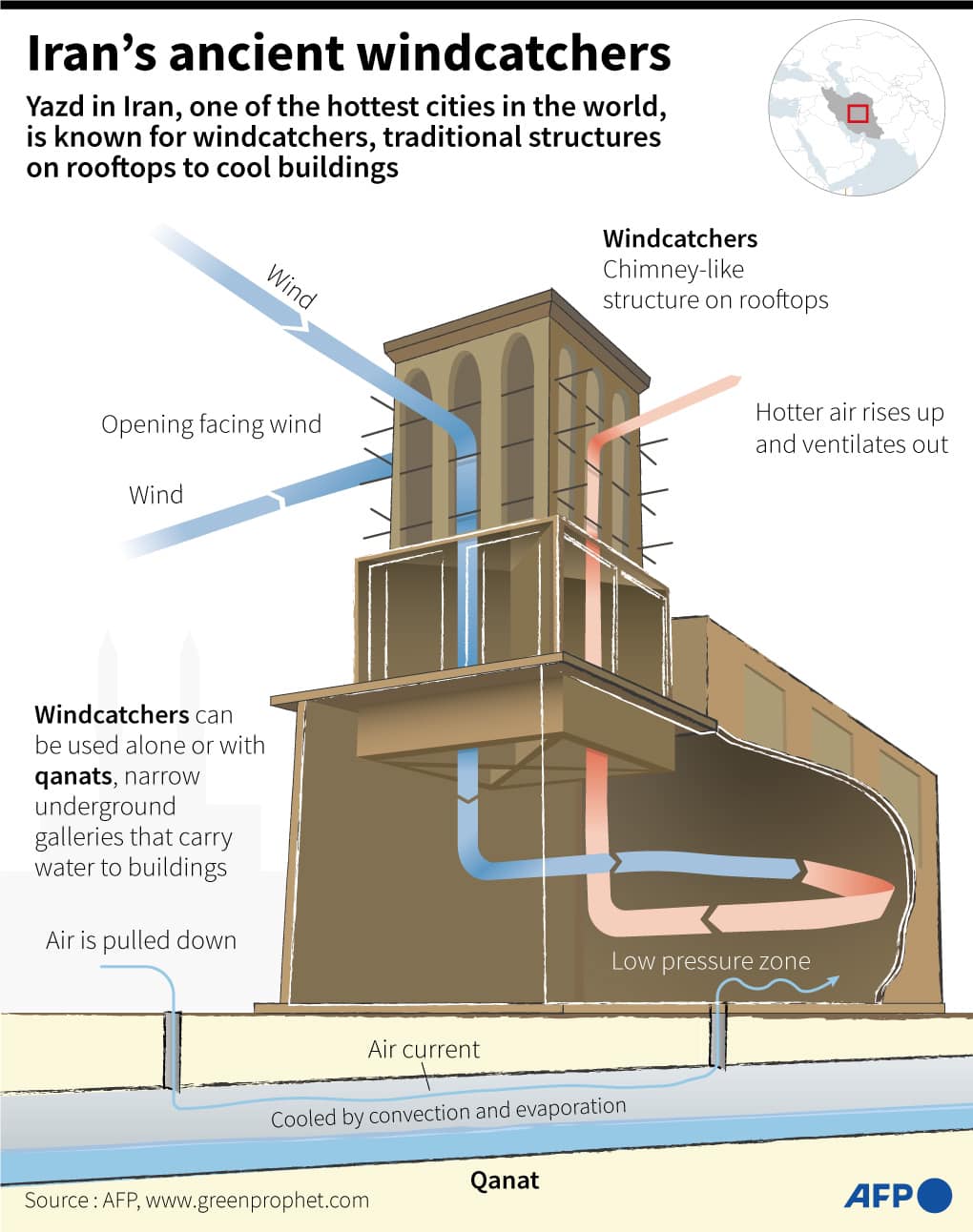
    Not really mentioned in the picture but Qanats are basically underground aquaducts, bringing water from nearby mountains to the cities. They can be up to 70km long. We went into one when I visited Iran.

  • source
  • [–] 19 points 3 years ago (7 children)

    Ancient Iran had swamp coolers* to be more accurate here.

    This works in the desert, but you can't replicate it in a humid climate like you can with AC.

  • source
  • hideshow 7 child comments
  • load more comments (7 replies)
    [–] 16 points 3 years ago

    I tought this was a meme and have been looking for Saddam Hussein's red sillouette for half a minute.

  • source
  • [–] 16 points 3 years ago (2 children)

    Wow, I thought quanat was a made-up word from dune.

  • source
  • hideshow 2 child comments
  • [–] 16 points 3 years ago (1 child)

    Iran used to have AC. They still do, but they used to, too.

  • source
  • hideshow 1 child comment
  • load more comments (1 reply)
    [–] 13 points 3 years ago (2 children)

    This looks like some other things I have heard of before.

    Makes me wonder how many ancient desert cultures designed ways to cool the air in their structures.

  • source
  • hideshow 2 child comments
  • load more comments (2 replies)
    [–] 13 points 3 years ago

    I was told that the houses in trinidad, Cuba have a similar cooling effect. Also the round white houses in tunesia have a cooling effect. Any tunesian or Cubans here?

  • source
  • [–] 10 points 3 years ago

    I remember using something similar to that in college but if I recall correctly it was for weed

  • source
  • [–] 9 points 3 years ago (4 children)

    I think that the Eastgate Mall in Zimbabwe makes usage of a similar principle, but their inspiration came from Termite Mounds https://www.youtube.com/watch?v=qP8DSdfoiZw

  • source
  • hideshow 4 child comments
  • load more comments (4 replies)
    load more comments
    view more: next ›