top 50 comments

sorted by: hot top controversial new old
[–] 51 points 2 years ago (3 children)

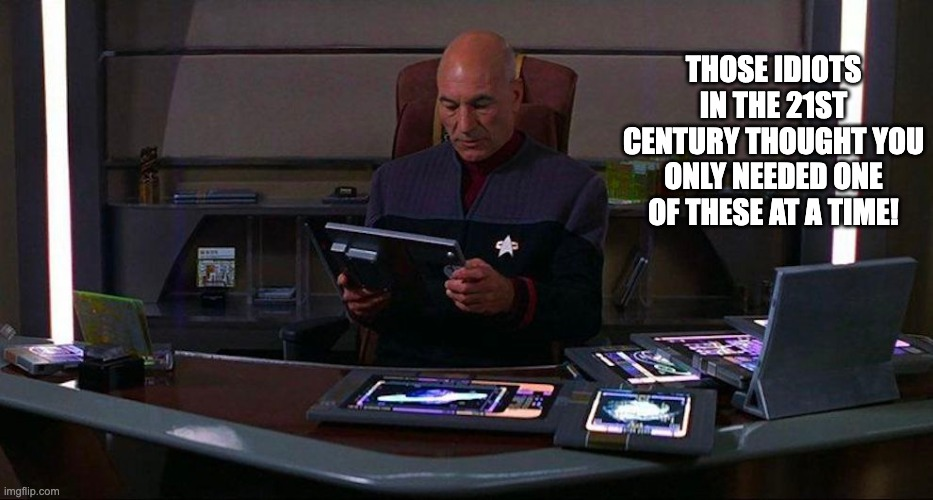
Honestly if I could just print up a new tablet instantly and without cost, I would have half a dozen around me when I am deep into a research fugue.

Being able to quickly and easily flip between books or articles (or even different sections of the same book) while at the same time keeping the existing information up on a screen that I can directly reference is great.

  • source
  • hideshow 6 child comments
  • [–] 25 points 2 years ago (1 child)

    Why are there 4 browsers split between 2 monitors with dozens of tabs a piece?

  • source
  • parent
  • hideshow 2 child comments
  • [–] 4 points 2 years ago (1 child)

    I'm starting to feel limited at two monitors and I think I have a problem. I don't even know what I'd use #3 for yet, I just would like to have options.

  • source
  • parent
  • hideshow 2 child comments
  • [–] 7 points 2 years ago (3 children)

    I have a 42inch curved 4K main monitor.

    It's fucking huge.

    Still have 2 27 inch ones in portrait to each side for documentation and browsing.

  • source
  • parent
  • hideshow 4 child comments
  • load more comments (2 replies)
  • [–] [S] 6 points 2 years ago (1 child)

    I can see it used for that sort of thing, but they pass them around like they're post-it notes.

  • source
  • parent
  • hideshow 2 child comments
  • [–] 16 points 2 years ago (2 children)

    My headcanon is that some of the PADDs are 1-time use with read only memory that can't have the data loaded or transferred off it. A secure way of passing information.

  • source
  • hideshow 4 child comments
  • [–] 9 points 2 years ago (2 children)

    Just chuck them into a matter recycler when finished. No messy piles of old PADDs. Unless you're Sloan from Section 31.

    I know this is in his head, but in all likelihood how he really kept his notes.

  • source
  • parent
  • hideshow 4 child comments
  • Reminds me of the paper printouts in the very earliest TOS episodes. Like, what do you do when you run out of paper in deep space? And do you really have the storage for 5 years worth of computer printouts? Logistically, even an etch-a-sketch makes more sense.

  • source
  • parent
  • [–] 8 points 2 years ago*

    Yeah, it's commonly thought to have something to do with security. Similar to chain of custody for criminal evidence.

    Engineering compiles a department report for the captain. The Shift Lead puts the data on a PADD, then gives that PADD to the Chief Engineer. The Chief Engineer signs the data with their command code and notes that it is PADD-1217. That data then becomes locked to that PADD. Someone from Engineering is assigned to take PADD-1217 to the bridge and hand deliver it to the Captain. The Captain receives the PADD, reviews the report, confirms that they are holding PADD-1217, and signs the report with their command code. Someone from Engineering is sent to retrieve the PADD, and re-deliver it to the Chief Engineer. The Chief Engineer confirms the PADD was read and signed by the Captain, confirms it is PADD-1217, and transfers the signed data to the computer core to be logged and archived. The Chief Engineer then confirms all data on the PADD has been transferred and erased, then stores the PADD until it is needed again.

    This is why it's common to see a pile of PADDs on the Captain's desk. Each department is sending their own secure report on their own PADD.

  • source
  • parent
  • [–] 16 points 2 years ago* (3 children)

    Engineering - Apple iPad

    Security - GNU/Hurd Mobile Flatscreen

    Medical - MS Surface TNG

    10 Front - Samsung FuchsiaPad

    And none of them are interoperable. Did you really think they would solve that in the future?

  • source
  • hideshow 6 child comments
  • [–] 7 points 2 years ago (3 children)

    Considering that Star Trek's Earth is a communist utopia, I would expect so, yes.

  • source
  • parent
  • hideshow 6 child comments
  • [–] 9 points 2 years ago (1 child)

    I recently read an interesting argument that the federation isn’t in fact communist, but basically something beyond our current economic concepts.

    We have:

    • explicit self determination, individualism and self fulfillment are held in the highest regard, so much so that it is considered the objective of life to find personal fulfillment and in doing so, giving back to society
    • post scarcity economy, everyone can have any material need fulfilled at any time by virtue of replicators. Though many goods and commodities are still produced in the traditional way to provide a better quality product (how is this limited amount allocated?)
    • Money is not used internally, but the federation has no objection to using it for commerce with other cultures. There is also indication for power tied credit system that federation citizens are subject to, for example for complex replication and transport
    • being a merchant or trader, or rather generally seeking profit and material wealth are, while considered outdated by most, not offensive or even illegal within the federation. There is plenty of evidence for private enterprise, for example the publishing studio that distributes the doctor's holo novel in VOY

    And many more, even contradictory to our current day minds, aspects that put the federation system and ideology someplace further than our current concepts.

  • source
  • parent
  • hideshow 2 child comments
  • [–] 3 points 2 years ago

    It has always seemed to me that their society is what you'd get if the United States didn't have billionaires hoarding 90% of the wealth. Allocate all of those resources fairly, reduce the population, add in some free electricity and replicators, and you have TNG.

  • source
  • parent
  • [–] 14 points 2 years ago (1 child)

    Like all predictions about future technology, Star Trek was both right and way off.

    Padds are almost used like portable storage devices. Want to give someone a book? Load it onto a padd for them.

  • source
  • hideshow 2 child comments
  • [–] 12 points 2 years ago (2 children)

    But who wants to deal with searching through the UI for pertinent info when you can have several PADDs each attuned to a specific set of data?

  • source
  • parent
  • hideshow 4 child comments
  • [–] [S] 8 points 2 years ago (3 children)

    I'm more amused by Jake writing his stories on a PADD with a stylus, but you see it and it's all printed text.

  • source
  • parent
  • hideshow 6 child comments
  • [–] 11 points 2 years ago (1 child)

    I get it. I hate typing on mobile devices.

  • source
  • parent
  • hideshow 2 child comments
  • [–] [S] 2 points 2 years ago (3 children)

    Yeah, but you never see the handwriting part. Like he's writing on it and it's doing handwriting to text, but the handwriting is not on the screen, which just seems like a bad interface.

  • source
  • parent
  • hideshow 6 child comments
  • [–] 13 points 2 years ago* (2 children)

    This is a thing that existed even when DS9 was being filmed; taking handwriting and converting it to printed fonts? It wasn't as on the fly IRL, but by the 24th century I'm sure it would be perfect where you could write by hand and instantly have it transformed into print.

  • source
  • parent
  • hideshow 4 child comments
  • [–] 6 points 2 years ago (2 children)

    What if a piece of consumer tech from the mid 90s helped explain? The Apple Newton brought offline handwriting recognition into the public perception and it was thought of as the Next Big Thing like AI or crypto. Inputs were all the rage in the 90s and handwriting recognition fell out of favor when speech to text software was released in the later half of the 90s.

    Trek writers were trying to be forward thinking, and maybe there will be a handwriting resurgence that sees a maturation of the OCR tech, but for now it was a nice quiet piece of trivia that will be lost to time.

  • source
  • parent
  • hideshow 4 child comments
  • [–] 1 point 2 years ago

    I mean, Samsung tablets come with handwriting detection. I immediately turned it off of on mine because it expects since kind of cursive that I don't use but it's there.

    I consider Palm's Graffiti input system superior – sure, you had to learn the alphabet but every palmtop came with a cheat sheet and one you had it down it was pretty damn quick to write with.

  • source
  • parent
  • [–] 8 points 2 years ago

    They can even have their own special UI! The way they talk about reconfiguring panels makes it seem like you can build your own UI on the fly, especially the time Worf yelled at a dude who put the con controls in the engine room of the defiant and didn't use the standard layout.

  • source
  • parent
  • [–] 13 points 2 years ago

    It's very amazing to me that we have better tablets today than they had on TNG, yet we're further from space exploration today than we were when TNG was being made.

  • source
  • [–] 11 points 2 years ago (1 child)

    Never forget Voyager, where Torres could invent a brand new method of transporter lock and implement it on-the-fly all through a console on the bridge, but even the bio-neural gel packs weren't smart enough to get a power requisition down to the bottom decks without someone putting it into a padd and physically walking it down there.

  • source
  • hideshow 2 child comments
  • [–] 11 points 2 years ago (1 child)

    My desk has a desktop with two monitors, a laptop, an iPad, and a phone. I use each of them for different reasons throughout a day.

    TBH the only reason I have so few devices laying around is because they’re expensive. If I lived in a post-scarcity society, I’d have a lot more tablets on my desk.

  • source
  • hideshow 1 child comment
  • load more comments (1 reply)
    [–] 10 points 2 years ago (1 child)

    It made sense a few years ago, but come on, how many portable devices with large screens do we have now?

    Plus if I could replicate 10 iPads so I could have a page open on each to make research easier, I'd do it. What's better, having to switch between tabs or apps, or just grabbing a pad with the info ready to cross reference.

  • source
  • hideshow 2 child comments
  • [+] 4 points 2 years ago* (last edited 2 years ago) (2 children)
  • [–] 6 points 2 years ago (1 child)

    $0.02:

    We used to get plenty done with much less screen area, so there's isn't really a driving need, per-se. There's nothing wrong with that workflow, even today.

    That said, more pixels does enable some useful possibilities. IMO, the major difference comes down to using your peripheral vision (which wasn't possible before) and less background tasking. Both converge on less cognitive load since you don't need a mental map of what's in the background (everything is "foreground" now). Instead, you can scan your immediate environment (screen real-estate, physical devices, etc) to find what you want. And I think it's ultimately a matter of taste: some people will find that overwhelming instead of helpful or useful.

  • source
  • parent
  • hideshow 2 child comments
  • [–] [S] 4 points 2 years ago* (last edited 2 years ago)

    No, I'm with you. I think it's needless most of the time. People are arguing uses, but Star Trek really takes it to a needless level. I remember an episode of, I think, TNG where someone has to be trained and is given a big box of PADDs to read. Jake has a different PADD for everything he writes.

    I have a two monitor system on my desktop and I do use all of that desktop space, but there's a limit to how many screens I could see myself ever needing.

    And really, you would think Starfleet would come up with something more efficient.

  • source
  • parent
  • load more comments
    view more: next ›