top 50 comments

sorted by: hot top controversial new old
[–] 158 points 1 year ago (46 children)

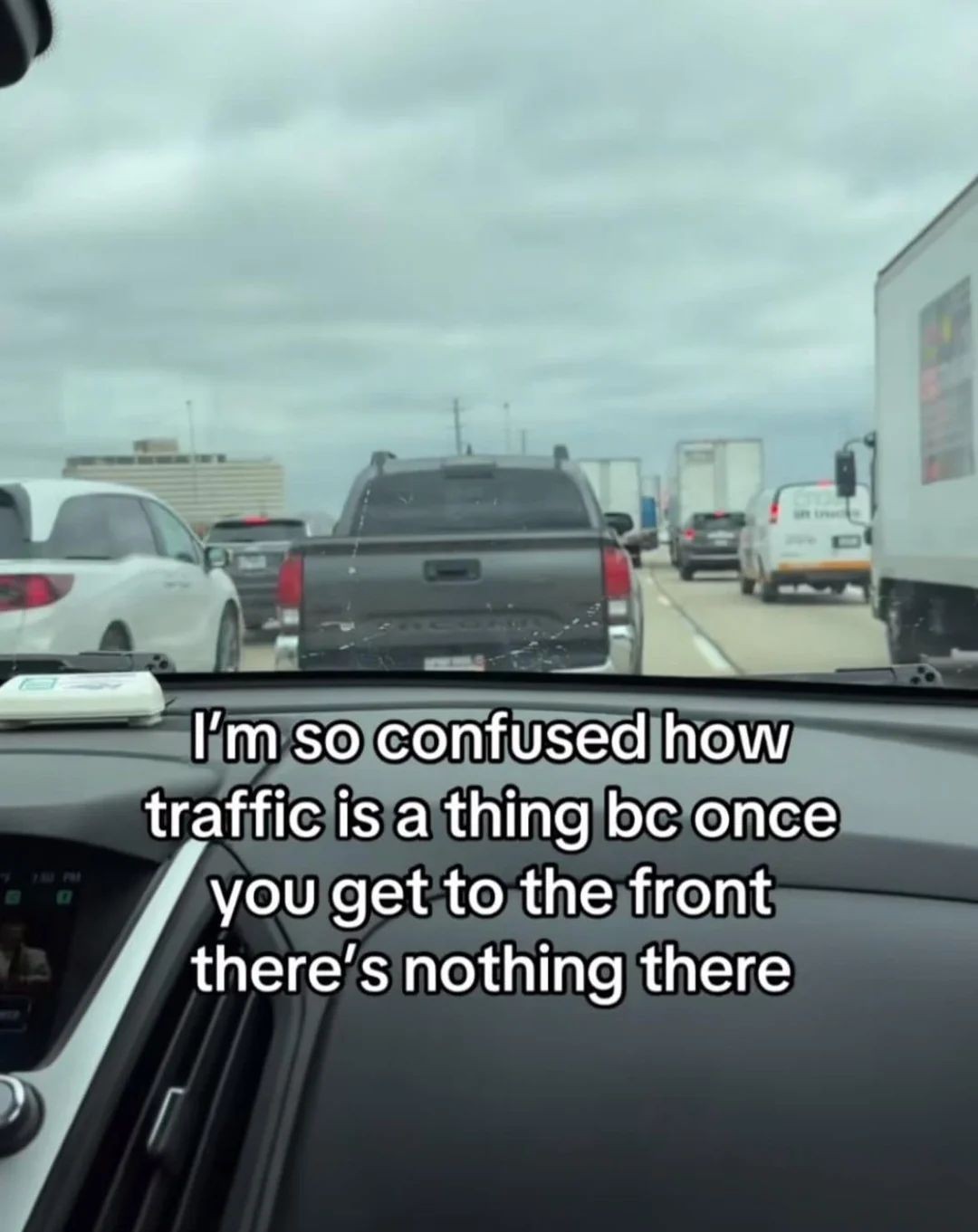
Most traffic jams actually act as a kind of compression wave moving backwards through traffic. Something as small as a squirrel running across the road can cascade into an hour-long jam.

One person brakes, then the person behind them, then the person behind them, but each time they are getting closer to each other (nobody stays equidistant from the car in front of them when braking). This causes a greater and greater slowdown as more cars are compacted into a tighter space, which travels backwards in traffic like a wave. Often the person who caused it doesn't even realize anything happened.

A lot of mapping software actually estimates a given traffic slowdown by treating traffic as a fluid with a wave moving backwards through it.

  • source
  • hideshow 46 child comments
  • [–] 102 points 1 year ago* (last edited 1 year ago) (35 children)

    That's also why the best way to relieve traffic is to go at a slow even pace without braking. Every time the someone in heavy traffic runs up the ass of another car and brakes hard, or swerves into the "faster" lane and make someone else brake to not hit them, they cause another brake wave. If you have a few cars intentionally just hanging back and cruising with a big enough gap between them and the cars jocking for position in traffic in front of them, then their brake waves do not propogate behind you and eventually traffic just picks up pace again.

    Edit: side bonus, you still get there just as fast, but with a lot less stress fighting assholes for position (minus the ones who fly past you thinking you're the asshole for not riding someone else's bumper)

  • source
  • parent
  • hideshow 35 child comments
  • [–] 50 points 1 year ago* (15 children)

    Yeah, in theory it's great but every time I try it people just cut in front of me then slam on brakes causing me to have to brake then adjust then repeat ad nauseam. People suck.

  • source
  • parent
  • hideshow 15 child comments
  • [–] 15 points 1 year ago*

    Yeah, maybe I’m fooling myself but it really seems like hanging back more makes me have to do more sudden braking. Traffic seems smoothest when I’m close enough to discourage cut-ins …. Even if that means Im more at the mercy of traffic in front flowing down a bit

    But as a corollary, this is one of the reasons fewer lanes are sometimes better. A main road near me proved this out when they cut back from two lanes in each direction to one plus turn lanes. There’s no more jockeying for position, no more cut-in’s and you no longer have to protect your gap. Traffic is smooth and calm, and it improved accident statistics. Most importantly timing to get through that section is consistently better!

  • source
  • parent
  • load more comments (14 replies)
  • load more comments (19 replies)
  • [–] 11 points 1 year ago (4 children)

    Do you know of a paper that describes this kind of traffic motion?

  • source
  • parent
  • hideshow 4 child comments
  • load more comments (3 replies)
  • [–] 95 points 1 year ago (22 children)

    Hey I studied this in grad school for a bit, and it really is just "someone does some dumb shit which leads to a cascading wave of additional people doing dumb shit which propagates backwards for miles." Basically when the offered load is getting close to the maximum load, all it takes is one person aggressively changing lanes to throw that section of highway into gridlock, and it will remain that way until the total integrated traffic flux across that incident boundary again falls below the critical offered load inflection point.

    Basically, pick a lane and just stay in it. Maintain proper following distance. Counterintuitively, the following distance should be for the speed you want to drive, so even in traffic it should be like 5+ car lengths even though you are going slow. This is because it reduces the offered load, and once that number falls below the critical point, speeds will increase again. Bumper to bumper traffic basically prevents that from happening because it dampens the ability for a "speedup" wave to propagate.

    Of course this is all impossible for humans. All it takes is a few idiots to throw off the balance.

  • source
  • hideshow 22 child comments
  • load more comments (18 replies)
    [–] 75 points 1 year ago (10 children)

    A few years ago, I was bitching and moaning about a jam, and my pal just said "you're not in traffic, you are traffic".

    I know it's nothing more than a cheeky soundbite but just reframing it like that and knowing I'm part of the problem rather than the exception has made me a lot calmer on slow moving roads.

    Plus it has encouraged me to either use public transport more, or just drive to a park-and-ride a mile or three out, and run the rest - facilities permitting of course.

  • source
  • hideshow 10 child comments
  • load more comments (3 replies)
    [+] 70 points 1 year ago* (last edited 1 year ago) (6 children)
  • load more comments (4 replies)
    [–] 35 points 1 year ago (17 children)

    99% of traffic like this is caused by people following too closely.

  • source
  • hideshow 17 child comments
  • [–] 14 points 1 year ago* (16 children)

    Yeah ideally you put 3 seconds between you and the car in front of you. Gives a nice, springy cushion to not brake as much. Your mechanic will also be surprised how much longer your brakes last.

  • source
  • parent
  • hideshow 16 child comments
  • [–] 13 points 1 year ago (2 children)

    I've always said that if you're using your brakes on the highway and it's not for an emergency stop, you're too close to the car in front of you. Even if they're the type that are on and off the brake constantly, if their speed isn't changing much you shouldn't need to follow their example. Of course I try to get out from behind them because they are like crying wolf and one of those brakes might be for real.

    When caught in a traffic jam I look for a semi to get behind. They won't accelerate fast like some car drivers do, and they don't stop as fast either. Plus they can see better if things area really starting to move or not. Keep a few car lengths behind them and while everyone is doing the start and stop motions, I'm keeping a slow but steady speed usually without needing to brake at all. It's also less stressful.

  • source
  • parent
  • hideshow 2 child comments
  • load more comments (2 replies)
  • load more comments (13 replies)
  • [–] 35 points 1 year ago (16 children)

    It's the people not zipper merging correctly. You have idiots entering that are not up to speed and you have idiots breaking for the idiots not up to speed.

    On ramps should be required to have their lane not end abruptly which causes the panic. The on ram should continue for at least a 1/4 mile.

  • source
  • hideshow 16 child comments
  • [–] 15 points 1 year ago (4 children)

    Cars cause traffic. Cars changing lanes causes traffic. Cars merging causes traffic. Only solution, get rid of the cars and the system built to cater to them.

  • source
  • parent
  • hideshow 4 child comments
  • [–] 15 points 1 year ago

    I've literally seen a test with 4 cars driving around a circle, and they tell the drivers, "go at a consistent speed and maintain the distance in front of you" and after 5 minutes they're all bunched up on one side of the circle. No amount of zipper merging and nice ramps will fix this.

  • source
  • parent
  • [–] 9 points 1 year ago* (2 children)

    people not zipper merging correctly

    Zipper merging is more complicated than driving straight forward and requires both lanes to slow down significantly relative to the cars in front and behind them.

  • source
  • parent
  • hideshow 2 child comments
  • load more comments (4 replies)

    There are phantom traffic jams where someone breaks hard and it ripples on for ages. You can see on YouTube.

  • source
  • [–] 24 points 1 year ago (2 children)

    CGP grey did a video on it: https://www.youtube.com/watch?v=iHzzSao6ypE

    Basically one car breaking too much will make the following brake even more and so on until one stops and there's a jam. There is no clear reason like a road blockage or an accident, just compounding slow down.

  • source
  • hideshow 2 child comments
  • load more comments (2 replies)
    [–] 22 points 1 year ago (8 children)

    3 fucking seconds

    The answer is a simple 3 second gap.

    That's it, just 3-mississippi (or 3-onethousand) seconds behind the car in front of you and most of the avoidable jams go away.

  • source
  • hideshow 8 child comments
  • [–] 21 points 1 year ago (5 children)

    If you do that, someone will move into the gap. If someone moves into the gap you can slow down to make another gap to them, but then someone else will drive into that gap. I don't know of any major city where you can maintain a 3 second gap during rush hour.

    Even worse, if you ever brake to try to create a gap, you're likely to cause a traffic jam behind you.

    Sure, if everybody did follow the suggestion and allowed a 3 second gap you wouldn't have traffic jams, but that's just not human nature, apparently.

  • source
  • parent
  • hideshow 5 child comments
  • load more comments (5 replies)
  • load more comments (2 replies)
    [–] 18 points 1 year ago (1 child)

    The people at the front are morons and probably in the wrong lane.

  • source
  • hideshow 1 child comment
  • load more comments (1 reply)
    [–] 18 points 1 year ago (2 children)

    I find it’s the speeders, tailgaters, and the infuriating few that can’t seem to manage to go at the prevailing speed that cause the waves in traffic. The rest is structural - merges, construction, lane reductions, etc. The aforementioned all cause the slowdowns because they move quickly, traffic tends to follow, and end up constantly hitting their brakes riding the ass of the slower traffic. That starts a wave that ends up with traffic stopping when density is high enough.

    You can’t control others moving slower than you want, bitching about lane campers changes nothing, but managing a speed/spacing that allows little or no braking does wonders to keep things moving. If only people would bother to do so.

  • source
  • hideshow 2 child comments
  • load more comments (2 replies)
    [–] 17 points 1 year ago (6 children)

    They called it "ghost jam" but man, i prefer blackberry jam.

  • source
  • hideshow 6 child comments
  • load more comments (6 replies)
    [–] 17 points 1 year ago

    Exactly, it's entirely because the people in front of you are going slow.

  • source
  • [–] 17 points 1 year ago (4 children)

    It's usually a complex crowd effect created by many participants trying to maneuver among each other in slightly disperate ways.

    In Portland OR, it really is because some dingbat slowed down to 20 MPH on the interstate for literally no fucking reason at all.

  • source
  • hideshow 4 child comments
  • load more comments (4 replies)
    [–] 13 points 1 year ago

    People drive too close to each other, someone has to slow down and then the car behind slows down a bit more. Repeat until you get to the point someone completely stops. Then the next car stops for slightly longer.

    If you leave a safe distance then it wouldn't happen.

  • source
  • [–] 13 points 1 year ago

    This is like saying you don’t know how a bottleneck works.

  • source
  • [–] 12 points 1 year ago* (1 child)

    It all starts with someone in the passing lane, not passing, and one or more pissed off people behind them :)

    The pissed off people trying to get around causes the wave of people behind them to brake and it snowballs from there.

  • source
  • hideshow 1 child comment
  • [–] 8 points 1 year ago

    Yeah I drive around 3 hours on the highway every several weeks. Sometimes on my drive, there's obviously traffic. A lot of times it will be something like rush hour traffic, a crash, construction, etc.

    But then like...a good portion of the time when I come to the very front of the "clog", I find that it is just a blockade of multiple people going incredibly slowly and taking up all lanes of traffic, refusing to move over despite the fact that they are going under the speed limit.

  • source
  • parent
  • [–] 11 points 1 year ago (1 child)

    The Mythbusters did it! They couldn't even get up to speed to begin the first experiment because the traffic jam formed naturally.

  • source
  • hideshow 1 child comment
  • load more comments (1 reply)
    [–] 10 points 1 year ago* (1 child)

    Its because of two things. One is that people hog the passing lane or try to pass slowly so it takes them a few minutes to overtake a few cars, and also because people drive at different speeds. Some people drive at the speed that feels comfortable, others drive the state imposed speed limit. This creates pockets of dense traffic, and then people try to pass, but there is always the person who tries to pass as slow as possible because they are going a few mph over the speed limit.

    Its really just a bad combination of laws, and drivers who are terrified of breaking the law, and people who dont know how to drive correctly in a way to reduce traffic. Also many people are just never consider that others also need to use the roads. They don't care about traffic. Some people also have health issues, like blindness, or mental handicaps, which means driving at interstate speeds is about all they can muster.

  • source
  • hideshow 1 child comment
  • load more comments (1 reply)
    [–] 9 points 1 year ago

    Years ago I was in LA on business and ended up on I-5. All of a sudden traffic stopped dead. Eventually people were getting out of their cars and walking around. About a half-hour later, traffic started up again. We never saw what was responsible for the blockage. No wreckage, no obvious marks or debris on the pavement, nothing. I'm glad I live in a small city nowhere near California.

  • source
  • [–] 8 points 1 year ago

    https://www.mdpi.com/2076-3417/11/9/4278

    TLDR: modeling traffic as a gas leads to fairly accurate predictions. If that doesnt mean anything to you, here's a decent visualization of how gasses move around in a system. In this analogy, each of the gas particles models a car on the road. https://youtu.be/Hr5Baj3lXFA

  • source
  • load more comments
    view more: next ›