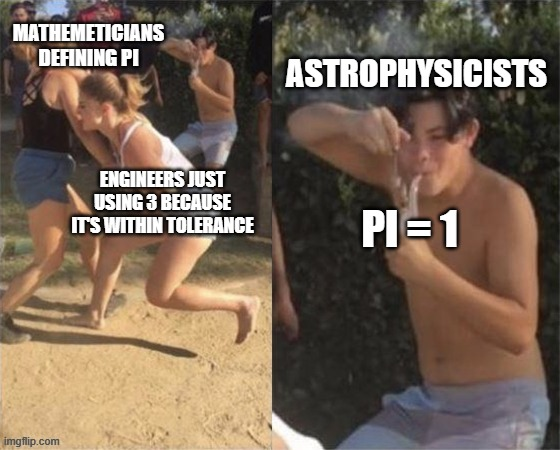
Meme of two women fighting while a man smokes from a pipe in the background.

The women fighting are labeled "mathematicians defining pi" and "engineers just using 3 because it's within tolerance"

The man smoking is labeled "astrophysicists" and the pipe is labeled "pi = 1"
top 50 comments

sorted by: hot top controversial new old
[+] 162 points 1 year ago* (last edited 1 month ago) (6 children)
  • [–] 17 points 1 year ago* (1 child)

    And just two digits introduces less error than your average terrible model

  • source
  • parent
  • hideshow 2 child comments
  • load more comments (2 replies)
    [–] 55 points 1 year ago (2 children)

    as an engineer, a lot of languages (even proprietary ones) have a built-in constant pi variable because it is so ubiquitous - its easier and more readable to use pi than 3........

  • source
  • hideshow 3 child comments
  • [–] 17 points 1 year ago (2 children)

    And then you’re using C++ and they scold you for including cmath for just M_PI because it increases compilation times.

  • source
  • parent
  • hideshow 4 child comments
  • [–] 20 points 1 year ago (2 children)

    We're talking about engineers here! We're using MATLAB or Python if we're programming at all.

  • source
  • parent
  • hideshow 4 child comments
  • [–] 35 points 1 year ago (3 children)

    Your not writing regular python code, your writing a special subset of python intended for engineers and scientists called "bad python code"

  • source
  • parent
  • hideshow 4 child comments
  • load more comments (2 replies)
  • load more comments (1 reply)
    [–] 44 points 1 year ago (3 children)

    As a retired mechanical engineer, the joke is that we don't really remember the value of Pi, but we think it's somewhere around 3. But maybe we should use 4 just to be safe.

    In any case, I have to remember 3.14 because one of my Daughters was born on Pi Day. Which, according her, is the second most important day of the year, just right behind Christmas Day, when she was growing up. So when she got into high school that meant that we had to bring enough pie to be served in each of her math classes on that day. (Oddly enough she prefers cheese cake over pie on her Birthday).

    Now I'm not saying being born on Pi Day influenced her life any, but she has a PhD in Mech Engineering.

  • source
  • hideshow 6 child comments
  • [–] 38 points 1 year ago (1 child)

    38 digits of pie gives youv an error of less then a hydrogen atom in the circumference of the known universe.

    https://www.jpl.nasa.gov/edu/news/how-many-decimals-of-pi-do-we-really-need/

  • source
  • hideshow 2 child comments
  • [–] 11 points 1 year ago

    From the article for anyone who cares, NASA uses 15 digits (3.141592653589793) because at Voyagers current distance from earth (~48 billion kilometers) that would give you an accuracy of less than half an inch.

  • source
  • parent
  • [–] 32 points 1 year ago (2 children)

    As an Astrophysicist, I have never seen anybody use pi=1, you just leave the character, it's anyway better to read, is not like you do any calculations by hand anyway. More common is c=hbar=kB=1, but that is not an approximate, is a gauge in another unit system. Also... Astronomy is not astrophysics...

  • source
  • hideshow 4 child comments
  • [–] 25 points 1 year ago (2 children)

    Using 1 is fun. That means the circumference of a circle is equal to its diameter.

  • source
  • hideshow 4 child comments
  • [–] 12 points 1 year ago (1 child)

    Isn't this functionally true for objects on the infinite focal plane? I.e. a star? Betelgeuse might actually be huge in absolute terms, but from earth, and even in a large telescope, it's still a pinpoint whose circumference is not meaningfully distinct from its diameter.

  • source
  • parent
  • hideshow 2 child comments
  • [–] 7 points 1 year ago (1 child)

    It would be the size of the telescope's diffraction artifacts probably. Meaning the shape you see on the picture is not related to the size of the star but only to the physical limits of the optical instrument. This diffraction pattern is proportional to the color your looking at and inversely proportional to the size of the telescope primary mirror. The bigger the telescope primary mirror, the smaller the diffraction pattern and the more chance you have that this artifact will not completely hide the object you are looking at. I didn't do the math, but I guess to image the actual disk of Betelgeuse, the size of the telescope you need is probably still science fiction, even with interferometry.

  • source
  • parent
  • hideshow 2 child comments
  • [–] 7 points 1 year ago* (last edited 1 year ago) (1 child)

    I want you to know that you nerd sniped me with this comment and I started doing the math. To raise the apparent size of Betelgeuse to the apparent size of Jupiter (at its largest to the naked eye), you'd need a minimum 20 inch aperture telescope to pull the required 1000x magnification. Mind you:

    • 20 inches is not a mass produced telescope size, but there ARE custom makers who produce reflectors at and well beyond this size. There are certainly terrestrial telescopes that can achieve what we need.

    • you're still not resolving any details at that size, it's just raising Betelgeuse to the same apparent size as Jupiter at its naked eye largest.

    • most places on earth are not conducive to magnifications over 300x. You can certainly do it, and sometimes the atmospheric conditions are ridiculously clear and you can pull off stupid levels of magnification, but there's a reason why observatories get built up on mountains a lot. 1000x is... Well, good luck. Especially since Orion and Betelgeuse never get too close to the zenith, meaning there's always a substantial amount of atmosphere to deal with.

    Edit: let's go with raising it to the same apparent size as the full moon, which occupies about 30 arcminutes or 1800 arc seconds. Jupiter is 50 arc seconds at the largest, and Betelgeuse is 0.05 arc s. To figure out how much we need to magnify Betelgeuse by, we take the apparent size of the moon and divide it by the apparent size of Betelgeuse, yielding 36,000x. Assuming a spherical cow, telescope aperture is what limits the maximum useful magnification, and the equation to derive that is roughly 50x aperture. So, if we divide 36,000 by 50, we'll get our minimum required aperture of 720 inches, or fifty feet. IIRC, we have at least one terrestrial telescope that's at least that large, down in Chile, though I'm almost certain there are more and larger ones, too.

  • source
  • parent
  • hideshow 1 child comment
  • load more comments (1 reply)
  • [–] 22 points 1 year ago (1 child)

    Computer science: pi is O(1)

  • source
  • hideshow 2 child comments
  • [–] [S] 8 points 1 year ago (4 children)

    Is it actually? I'll admit im pretty rusty on time complexity, but naively I'd think that pi being irrational would technically make even reading or writing it from memory an undecidable problem

  • source
  • parent
  • hideshow 6 child comments
  • [–] 15 points 1 year ago (1 child)

    If you're trying to calculate it, then it's quite difficult.

    If you just want to use it in a computer program, most programming languages have it as a constant you can request. You get to pick whether you want single or double precision, but both are atomic (a single instruction) on modern computers.

  • source
  • parent
  • hideshow 2 child comments
  • [–] 6 points 1 year ago

    It's a number and complexity refers to functions. The natural inclusion of numbers into functions maps pi to the constant function x -> pi which is O(1).

    If you want the time complexity of an algorithm that produces the nth digit of pi, the best known ones are something like O(n log n) with O(1) being impossible.

  • source
  • parent
  • load more comments (2 replies)
  • [–] 20 points 1 year ago
    [+] 16 points 1 year ago* (last edited 1 year ago) (5 children)
  • [–] [S] 35 points 1 year ago* (last edited 1 year ago) (2 children)

    Somebody else already said it, but that's what the title is.

    Longform: a lot of calculations that happen in astro deal with distances so large so large that only order of magnitude changes actually meaningfully affect the end result. To connect to a more common topic, here's a joke.

    "Whats the difference between a million dollars and a billion dollars?"

    "About a billion dollars"

    This joke works for the same reason; 1 billion is so many orders of magnitude larger than 1 million that (1,000,000,000 - 1,000,000 = 1,000,000,000) is only incorrect by ~0.1%, even though substituting 0 for 1 million in that equation seems ridiculous on the face of it. Substituting 1 for pi has similarly minimal errors (tbh it usually matters waaaaaaaaay less than .1% error) in a lot of astro math

  • source
  • parent
  • hideshow 2 child comments
  • load more comments (2 replies)
  • load more comments (2 replies)
    [–] 12 points 1 year ago* (last edited 1 year ago) (1 child)

    I heard once π²=10 is fairly accurate approx and thus g=π²=10 in astrophysics where people thinks in order of magnitude, not value.

    But my engineering ass is telling assumptions with larger than 50% difference from actual value may cause issues on order of magnitude if the value is used multiple times and isnt it better be like 5=1/2×10?

  • source
  • hideshow 2 child comments
  • [–] [S] 10 points 1 year ago

    That's because your engineering ass needs things to be physical and sane. Physics is a field for the mentally unwell to sink further into insanity while incoherently scribbling greek letters on every available flat surface.

    On a more serious note, yeah you absolutely have to be careful about where you apply really ambitious simplifications like that. There are plenty of mathematical regimes where you can use natural units (this is the term to look up if your interest extends further) and simplify your reference frame by a hell of a lot though. Setting the speed of light to 1 is also a hell of a drug, and brother I've got an addiction

  • source
  • parent
  • [–] 10 points 1 year ago (2 children)
  • [–] 10 points 1 year ago (10 children)

    Electrical engineer. Never used 3. Always 3.14. don't really get the joke.

  • source
  • hideshow 10 child comments
  • load more comments (10 replies)
    load more comments
    view more: next ›