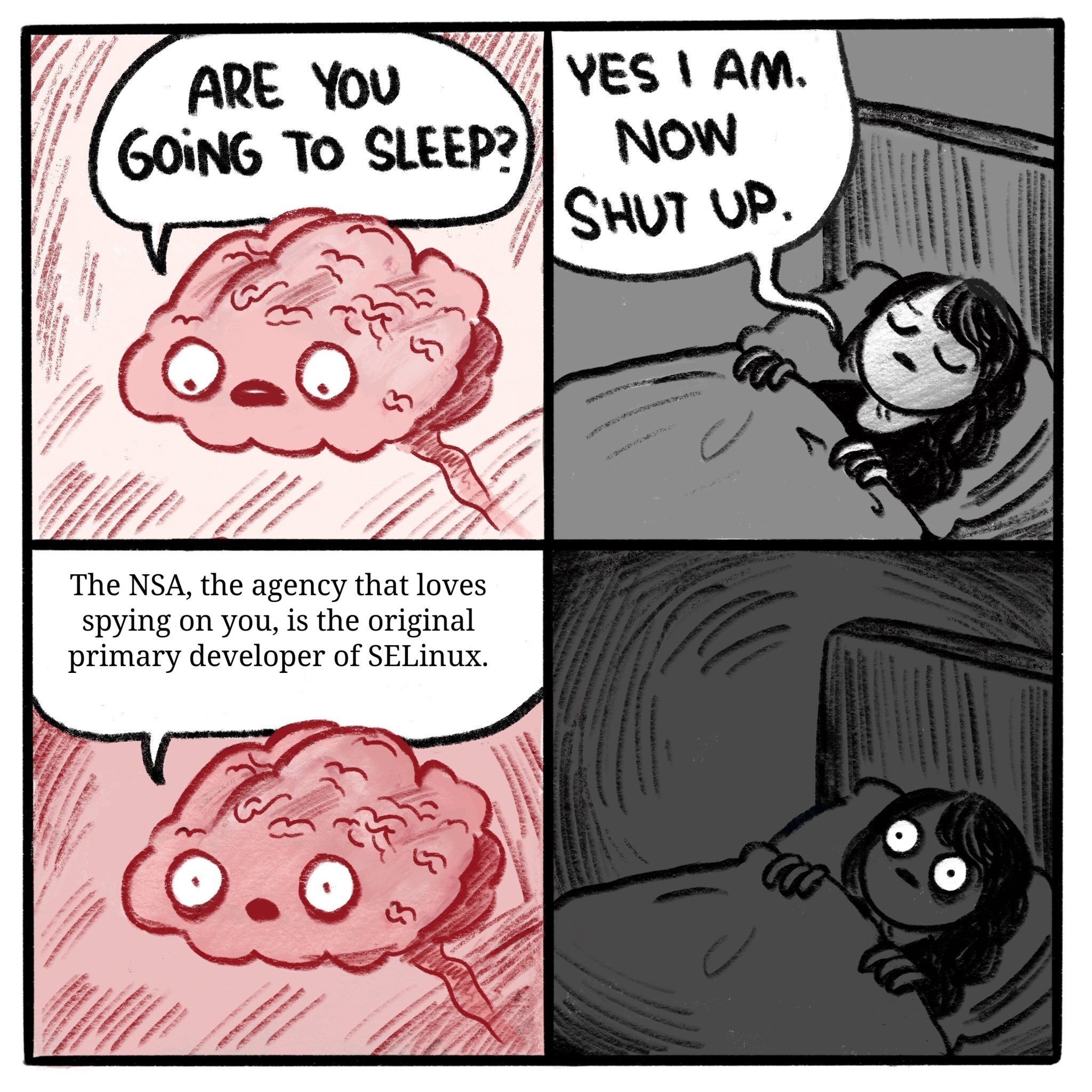
The NSA, the original primary developer of SELinux, released the first version to the open source development community under the GNU GPL on December 22, 2000.[6] The software was merged into the mainline Linux kernel 2.6.0-test3, released on 8 August 2003. Other significant contributors include Red Hat, Network Associates, Secure Computing Corporation, Tresys Technology, and Trusted Computer Solutions.
https://en.wikipedia.org/wiki/Security-Enhanced_Linux

top 50 comments

sorted by: hot top controversial new old
[–] 155 points 2 years ago* (16 children)

I mean, it's still Open Source, right? So it would be pretty hard for them to hide a backdoor or something??

I guess I don't know what's so sus when it's easily auditable by the community and has been for two decades now.

If it's just because it's memes and you're not being that serious, then disregard please.

  • source
  • hideshow 16 child comments
  • [–] 129 points 2 years ago (5 children)

    I mean, it’s still Open Source, right? So it would be pretty hard for them to hide a backdoor or something??

    Right but maybe it combined with other tools they have is what helps them with some exploit.
    Like they figured out an exploit but needed SELinux as a piece of the puzzle. It's open source
    and we can all read the code but we can't see the other pieces of the puzzle.

    Come on, put your conspiracy hat on! ;)

  • source
  • parent
  • hideshow 5 child comments
  • [–] 111 points 2 years ago (2 children)
  • [–] 42 points 2 years ago (1 child)

    I maintain open source software on a much smaller codebase that is less security critical. We have dozens of maintainers on a project with about 3k stars on GitHub. Stuff gets by that are potentially security vulnerabilities and we don’t know until upstream sources tell us there is a vulnerability

  • source
  • parent
  • hideshow 1 child comment
  • [–] 28 points 2 years ago (7 children)

    So it would be pretty hard for them to hide a backdoor or something??

    It happens, though.

  • source
  • parent
  • hideshow 7 child comments
  • [–] 26 points 2 years ago (1 child)

    This is also probably the reason why you lost your DARPA funding, they more than likely caught wind of the fact that those backdoors were present and didn't want to create any derivative products based upon the same.

    Though this implies that the Department of Defense doesn't want to use compromised tools, since DARPA is DoD. NSA is also DoD.

  • source
  • parent
  • hideshow 1 child comment
  • [–] 8 points 2 years ago (1 child)

    People don't understand that the way a backdoor is usually implemented is not going to be obviously saying "backdoor_here", neither it will look like a some magic code loading a large string and unzipping it on the fly -- that's sus af. What you will see is some "play video" functionality that has a very subtle buffer overflow bug that's also not trivially triggerable.

    This already happened with WhatsApp.

  • source
  • parent
  • hideshow 1 child comment
  • load more comments (1 reply)
  • [–] 8 points 2 years ago (1 child)

    Do you know of any good comprehensive followup to this? A quick search shows me lots of outdated info and inconclusive articles. Do you know if they conclusively found anything or if there is a good writeup on the whole situation?

  • source
  • parent
  • hideshow 1 child comment
  • [–] 5 points 2 years ago*

    I don't have such a source, but the Cybersecurity community throw accusations around easily, and are loathe to ever bless any software as completely innocent - which is a good thing.

    When the accusations stop, the issue has either been addressed (typical outcome), or the product owner was written off by the Cybersecurity community as a lost cause (rare, but it happens).

  • source
  • parent
  • [–] 133 points 2 years ago (2 children)

    I mean, leaving aside their surveillance tasks, it's still their job to ensure national security. It's in their best interest to keep at least themselves and their nation safe, and considering how prevalent Linux is on servers, they likely saw a net benefit this way. They even open sourced their reverse engineering toolkit Ghidra in a similar vein

  • source
  • hideshow 2 child comments
  • [–] 25 points 2 years ago (1 child)

    Ghidra was about hiring and cost savings. Its easier to hire when people already know your tools. Also people are more willing to use your tools rather than expensive ones if they can still use them when they leave (go into contracting). Also interoperability with contractors may improve.

  • source
  • parent
  • hideshow 1 child comment
  • [–] 115 points 2 years ago (9 children)

    While they created a set of patches that would implement the security features that selinux provides, what was actually merged was the result of several years of open collaboration and development towards implementing those features.

    There's general agreement that the idea that the NSA proposed is good and an improvement, but there was, and still is, disagreement about the specific implementation approaches.
    To avoid issues, an approach was taken to create a more generic system that selinux would then take advantage of. That's why selinux, app armor and others can live side by without it being a constant maintenance and security nightmare. Each one lives in their little self contained auditable boxes, and the kernel just makes the "check authorization" function call and it flows into the right module by configuration.

    The Linux community was pretty paranoid about the NSA in 2000, so the code definitely got a lot more scrutiny than the typical proposal.

    A much easier way to introduce a backdoor would be to start a tiny company that produces some arbitrary piece of hardware which you then add kernel support for.

    https://github.com/torvalds/linux/tree/master/drivers/input/keyboard - that's just the keyboard drivers.

    Now you're adding code to the kernel and with the right driver and development ability you can plausibly make changes that have non-obvious impacts, and as a bonus if someone notices, you can just say "oops!" And not be "the god-damned NSA" who everyone expects to be up to something, and instead be 4 humble keyboard enthusiasts with an esoteric set of lighting and input opinions like are a dime a dozen on Kickstarter.

  • source
  • hideshow 9 child comments
  • I haven't looked at the keyboard drivers, or much Linux source. I never really had a reason to do a lot of C other than small microcontroller projects.

    But I see this stuff and think of how awesome it must have felt to get a different keyboard working on an OS the first time. I have to do all this stuff with cloud, and api levels, and configuring CI/CD pipelines, and sometimes I get to write backend C# code or they let me play in the front end. Most of the time it's telling another team of developers what to do, and listening to our clients explain the problems and I have to figure out if we already have anything to fulfill at least some of those needs.

    These drivers are the divine marriage of hardware that's not native to the machine that an OS is running on. It's so beautiful to read. You can visualize where the values enter a memory address, and bits get shifted or something is static so the keyboard always uses the right thing.

  • source
  • parent
  • [–] 85 points 2 years ago* (last edited 2 years ago) (7 children)

    I'm not sure why that's a problem. The NSA needed strong security so they created a project to serve the need. They are no longer in charge of SELinux but I wouldn't be surprised if they still worked on it occasionally.

    There are a lot of reasons to not like the NSA but SELinux is not one of them.

  • source
  • hideshow 7 child comments
  • [–] 42 points 2 years ago (4 children)

    That's the trubble with the NSA. They want to spy on people, but they also need to protect American companies from foreign spies. When you use their stuff, it's hard to be sure which part of the NSA was involved, or if both were in some way.

  • source
  • parent
  • hideshow 4 child comments
  • [–] 24 points 2 years ago (3 children)

    The NSA has a fairly specific pattern of behavior. They work in the shadows not in the open. If they target things with low visibility so it is hard to trace. Backdooring SELinux would be uncharacteristic and silly. They target things like hardware supply chains and ISPs. There operations aren't even that covert as they work with companies.

  • source
  • parent
  • hideshow 3 child comments
  • [–] 15 points 2 years ago (1 child)

    The specific example I'm thinking of is DES. They messed with the S-boxes, and nobody at the time knew why. The assumption was that they weakened them.

    However, some years later, cryptographers working in public developed differential cryptanalysis to break ciphers. Turns out, those changed S-boxes made it difficult to apply differential cryptanalysis. So it appears they actually made it stronger.

    But then there's this other wrinkle. They limited the key size to 56-bits, which even at the time was known to be too small. Computers would eventually catch up to that. Nation states would be able to break it, and eventually, well funded corporations would be able to break it. That time came in the 90s.

    It appears they went both directions with that one. They gave themselves a window where they would be able to break it when few others could, including anything they had stored away over the decades.

  • source
  • parent
  • hideshow 1 child comment
  • load more comments (1 reply)
  • load more comments (2 replies)
    [–] 45 points 2 years ago (4 children)

    Only because they use Linux too and had to make it public as Linux is a public, open-source kernel

  • source
  • hideshow 4 child comments
  • load more comments (2 replies)
    [–] 22 points 2 years ago (3 children)

    If they afterwards released it under a Free (Libre) Software licence then it's fine. The licence itself prohibites against any obfuscation or combination of obfuscated code with libre one. If you have the entire code, not just some part, as most companies do when go Open Source (not free software), then you don't have to worry about unknown behavior because everything is in the source.

  • source
  • hideshow 3 child comments
  • [–] 11 points 2 years ago (1 child)

    If you have the entire code, not just some part, as most companies do when go Open Source (not free software), then you don't have to worry about unknown behavior because everything is in the source.

    Hahaha, good joke

  • source
  • parent
  • hideshow 1 child comment
  • [–] 6 points 2 years ago

    I mean if you have the entire source then you have everything to reproduce the program. Finding a malicious part does not only depend on the source but on the inspector, that is true.

    But anyways having the entire code and not just the part that a company feels they may share is better anyways. Even if it's literally malware.

    The free software community users depend on the community in order to detect malicious code. But at least there's a source code way of doing so.

    If I tell you that this building has a structural deformation, having the possibility of accesing the architect blueprints and list of materials is better than just being able to go inside the building and try to search for it, no?

  • source
  • parent
  • [–] 20 points 2 years ago (2 children)

    Same thing with SHA-1, 2, and I'm not sure about 3.

  • source
  • hideshow 2 child comments
  • [–] 15 points 2 years ago (6 children)

    Wasn't Signal messenger also funded by the NSA+DARPA? And TOR too?

    Anti Commercial-AI license

  • source
  • hideshow 6 child comments
  • [–] 13 points 2 years ago* (4 children)

    Signal is weird about actually allowing others to reproduce the APK builds.

    Specifically, they are the kind of weird about it that one would expect if the Signal client app had an NSA back-door injected at build time.

    This doesn't prove anything. It just stands next to anything and waggles it's eyebrows meaningfully.

  • source
  • parent
  • hideshow 4 child comments
  • [–] 8 points 2 years ago (1 child)

    Do you have more recent information by Signal on the topic? The GitHub issue you linked is actually concerned with publicly hosting APKs. They also seem to have been offering reproducible builds for a good while, though it's currently broken according to a recent issue.

  • source
  • parent
  • hideshow 1 child comment
  • [–] 5 points 2 years ago* (last edited 2 years ago)

    I had a hard time choosing a link. Searching GitHub for "F-Droid" reveals a long convoluted back-and-forth about meeting F-Droid's requirements for reproducible builds. Signal is not, as of earlier today, listed on F-Droid.

    F-Droid's reproducibility rules are meant to cut out the kind of shenanigans that would be necessary to hide a back door in the binaries.

    Again, this isn't proof. But it's beyond fishy for an open source security tool.

    Edit: And Signal's official statements on the topic are always reasonable - but kind of bullshit.

    Reasonable in that I alwould absolutely accept that answer, if it were the first time that Signal rejected a contribution to add it to F-Droid.

    Bullshit in that it's been a long time, lots of folks have volunteered to help, and Signal still isn't available on F-Droid.

  • source
  • parent
  • [–] 8 points 2 years ago (5 children)

    do i remember correctly that android is based on se?

  • source
  • hideshow 5 child comments
  • load more comments
    view more: next β€Ί