I heard some people say theyre the same thing, but others are adamant that they have different meanings. Which is it?

I heard some people say theyre the same thing, but others are adamant that they have different meanings. Which is it?
Disk is for things that are more kiki, but disc, with that rounded off c, is for things that are more bouba.
Disc is short for discus.
Disk is short for diskette, the square things some discs are kept in.
Disc and disk are varient spellings of the same word that pre-exist computing. Disc is more common in British English, Disk more common in American English. But yeah since computing came along disk has also been used more for magnetic media (hard disk) while disc has been used more for optical media (compact disc). I wouldn't be surprised if this only happened because of how the CD was marketed and branded as a "compact disc" as a trademark while hard disks and floppy disks etc were more generic terms.
I've always known disc to refer specifically to optical media.
Disc = round
Disk = rectangular
Disq
All I know is there's no such thing as a discette.
Disque
It's all disk? 🌎👨🚀
Always has been 🌎👨🚀🔫👨🚀
Its a disk when its magnetic, disc when optical.
The way to remember it is that its disk because its magnetik.
A CD is a disk that is disc shaped.
I am not sure, but my oldest child was looking at an English brochure for a trip to France and a asked me "what the heck is a dis-coth-a-cue? Discotheque. A Disco, a dance club. And yes disco-tek is spelled Discotheque in English.
As others have said and how I always see it:
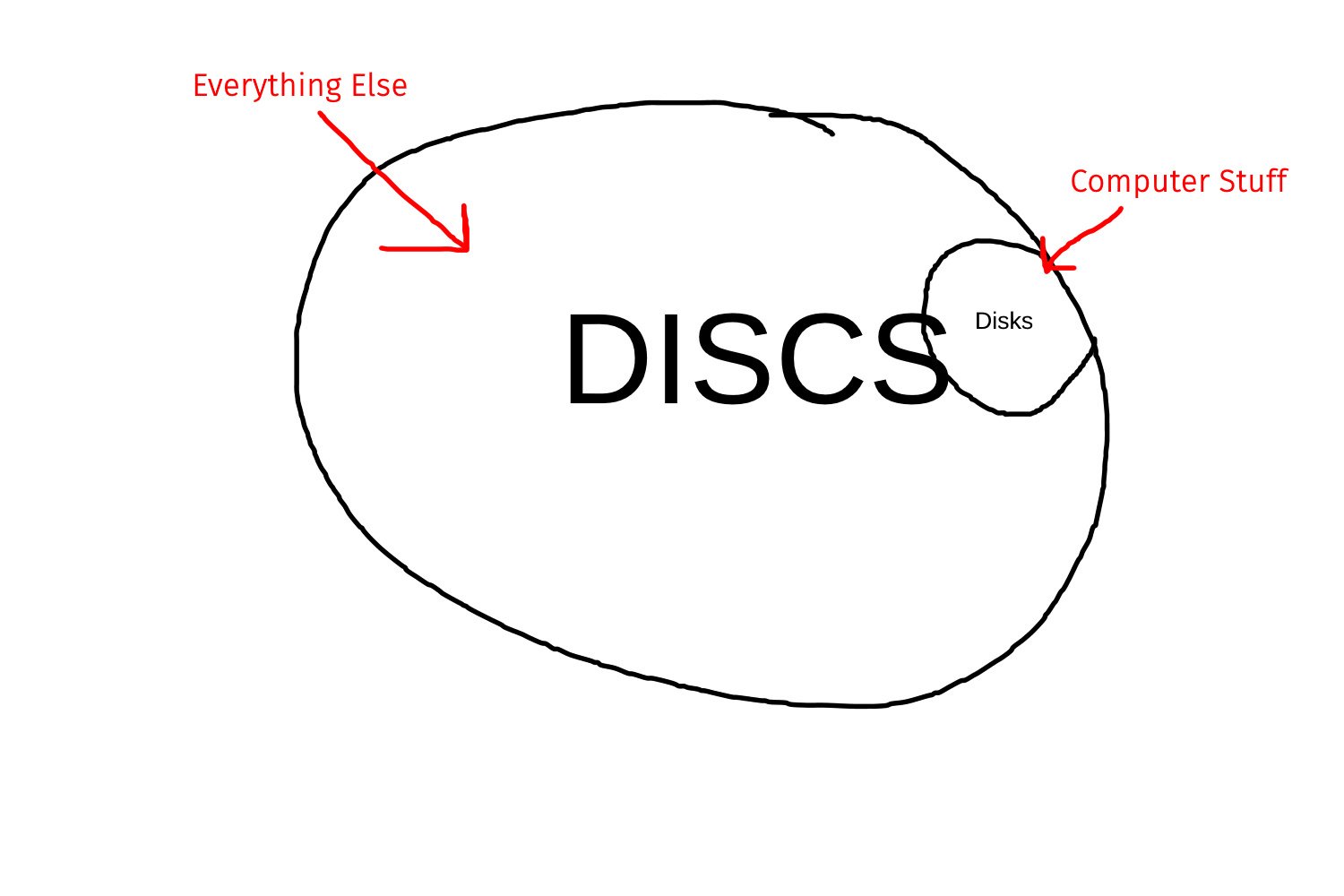
In other words, all disks are discs, but not all discs are disks.
Here's a shitty drawing I made to illustrate:
I always thought discs were optical and disks were magnetic
At its root this was originally a British vs. American English thing. However, the spelling of "disc" with a C has been used specifically as the trade name of various brands including both the throwable and optical media varieties, which have since become genericized trademarks.
For the optical media side of things, the name was coined by Phillips while they were consorting with Sony to develop the standard and named it the "Compact Disc" to compliment their already existing "Compact Cassette" product. They developed an official logo for the format which spelled it "disc." That's been with us ever since.
Volumes of computer storage are now colloquially referred to as "disks" because A) a significant majority of the early computer development milieu in general happened in America where we, or at least IBM, spell it with a K, and B) for a very long time, that's exactly what they were. Tape and magnetic core memory and wire loop memory were all early developments that ultimately gave way to the longstanding popularity of magnetic platter/disk fixed storage... With some exception granted to tape, which hung around for a very long time but definitely was not a random access storage medium suitable for general purpose applications whereas disks were. It's probably pure happenstance that the dominant non-fixed computer storage media also wound up being disk shaped, namely the various sizes and types of floppy disks. Computers handle linear tape based storage and random access disk based storage very differently, and nowadays random access permanent storage still has the "disk" moniker stuck to it even though it's now likely to be solid state.
As a generalized descriptor of a flat circular object, either "disk" or "disc" is appropriate but which is preferred seems to be largely depending on which continent you're from. The root of the word is indeed the Greek "discus," as in the object yeeted across the playing field by Olympic contestants.
Where I'm from we spell it disj but that's because the c and k keys were broken 😞
A disk drive reading disc's would be a disc disk drive
They're all the same word at their core, evolving from the older Latin word. The difference just comes in how the words were used to describe either a computer related device, hard disk, floppy disk, or a sound carrying device, disc record, compact disc.
Disck
I haven't heard USB drives or SSD's be referred to as disks.
In systems we consider discs to be optical devices and sometimes just lump any portable media as a “disc”
Once it’s on my system and seen as a device is becomes a disk
top 50 comments