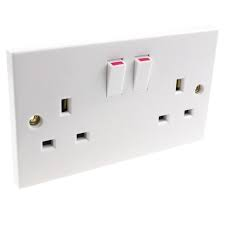
They're like that in this apartment we're renting and I keep seeing them elsewhere. I don't get it.

you are viewing a single comment's thread
view the rest of the comments
[–] 122 points 2 years ago (23 children)

So we can turn the power on and off.

Why else would you have a switch next to a power socket?

  • source
  • hideshow 23 child comments
  • [–] [S] 23 points 2 years ago (4 children)

    Most of the places in the world I have been to do without them, or at least did when I was there, so it confused me. But some people have given good explanations now.

  • source
  • parent
  • hideshow 4 child comments
  • [–] 37 points 2 years ago (3 children)

    Open one up. There's also a fuse connected to the live wire. The amperage is dependent on the normal draw of the appliance. Just added safety features. Also the live and neutral holes only open up if you put the earth in first (that's why it's longer). British plugs are arguably the safest.... Unless you leave them prongs up and step on it accidentally. That makes stepping on Lego feel like a shag carpet.

  • source
  • parent
  • hideshow 3 child comments
  • [–] -1 points 2 years ago (2 children)

    It seems a bit overengineered for little gain compared to good old schuko imo

  • source
  • parent
  • hideshow 2 child comments
  • [–] 4 points 2 years ago* (1 child)

    You were down voted for whatever reason. These outlets are complete bullshit. You have your safeties in the electrical cabinet and then you make sure to wire your house according to certain standards. Schuko is leagues ahead of this crap. Modern Schuko sockets will only allow anything to enter, when both prongs are inserted at the same time. If you do happen to short anything, the FI switch (no idea what it's called in English) will cut the power before anything can happen.

  • source
  • parent
  • hideshow 1 child comment
  • [–] 3 points 2 years ago (8 children)

    The real question is why did the UK decide that on the outlet itself is the best place for that switch, as opposed to e.g. in the US where outlets are sometimes wired to a switch located next to the door to the room?

  • source
  • parent
  • hideshow 8 child comments
  • [–] 28 points 2 years ago (2 children)

    Switches located next to the door are for lighting, as opposed to switches on the socket which mean you can fully turn off your rice cooker without unplugging it. We do sometimes have sockets in the UK with the switch at the door, but they are usually a different shape socket that is designed for a lower current and is only intended to be used for floor lamps.

  • source
  • parent
  • hideshow 2 child comments
  • [–] 4 points 2 years ago (1 child)
    1. Okay, that makes sense.
    2. Wait, your lamps use a different plug? That seems needlessly limiting/inconvenient.
  • source
  • parent
  • hideshow 1 child comment
  • [–] 15 points 2 years ago

    The specific-plugs-for-lamps think is very rare these days. The reason for it is that it's not uncommon for our plugs to be on a high amperage circuit - sometimes 30A, occasionally higher - that can't be safely controlled with a light switch or similar, so the lamp-only circuit will be capped at, say, 3A with unusual plugs to avoid someone trying to connect a tumble dryer.

  • source
  • parent
  • [–] 22 points 2 years ago (1 child)

    Do you have individual switches for each plug socket / outlet wired next to the door? That seems like it would take a lot of wiring, and need a lot of switches.

    The room I'm currently in has six double sockets spread out around the room. They each have one switch per socket like in the post's image. If they were wired back to the door, they would need a lot more wiring, and one of the two entrance doors would have to be chosen. You'd then have to walk to that door every time you wanted to turn something off.

    It seems like a lot more work for no real benefit.

  • source
  • parent
  • hideshow 1 child comment
  • [–] 7 points 2 years ago

    Do you have individual switches for each plug socket / outlet wired next to the door?

    No, the rooms I've seen wired with lamp circuits would typically have one switch next to the entrance with several outlets wired together to it in the same circuit, along with another circuit of several unswitched outlets. Flipping that one switch would turn all the lamps on at once.

    (More rarely, there might be two lamp circuits in a room, with two switches controlling two groups of outlets. I think my parents' formal living room might be like that, but we barely used it and I haven't lived there for 20 years, so I can't quite remember.)

    and one of the two entrance doors would have to be chosen. You’d then have to walk to that door every time you wanted to turn something off.

    Nah, that's what three-way switches are for: you can have a switch at each entrance that controls the same group of outlets.

  • source
  • parent
  • [–] 6 points 2 years ago* (last edited 2 years ago) (1 child)

    Having a switch next to the door would be useful if you're using that socket for a lamp but not if you're using them for anything else. In my kitchen the sockets for my under counter oven and fridge are under the counter and the switches are above it so I can easily access them.

  • source
  • parent
  • hideshow 1 child comment
  • [–] 1 point 2 years ago

    Having a switch next to the door would be useful if you're using that socket for a lamp

    That is specifically what switched outlets in north America are intended to be used for.

  • source
  • parent
  • [–] 0 points 2 years ago (8 children)

    Why can't you just unplug it? If you have to go to the socket anyway... maybe I don't understand because I've never lived with the convenience?

  • source
  • parent
  • hideshow 8 child comments
  • [–] 4 points 2 years ago (2 children)

    Even if you unplug it, the socket is still live at more than 200 V.

  • source
  • parent
  • hideshow 2 child comments
  • [–] -1 points 2 years ago* (1 child)

    Maybe this was meant to be a joke, but that's not how it works. If it were the switch would also not do anything, because what the switch does is exactly the same as unplugging the thing, i.e. cut a piece of the wire out.

    Edit: unless you meant for safety reasons, in which case the shutter inside is a lot safer than the button.

  • source
  • parent
  • hideshow 1 child comment
  • [–] 1 point 2 years ago

    A switch shuts the supply to the socket. Even after unplugging the socket does have electric supply, i.e. it is live. If any metallic object is inserted into the live socket it can give you a worse shock. Since the voltage supply in UK is 220V not 110V.

    Shutter inside is much safer than button but is slightly costlier.

  • source
  • parent
  • [–] 4 points 2 years ago (2 children)

    Depends on the device.

    Something like a vacuum, sure. You're probably going to move it around anyway.

    But I used to have a Spectrum computer, and it had no power switch. If you plugged it in then it was just on. Much simpler to power off at the switch than unplug it and risk the plug falling down the back of the table into a rats nest of cables.

    Plus I guess it's one more step a toddler needs to do to electrocute themselves...

  • source
  • parent
  • hideshow 2 child comments
  • [–] 4 points 2 years ago (1 child)

    But I used to have a Spectrum computer, and it had no power switch. If you plugged it in then it was just on

    Something I've learned talking to my bri'ish friends online over the years: this happens to you guys because you have those switches. I cannot think of anything I've bought in the US that didn't have its own power control for when it's plugged into the wall (unless it's something silly that I made or, for whatever fucking reason, Christmas lights and ONLY Christmas lights as every other decorative string light I own has a switch)

  • source
  • parent
  • hideshow 1 child comment