[–] 1 point 25 minutes ago* (last edited 19 minutes ago)

Never skimp on interfaces. Anything that goes between your skin and something else, anywhere energy is changing medium, this is where money is well-spent. Tires, handlebar tape, speakers/headphones, bicycle saddle, hand tools, work gloves, climbing shoes, keyboard, mouse, monitors, seat cushions, you get the idea... finding what works well for you regardless of cost reaps serious benefits. More money does not necessarily mean better performance for you, but time invested in the trial and error process does mean better results.

In the case of bicycling shorts: these are the sacrificial layer. Your skin is pretty valuable, but at least it can heal. Your comfort on a bike ride is invaluable.

Regarding the stink factor, you mentioned elsewhere in this thread about getting the stink out of technical fabrics. And some people talked stupid shit in response. Anyone who claims "I just wash my stuff and it don't stink no more." Uh, yeah, their noses don't work so well. Getting the tenacious stink out of polyester is a special set of skills. Polyester has a unique affinity for molecules that contribute to stink. Cotton-poly blend exhibits a similar tenacious stink. Very briefly: the polar nature of polyester makes it good for wicking sweat, but also makes it good for hanging onto stinky molecules; standard washing and laundry detergents won't cut it. You need to overcome that molecular-level affinity; vinegar in your first rinse cycle is strong enough. Washing soda (sodium carbonate, not to be confused with sodium bicarbonate AKA baking soda) is a strong alkaline that can strip a bunch of shit out of all your fabrics; it's also pretty harsh. The other alternative is to use sunlight, e.g. line drying, to denature the stinky molecules. But the UV light is hard on fabrics.

  • source
  • parent
  • context
  • [–] 3 points 9 hours ago (2 children)

    On something like a long bike tour, this is not an option. As it is, good shorts are too expensive and too delicate to be washing every single time you wear them. Start with a clean crack and taint, let the shorts dry between wearing. No problems.

  • source
  • parent
  • context
  • [–] 7 points 12 hours ago (1 child)

    Most thumb throttles are cheap garbage, and looking at the Yose site looks like they are no exception. If you have a multimeter and some connectors, wire it up to a ~3V DC source like 2 AA cells wired in series. Check the voltage on the output. Since there are a bunch of variables, I'll leave it to you to find your exact details. Also check that both sides of the plug are in good condition. And finally, thumb throttles are pretty cheap to replace. Grin is my source for all things ebikes related: https://ebikes.ca/ebike-parts/control-stuff/throttles.html

  • source
  • [–] 2 points 13 hours ago

    Also a former WS and CS host and user. I haven't had any bad experiences either as host or user, which I thought odd if only from a sheer numbers/probability standpoint. My take was that I was merely very lucky. Even a large group of dirtbagging teens I hosted were beyond courteous and chill. But constant nagging for money (for being a host? fuck off) and lack of transparency broke it off for me. Sure I get that servers and development cost money, but the compensation packages were unreasonable for services that are provided by community volunteers.

    It looks like there are some good options now for hosting.

  • source
  • parent
  • context
  • [–] 3 points 15 hours ago (2 children)

    I’ve met some hippy types that use soap sparingly for this reason

    TL;DR: This is exactly what I'm talking about.

    I am one of those dirtbag hippie types.

    Some background: My skin is so oily, I could singlehandedly solve the Suez Canal blockade. I struggled my whole life with blackheads and boils, especially crotch boils from cycling and blackheads just about everywhere else. No exaggeration, when I was commuting 52 miles every day, I always had at least two crotch boils going, despite showering before and after my ride at both ends of my commute. I also always had at least one boil on my head, face, or back.

    About 20 years ago, I met a dermatological researcher at a party, and he was talking about his latest clinical work. He mentioned a bunch of testing with disrupting vs maintaining skin flora and microbiota. Stuff like S. aureus and Prevotella being held in check by [other micro-organisms, can't remember the names], but that the skin also produces antimicrobial substances (catechins? or is that the stuff in green tea?). The pH of skin also tends acidic, but soap is alkaline. His tentative hypothesis at the time was that most people shower too much and too vigorously, and that creates a whole host of downstream issues. He mentioned that based on his early findings, he stopped showering every day, instead opting to sponge-bathe with showers being a rarer occurrence. And then only to rinse off sweat from a serious workout.

    With nothing to lose, I gave it a try. Sponge-bathe the foldy bits every day, and before and after rides. No more chlorhexidine soap, no more Bag Balm on my crotch before rides, only Dr Bronner's soap. I only take quick, cold showers to rinse off from heavy sweating. Every couple days, I'll exfoliate the long bits with just a damp cloth. My skin cleared up almost in the same week, the blackheads all went away, and no more visible puddles of skin oil. I haven't had a crotch boil since, despite plenty of crotch abrasion and more than a few skin tears from crashing my mountain bike. I also haven't had skin infection since changing up my wash routine.

    Extra bonus points: lower water and electricity bills. Or when I lived on my sailboat, less power required for water generator and hot water heater.

  • source
  • parent
  • context
  • [–] 3 points 17 hours ago (4 children)

    I sponge-bathe or use a French showerhead, washing all of the bits that are going to be in the shorts. I'm not so worried about fecal matter, even though I don't want to skid-mark an expensive pair of shorts. But I am concerned with the skin flora balance.

  • source
  • [–] 6 points 2 days ago (1 child)

    The title is misleading. The problem is industrial scale egg-farming and the meaningless "free-range" label; most people see "free-range" and think "pastured." The marketing is unfortunately working exactly as intended. Industrial scale anything is going to be bad for ecosystems, animals, and people.

  • source
  • [–] 4 points 3 days ago (2 children)

    I'm also in the process of moving my music production (composition, DJing, editing, a little bit of sound design for video) to Linux. Just curious: what software and interfaces are you using? What's worked well for you and what hasn't?

  • source
  • [–] [S] 2 points 3 days ago

    That's basically a Corsi-Rosenthal box, but smaller. I've been playing around with a bowl of activated charcoal in the box, which helps a bit. I also have a bag of zeolite coming, which I've read is even more effective and has the added bonus of being renewable just by placing it out in bright sunlight.

  • source
  • parent
  • context
  • [–] [S] 2 points 3 days ago

    The seals are all super solid. This is pretty recent construction and a custom build (not a spec house). When running exhaust fans, there is enough negative pressure to pull in a little bit of stinky outside air, and enough resistance to reduce the effectiveness to exhausting cooking and bathroom air (humidity is my foremost concern there).

    Lots of great suggestions in the thread that launched me down a few different rabbit holes. Ideally, I'd like to exchange some fresh air at will, but right now that is limited to when the wind is blowing the right way. It's starting to look something like a heat exchanger outside air intake with a zeolite cartridge and/or photocatalytic mitigation.

  • source
  • parent
  • context
  •  

    TL;DR: what are your tricks to keep the interior air of a house pleasant when living in a stinky locale?

    For the next couple years, I am stuck on land* in a house that is occasionally downwind from a paper mill. Holy hell, the smell can be eye-wateringly bad when the winds blow just the wrong way. The house is ~1700 square feet with HVAC.

    *I normally live on my sailboat and move around at will.

    I have an ozone generator for serious de-stinking, but wow ozone is nasty even in small quantities. I have a Corsi-Rosenthal box, but that does nothing for smells. I was thinking maybe a big tray of activated charcoal in the HVAC intake and another in the CR box. In my experience, the tiny charcoal filters in most air cleaners get saturated in about 48 hours. What works for y'all? Super extra bonus points for ongoing maintenance and cost-reduction tips and tricks.

    Thank you fellow Lemmings for anything ya got.

    submitted 3 months ago* (last edited 3 months ago) by to c/til@lemmy.world
     

    "inflammation is now understood to be a key mediator of OA that contributes to cartilage loss and progressive degeneration of affected joints... OA is no longer considered a noninflammatory arthritis or a 'wear and tear' disease"

    I heretofore thought age-related cartilage loss was the cause of osteoarthritis and inflammation. Turns out it's the other way around: the inflammation degrades cartilage. Okay, no more slogging through joint pains for me, regardless of how small.

    Edit: added a phrase for clarity


    I'd wanted to jump to Linux since the 90s, but it was never quite there for me, plus my day jerb requires me to be on Windows. I finally started ripping the band-aid off a couple years ago and it's been amazing. I received a private message in response to a long-running issue I was having with my dGPU, and that person absolutely got me squared away by suggesting I give Aurora Linux a try for use cases.

    Win10 at some point stopped recognizing my beloved FiiO E10 USB headphone amp despite it supposedly being class-compliant. Nothing I did could get any Windows machine to recognize it. Today, I found that amp in a drawer. I plugged it into one of my Aurora Linux machines, and the OS immediately recognized it. Works great and gave me back the headphone sound that I know and love.

    So thank you all, for this community, for your contributions, for paying forward the Linux love. Have a great day all.

    New Cookbook Day! (thelemmy.club)
     

    My partner surprised me with a Yuto Omura's Japanese cuisine cookbook. I've been trying his recipes from his site (https://sudachirecipes.com/) and YT channel for about a year now. Every single recipe of his I tried has been an absolute slam dunk, sometimes helping me solve a particular recipe I've been trying to dial in for years (or decades). "Hm, sure, I'll get around to buying his cookbook at some point."

    Oh, wow, I wish I'd gotten this book sooner.

    There are elucidating primers and explanations, beautiful photographs, and just enough text to get you to your destination. The book + site + YT channel are force multipliers for each other. Even though I was using his website a lot, there are some recipe refinements in the book as he found tweaks and improvements. Yamitsuki (https://sudachirecipes.com/izakaya-salted-cabbage/), for example, has some tweaks in the book that I would have never imagined on my own.

    And if you've never made yamitsuki, do yourself a huge favor. The website version of the recipe has been my most requested side ever. That shit gets mowed. down. Every time. Omura isn't kidding when he calls it addictive.

    In addition to the great content, this is one of the best designed cookbooks I own: lay flat binding, two bookmark ribbons, a serious index (rather than an afterthought jammed into as few pages as possible), and a matte finish on the pages so that your fingerprints don't muck up the images. A lot of thought went into making a cookbook that people would want to use.

    Edit: two words.


    Braised lamb hindshank on Punjab coconut cream curry with cashew, apricot, kale, and peas. The lamb is from a local rancher. Coconut cream is what I had available, which was almost too rich. Oh, who am I kidding? Coconut cream was amazing!

    I prefer soltanas for this kind of curry, but apricots are what I had; the substitution worked great. I seared and braised the shank in a little bit of lamb stock I made from another meal, then crisped it up under the broiler right before plating. The result was crispy, creamy, almost-fall-off-the-bone meat.

    As a sidenote for anyone else trying to rein in their grocery bill but are tired of ground beef/chicken/pork, shanks + curries are my go-to when I want a hearty, satisfying dinner that makes great use of whatever is available. The disadvantage of this is that the leftover bones are not really suitable for stocks; too much of the minerals tend to leech out resulting in yucky metallic notes in the stock. Rice would stretch this out, but we're trying to bring our blood markers into normal range, so we've been scaling way back on the straight carbs.


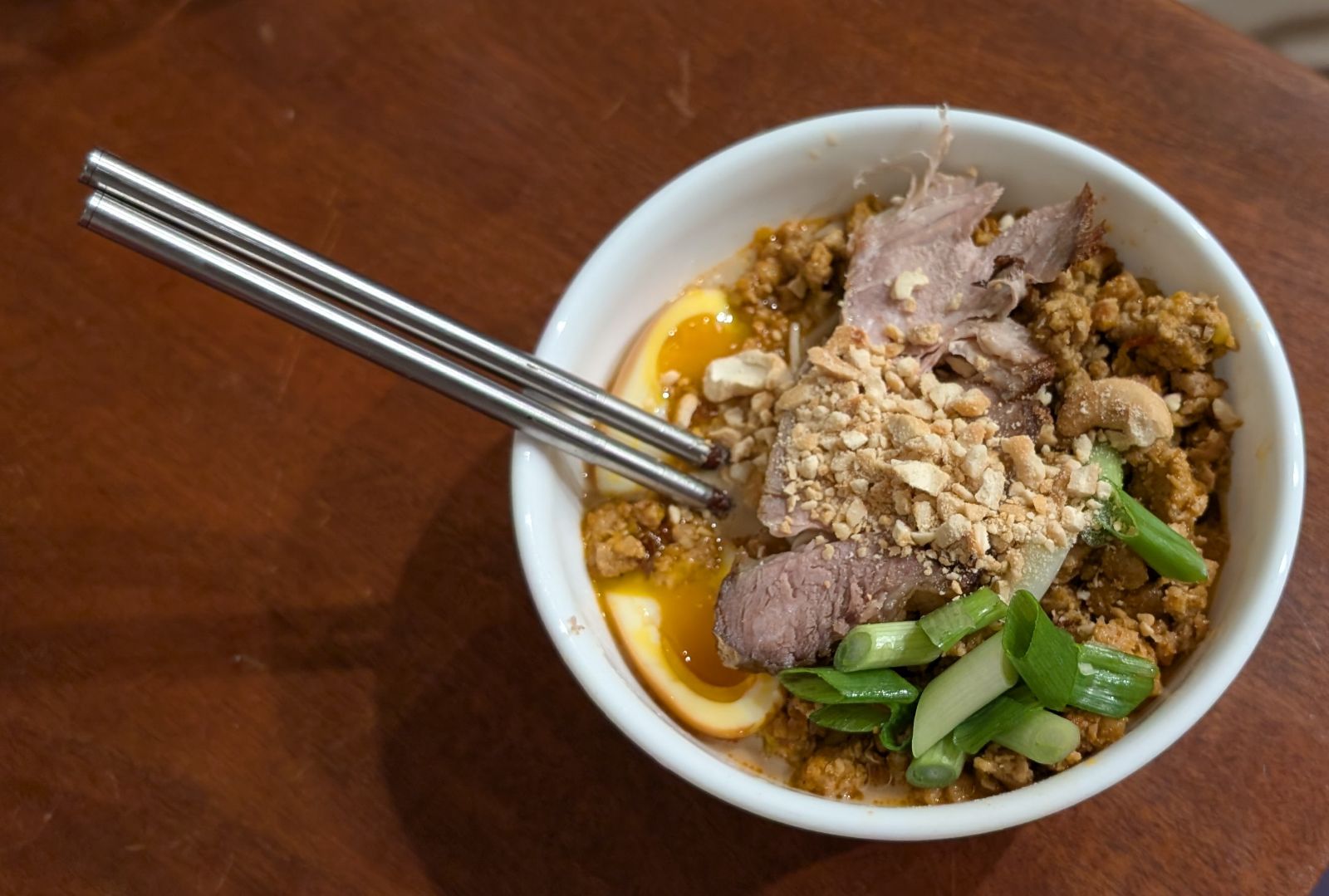
    Broth base was a stock made from bones from a prime rib roast, turkey carcass, chicken carcass, pork bones, ham hock, reduced pastrami cooking liquor, kombu, and mirepoix. Not the traditional tantanmen base, but the results were worth the effort. Also, the single ham hock somehow initially overwhelmed the pastrami liquor. :D Had to tweak things a bit.

    The tare was Japanese dark soy sauce, ground sesame, roasted tahini, peanut butter, leek, and homemade chili oil.

    Toppings are pork shoulder "chashu" crisped up under the broiler before serving, seasoned ground pork, ajitsuke tamago, and roasted ground cashews.


    I have a Roxim Z3EK bicycle headlight. This light is supposed to have a low and high beam function, but I can only get the low beam to work. So far, I have tried:

    • grounding the green wire
    • sending 12V+ to green
    • sending 12V- to green
    • bridging the green and black wires
    • bridging the green and white wires

    I emailed the manufacturer asking for a wiring diagram, but no response.

    I appreciate any guidance y'all might have. Thanks!


    The runner Fauja Singh, believed to be the oldest person to complete a marathon, has died in a road accident in India aged 114.

    The athlete, who lived in Ilford in east London, was hit by a car and suffered fatal injuries while trying to cross a road in his birth village of Beas Pind, near Jalandhar in Punjab, on Monday, according to reports in India.

    Come on, Guardian. "Accident?!" Notice the use of language in these cases. When the person killed is driving, that's a "crash." For example, "crash" was used to describe Kelvin Kiptum's (marathon record holder) death.

    Off the top of my head, a couple more ultra-endurance athletes killed when hit by automobiles:


    Last summer the LBS gave me this old Rodriguez that was part of a batch of bikes they got from an estate sale. I just "completed" it yesterday. Even in its neglected state, it felt soooo good. Also, since it was from the original era of Rodriguez, it merits all the love.

    How I got it:

    The original TA 50.4 BCD crank was ruined because it was over-torqued to the point of rubbing the frame. Not the biggest issue since 50.4 chainring selection has been problematic for decades.

    I stripped it down, cleaned it thoroughly, touched up the paint dings, and put clear film on all the wear points. I'm not a fan of blue on bicycles, but this metal flake blue really grabs me.

    The handcut lugs and brazed cable guides are also a pretty detail.

    Upgrades:

    • VO fluted triple crankset, 165mm
    • VO 124mm cartridge bottom bracket (holy hell, this took me months to find; of course, now they're back in stock :D )
    • VO Enterprise wheelset, 27inch, 126mm rear OLD
    • Pasela Pro-Tite tires, 27x1 1/4 (meh)
    • VO first gen quill stem, 100mm, NOS
    • Nitto Noodle 177 bars, 46cm, NOS, traded some IT work with the LBS for these
    • Shimano BR400 brake levers, NOS (although I recently found out these are still in production!)
    • 14-30 custom, rebuildable freewheel traded from the LBS retrogrouch in exchange for homemade peppermint patties :D
    • VO clear braided stainless brake and shifter cables
    • Forager Cycles cable cherries (highly suggested farkle for all your bikes! They make cable adjustments much easier away from the workbench.)

    What I kept:

    • Suntour Honor rear derailleur - not the prettiest, but a total workhorse and will last until the heat death of the universe
    • Huret front derailleur
    • Campagnolo Record downtube shifters
    • Suntour Superbe sidepull brakes
    • Specialized cartridge headset
    • SR Laprade seatpost (but it needs a polishing)

    What I'm going to change:

    • 700C wheels - there's plenty of room on the brake arms to move the pads down; the switch to 700C will vastly improve my tire selection and give me room to add...
    • Full coverage fenders, probably VO smooth
    • Tubus Fly stainless racks, front and rear
    • That bar tape was not my best wrapping job and the tape itself doesn't impress me; probably gonna go with Lizard Skins DSP or Supacaz Super Sticky Kush

    Part of the fun of these old bikes is the by-hook-or-by-crook refurbishing journey. The networking and human connection involved in bringing this bike to its rideable state... it absolutely took a village. I found fellow retrogrouches in my small city. I helped the LBS resolve a bunch of their computer network problems. Old components that were languishing in a box got a new life on a bike that will be ridden. Seeing this in the sun, feeling it on the pavement, all that frustration turns to joy.

    Special callout to Classic Cycle in Bainbridge Island WA USA: (https://classiccycleus.com/museum/bikes/). They are a seriously cool museum bike shop. They have encyclopedic knowledge and a ridiculous NOS parts selection. For being such a tiny shop, it's absolutely worth the trip. Be sure to say hi to Tullio, the friendly chill shop kitty.


    No, this isn't a cast iron thing. Using stainless pans, you can get nonstick effects that, in my experience, far outperform Teflon anyway. The process is called "spot seasoning." I have cooked crispy, cheesy rice noodles with eggs with zero sticking.

    I love my cast iron pans, but stainless is my daily go-to. Added bonus: use 100% copper wool to clean your stainless pan. The copper-coated wool at most grocery stores is problematic; you might get a few uses out of the coated garbage and then it starts shedding metal bits.

    view more: next ›