Arch Linux. Always very up-to-date and the AUR is huge. No dealing with PPAs or snaps or flatpaks or appimages. Just paru -S any-software-ever-made. Also very streamlined (systemd for everything lol) and well documented. I tried NixOS for a bit but it was very inconvenient in comparison and I felt like it was impossible to tinker with or understand if you weren't good at Haskell. Terrible documentation.
For servers it's definitely Debian + docker.
Debian. Several reasons:
- It's trustworthy.
- It's not going anywhere. Debian existed when I was a kid and it'll probably still exist when I draw my last breath.
- I know how to use it, since, once again, I've been using it since I was a kid.
- It has all the desktop environments.
- It fully supports systemd. I do not miss the unreliability, slowness, and complexity of what came before that. (Normally I wouldn't mention this, but your former distro of choice exists solely for the purpose of not having systemd, so it's relevant this time.)
The thought that Debian will continue into the future feels comforting. How cool it would be if in 5000AD kids on Mars or Europa are running Debian 100?
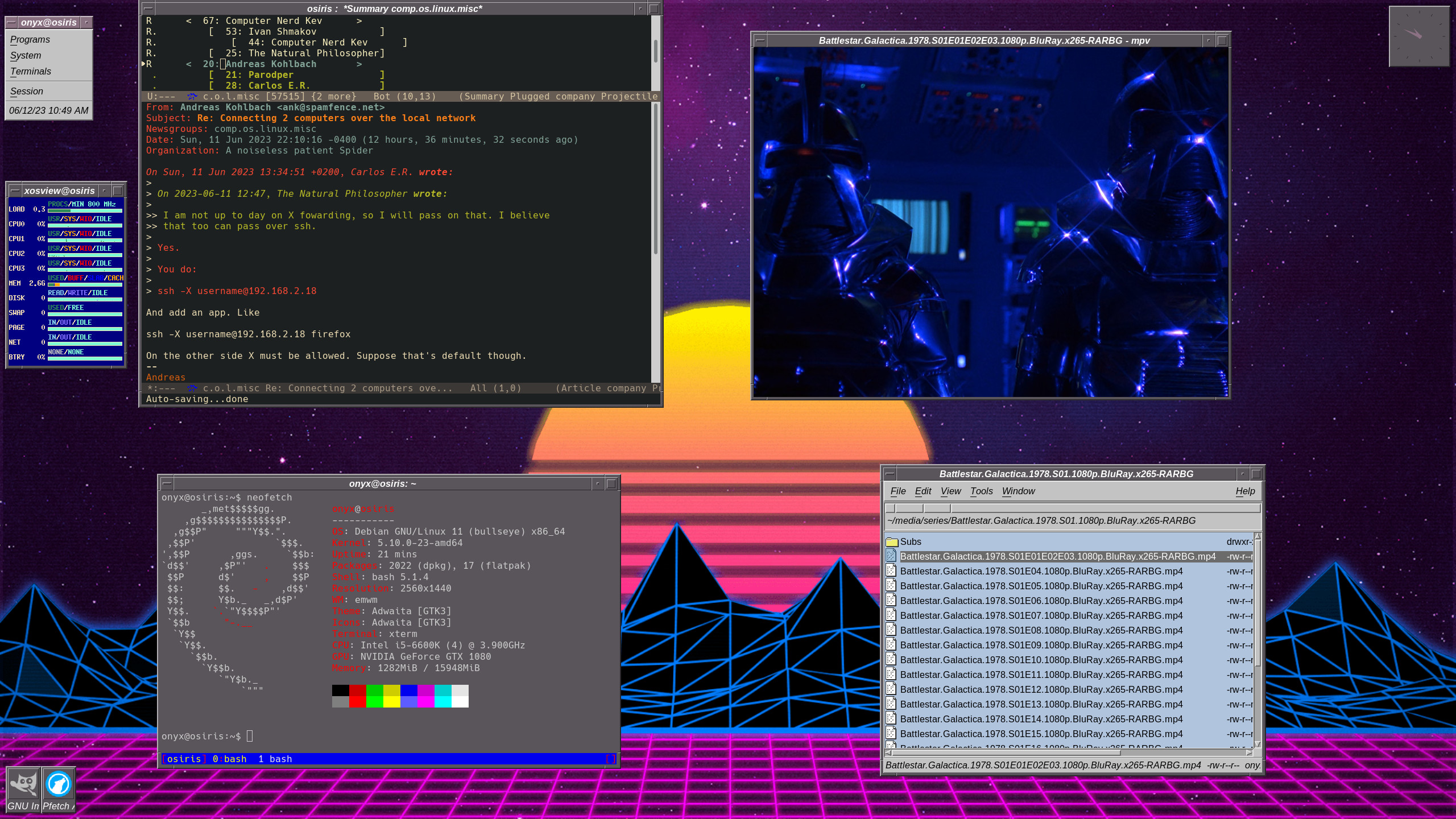
I use Debian with a patched version of motif window manager. The 90s never ended:

As someone who uses mwm for work, I only have one question for you: Why?
I was a distro hopper once, then I saw the light of NixOS...
Tell me about it...
The only reason I might, in the distant future, ever consider changing again is this project, which hopefully would be something between NixOS and Qubes. But that is far in the future and not even that certain.
arch
btw
Ubuntu for life. Unpopular opinion i know, please don't stone.
NixOS everywhere (except for one server which I have yet to migrate from Rocky to NixOS)
I have a few dozen computers and most run Pop!_OS.
I've been a daily fedora user for the half year. Initially I started off with ElementaryOS but it was so filled with bugs, and glitches, so it didnt last for more than a couple of months. While the fedora experience is way more streamlined.
Fedora, because it just works and it ships recent software versions.
I also like Fedora Silverblue, and projects like ublue are very interesting in my opinion.
Could you explain what you find interesting about Silverblue ?
EndeavourOS on my desktop, Red Hat and Ubuntu on servers(at work).
Garuuuuuda. Love it. Been running it for the past few years. The devs come off as assholes, but they're actually just German;)
Linux Mint. Nothing beats your computer just working when you have shit to get done.
Debian, for ultimate stability, Fedora for every day, and Arch for my project box.
Does SteamOS count? My steam deck is my current “Linux” machine.
Yes! My coworker does this and I think it's pretty cool.
Linux Mint with Mate DE.
Linux Mint, it just works
NixOS. Declarative config with opt-in state is awesome.
Been switching between Arch and Linux Mint for a while now. I run Arch and EndeavourOS on my laptops (Arch on my daily 2-in-1, Endeavour on my TV laptop) but I can't decide which is better for VR on my main rig... probably because VR on Linux is kinda in a pathetic state anyway lol. Next week I'm getting a second GPU for simple display-out so I can use my 6800XT to run VR in a Windows VM, probably on Arch
Edit: landed on EndeavourOS, basically just Arch with a GUI installer, DE by default, and some other tweaks. It's what I kept turning Arch into pretty much lol
I use opensuse with kde and I love it. Have been using it for 2 years now.
For server use at home I use Ubuntu Server and Alma Linux (mostly)
At work it is all RedHat.
Arch, Debian, NixOS, Fedora Silverblue, Raspbian, GrapheneOS[Android]
I used to use Arch but recently switched to Fedora. I need stability now.
I use Debian for my docker servers. I try to use it on the desktop. Was using pop-os, games kept crashing, replace with arch? Archinstall wouldn’t work. Back to windows I guess. Maybe I should try Debian on the desktop since it’s the only one I ever get working properly.
Fedora, for the “It Just Works”™ experience of an enterprise-supported distro.
Fedora, I'm not a tech person by Linux user standards and I just need an OS that works
xubuntu. when this install gets too messy i'm probably going to try the minimal edition and install my old openbox or awesome wm configs.
Now I am using fedora, before that I used debian stable.
Debian on my gaming desktop and Ubuntu on the family laptop.
I distro hop a lot. After using Majaro (gnome) for a long time I switched to Pop_OS for a long time. I switched back to Manjaro (Gnome) again, but after a week of use I've just downloaded Ubuntu.
I'm getting basic display issues that I've never got in another distro (including tails!) and it's generally annoying me. I'd rather use a distro that doesn't require troubleshooting on Day 1
Ubuntu, Debian, Fedora, FreeBSD, Arch. :) I need to learn NixOs or something that is immutable / reproducible at some point.
NixOS. Declarative reproducible immutable systems are the future.
Alpine is honestly my go to
Been using NixOS for a couple months. It’s gotten easier to configure and change because of it, and new computers are super easy to setup because I can just change/apply the config and system wide changes will apply with one command!
I'm currently using a mix of Arch and Fedora, but I've been starting to look in to NixOS.
Been using nobara with kde for the last 2-3 months
I fall firmly in the Ubuntu/derivative camp for the most part. My laptop is on Pop, some of my virtual servers are on Ubuntu. Only exception is UnRAID, which is technically Slackware.
Xubuntu for over ten years now. It was the first thing I landed on when in a panic that my store-bought, WinXP -preinstalled PC was failing and I couldn't afford to be without it nor replace it. Even after being so grateful for it rescuing me, it's also taught me, and worked flawlessly for all I need from my computers since.
Linux
From Wikipedia, the free encyclopedia
Linux is a family of open source Unix-like operating systems based on the Linux kernel, an operating system kernel first released on September 17, 1991 by Linus Torvalds. Linux is typically packaged in a Linux distribution (or distro for short).
Distributions include the Linux kernel and supporting system software and libraries, many of which are provided by the GNU Project. Many Linux distributions use the word "Linux" in their name, but the Free Software Foundation uses the name GNU/Linux to emphasize the importance of GNU software, causing some controversy.
Rules
- Posts must be relevant to operating systems running the Linux kernel. GNU/Linux or otherwise.
- No misinformation
- No NSFW content
- No hate speech, bigotry, etc
Related Communities
Community icon by Alpár-Etele Méder, licensed under CC BY 3.0