15
submitted 1 month ago* (last edited 1 month ago) by birdwing@lemmy.blahaj.zone to c/askscience@lemmy.world

I watched a few vids of chickens developing in eggs without shells (see here for an example, somewhat graphic), and got to wonder.

You'd think that all the yolk is uniform and therefore it could develop anywhere, but is there an underlying mechanism that could cause the primitive streak and everything to develop near the centre? Maybe a sort of yolk density mechanism, that it starts where the yolk is densest? The furthest from oxygen exchange at the shell?

Or does such a mechanism not exist?

top 7 comments
sorted by: hot top new old
[-] southsamurai@sh.itjust.works 10 points 1 month ago

Wait, are you asking where the actual fertilized egg cell is? I think that's what you're wanting, but could be wrong.

The yolk isn't actually the "egg" in the same way a human ovum is. I mean, it kinda is, but there's a spot in/on it called a blastodisc. That is what rooster sperm fertilizes, and where all development starts from. Once fertilized, it's called a blastoderm. Not the blastodisc is the direct equivalent of a mammalian ovum.

That's why the embryo develops in roughly the same place, it's all starting from one place; and because of how yolks form, that growth is going to be roughly towards the center.

[-] birdwing@lemmy.blahaj.zone 3 points 1 month ago

That's what I wondered, yeah. I thought the yolk as a whole was the equivalent of the ovum, but apparently not, now that you've told. TIL!

But then, how does the blastodisc form?

[-] southsamurai@sh.itjust.works 2 points 1 month ago

To the best of my understanding, it works similar to how our reproductive cells do. Basically, a splitting up of genetic material followed by formation of the initial cell. Then, upon fertilization, you get the same process of cellular multiplication as mammals undergo.

[-] cecilkorik@lemmy.ca 8 points 1 month ago* (last edited 1 month ago)

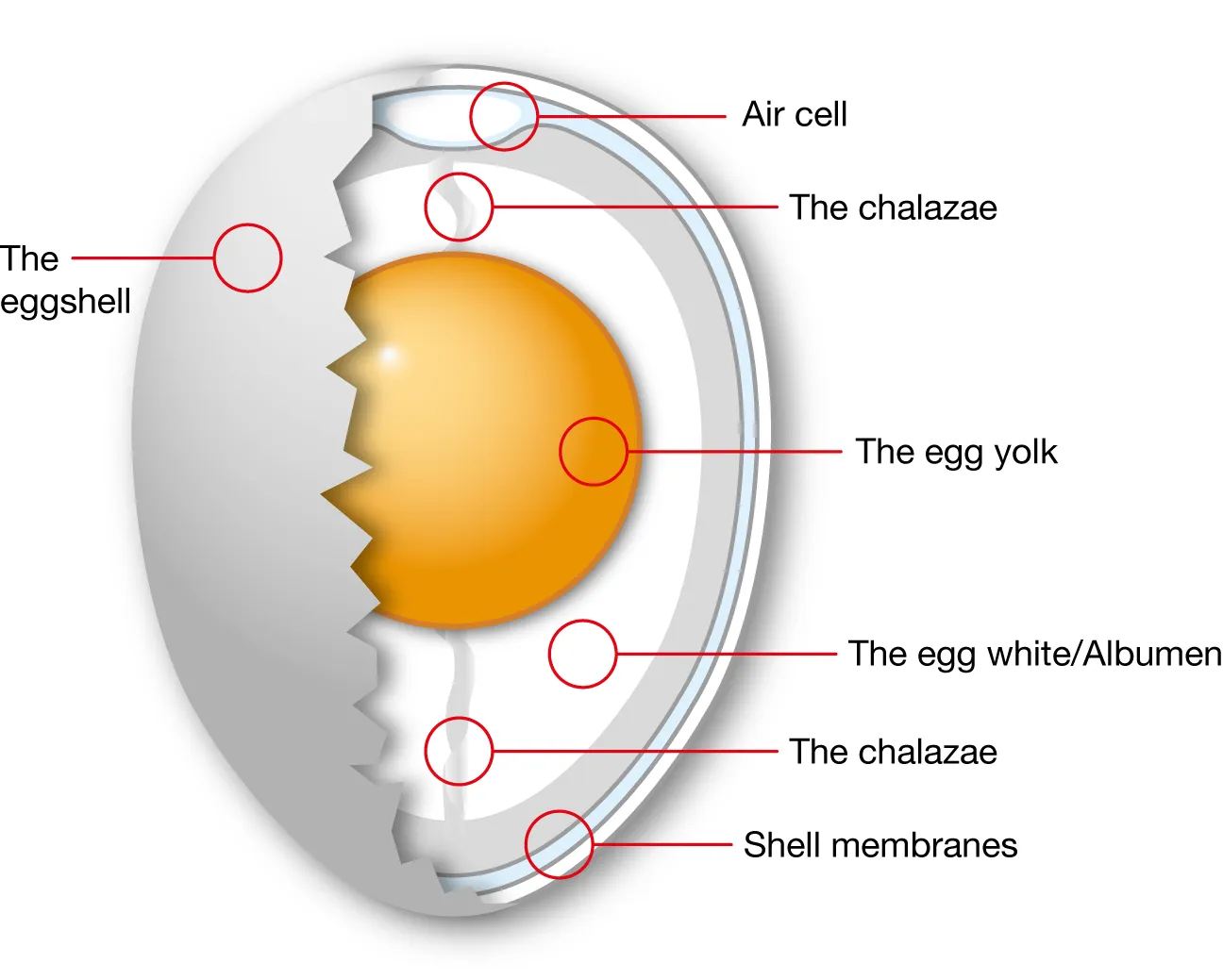
The "white" of an egg is not just uniform transparent goo, it is full of transparent structures designed to support, suspend, and cushion the yolk while providing the nutrients it needs during growth. You can actually see this when you are cooking an egg if you are paying attention.

In particular, the yolk is suspended by two cords on either end called chalazae.

[-] birdwing@lemmy.blahaj.zone 3 points 1 month ago* (last edited 1 month ago)

I'm aware that the egg has more than the yolk, however my question concerned specifically the initial development of the embryo in the yolk itself. Does the yolk then have internal structures preceding embryonic formation?

[-] BlackJerseyGiant@lemmy.world 3 points 1 month ago* (last edited 1 month ago)

As best I understand it, the chick to be doesn't grow in the yolk, but on it. What is left of the yolk is still attached to the chick when it hatches, and acts as a food supply for the chick for about 3 days. This is one of the reasons newly hatched chicks can be shipped through the mail. I would posit that eggs have evolved to grow chicks in the middle for the same reason hens turn their eggs regularly, to prevent long term blood flow loss to whatever part of the body the chick's weight would be on. Growing closer to the middle of the eggs will let the Lil chicks to float for as long as possible before starting to rest weight on the "down" side of the shell.

Edit: I dont think the yolk has internal structures.

[-] kindnesskills@literature.cafe 6 points 1 month ago

The fertilization happens only at that white spot on the yolk, the egg cell/germinal disc which is what becomes the embryo, so that's determining factor for where the embryo begins.

this post was submitted on 17 Apr 2026
15 points (100.0% liked)

Ask Science

16641 readers
3 users here now

Ask a science question, get a science answer.


Community Rules


Rule 1: Be respectful and inclusive.Treat others with respect, and maintain a positive atmosphere.


Rule 2: No harassment, hate speech, bigotry, or trolling.Avoid any form of harassment, hate speech, bigotry, or offensive behavior.


Rule 3: Engage in constructive discussions.Contribute to meaningful and constructive discussions that enhance scientific understanding.


Rule 4: No AI-generated answers.Strictly prohibit the use of AI-generated answers. Providing answers generated by AI systems is not allowed and may result in a ban.


Rule 5: Follow guidelines and moderators' instructions.Adhere to community guidelines and comply with instructions given by moderators.


Rule 6: Use appropriate language and tone.Communicate using suitable language and maintain a professional and respectful tone.


Rule 7: Report violations.Report any violations of the community rules to the moderators for appropriate action.


Rule 8: Foster a continuous learning environment.Encourage a continuous learning environment where members can share knowledge and engage in scientific discussions.


Rule 9: Source required for answers.Provide credible sources for answers. Failure to include a source may result in the removal of the answer to ensure information reliability.


By adhering to these rules, we create a welcoming and informative environment where science-related questions receive accurate and credible answers. Thank you for your cooperation in making the Ask Science community a valuable resource for scientific knowledge.

We retain the discretion to modify the rules as we deem necessary.


founded 2 years ago
MODERATORS