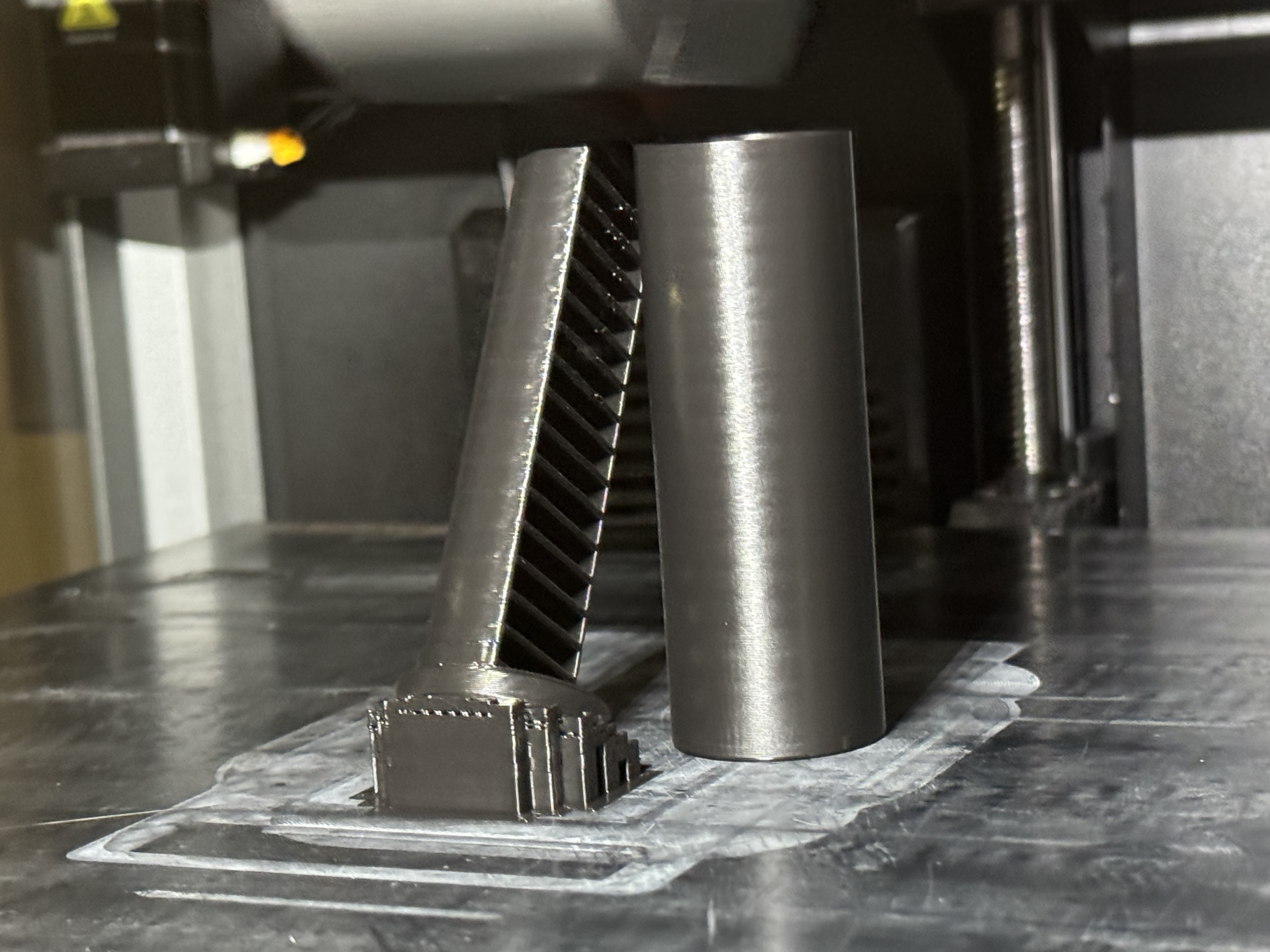
This is a battery cell case that was a pain last time I printed it with supports
Model: https://www.thingiverse.com/thing:5240533/files

all 21 comments

sorted by: hot top controversial new old
[–] 17 points 2 years ago (6 children)

Ohh nice, battery pez dispenser!

Is that considered a raft + supports or just supports on there?

  • source
  • hideshow 6 child comments
  • [–] [S] 8 points 2 years ago (4 children)

    Just supports, I had to manually paint them in to prevent the slicer from putting them all the way up the side

  • source
  • parent
  • hideshow 4 child comments
  • [–] 7 points 2 years ago (3 children)

    In Orca slicer, if you use tree supports and hybrid, an option appears (advanced must be enabled) for something like "Essential supports only". It is so much better than spending all that time adding or blocking supports.

  • source
  • parent
  • hideshow 3 child comments
  • [–] 9 points 2 years ago (1 child)

    As a total beginner, it's not really clear to me what's meant here. I read printing some things are better to print at an angle, like boxes, for additional strength. Is that what's meant here?

  • source
  • hideshow 1 child comment
  • [–] 8 points 2 years ago (6 children)

    What exactly is the difference to just printing it standing?

  • source
  • hideshow 6 child comments
  • [–] 10 points 2 years ago (3 children)
  • [–] 7 points 2 years ago (2 children)

    That's one, but if you are priting a particularly delicate part, printing at an angle could strengthen the part significantly

  • source
  • parent
  • hideshow 2 child comments
  • [–] 7 points 2 years ago* (1 child)

    How? What mechanisms, conditions, etc, are we manipulating which produce such a significant effect? After a bit of searching I found this write up:

    https://thor3d.ca/wp/the-effects-of-print-orientation-on-strength/

    Is this what we're referring to? To summarize (if I've understood this properly): Printing at 45 degrees ensures none of the print's three axes are aligned with the printer's least accurate axis of movement.

  • source
  • parent
  • hideshow 1 child comment
  • [–] 4 points 2 years ago

    Similar, but I believe the strength addition is also because it changes the directions of the Z-axis layers.

    Most filament is rather strong in tension. If you imagine printing a regular cube, without rotation, it’s going to be strongest stretching or compressing the sides of the cube.

    But if you pulled the cube apart from its top and bottom, the only adhesive strength is the fused connection between layer heights. Which is super weak.

    By printing at an angle, the layer heights may be in a direction that doesn’t receive tensile load, making it functionally stronger.

  • source
  • parent
  • [–] 7 points 2 years ago

    That's actually genius, thanks for the tip man

  • source
  • [–] 4 points 2 years ago

    That's so smart! Thanks for the tip

  • source
  • [–] 3 points 2 years ago (2 children)

    Caveat: I know nothing about 3D printing.

    That being said, couldn't you just print it on its side?

  • source
  • hideshow 2 child comments
  • [–] 5 points 2 years ago*

    It really depends on what you're printing, how strong you need it to be, and/or what axis you don't mind looking uglier because of layer lines.

    In this case OP might have been able to print it on a side with minimal supports, but the idea is that printing it at an angle turns things that would have been overhangs (which are hard for printers to do because of the melted plastic sagging) into upwards slopes. The alternative is adding support material that is intended to snap off (i.e. The block at the bottom of this picture), but those would be hard/impossible to remove in models like OP's that would have supports inside the holes.

  • source
  • parent
  • [–] [S] 1 point 2 years ago

    That’s a great idea and would require similar amounts of support, however there’s still going to be 90 degree overhangs that wouldn’t come out quite as nice as the orientation I used

    The model in question only has 1 flat side, its end (which is the top in the photo). Every other side requires supports if it’s on the build plate because of the recess in the cap, and the cap being wider than the rest of the model

  • source
  • parent