top 50 comments

sorted by: hot top controversial new old
[–] 140 points 2 years ago* (7 children)
  • [–] 59 points 2 years ago (6 children)

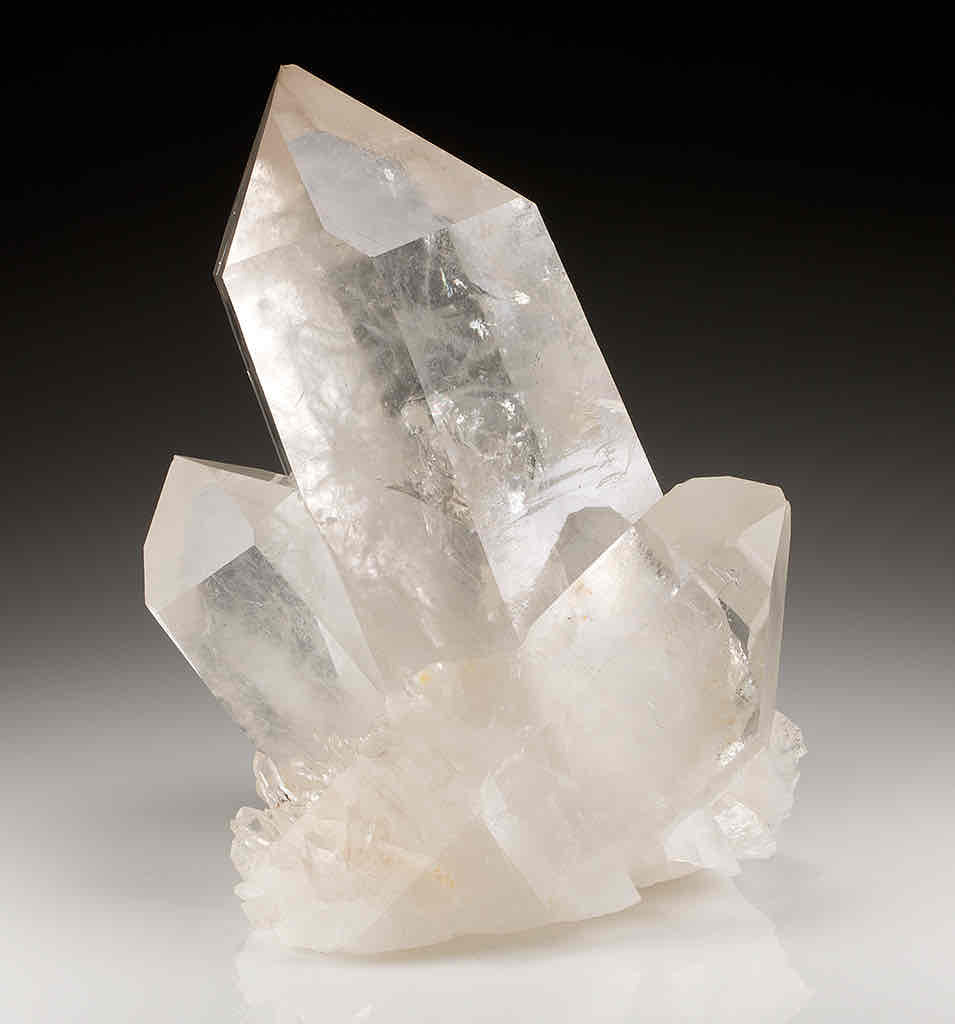
    It depends on where you draw the line (heh) on "straightness" and "flatness". Some planes on gems or geodes are pretty flat, but probably not perfectly flat. Another example is a spider's web between two points. That's a pretty straight line if it's taut, but again, probably not exactly perfect.

  • source
  • hideshow 6 child comments
  • [–] 43 points 2 years ago (2 children)

    Nothing is perfectly flat, neither in nature nor man made. It's purely a mathematical concept as every surface has some form of texture if you look close enough.

  • source
  • parent
  • hideshow 2 child comments
  • [–] 27 points 2 years ago* (9 children)

    Lines and planes in the mathematical sense are 1 and 2 dimensional. They don't have any height (and lines also no width). So they can't exist as a physical object made out of atoms as they are already 3 dimensional.

    They only exist as a concept.

  • source
  • hideshow 9 child comments
  • load more comments (9 replies)
    [–] 26 points 2 years ago

    Short answer, depends on perspective. For example surface of perfectly still lake could be considered flat, but on macro level it follows curvature of the earth. But we still use water to level our buildings, because radius of a planet is so big. On microscopic level it's anything but flat.

    Someone else mentioned spider silk danging. It's also another great example, but the same perspective clause applies. But usually crystals and some geological features tend to have flat features.

  • source
  • [–] 26 points 2 years ago (1 child)

    maybe somebody else pointed this out:

    Light ALWAYS travels in its idea of a straight-line.

    Always.

    It doesn't matter whether it is bent by gravity or refraction, from its perspective, it kept going straight.

    Only an "outside viewer" sees any non-straight-line-ness being done, but the outside-viewer isn't seeing the curved-space or the curved-refractive-index that the photon saw.

  • source
  • hideshow 1 child comment
  • [–] 4 points 2 years ago*

    Well, kinda, but the trajectory of the photon is contracted into a single point from its POV. Whatever destination is has, it's already there as far as it's concerned. It doesn't experience time given that it's moving at the speed of light.

  • source
  • parent
  • [–] 22 points 2 years ago

    You really have to declare to what degree you are asking. You could take a very carefully grown crystal and define a plane based on its lattice structure. But the atoms are not all perfectly placed on the lattice once you zoom in far enough. There's even gaps between the atoms! A "plane" of carbon looks more like a net to an observer on the scale of those atoms.

    Is an electron a perfect sphere? Scientists probably thought so in 1900 but now ask a physicist and they will say "No, probably not".

    And yes, as others have stated, our space time is not perfectly Euclidean so that's another level of uncertainty. How do you measure the small imperfections in a Euclidean model when actual space time isn't Euclidean?

    As a professor used to tell my class, there are no 0s.

  • source
  • [–] 17 points 2 years ago (16 children)

    No, they are mathematical constructs. Everything in nature is composed of matter and the like, so there are no perfectly straight lines or flat planes.

    Even a beam of light curves and refracts as it interacts with matter and space over a long enough distance.

  • source
  • hideshow 16 child comments
  • [–] 7 points 2 years ago (9 children)

    Light is going straight from it's point of view . It is following the shortest path between two points. The transform from different reference frames is why we see it as curved.

    But if that's your definition, then there are no straight lines in mathematics either because you could transform the straight line from one system into a curved line in another system.

  • source
  • parent
  • hideshow 9 child comments
  • [–] 5 points 2 years ago* (last edited 2 years ago) (8 children)

    Yes, nature is not objective - it is relative. Mathematics is a discipline that is based around an objective framework. Lines and planes are mathematical constructs. Mathematics gives us an objective framework that can be used to model a natural world, but they are just models.

    Some things are "line-like" or "plane-like," in that modeling them as lines or planes is helpful to describe them. You can measure a distance "as the bird flies" because birds fly in lines compared to how humans travel along roads and paths. You can describe a dense, heavy, falling object as traveling in a straight line, because air resistance may be negligible over short distances.

    A model is only useful insofar as it accurately represents reality. Lines and planes are mathematical constructs, and they may be incorporated into models that describe real things. "A beam of light crossing a room travels in a straight line" is probably a useful construct because the effects of gravity and refraction of the air are probably negligible for nearly all purposes. "The surface of a pond is a plane" is probably an acceptable model for a cartographer, since the height of ripples and the curvature of the earth are negligible at that scale.

    The initial question was not "Do straight lines and flat planes model anything in nature," but whether they exist in nature. They do not. They only exist in mathematics.

  • source
  • parent
  • hideshow 8 child comments
  • [–] 2 points 2 years ago (7 children)

    They only exist in mathematics.

    The curved light path is because a mathematical transform is done between two different frames of reference.

    It's no different than taking a mathematically straight line and performing a transform function to map it to a curved coordinate system. Because you allow transformation functions, there would also be no straight lines in math.

  • source
  • parent
  • hideshow 7 child comments
  • load more comments (7 replies)
  • [–] 3 points 2 years ago (5 children)

    Unless the light is in a vacuum like space

  • source
  • parent
  • hideshow 5 child comments
  • [–] 2 points 2 years ago

    There is no perfect vacuum, even in deep space. In the space of our Solar System, there is on average 5 atoms in every cubic centimeter. In interstellar space, there is on average 1 atom every cubic centimeter. In intergalactic space, there is on average 1 atom every 100 cubic centimeters. It's a gradient, but much like the perfectly straight lines and flat planes in the original question, perfect vacuum is a theoretical construct that is impossible to achieve in our reality.

  • source
  • parent
  • [–] 16 points 2 years ago (4 children)

    Depending on scale. Is the surface of the lake flat?

    Once you experience true level you will never go back.

  • source
  • hideshow 4 child comments
  • [–] [S] 4 points 2 years ago (3 children)

    True level must be like true symbols (like, in the idea that there are true names and words. Like a divine language).

    If you have a true level or symbol then you have something, just as good as reality, but manipulable like language. The best of both worlds.

    And even better, you need never leave the confines of the inside of your mind ever again. You can live, within your construct of perfect god-language, and interact with the world from there. Safe and powerful.

  • source
  • parent
  • hideshow 3 child comments
  • load more comments (3 replies)
  • [–] 14 points 2 years ago (9 children)

    Neutrinos travel in a straight line.

  • source
  • hideshow 9 child comments
  • [–] 17 points 2 years ago (5 children)

    Unfortunately (fortunately?) the space they're traveling through is curved. It was a good attempt though neutrinos.

  • source
  • parent
  • hideshow 5 child comments
  • [–] 2 points 2 years ago (1 child)

    It appears curved to us because we mathematically transformed the reference frame.

    If you are allowed to transform your geometric space to say "no straight lines" then there are no straight lines in math either. Because you could perform a transform on the straight line into a curved geometry.

  • source
  • parent
  • hideshow 1 child comment
  • load more comments (2 replies)
  • load more comments (3 replies)
    [–] 13 points 2 years ago (1 child)

    Cubed pyrite is one of my favorite examples of this.

  • source
  • hideshow 1 child comment
  • [–] 6 points 2 years ago

    According to mathematical platonism, yes.

    Otherwise we have no idea. We have some models of physics, none perfectly describing our universe. We don't know the structure of space, or the structure of time.

    Even if we did: what would it mean for a line or a plane to exist? There could be equivalent descriptions of our universe, some including those as objects and some only as emergent properties.

  • source
  • [–] 5 points 2 years ago

    A lot of people talk about straightness and flatness as mathematical concepts. But I think OP means it in a technical sense, as in flat like your phone screen or straight as the edges of the screen but in nature. In this sense, flatness or straightness is defined as a finite number of measured points on a surface of which the coordinates all lie between 2 mathematicaly flat/straight parallel tolerance planes/lines. By that definition, depending on what a person would consider flat, say 0.002 mm between the planes/lines, there are definetly naturally occurring crystals that would pass that test.

  • source
  • [–] 5 points 2 years ago (4 children)

    A frozen lake.

    A spider's thread when it's climbing downwards.

  • source
  • hideshow 4 child comments
  • [–] 2 points 2 years ago (1 child)

    Is the Higgs Field a flat plane?

  • source
  • hideshow 1 child comment
  • [–] 2 points 2 years ago

    Simple answer: no

  • source
  • load more comments
    view more: next ›