1
34

Great Lakes region, USA. April 2026.

I was walking around the woods near the outskirts of town and happened upon this family of white-tailed deer in a sumac thicket, seven by my count. They were surprisingly alright with me getting close and taking photographs.

2
19
3
119

Great Lakes region, USA. April 2026.

I decided to go kayaking early in the morning to get bird shots and I happened to paddle up to this cutie, it was not happy to see me. It kept making aggressive noises and movements at me until I left. Sorry little buddy I was just passing through.

4
38

The fawn-breasted brilliant (Heliodoxa rubinoides) is a bird in the hummingbird family, Trochilidae. It is native to the Andes of South America, occurring in Bolivia, Colombia, Ecuador and Peru. The species inhabits tropical and subtropical forests, at altitudes between 1,000 to 2,300 metres (3,300 to 7,500 ft), and feeds mainly on nectar, as well as occasional small insects and spiders. The fawn-breasted brilliant has a patchy distribution, but is nonetheless classified as a least-concern species by the International Union for Conservation of Nature. It is green above with iridescent copper underparts, and a long, slightly curved bill. Males perform courtship displays but do not assist with nesting. The female builds a camouflaged nest, lays two eggs, and raises the chicks alone. This fawn-breasted brilliant of the subspecies H. r. aequatorialis was photographed in flight in the Refugio Paz de las Aves, a nature reserve in the foothills of the Ecuadorian Andes.

Author: Charles J. Sharp

CC BY-SA 4.0

5
20

Priacanthus hamrur, commonly known as the lunar-tailed bigeye or moontail bullseye, is a species of marine fish in the family Priacanthidae. It is widespread but uncommon in the Indo-Pacific, ranging from the Red Sea and eastern Africa to Japan, Australia and French Polynesia, with rare records in the Mediterranean Sea. A reef-associated species, P. hamrur inhabits lagoons and outer reef slopes at depths of 8 to 250 metres (26 to 820 ft). It has a deep, laterally compressed body, very large red eyes, and a crescent-shaped tail. Its colour varies from silver to red, with red bands. A nocturnal feeder, its diet consists primarily of small fishes, crustaceans and other invertebrates. It may live solitarily or form schools, and is listed as a least-concern species by the International Union for Conservation of Nature. This P. hamrur fish was photographed off the coast off Zanzibar, Tanzania.

Author: Diego Delso

CC BY-SA 4.0

6
61

cross-posted from: https://lemmy.world/post/45710526

Great Lakes region, USA. April 2026.

I was out for a walk when I stumbled on this guy trying to cross a busy road. I made sure to save him before he was roadkill. They have such beautiful eyes.

7
39

cross-posted from: https://lemmy.world/post/45710327

Great Lakes region, USA. April 2026.

I was out on a walk exploring our flooded town, and I decided to peek over a ledge to see the damage. I wasn't ready to see this beautiful creature staring back at me. Before I could get a good shot he took off like a bat out of hell. I'll be exploring again tomorrow, so fingers crossed he's still in the area. I'll be much more stealthy next time.

8
24

The blue shark (prionace glauca) is a species of requiem shark, in the family Carcharhinidae, that inhabits deep waters (images taken though between 5 and 10 meter below water) averaging around 3.1 m (10 ft) and preferring cooler waters. They can live up to 20 years, can move very quickly and feed primarily on small fish and squid, although they can take larger prey.

Author: Diego Delso

CC BY-SA 4.0

9
43

Great Lakes region, USA. April 2026.

"Doin' the town and doin' it right, In the evenin', It's pretty pleasin'"

I was out looking for cool critters and found quite a few muskrats. I'm sure they're none too pleased with all the flooding we have currently. It was fun bounding down the river line and snapping photos of them swimming and foraging.

10
33

The black caracara (Daptrius ater) is a bird of prey in the family Falconidae, found in the lowlands of the Amazon basin and French Guiana. Its common habitats include rivers, gallery forest and wooded savanna, at elevations up to 900 meters (3,000 ft). A largely sedentary and sociable species, it is an opportunistic omnivore, its diet including carrion, small mammals and reptiles, fish, fruit, insects, and other bird species. It is also known for removing parasites from animals such as tapirs and capybaras. Adults are mostly glossy black, with a white band on the tail, and bright yellow to orange-red feet and face. This black caracara was photographed on a branch near the Napo River in Sucumbíos Province, northeastern Ecuador.

Author: Charles J. Sharp

CC BY-SA 4.0

11
31
submitted 1 week ago* (last edited 1 week ago) by Tempus_Fugit@lemmy.world to c/wildlifephotography@lemmy.world

Great Lakes region, USA. April 2026.

While out birding today I spotted this snapper laying still on the side of the river. I assume it's nesting, but it could be waiting for a snack. Last week we had snow, and already the turtles are active.

Bonus painted turtle looking for a snack.

12
19

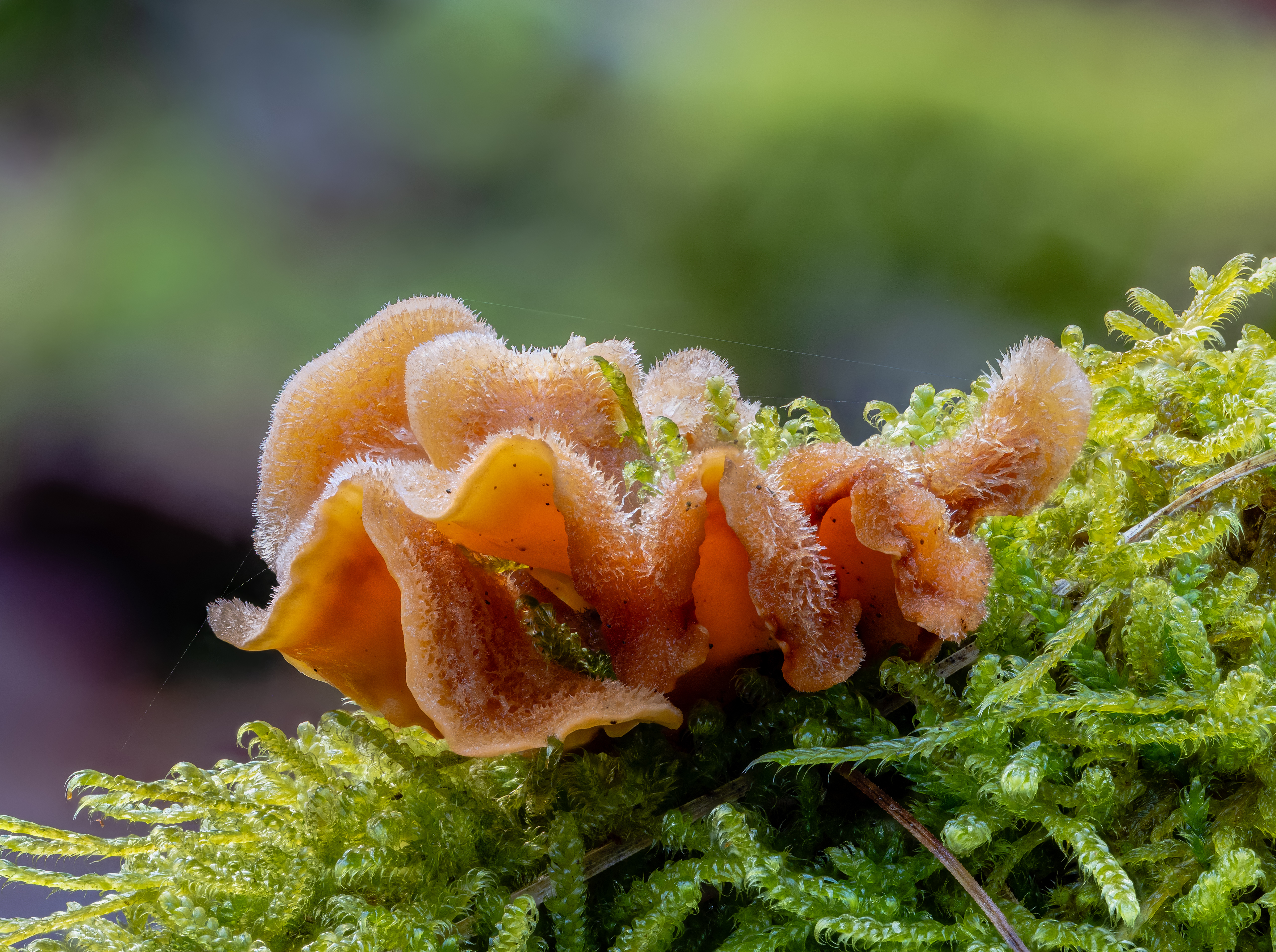
Stereum hirsutum, commonly known as the false turkey tail or the hairy curtain crust, is a species of fungus in the genus Stereum. An inedible species, it is found in various parts of the world, including North America, Europe and Australia. It forms thin, tough, bracket-like fruiting bodies, often in overlapping brackets on dead wood of both hardwood and conifer trees. The cap is 1 to 5 centimetres (0.5 to 2 in) wide, sometimes fused to form wider shelves, while the flesh is thin and tough. It produces white spores. The species is a plant pathogen that can infect peach trees, and is also itself parasitised by species such as the fungus Naematelia aurantia. This S. hirsutum growth was photographed in the Bruderwald, near Bamberg, Germany, with a focus stack of 23 frames.

Author: Reinhold Möller

CC BY-SA 4.0

13
43

The chimango caracara (Daptrius chimango) is a species of bird of prey in the family Falconidae. It is found across southern South America, including Argentina, Chile, Brazil, Paraguay, Uruguay, and Bolivia, where it inhabits open environments such as grasslands, marshes, farmland, and urban areas. A medium-sized raptor, it has brown plumage and a wingspan of up to 100 centimetres (40 in). The chimango caracara is omnivorous, feeding on insects, lizards, amphibians, the eggs and young of other birds, and rodents, as well as carrion and some plant material. It is noted for its intelligence and problem-solving ability. This female chimango caracara of the subspecies D. c. temucoensis was photographed in Puerto Varas, Chile.

Author: Charles J. Sharp

CC BY-SA 4.0

14
16

Goniobranchus reticulatus is a small, colourful species of sea slug in the family Chromodorididae. It is found in the western Indo-Pacific and originally described from Tongatapu, Tonga. It has a white mantle covered in a reddish reticulate pattern, with yellow edging on the foot and appendages. Several similar species occur within the G. tinctorius colour group, forming a complex of at least seven species, and the true G. reticulatus is probably not the species most commonly identified under that name. The length of the body is reported to reach 100 millimetres (3.9 in), but the original description is of an animal 27 to 34 millimetres (1.1 to 1.3 in) in length. Like other hermaphroditic gastropod molluscs, the species possesses both male and female organs, and can shed and rapidly regenerate the external portion of the penis after mating. This G. reticulatus sea slug was photographed off the coast of Anilao in the Philippines.

Author: Diego Delso

CC BY-SA 4.0

15
26

The painted francolin (Francolinus pictus), or painted partridge, is a species of francolin in the family Phasianidae. It is found in central and southern India and parts of Sri Lanka, residing in semi-dry undulating grasslands with scrub or cultivation. The painted francolin typically roosts in trees or on the ground and has a rufous face, white-spotted underparts, and orange-yellow to red legs. It feeds on seeds, grains and insects, and nests in a scrape on the ground, laying several eggs. The species is sometimes vocal, especially during the monsoon season, emitting a guttural broken "chee-kee-kerray" call.

Author: Tisha Mukherjee

CC BY-SA 4.0

16
27

All of the insect (Laothoe populi populi) is in focus after focus stacking 15 images.

Author: Charles J. Sharp

CC BY-SA 4.0

17
32

Junonia coenia, the common buckeye, is a species of butterfly in the family Nymphalidae. It is found as a resident or vagrant across much of North and Central America, as well as parts of northern South America, and likely originated from African ancestors that later diversified in Asia. The species typically inhabits open, sunny terrains such as fields, dunes and scrub, up to 1,300 meters (4,300 ft) in elevation. Junonia coenia adults are mostly brown with prominent black eyespots, while the caterpillars are spiny with complex color patterns. The caterpillars feed on plants rich in iridoid glycosides, such as Plantago lanceolata, which also influence female oviposition, while adults prefer nectar from yellow flowers. Some individuals migrate seasonally, and the species faces threats from predators, parasites, and a specific densovirus.

Author: Rhododendrites

CC BY-SA 4.0

18
35

The King's Guard adopted the penguin as their mascot in 1972 during a visit to Edinburgh for the annual Military Tattoo. The tradition has stuck and each time the Guards visit the city, Nils Olav is promoted and invited to inspect the troops once more.

Sir Nils Olav, colonel-in-chief of the Norwegian Army's King's Guard, inspects his troops in 2008. Olav was inducted into the army in 1972 with the rank of lance corporal, and has received a series of promotions since then as well as a knighthood. Since 2023 he has held the rank of major general. The name Nils Olav, and its associated ranks, have been used by three king penguins over the years, all resident at Edinburgh Zoo. The animal pictured is the second. His military insignia is attached to his flipper.

Author: Mark Owens

OGL v1.0

19
24

The Pacific golden plover (Pluvialis fulva) is a medium-sized migratory plover. It breeds in the Arctic tundra from northernmost Asia into western Alaska and winters in south Asia and Australasia.

Author: JJ Harrison

CC BY-SA 3.0

20
29

The Argentine black and white tegu (Salvator merianae) is a species of lizard in the family Teiidae. It is native to eastern and central South America, including Argentina, Brazil, Paraguay, Bolivia, and Uruguay, where it inhabits forests, savannas, and semi-deserts. It is the largest known tegu lizard, with males sometimes growing up to 4.5 feet (140 cm) in length. An omnivore, the Argentine black and white tegu feeds on invertebrates, fruit, eggs, and small vertebrates. It is notable for its intelligence, popularity in the pet trade, and seasonal brumation. It is the only known non-avian reptile to show partial endothermy during the breeding season. The species is sometimes kept as a pet, and has also become invasive in parts of the United States, threatening native wildlife by preying on eggs and small animals. This male Argentine black and white tegu was photographed in the Vicente López Ecological Reserve in La Lucila, Argentina.

Author: Charles J. Sharp

CC BY-SA 4.0

21
45

Flying Rodent from Josef Stefan, Austria

More finalist pictures in the article.

Alternative link: https://web.archive.org/web/20260325091937/https://www.bbc.com/news/articles/c150yl0y5vzo

22
25

Cacatua sanguinea gymnopis, a type of cockatoo.

Author: Charles J. Sharp

CC BY-SA 4.0

23
32

The hyacinth macaw (Anodorhynchus hyacinthinus) is a parrot in the family Psittacidae, native to central and eastern South America. With a length of around 1 metre (3.3 ft), it is longer than any other species of parrot. It is also the largest macaw and the largest flying parrot species. The hyacinth macaw mostly nests in manduvi trees; these trees rely on the toco toucan for the majority of their distribution of seeds, but that bird also feeds on a sizeable proportion of the hyacinth macaw's eggs. Habitat loss and the trapping of wild birds for the pet trade have taken a heavy toll on their population in the wild, so the species is classified as vulnerable on the IUCN Red List. This hyacinth macaw in flight was photographed in the Pantanal near the town of Poconé, in the Brazilian state of Mato Grosso.

Author: Charles J. Sharp
CC BY-SA 4.0

24
17

Royal angelfish (Pygoplites diacanthus), Ras Muhammad National Park, Red Sea, Egypt. The body of the royal angelfish is moderately elongate, is very compressed and can reach a length of up to 25 centimetres (9.8 in) It's widely distributed throughout the Indo-Pacific and can be found in the Red Sea and Indian Ocean around East Africa and the Maldives, stretching to the Tuamoto Islands, New Caledonia, and Great Barrier Reef. The royal angelfish occurs at depths ranging from 0 to 80m (0 to 262 ft), in coral rich areas of lagoons, reefs, and are also often found in the vicinity of caves. It is a carnivorous species that feeds on sponges and tunicates located throughout reefs and underwater caves. They are a non-migratory species that can be found solitary, in pairs, or groups.

Author: Diego Delso

CC BY-SA 4.0

25
19

The arc-eye hawkfish (Paracirrhites arcatus) is a species of ray-finned fish in the family Cirrhitidae, the hawkfishes. It is found across the tropical Indo-Pacific, from East Africa to the central Pacific (including the Hawaiian and Pitcairn Islands), and from Japan south to Australia. The arc-eye hawkfish inhabits lagoons and seaward coral reefs, often resting motionless among coral heads at depths of 1 to 30 metres (3 to 100 ft). With a length of up to 20 centimetres (8 in), it has variable colouration, typically pale pinkish-brown. The species feeds on crustaceans and small fishes, is usually solitary, and spawns in pairs. It is also collected for the aquarium trade. This arc-eye hawkfish was photographed off the coast of Zanzibar in Tanzania.

Author: Diego Delso

CC BY-SA 4.0

view more: next ›

wildlife photography

3054 readers
37 users here now

Welcome to our Wildlife Photography Community!

c/WildlifePhotography is community dedicated to all wildlife photographers and enthusiasts who have an unwavering appreciation for the mesmerizing art of capturing nature's wonders. Whether you're a seasoned pro or just starting your photography journey, this community offers a supportive and inspiring space to connect, learn, and share your work.

Feel free to showcase your breathtaking wildlife photographs and share the stories behind them. From stunning landscapes to up-close encounters, every image has the power to captivate and ignite conversations. Inspire others with your unique perspective, receive valuable feedback, and engage in meaningful discussions about the beauty and significance of wildlife.

We encourage you to credit the original creator when sharing photos that aren't your own. Respecting the work of others fosters a culture of integrity and appreciation within our community, ensuring that every artist receives the recognition they deserve.

If you're seeking help identifying a particular species, please include your location along with the photo.

founded 2 years ago
MODERATORS