1
30
2
1
submitted 5 hours ago by stenAanden@feddit.dk to c/folklore@mander.xyz

Some excerpts from Tacitus' Germania on religion and magic customs:

  1. Of the gods, Mercury 62 is the principal object of their adoration; whom, on certain days, 63 they think it lawful to propitiate even with human victims. To Hercules and Mars 64 they offer the animals usually allotted for sacrifice. 65 Some of the Suevi also perform sacred rites to Isis. What was the cause and origin of this foreign worship, I have not been able to discover; further than that her being represented with the symbol of a galley, seems to indicate an imported religion. 66 They conceive it unworthy the grandeur of celestial beings to confine their deities within walls, or to represent them under a human similitude: 67 woods and groves are their temples; and they affix names of divinity to that secret power, which they behold with the eye of adoration alone.
  2. No people are more addicted to divination by omens and lots. The latter is performed in the following simple manner. They cut a twig 68 from a fruit-tree, and divide it into small pieces, which, distinguished by certain marks, are thrown promiscuously upon a white garment. Then, the priest of the canton, if the occasion be public; if private, the master of the family; after an invocation of the gods, with his eyes lifted up to heaven, thrice takes out each piece, and, as they come up, interprets their signification according to the marks fixed upon them. If the result prove unfavorable, there is no more consultation on the same affair that day; if propitious, a confirmation by omens is still required. In common with other nations, the Germans are acquainted with the practice of auguring from the notes and flight of birds; but it is peculiar to them to derive admonitions and presages from horses also. 69 Certain of these animals, milk-white, and untouched by earthly labor, are pastured at the public expense in the sacred woods and groves. These, yoked to a consecrated chariot, are accompanied by the priest, and king, or chief person of the community, who attentively observe their manner of neighing and snorting; and no kind of augury is more credited, not only among the populace, but among the nobles and priests. For the latter consider themselves as the ministers of the gods, and the horses, as privy to the divine will. Another kind of divination, by which they explore the event of momentous wars, is to oblige a prisoner, taken by any means whatsoever from the nation with whom they are at variance, to fight with a picked man of their own, each with his own country's arms; and, according as the victory falls, they presage success to the one or to the other party. 70
  3. On affairs of smaller moment, the chiefs consult; on those of greater importance, the whole community; yet with this circumstance, that what is referred to the decision of the people, is first maturely discussed by the chiefs. 71 They assemble, unless upon some sudden emergency, on stated days, either at the new or full moon, which they account the most auspicious season for beginning any enterprise. Nor do they, in their computation of time, reckon, like us, by the number of days, but of nights. In this way they arrange their business; in this way they fix their appointments; so that, with them, the night seems to lead the day. 72 An inconvenience produced by their liberty is, that they do not all assemble at a stated time, as if it were in obedience to a command; but two or three days are lost in the delays of convening. When they all think fit, 73 they sit down armed. 74 Silence is proclaimed by the priests, who have on this occasion a coercive power. Then the king, or chief, and such others as are conspicuous for age, birth, military renown, or eloquence, are heard; and gain attention rather from their ability to persuade, than their authority to command. If a proposal displease, the assembly reject it by an inarticulate murmur; if it prove agreeable, they clash their javelins; 75 for the most honorable expression of assent among them is the sound of arms.
  1. Their funerals are without parade. 146 The only circumstance to which they attend, is to burn the bodies of eminent persons with some particular kinds of wood. Neither vestments nor perfumes are heaped upon the pile: 147 the arms of the deceased, and sometimes his horse, 148 are given to the flames. The tomb is a mound of turf. They contemn the elaborate and costly honours of monumental structures, as mere burthens to the dead. They soon dismiss tears and lamentations; slowly, sorrow and regret. They think it the women's part to bewail their friends, the men's to remember them.
3
2
Nero’s Afterlife Part II: Nero Redivivus (classicalassociationni.wordpress.com)
4
9
submitted 2 days ago* (last edited 2 days ago) by stenAanden@feddit.dk to c/folklore@mander.xyz

I really recommend this episode. It touches on the relationship between popular religions and organized philosophies in Chinese religion as well as the role of the Chinese state and aspects of how the popular religion changes over time.

5
8
6
10
San Pascualito Muerte (en.wikipedia.org)

This is the third but probably last Latin American folk saint depicted as a skeleton figure, San Pascualito Muerte or El Rey San Pascual.

Contrary to Santa Muerte and to a lesser extend San La Muerte, I have had great difficulty finding info about this saint. It might be because his name is very similar to an associated saint, Paschal Baylón.

I have found a few videos that depict his shrine:

7
5
Pascual Abaj (en.wikipedia.org)
8
11
9
6
10
14
Folk saint (en.wikipedia.org)
11
17

Dragons and serpents

Draugr - sorta of an undead in medieval stories and litterature. Later they became more associated with people who had died at the sea.

Trolls

Gnomes

Witch with spindle

Soria Moria - a Norwegian folk tale

12
24
Santa Muerte (thelemmy.club)
submitted 2 weeks ago* (last edited 2 weeks ago) by stenAanden@feddit.dk to c/folklore@mander.xyz

A female folk saint from Mexico, she is depicted mostly as the grim reaper. Santa Muerte has been a public practice since the early 2000s and has enjoyed explosive growth in popularity (author Andrew Chestnut consider her devotion to be the fastest growing religion in the world).

Her idols are sold in many locations in Mexico and small shrines are set up in many cities as well as spreading to the southern USA. Specifically the woman Enriqueta Romero is important in the history of Santa Muerte, as she set up the first public shrine in her honour.

Devotees to Santa Muerte are mostly at the bottom of society or working dangerous jobs: prostitutes, criminals, taxi drivers, police and similar. A practice of hers is to ask her for favors in return to regular devotions. Another is the burning of candles in her honour with different coloured candles for different desired outcomes like luck, love or income.

Santa Muerte has been meet with fierce opposition from christian churches, not least the Catholic Church, who associate her with the devil, and the Mexican government in general, who associate her with criminality.
The origins of Santa Muerte has been a source of discussion. Some believe her origins to be fully christian or related to European skeletal depictions, while other claim she is descended from the general belief in skeletal death gods that existed in many Mesoamerican cultures.

She is not to be confused with the Argentinian San La Muerte.

I recommend taking a look at the reference section of the Wikipedia page. It contains many good links to various resources, articles, papers, videos and books. Youtube also has many good videos, especially of one of her shrines in Mexico City.

Specific sources:

13
8
Ofuda (en.wikipedia.org)
submitted 2 weeks ago by stenAanden@feddit.dk to c/folklore@mander.xyz
14
10
submitted 2 weeks ago* (last edited 2 weeks ago) by stenAanden@feddit.dk to c/folklore@mander.xyz

A trend of claiming ownership of letters that have dropped from heaven.

Pagan Survivals, Superstition and Popular Culture In Early Medieval Culture has a chapter on this.

In the mid 8th century, a certain Aldebert of Gaul enjoyed a considerable following, claiming that his mom saw prophetic dreams before his birth. Himself he claimed to have divine powers, relics given to him by angles and a letter, written by Jesus, that was dropped from heaven. His actions included worshiping angles, setting up roadside crosses and shrines performing miracles and giving away clippings of his hair and nails. Fancying himself equal to the apostles, the shrines he made was dedicated to himself.

A condemnation of the phenomena, written by Charlemagne:

Likewise, both pseudepigrapha and dubious narratives—or anything entirely contrary to the Catholic faith—and that most wicked and false letter, which some misguided individuals last year claimed had fallen from heaven, should neither be believed nor read, but rather burned, lest the people be led into error by such writings. Only the canonical books, Catholic treatises, and the sayings of the holy authors should be read and handed down.

I recommend reading the chapter. It contains other accounts and details. >

15
16
submitted 2 weeks ago* (last edited 2 weeks ago) by stenAanden@feddit.dk to c/folklore@mander.xyz

Theodor Kittelsen was a Norwegian artist known for his illustrations of Norwegian nature and folklore.

These three pictures all depict the nixie, a water dwelling spirit that would attempt to drown people by luring them into the water, often by taking the shape of a horse
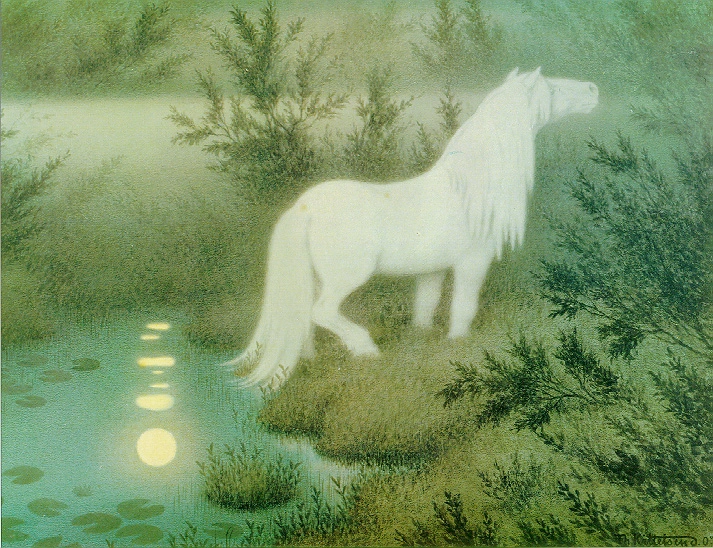
These are elves or huldra, humanoid creatures that are often conflated. Elves are said to dance and create the morning fog while huldra could be said to have tails but have many similar attributes.

Pesta was a personification of the black plague

Polar bear and king Valemon, a Norwegian folk tale

Various trolls

16
11
Slavic household gods (thelemmy.club)
submitted 2 weeks ago* (last edited 2 weeks ago) by stenAanden@feddit.dk to c/folklore@mander.xyz

Mythology of All the Races was a large series that described folklore, mythology and customs among large parts of the world.

Volume 3, Chapter 3: The household Gods describe beliefs among the Slavic peoples of household gods or spirits. Read it yourself here: https://archive.org/details/mythologyofall03gray/page/240/mode/1up

Some general notes:

  • the earliest description of what might be the veneration of household spirits, referred to with the latin term penates, come from historians in the early middle ages
  • the Slavic household god was often referred to as "grandfather"
  • it would help around the house and give prosperity to its household
  • commonly it would receive food offerings
  • a ritual for bringing their household spirit with them when a family moved house, was to put the embers from the oven in a pan and bring it to the new house
  • it was often described as hairy and looking like a deceased relative but could take the shape of an animal
  • the various characteristics of the household deity like name, associated rituals and responsibilities varied from place to place
  • it would live in a specific place in the house, often near the oven
  • Domovoy is Russian and means houselord
  • Ukrainians (referred to here as "Little Russians", and there are other similar ethnic designations like these that falls flat on you if you don't know about about ethnic minorities in Eastern Europe) call it Didko or Domovyk
  • Czechs, Dedeks
  • Silesia, Djadeks and could make little clay figures of the spirit (see image at bottom)
  • Slovenians, Setek or Skritek, and he could be represented by a wooden figure
  • Slovaks call it Skrata or Skriatek
  • Poland, Skrzatek, Skrzat or Skrzot
  • Bulgarians, Stopan

The wikipedia page on the subject seems to rely heavily on this chapter and might point you to sources for some of the claims.

17
12
submitted 2 weeks ago by stenAanden@feddit.dk to c/folklore@mander.xyz
18
2
submitted 3 weeks ago by stenAanden@feddit.dk to c/folklore@mander.xyz

The Author

Martin von Amberg was a German preacher from Prague. Little is known about his life but he lived from around 1400, with references to him in an official position from 1380.

He is interesting because he wrote a short text that details various superstitions.

The Source

This text has been featured in the 1837 year book of the Berlinische Gesellschaft für Deutsche Sprache und Alterthumskunde.

Translating

Due to my limited understanding of German I have tried using Mistrals Le Chat AI to translate the text written by Amberg. I have omitted the intro and outro because these were written by the editors of the year book. The intro discuss various similar text, mostly written by clergy, discussing the same themes of warnings against superstitions, often declared to be pagan. The outro writes how many of the practices noted by Amberg were still alive at the time of writing.

As to the quality of translation: I have run the translation AI multiple times, reading the text myself and compared it to the translation and had it translate it again if I found some glaring contradictions.

Gewissensspiegel des Predigers Martin von Amberg

Cursed are those who go to foreign houses and beg or ask for food and drink, like those who beg with arrows in their hands. Cursed are all who believe in sorcerers and sorceresses, in war luck and war misfortune, in soothsayers and soothsayeresses, in those who can make invisible things visible, in hand-warmers and hand-warmeresses, in lot-casters, in foot-examiners, in iron-examiners, in those who dig for mandrakes and alrauns, and in all kinds of scarecrows.

Cursed are also those who on cursed days, which they call "pezzar," work or do anything other than remain silent that day, or who believe that one can heal illnesses in humans or animals by tying knots, or who believe that one can bewitch milk, wool, or hemp, and other crops, or who believe that one can bewitch a cow so that it does not give milk, or who believe that one can bewitch a horse so that it cannot run, or who believe that one can bewitch a person so that they cannot have children, or who believe that one can bewitch a person so that they cannot succeed in anything they undertake.

Cursed are also all who carry any such things with them, who believe in Percht with various names, in Herodiadis, in Dyan, in pagan gods, in pilwifen, in night-wanderers.

Cursed are those who predict, trust, or believe in Drudes, in elves, in albs (elves). And how much foolish deception and superstition there is.

Also, those who say or believe that a person must do good or evil according to the influence of the planets under which they were born. And this superstition is widespread in the world.

Likewise, cursed are those who on Perchtnacht (Percht Night) leave food or drink for Percht, so that it may go well in the coming year and they may have luck in all things.

For the fifth, cursed is the one who acts against the first commandment, who offers a child or clothing to a wooden idol and makes wings for it; and this pilbizz is none other than the devil.

Also cursed are those who offer food and drink to Percht, or to the small bowl, or to the red, round bowl. For the eighth, they create a creature from petten, whether it is fun or serious, or on the day when the moon is full or new, so that they have found what they seek. — Also, to observe petten on that day: that is against everything the first commandment says.

Incorrect translations

The translation of the text I received was mostly coherent, in fact, it was mostly two sections that gave any issues:

Cursed are those who predict, trust, or believe in Drudes, in elves, in albs (elves).

At first this part was skipped or translated as describing magic. But I noted that trutes are creatures in German folklore, as are alben and elben.

Otherwise, this section still gives me issues:

For the eighth, they create a creature from petten, whether it is fun or serious, or on the day when the moon is full or new, so that they have found what they seek. — Also, to observe petten on that day: that is against everything the first commandment says.

An alternative translation I have received is:

For the eighth, cursed is the one who prays to a creature in pots, whether it is five or more, or prays on the day when the moon is full or new — they have found their deception.

Any help is very much appreciated.

Thoughts on described practices

Most notably is that this text is one of, if not, THE earliest text to describe Perchta as a character in an of herself. And it even describes how she is given an offering. She is also described together with other folkloric figures that we from both earlier and later sources are described travelling across the country, often referred to as the Wild Hunt (which is not always an accurate description). Here is described Herodias, Dyan (which I guess would be Diana), demonic or pagan gods, night wanderers, along with trutes and elves.

Various types of magic are described: lot casting, horoscopes, special days, reading hands, reading iron (my guess would be something to casting lead), tying knots, healing or cursing people, livestock, produce and crops.
I don't know what the very first line, visiting houses and asking for food and drink, means but I could guess it would be some sort of public spectacle like trick-or-treating which exist in many different forms across cultures and not just for Halloween.

There is even described the veneration of a wooden idol (pilbizz).

19
23
submitted 3 weeks ago by stenAanden@feddit.dk to c/folklore@mander.xyz

A collection of tales from various native Indian peoples.

20
3
submitted 4 weeks ago by stenAanden@feddit.dk to c/folklore@mander.xyz

Except from a book, Chinese Religion an introduction by Michel Clasquin-Johnson. As far as I can read, the book focuses on the folk aspects of Chinese religion, like the numerous local, native deities worshiped by the common people, instead of just Buddhism, taoism and confucianism. In this chapter, a sample of various Chinese gods is represented as well as the general workings of Chinese temples.

A review

21
11
Moss people - Wikipedia (en.wikipedia.org)
submitted 4 weeks ago by stenAanden@feddit.dk to c/folklore@mander.xyz

Moss or wood people is a general category of elf or gnome like creatures from many parts of Germany. They have been reported as early as the 6th century by the writer Jordanes, as well as the priest Buchard of Worms. Moss could be helpful to people working in the woods and even act as household spirits if given offerings.

22
7
submitted 1 month ago by stenAanden@feddit.dk to c/folklore@mander.xyz

A cool website dedicated to the folkloric figure Frau Holle, prominent in central Germany.

Frau Holle even has a specific lake connected to her.

23
6
submitted 1 month ago by stenAanden@feddit.dk to c/folklore@mander.xyz

This is probably the longest and best treatment of early medieval texts referencing folk practices, often referred to as being pagan.

Review

24
40

I've been working on this wiki and interactive map of translated German-language folk tales since last June, and while there are always more tales to add, the wiki is functionally complete.

Please take a look, and tell me if there's anything that could be improved!

25
15
Wayland's Smithy (en.wikipedia.org)
submitted 1 month ago by stenAanden@feddit.dk to c/folklore@mander.xyz

The deposition of coins at the site has taken place since at least the 1960s, with visitors lodging the coins into cracks in the site's stones.[17] As of 2015, the local wardens from The National Trust are tasked with removing said deposits, and around 2010, English Heritage removed information about the coin deposition custom from the site's information panel.[17] The coins removed by the wardens are then donated to local charities.[18] As the folklorist Ceri Houlbrook noted, all of this deposited material "contributes to the ritual narrative of a site".[19]

Modern Pagans, including Druids and Heathens use Wayland's Smithy for ritual purposes. Anthropologist Thorsten Gieser thinks the modern ritualistic use of the site by new age religions to communicate with "ancestors", "spirits of the earth", and an "earth goddess" is symbolic of its folkloric links to Wayland and its use as a prehistoric burial ground.[20]

view more: next ›

Folklore and paganism

1192 readers
3 users here now

Welcome to c/Folklore @ Mander.xyz!


Notice Board

This is a work in progress, please don't mind the mess.


About

Rules

  1. Don't throw mud. Be kind and remember the human.
  2. Keep it rooted (on topic).
  3. No spam.


Resources

Tools:

Collections:


Similar Communities


Sister Communities

Science and Research

Biology and Life Sciences

Plants & Gardening

Physical Sciences

Humanities and Social Sciences

Memes

founded 2 years ago
MODERATORS