view the rest of the comments
Science Memes
Welcome to c/science_memes @ Mander.xyz!
A place for majestic STEMLORD peacocking, as well as memes about the realities of working in a lab.

Meta Post Tags
Rules
- Don't throw mud. Behave like an intellectual and remember the human.
- Keep it rooted (on topic).
- No spam.
- Infographics welcome, get schooled.
If you are here asking: "Is this a science meme?"
Probably, yes. We use the Dawkins definition of meme: a replicating idea, not just an image macro with a fact on it. A good post here doesn't need to teach you something. It needs to make you ask something: who, what, where, when, and especially why or how.
Science isn't a filing cabinet of facts, it's a conversation. For example, a photo of an eel or other localized wildlife counts because most people never see one, and wonder is the first step of inquiry. A car meme counts if it makes you curious about what's under the bonnet. If you want to talk about something you noticed in the world, chances are someone else wants to talk about it too.
We moderate for vibe, not category. Pruning is light, especially where a post creates interesting discussion. Experimenting is encouraged.
See the pinned paper on Shitposting as Public Pedagogy if you want the academic case for why this works.
Research Committee
Other Mander Communities
Science and Research
Biology and Life Sciences
- !abiogenesis@mander.xyz
- !animal-behavior@mander.xyz
- !anthropology@mander.xyz
- !arachnology@mander.xyz
- !balconygardening@slrpnk.net
- !biodiversity@mander.xyz
- !biology@mander.xyz
- !biophysics@mander.xyz
- !botany@mander.xyz
- !ecology@mander.xyz
- !entomology@mander.xyz
- !fermentation@mander.xyz
- !herpetology@mander.xyz
- !houseplants@mander.xyz
- !medicine@mander.xyz
- !microscopy@mander.xyz
- !mycology@mander.xyz
- !nudibranchs@mander.xyz
- !nutrition@mander.xyz
- !palaeoecology@mander.xyz
- !palaeontology@mander.xyz
- !photosynthesis@mander.xyz
- !plantid@mander.xyz
- !plants@mander.xyz
- !reptiles and amphibians@mander.xyz
Physical Sciences
- !astronomy@mander.xyz
- !chemistry@mander.xyz
- !earthscience@mander.xyz
- !geography@mander.xyz
- !geospatial@mander.xyz
- !nuclear@mander.xyz
- !physics@mander.xyz
- !quantum-computing@mander.xyz
- !spectroscopy@mander.xyz
Humanities and Social Sciences
Practical and Applied Sciences
- !exercise-and sports-science@mander.xyz
- !gardening@mander.xyz
- !self sufficiency@mander.xyz
- !soilscience@slrpnk.net
- !terrariums@mander.xyz
- !timelapse@mander.xyz
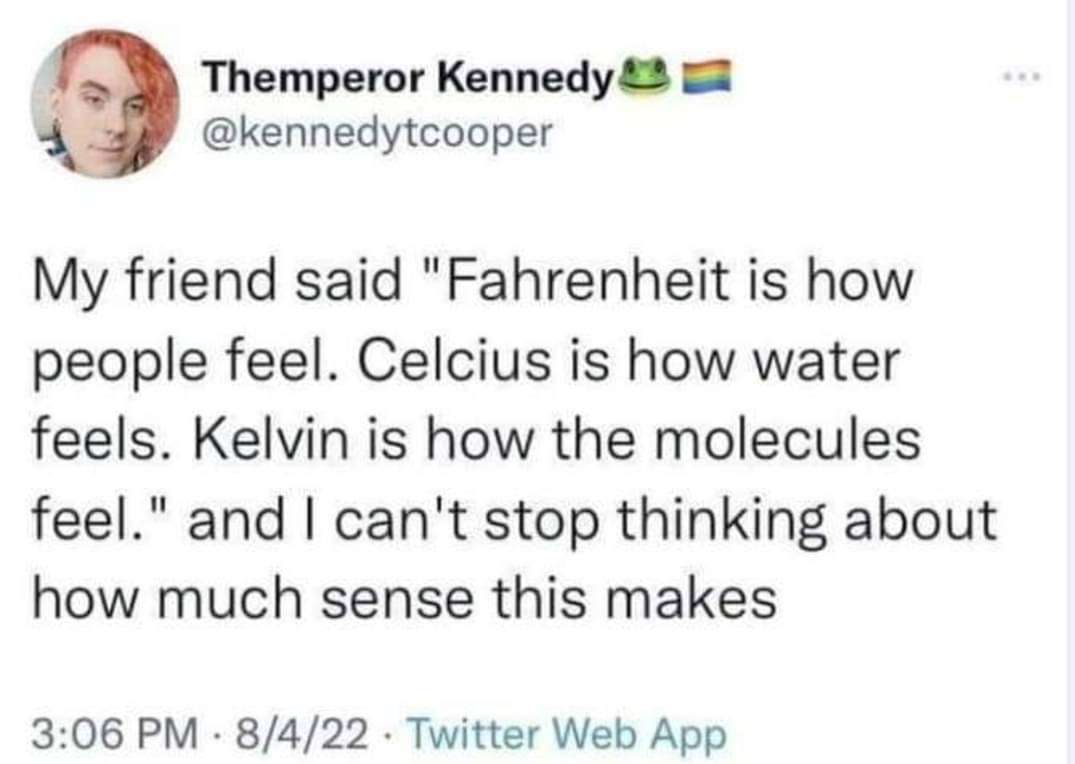
I'm sorry, but if you go out on a cold day and see a barrel of water with ice on the top, you immediately know it's freezing cold and we're in the negatives. Water freezing being 0 is a solid, objective anchor point.
"When it feels cold" will vary from someone that lives in a generally warm climate to someone that lives in a colder climate but water will freeze at 0. That means the warm and cold people can base their range around that and intuitively understand how far or above or below 0 the extreme hot or cold areas are. Generally -40 to 40 are the extremes of livable areas.
Sure, water is a really good system and it works well.
And for F that range is -40 to 104. See how you get 64 extra degrees of precision and nearly all of them are double digit numbers? No downside.
Furthermore F can use its base 10 system to describe useful ranges of temperature such as the 20s, 60s, etc. So you have 144 degrees instead of just 80, and you also have the option to utilize a more broad 16 degree scale that's also built in.
You might say that Celsius technically also has an 8 degree scale(10s, 30s), but I would argue that the range of 10 degrees Celsius is too broad to be useful in the same way. In order to scale such that 0C is water freezing and 100C boiling, it was necessary for the units to become larger and thus the 10C shorthand is much less descriptive than the 10F shorthand, at least for most human purposes.
Fahrenheit stays winning in my book.
It could easily be argued that weather having to deal in so high numbers is a con for F and the positive negative distinction of C is an easy to understand system of how far from snow are we. As others I don’t believe one is particularly better than the other for the purpose of describing day to day weather. Your arguments ring hollow to me and often seem based on heuristics for F and often with the “close to this value” caveat making it seem like a stretch.